Homepage Blank California Ea 109 Form
Outline

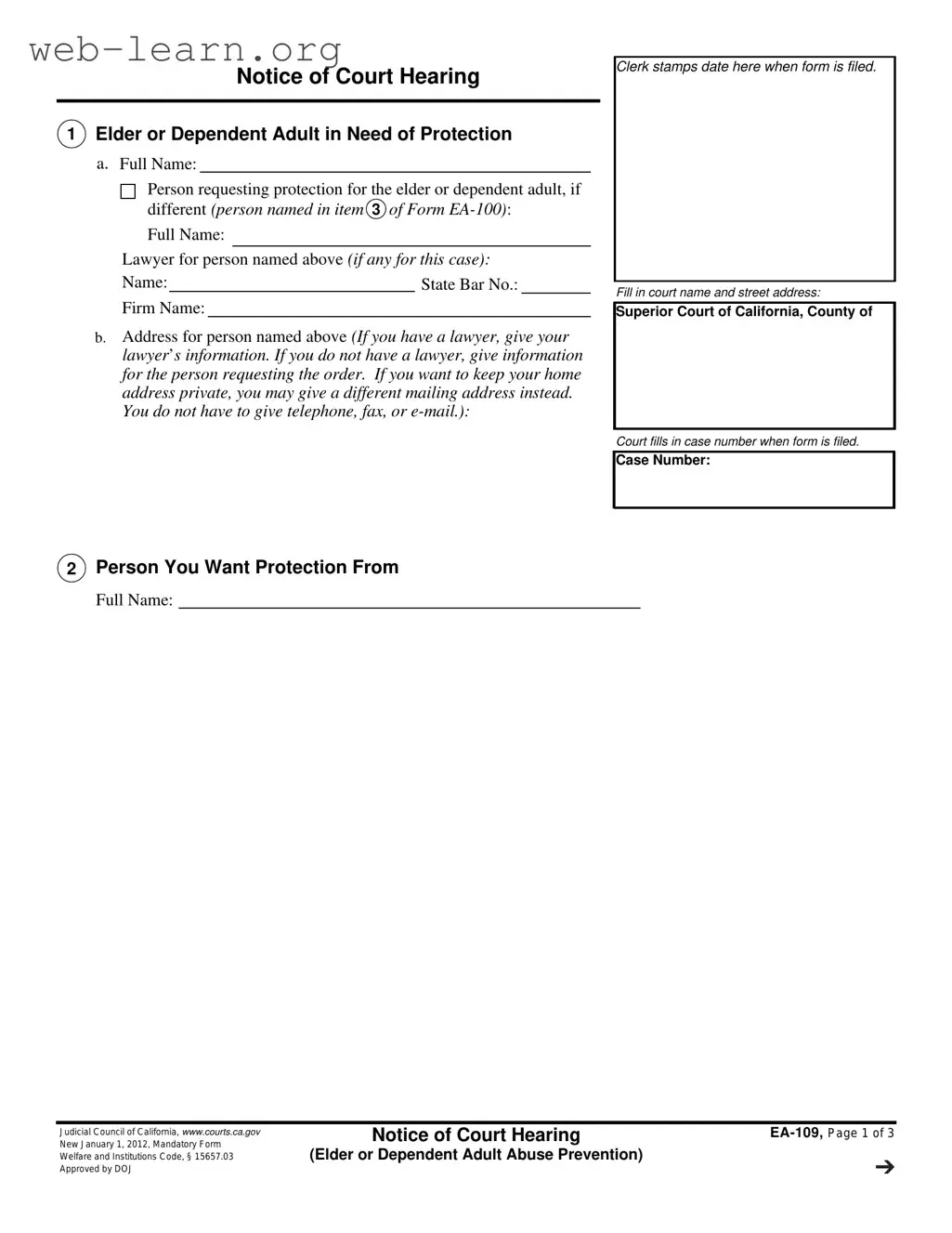
The California EA 109 form serves as a critical document in the process of seeking protection for elders or dependent adults who may be victims of abuse. This form, officially titled "Notice of Court Hearing," outlines essential details regarding the court proceedings related to elder or dependent adult abuse restraining orders. It includes the names of the individuals involved, such as the person requesting protection and the individual from whom protection is sought. The form requires specific information about the legal representation, if applicable, and provides space for the court's case number. Furthermore, it outlines the necessity of serving the relevant documents to the accused party at least five days prior to the hearing. This includes the EA-100 request form, any temporary restraining orders, and response forms, ensuring all parties are adequately informed. The EA 109 also emphasizes the importance of attendance at the hearing, where the judge may issue restraining orders that can last up to five years, along with potential firearm restrictions. Overall, understanding the EA 109 form is vital for anyone involved in these sensitive legal matters, as it lays the groundwork for the protection of vulnerable individuals in California.
Sample - California Ea 109 Form

Clerk stamps date here when form is filed.
Fill in court name and street address:
EA-109,
Page 1 of 3
Notice of Court Hearing
(Elder or Dependent Adult Abuse Prevention)
Judicial Council of California, www.courts.ca.gov
New January 1, 2012, Mandatory Form
Welfare and Institutions Code, § 15657.03
Approved by DOJ
Court fills in case number when form is filed.
Notice of Court Hearing
2
Person You Want Protection From
Full Name:
Superior Court of California, County of
Case Number:
Full Name:
1
Elder or Dependent Adult in Need of Protection
Lawyer for person named above (if any for this case):
Name:
State Bar No.:
Firm Name:
3
Full Name:
Person requesting protection for the elder or dependent adult, if
different (person named in item of Form EA-100):
Address for person named above (If you have a lawyer, give your
lawyers information. If you do not have a lawyer, give information
for the person requesting the order. If you want to keep your home
address private, you may give a different mailing address instead.
You do not have to give telephone, fax, or e-mail.):
a
.
b.
Notice of Court Hearing
(Elder or Dependent Adult Abuse Prevention)
EA-109, Page 2 of 3
New January 1, 2012
EA-100, Request for Elder or Dependent Adult Abuse Restraining Orders (file-stamped)
a.
EA-120, Response to Request for Elder or Dependent Adult Abuse Restraining Orders (blank form)
c.
e.
EA-120-INFO, How Can I Respond to a Request for Elder or Dependent Adult Abuse Restraining Orders?
Other (specify):
f.
EA-250, Proof of Service of Response by Mail (blank form)
d.
EA-110, Temporary Restraining Order (file-stamped) IF GRANTED
b
.
Case Number:
Temporary Restraining Orders (Continued)
4
As set forth on Attachment 4b.
Reasons for denial of some or all of those personal conduct and stay away orders as requested in Form
EA-100, Request for Elder or Dependent Adult Abuse Restraining Orders, are:
b
.
(1)
(2)
Other (specify):
The facts as stated in Form EA-100 do not sufficiently show reasonable proof of a past act or
acts of abuse of the elder or dependent adult by the person in .
2
Service of Documents by the Person in
At least five days before the hearing, someone age 18 or older—not you or anyone to be
protected—must personally give (serve) a court file-stamped copy of this Form EA-109, Notice of Court Hearing,
to the person in along with a copy of all the forms indicated below:
5
2
1
If you are unable to serve the person in in time, you may ask for more time to serve the documents. Use
Form EA-115, Request to Continue Court Hearing and to Reissue Temporary Restraining Order.
For information about service, read Form EA-200-INFO, What Is “Proof of Personal Service”?
2
The court cannot make the restraining orders after the court hearing unless the person in has been personally given
(served) a copy of your request and any temporary orders. To show that the person in has been served, the person
who served the forms must fill out a proof of service form. Form EA-200, Proof of Personal Service, may be used.
2
2
To the Person in :
1
Date:
Judicial Officer
Notice of Court Hearing
(Elder or Dependent Adult Abuse Prevention)
EA-109, Page 3 of 3
New January 1, 2012
Case Number:
Clerks Certificate—
I certify that this Notice of Court Hearing is a true and correct copy of the original on file in the court.
Clerk, by
, Deputy
(Clerk will fill out this part.)
Date:
Request for Accommodations
Assistive listening systems, computer-assisted real-time captioning, or sign language
interpreter services are available if you ask at least five days before the hearing. Contact the
clerk’s office or go to www.courts.ca.gov/forms for Request for Accommodations by Persons
with Disabilities and Response (Form MC-410). (Civ. Code, § 54.8.)
If you want to respond to the request for orders in writing, file Form EA-120, Response to Request for Elder or
Dependent Adult Abuse Restraining Orders, and have someone age 18 or older—not you or anyone to be
protected—mail it to the person in .
Whether or not you respond in writing, go to the hearing if you want the judge to hear from you before making an
order. You may tell the judge why you agree or disagree with the orders requested.
You may bring witnesses and other evidence.
At the hearing, the judge may make restraining orders against you that could last up to five years and may
order you to sell or turn in any firearms that you own or possess.
The person who mailed the form must fill out a proof of service form. Form EA-250, Proof of Service of
Response by Mail, may be used. File the completed form with the court before the hearing and bring a copy with
you to the court hearing.
1
To the Person in :
2
Clerk’s Certificate
[seal]

Form Information

Fact Name Details
Purpose The California EA-109 form serves as a Notice of Court Hearing for cases involving elder or dependent adult abuse protection.
Governing Law This form is governed by the Welfare and Institutions Code, specifically § 15657.03.
Filing Requirement The form must be filed with the Superior Court of California in the appropriate county, and the case number will be assigned by the court.
Service of Documents At least five days prior to the hearing, the person requesting protection must ensure that a copy of the EA-109 is served to the alleged abuser.
Response Options The person accused of abuse has the right to respond to the request for orders by filing Form EA-120 before the hearing.
Accommodations Assistive services, such as sign language interpreters, can be requested at least five days before the hearing to ensure accessibility for all parties involved.

Detailed Guide for Filling Out California Ea 109

Filling out the California EA-109 form is an important step in seeking protection for an elder or dependent adult. After completing this form, you will need to serve it along with other necessary documents to the person from whom you seek protection. This ensures that all parties are informed and can participate in the upcoming court hearing.

  1. Provide Your Information: In the first section, write your full name if you are the person requesting protection. If you have a lawyer, include their name, State Bar number, and firm name.
  2. Fill Out Your Address: Enter your address or a different mailing address if you wish to keep your home address private. Telephone, fax, or email information is not required.
  3. Complete Court Information: Fill in the name of the court and its street address. This is typically the Superior Court of California, County of [Your County].
  4. Enter the Case Number: Leave this space blank for the court to fill in when the form is filed.
  5. Identify the Person You Want Protection From: Write the full name of the person you are seeking protection from in the designated area.
  6. State Reasons for Denial: If applicable, provide reasons for any denial of personal conduct and stay-away orders as requested in Form EA-100. Include any specific facts or attach additional information as needed.
  7. Service of Documents: Note that someone age 18 or older (not you or anyone to be protected) must serve the EA-109 form along with a file-stamped copy of Form EA-100, EA-110, EA-120, EA-250, and EA-120-INFO to the person you want protection from.
  8. Proof of Service: Ensure that the person who serves the documents fills out a proof of service form, like Form EA-200, to show that the person has been served.
  9. Request for Accommodations: If you need accommodations for the hearing, such as assistive listening devices or interpreters, make sure to request these at least five days before the hearing.

Once you have completed the form, be sure to review it for accuracy. After filing, remember to serve the documents promptly to ensure that everything is in order for your court hearing.

Obtain Answers on California Ea 109

  1. What is the purpose of the California EA-109 form?

    The EA-109 form, also known as the Notice of Court Hearing, is a crucial document in cases involving elder or dependent adult abuse. It informs the parties involved about the upcoming court hearing regarding a request for protection. This form ensures that all necessary parties are aware of the hearing date and can prepare accordingly.

  2. Who needs to fill out the EA-109 form?

    The person requesting protection for the elder or dependent adult must complete the EA-109 form. If the requester has a lawyer, their information should also be included. This form is essential for notifying the individual from whom protection is sought, as well as ensuring that the court is aware of all parties involved.

  3. How is the EA-109 form served to the other party?

    At least five days before the hearing, someone who is at least 18 years old must personally serve the EA-109 form to the individual from whom protection is sought. This person cannot be the requester or anyone who is to be protected. Along with the EA-109, the server must also provide copies of several other forms, including the EA-100 and EA-110, among others.

  4. What happens if the person cannot be served in time?

    If the individual seeking protection cannot serve the other party before the deadline, they may request more time. This can be done by filing Form EA-115, which is a request to continue the court hearing and reissue the temporary restraining order. It’s important to act promptly to ensure the hearing can proceed as scheduled.

  5. What should the person being served do upon receiving the EA-109 form?

    Upon receiving the EA-109 form, the individual has the right to respond in writing. They should file Form EA-120, which is the Response to Request for Elder or Dependent Adult Abuse Restraining Orders. It’s crucial to submit this response and ensure it is served to the requester. Attending the hearing is also important, as it allows the individual to present their side of the case to the judge.

  6. What accommodations are available for individuals with disabilities?

    The court provides various accommodations for individuals with disabilities, including assistive listening systems and sign language interpreter services. To access these services, a request must be made at least five days prior to the hearing. This ensures that everyone has the opportunity to participate fully in the court proceedings.

  7. What are the potential consequences of the court hearing?

    During the hearing, the judge may issue restraining orders that can last up to five years. Additionally, the judge may order the individual from whom protection is sought to surrender any firearms they own. It’s essential for all parties to understand the seriousness of the situation and prepare adequately for the hearing.

Common mistakes

Filling out the California EA-109 form can be a daunting task, especially for those who may not be familiar with legal processes. One common mistake is neglecting to provide complete names. When listing the full name of the person requesting protection, it’s essential to ensure that all names are spelled correctly and that no middle names or initials are omitted. This small oversight can lead to significant delays in the processing of your request.

Another frequent error involves the address section. Some individuals mistakenly provide their home address instead of a mailing address. If privacy is a concern, it’s crucial to remember that you can use a different mailing address. This helps protect your personal information while ensuring that you still receive important documents related to your case.

Many people also fail to accurately fill in the court name and address. Double-checking this information is vital, as submitting the form to the wrong court can lead to complications. Always verify that you are sending your form to the correct Superior Court of California in your county.

It’s not uncommon for individuals to overlook the case number. This number is assigned by the court when the form is filed and is necessary for tracking your case. If you forget to include it, it can cause confusion and delays in your proceedings.

Another mistake involves the service of documents. Some individuals do not understand that the form must be served to the person from whom protection is being sought. It is essential to ensure that this step is completed by someone who is at least 18 years old and not directly involved in the case. Failing to serve the documents properly can result in the court being unable to proceed with your request.

Additionally, people often forget to include all required forms when serving the documents. The EA-109 form must be accompanied by several other forms, including the EA-100 and EA-110. Missing any of these can jeopardize your case and lead to further complications.

Many individuals also misinterpret the timeline for serving the documents. The requirement is to serve the forms at least five days before the hearing. If you think you may not meet this timeline, it’s crucial to file a request for an extension using Form EA-115. Waiting until the last minute can leave you without the necessary time to prepare.

Lastly, some people do not take advantage of the accommodations available for those with disabilities. If you require assistance, such as sign language interpretation or assistive listening systems, remember to request these services at least five days prior to the hearing. This ensures that you can fully participate in the proceedings.

Documents used along the form

The California EA-109 form, known as the Notice of Court Hearing for Elder or Dependent Adult Abuse Prevention, is essential in legal proceedings aimed at protecting vulnerable individuals. When filing this form, several other documents are often required to ensure the process is completed correctly. Below is a list of forms that typically accompany the EA-109 form, each serving a specific purpose in the legal framework.

  • EA-100, Request for Elder or Dependent Adult Abuse Restraining Orders: This form initiates the request for a restraining order, outlining the reasons for seeking protection and the details of the situation.
  • EA-110, Temporary Restraining Order: If granted, this document provides immediate protection to the elder or dependent adult until the court hearing takes place.
  • EA-120, Response to Request for Elder or Dependent Adult Abuse Restraining Orders: This form allows the person being accused to respond to the request for a restraining order, providing their side of the story.
  • EA-250, Proof of Service of Response by Mail: This document serves as evidence that the response to the restraining order request was mailed to the appropriate parties, ensuring proper notification.
  • EA-120-INFO, How Can I Respond to a Request for Elder or Dependent Adult Abuse Restraining Orders?: This informational form guides individuals on how to properly respond to a request for a restraining order.
  • EA-200, Proof of Personal Service: This form verifies that the EA-109 and other related documents were personally delivered to the individual being served.
  • EA-115, Request to Continue Court Hearing and to Reissue Temporary Restraining Order: If additional time is needed to serve documents, this form requests a postponement of the court hearing.
  • MC-410, Request for Accommodations by Persons with Disabilities and Response: This form ensures that individuals with disabilities can request necessary accommodations for the court hearing.
  • Judicial Council Forms: Additional forms may be required based on specific circumstances, and these can be found on the Judicial Council of California’s website.

Understanding these accompanying forms is crucial for anyone involved in a case related to elder or dependent adult abuse. Each document plays a vital role in ensuring that the legal process is followed correctly, protecting the rights of all parties involved.

Similar forms

The California EA-109 form, which serves as a Notice of Court Hearing for elder or dependent adult abuse prevention, is similar to several other legal documents. Each of these documents plays a role in the legal process surrounding protective orders. Below is a list of eight documents that share similarities with the EA-109 form:

  • EA-100, Request for Elder or Dependent Adult Abuse Restraining Orders: This form initiates the process for seeking protection. It outlines the request for restraining orders and provides the basis for the court's consideration.
  • EA-110, Temporary Restraining Order: This document is issued by the court to provide immediate protection before the hearing. It is often used alongside the EA-109 to ensure that the person in need of protection has temporary relief.
  • EA-120, Response to Request for Elder or Dependent Adult Abuse Restraining Orders: This form allows the person from whom protection is sought to respond to the allegations. It is essential for ensuring both parties have a chance to present their side in court.
  • EA-250, Proof of Service of Response by Mail: This document confirms that the response to the restraining order request has been properly served to the requesting party, ensuring that all legal procedures are followed.
  • EA-200, Proof of Personal Service: This form is used to verify that the EA-109 and other related documents have been personally served to the respondent. It is crucial for the court to proceed with the case.
  • EA-120-INFO, How Can I Respond to a Request for Elder or Dependent Adult Abuse Restraining Orders? This informational document provides guidance to individuals on how to respond to requests for restraining orders, ensuring they understand their rights and options.
  • Form MC-410, Request for Accommodations by Persons with Disabilities: This form is similar in that it addresses the needs of individuals participating in the court process, ensuring accessibility for those with disabilities.
  • Form EA-115, Request to Continue Court Hearing and to Reissue Temporary Restraining Order: This document is used when additional time is needed to serve documents or when a party requests to postpone the hearing. It helps maintain fairness in the legal process.

Dos and Don'ts

When filling out the California EA 109 form, there are important guidelines to follow. Here’s a list of things you should and shouldn’t do:

  • Do provide accurate information about yourself and the person you want protection from.
  • Do ensure that all required forms are included when serving the documents.
  • Do check for any deadlines, such as the five-day requirement for serving documents.
  • Do keep a copy of the completed form for your records.
  • Don’t leave any sections of the form blank; complete all necessary fields.
  • Don’t serve the documents yourself; have someone age 18 or older do it.
  • Don’t forget to file proof of service with the court before the hearing.

Following these guidelines can help ensure that your form is filled out correctly and that your case proceeds smoothly.

Misconceptions

Understanding the California EA-109 form is essential for those seeking protection for an elder or dependent adult. Here are ten common misconceptions about this form:

  • Only lawyers can file the EA-109 form. Many people believe that only attorneys can submit this form. In reality, individuals can file it themselves.
  • The EA-109 form guarantees a restraining order. Submitting the form does not automatically result in a restraining order. A court hearing is necessary for a decision.
  • You must provide your home address on the form. If privacy is a concern, you can use a different mailing address instead of your home address.
  • The person being served must receive the documents in person. While personal service is required, it can be done by someone age 18 or older, not just the person requesting protection.
  • All hearings are public. Although court hearings are generally open to the public, you may request accommodations to keep certain details private.
  • The EA-109 form is only for physical abuse cases. This form can also address emotional, financial, or other types of abuse against elders or dependent adults.
  • You cannot change your request after filing the EA-109 form. Modifications can be made, but they may require additional documentation and court approval.
  • There is no time limit for serving the EA-109 form. You must serve the form at least five days before the hearing to ensure the other party has adequate notice.
  • You cannot bring witnesses to the hearing. You are encouraged to bring witnesses and evidence to support your case during the hearing.
  • Filing the EA-109 form is the only step needed. In addition to filing, you must also complete service and potentially respond to any counterclaims made by the other party.

Key takeaways

When filling out and using the California EA-109 form, there are several important points to keep in mind:

  • The EA-109 form is used to notify individuals about a court hearing regarding elder or dependent adult protection.
  • It is essential to provide accurate personal information, including the full name and address of the person requesting protection.
  • If you have a lawyer, include their name, State Bar number, and firm name in the designated section.
  • Be sure to fill in the court name and street address where the hearing will take place.
  • Personal service of the EA-109 form must be completed at least five days before the hearing.
  • The person serving the documents must be at least 18 years old and cannot be anyone who is to be protected.
  • Failure to serve the person named in the form may result in the court being unable to make restraining orders.
  • Respondents have the right to file a written response using Form EA-120 and must also provide proof of service.
  • Accommodations for individuals with disabilities can be requested at least five days prior to the hearing.

Understanding these key takeaways can help ensure that the process goes smoothly and that all parties are properly informed and represented during the court hearing.