Homepage Blank California Dv 260 Form
Outline

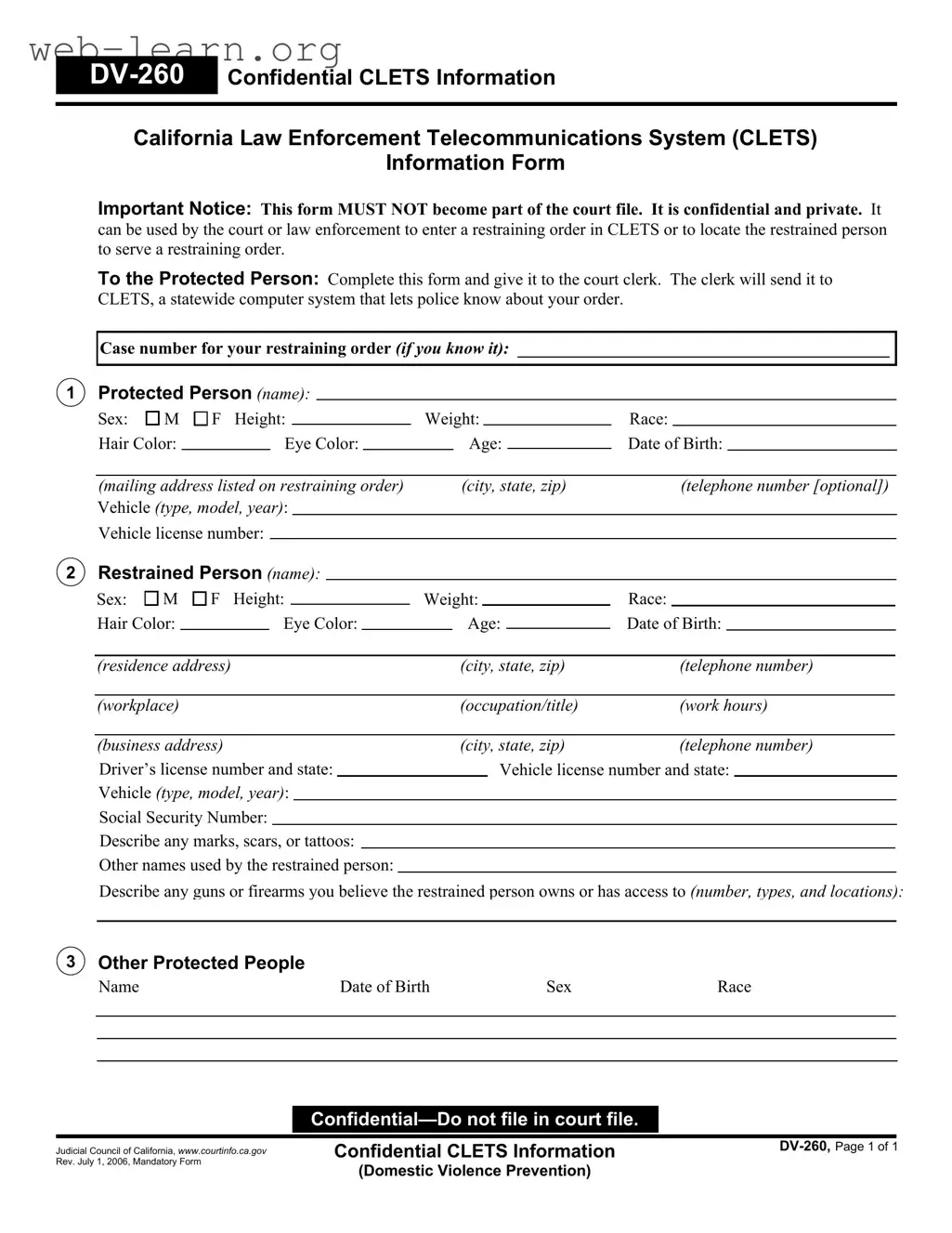
The California DV-260 form plays a crucial role in the process of obtaining a restraining order, particularly in cases involving domestic violence. Designed to protect individuals who find themselves in threatening situations, this form serves as a vital link between the court and law enforcement agencies. It contains sensitive information that must remain confidential, ensuring the safety and privacy of the protected person. When filling out the DV-260, the protected individual must provide detailed personal information, including their name, physical characteristics, and contact details, as well as information about the restrained person. This includes their name, physical attributes, and any known vehicles or firearms. The form also allows for the inclusion of other protected individuals, reinforcing the importance of safeguarding not just one person, but potentially others at risk. Once completed, the protected person submits the form to the court clerk, who then forwards it to the California Law Enforcement Telecommunications System (CLETS). This statewide system enables law enforcement to access and enforce the restraining order effectively. It is essential to remember that this form is confidential and must not be included in the public court file, highlighting the seriousness of the situation and the need for discretion.
Sample - California Dv 260 Form

DV-260
Confidential CLETS Information
California Law Enforcement Telecommunications System (CLETS)
Information Form
Important Notice: This form MUST NOT become part of the court file. It is confidential and private. It
can be used by the court or law enforcement to enter a restraining order in CLETS or to locate the restrained person
to serve a restraining order.
To the Protected Person: Complete this form and give it to the court clerk. The clerk will send it to
CLETS, a statewide computer system that lets police know about your order.
Case number for your restraining order (if you know it):
Protected Person (name):
Eye Color: Date of Birth: Hair Color: Age:
(mailing address listed on restraining order) (city, state, zip) (telephone number [optional])
Vehicle (type, model, year):
Vehicle license number:
Other Protected People
Name Date of Birth Sex
Confidential—Do not file in court file.
Confidential CLETS Information
(Domestic Violence Prevention)
Judicial Council of California, www.courtinfo.ca.gov
Rev. July 1, 2006, Mandatory Form
F
Sex:
Height:
Weight:
Race:
M
Restrained Person (name):
Driver’s license number and state:
Vehicle license number and state:
Vehicle (type, model, year):
Social Security Number:
Describe any marks, scars, or tattoos:
Other names used by the restrained person:
Describe any guns or firearms you believe the restrained person owns or has access to (number, types, and locations):
1
2
3
DV-260, Page 1 of 1
Race
Eye Color: Date of Birth: Hair Color:
Age:
(residence address) (city, state, zip) (telephone number)
F
Sex:
Height:
Weight:
Race:
M
(workplace) (occupation/title) (work hours)
(business address) (city, state, zip) (telephone number)

Form Information

Fact Name Details
Form Purpose The DV-260 form is used to provide confidential information to law enforcement regarding restraining orders in California.
Confidentiality This form is confidential and must not be part of the court file. It is designed to protect the privacy of individuals involved.
Governing Law The DV-260 form is governed by California Family Code Section 6200, which addresses domestic violence prevention.
Submission Process The protected person must complete the form and submit it to the court clerk, who will then send it to the California Law Enforcement Telecommunications System (CLETS).
Use by Law Enforcement Law enforcement agencies can access the information in this form to locate the restrained person or to enforce the restraining order.
Information Required The form requires detailed information about both the protected person and the restrained person, including physical descriptions and vehicle information.
Other Protected Individuals The form allows for the inclusion of other protected individuals, ensuring broader protection under the restraining order.

Detailed Guide for Filling Out California Dv 260

After gathering the necessary information, you are ready to fill out the California DV-260 form. This form is crucial for ensuring that law enforcement is aware of the restraining order. Follow the steps below to complete the form accurately.

  1. Begin by entering the case number for your restraining order, if you have it.
  2. Fill in the Protected Person's details:
    • Name
    • Sex (M or F)
    • Height
    • Weight
    • Race
    • Hair Color
    • Eye Color
    • Age
    • Date of Birth
    • Mailing Address (including city, state, and zip)
    • Telephone Number (optional)
  3. Provide information about the Vehicle owned by the Protected Person:
    • Type, Model, Year
    • Vehicle License Number
  4. Next, enter the Restrained Person's details:
    • Name
    • Sex (M or F)
    • Height
    • Weight
    • Race
    • Hair Color
    • Eye Color
    • Age
    • Date of Birth
    • Residence Address (including city, state, and zip)
    • Telephone Number
    • Workplace
    • Occupation/Title
    • Work Hours
    • Business Address
    • Driver’s License Number and State
    • Vehicle (Type, Model, Year)
    • Social Security Number
  5. Describe any marks, scars, or tattoos on the restrained person.
  6. List any other names used by the restrained person.
  7. Detail any guns or firearms you believe the restrained person owns or has access to, including number, types, and locations.
  8. If there are any other protected people, provide their names and dates of birth.

Once you have completed the form, ensure that all information is accurate and clear. After that, submit the form to the court clerk, who will send it to the appropriate law enforcement agency. This step is vital for the enforcement of the restraining order.

Obtain Answers on California Dv 260

  1. What is the purpose of the California DV-260 form?

    The California DV-260 form is designed to collect confidential information related to a restraining order. This information is crucial for law enforcement to enter the restraining order into the California Law Enforcement Telecommunications System (CLETS). It helps police locate the restrained person and ensures that the protective measures are effectively enforced.

  2. Who should complete the DV-260 form?

    The form should be completed by the protected person, who is the individual seeking protection from the restrained person. It is essential that this form is filled out accurately and comprehensively to facilitate the enforcement of the restraining order.

  3. What information is required on the DV-260 form?

    The DV-260 form requires several pieces of information, including:

    • Details about the protected person (name, sex, height, weight, race, hair color, eye color, age, and date of birth)
    • Information about the restrained person (name, sex, height, weight, race, hair color, eye color, age, date of birth, and other identifying details)
    • Vehicle information for both parties, including type, model, year, and license numbers
    • Any known firearms owned by the restrained person

    Accurate and complete information will help law enforcement respond effectively.

  4. Is the information on the DV-260 form public?

    No, the information on the DV-260 form is confidential and must not be part of the court file. It is intended solely for use by the court and law enforcement. This confidentiality is critical for the safety and privacy of the protected person.

  5. What should I do with the completed DV-260 form?

    Once you have completed the DV-260 form, submit it to the court clerk. The clerk will then send the form to CLETS. This step is vital to ensure that your restraining order is properly recorded and enforced.

  6. Can I provide additional information on the DV-260 form?

    Yes, if you have any additional details about the restrained person, such as scars, tattoos, or other names they may use, it is important to include that information on the form. This can assist law enforcement in identifying the restrained person and ensuring compliance with the restraining order.

Common mistakes

Filling out the California DV 260 form can be a crucial step in securing protection from domestic violence. However, many people make common mistakes that can hinder the process. Here are nine mistakes to avoid when completing this important document.

One frequent error is leaving out important personal information. The form requires details such as the protected person's name, date of birth, and contact information. Omitting any of this information can delay the processing of the restraining order.

Another mistake is incorrect identification of the restrained person. It's essential to provide accurate details, including their full name and any other names they may use. If the information is incorrect, it could lead to difficulties in enforcing the order.

People often forget to include physical descriptions. The form asks for specifics like height, weight, and hair color. Incomplete descriptions can make it harder for law enforcement to identify the restrained person.

Failing to provide vehicle information is also a common oversight. If the restrained person has a vehicle, it's important to list the type, model, and license plate number. This information can help law enforcement locate the individual more easily.

Another mistake is neglecting to mention any firearms. The form asks for details about any guns or firearms the restrained person may own or have access to. This information is critical for ensuring the safety of the protected person.

Some individuals mistakenly believe they can submit the form directly to the court. However, the DV 260 must be given to the court clerk, who will then send it to the California Law Enforcement Telecommunications System (CLETS). Skipping this step can lead to unnecessary delays.

Additionally, it's important to double-check the case number for the restraining order. If you know it, include it on the form. If not, leaving it blank can create confusion and complications in processing your request.

People sometimes overlook the confidentiality aspect of the form. The DV 260 is a confidential document and should not be filed in the court file. Failing to keep it confidential can compromise your safety.

Lastly, ensure that all information is filled out completely and accurately. Incomplete or inaccurate forms can lead to delays or even denial of the restraining order. Taking the time to review the form before submission can help avoid these pitfalls.

Documents used along the form

The California DV-260 form is a crucial document used in domestic violence cases to provide confidential information to law enforcement. However, it is often accompanied by several other forms and documents that play significant roles in the legal process surrounding restraining orders. Below is a list of these documents, each serving a specific purpose in the context of domestic violence prevention.

  • DV-100: Request for Domestic Violence Restraining Order - This form initiates the process for obtaining a restraining order. It outlines the reasons for the request and the specific protections sought by the protected person.
  • DV-110: Temporary Restraining Order - Issued by the court, this document provides immediate protection to the applicant until a hearing can be held. It is often granted ex parte, meaning without the presence of the restrained person.
  • DV-120: Response to Request for Domestic Violence Restraining Order - This form allows the restrained person to respond to the allegations and request for protection. It is essential for ensuring that both parties have an opportunity to present their sides.
  • DV-130: Restraining Order After Hearing - This document is issued after a court hearing and provides long-term protection to the applicant. It outlines the terms of the restraining order and any additional provisions determined by the court.
  • DV-140: Proof of Service - This form verifies that the restrained person has been formally served with the restraining order and related documents. Proper service is critical to the enforceability of the order.
  • DV-250: Notice of Court Hearing - This document informs the parties involved of the scheduled court date for the hearing regarding the restraining order. It ensures that both parties are aware of the proceedings.
  • CLETS-001: Criminal History Information Request - This form may be used to request information on the restrained person’s criminal history, which can be relevant in assessing the level of threat posed to the protected person.

Each of these documents contributes to the comprehensive legal framework designed to protect individuals from domestic violence. Understanding their purposes and how they interrelate can be vital for those navigating the complexities of restraining orders in California.

Similar forms

The California DV-260 form is designed to provide confidential information to law enforcement regarding restraining orders. Several other documents serve similar purposes in protecting individuals and ensuring the enforcement of legal orders. Below are eight documents that share similarities with the DV-260 form:

  • Restraining Order Application (Form DV-100): This form is used to request a restraining order, outlining the reasons for the request and the relationship between the parties involved.
  • Temporary Restraining Order (Form DV-110): This document provides immediate protection before a hearing can be held, similar to how the DV-260 communicates urgent information to law enforcement.
  • Proof of Service (Form DV-200): This form verifies that the restrained person has been properly notified of the restraining order, ensuring due process is followed.
  • Request for Order to Renew Restraining Order (Form DV-700): This document allows a protected person to request an extension of an existing restraining order, similar to the ongoing need for protection addressed in the DV-260.
  • Declaration of Disclosure (Form FL-140): This form is used to disclose financial information in family law cases, reflecting the need for transparency and protection in sensitive situations.
  • Child Custody and Visitation Order (Form FL-300): This document outlines custody arrangements, similar in its protective nature for children involved in domestic violence situations.
  • Domestic Violence Prevention Act (DVPA) Notice: This notice informs individuals of their rights under the DVPA, paralleling the DV-260's role in educating the protected person about their legal options.
  • Law Enforcement Information Sheet (Form DV-800): This form provides police with essential information regarding domestic violence incidents, akin to the role of the DV-260 in communicating critical details to law enforcement.

Dos and Don'ts

When filling out the California DV-260 form, it is crucial to ensure accuracy and confidentiality. Here are some important dos and don'ts to keep in mind:

  • Do provide accurate and complete information for both the protected and restrained persons.
  • Do ensure that all details, such as names, addresses, and physical descriptions, are clearly written.
  • Do keep the form confidential and do not file it in the court file.
  • Do give the completed form directly to the court clerk for processing.
  • Don't include any unnecessary personal information that is not required by the form.
  • Don't forget to check for any errors before submitting the form to avoid delays.

Taking these steps seriously can help ensure that the information is processed correctly and promptly. Your attention to detail is vital in these situations.

Misconceptions

Understanding the California DV-260 form is crucial for individuals seeking protection through the legal system. However, several misconceptions can lead to confusion. Here are seven common misconceptions about the DV-260 form:

  • It must be filed with the court. The DV-260 form is confidential and should not be part of the court file. Instead, it is submitted directly to the court clerk, who then sends it to the California Law Enforcement Telecommunications System (CLETS).
  • Anyone can access the information on the form. The information contained in the DV-260 is private and confidential. It is only accessible to the court and law enforcement personnel for the purpose of enforcing restraining orders.
  • Only the protected person can fill out the form. While the protected person typically completes the form, someone assisting them may also help in gathering the necessary information, especially if the protected person is unable to do so.
  • The form is only for individuals in immediate danger. While the DV-260 is often used in urgent situations, it can also be utilized in cases where there is a reasonable fear of harm, even if immediate danger is not present.
  • All information on the form is mandatory. Some sections of the DV-260 are optional, such as the telephone number of the protected person. However, providing as much information as possible can aid law enforcement in enforcing the order.
  • The DV-260 is only used for domestic violence cases. Although primarily associated with domestic violence, the form can also be relevant in cases involving harassment or stalking, where a restraining order is sought.
  • The form does not need to be updated. If circumstances change, such as a new address or additional protected persons, the DV-260 should be updated to reflect this information accurately.

Clarifying these misconceptions can help individuals navigate the process of seeking protection more effectively.

Key takeaways

When dealing with the California DV-260 form, it’s essential to understand its purpose and how to complete it accurately. Here are some key takeaways to keep in mind:

  • Confidentiality is Crucial: The DV-260 form is confidential and must not be part of the court file. This ensures the privacy of the individuals involved.
  • Purpose of the Form: This form is used to provide law enforcement with necessary information to enter a restraining order into the California Law Enforcement Telecommunications System (CLETS).
  • Who Completes the Form: The protected person, or the individual seeking protection, is responsible for filling out this form.
  • Submission Process: After completing the form, it should be given to the court clerk, who will then forward it to CLETS.
  • Information Required: You will need to provide detailed information about both the protected person and the restrained person, including physical descriptions and personal identifiers.
  • Vehicle Information: If applicable, include details about any vehicles owned by the restrained person, such as type, model, year, and license number.
  • Identifying Marks: Describe any scars, tattoos, or distinguishing marks on the restrained person to aid in identification.
  • Firearm Information: If you believe the restrained person has access to firearms, detail the types, numbers, and locations of these weapons.
  • Additional Protected People: If there are other individuals who need protection, their information can also be included on the form.
  • Review Before Submission: Double-check all information for accuracy before handing it to the court clerk to avoid delays or issues in processing.

By following these guidelines, you can ensure that the DV-260 form is filled out correctly and serves its intended purpose effectively.