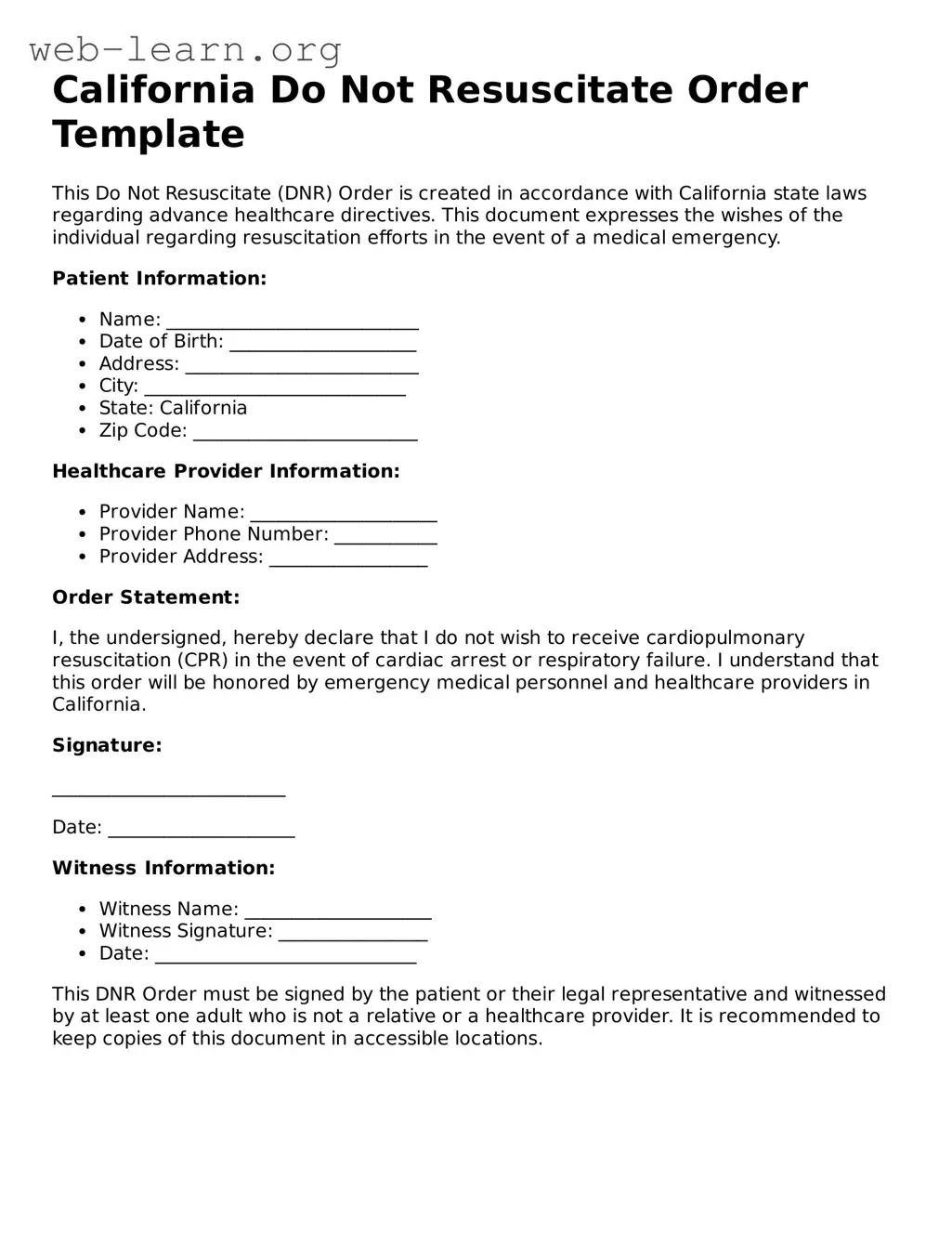
In California, the Do Not Resuscitate (DNR) Order form serves as a critical document for individuals who wish to make their end-of-life care preferences clear, particularly in situations where resuscitation efforts may be required. This form allows patients to express their desire not to receive cardiopulmonary resuscitation (CPR) or other life-sustaining treatments in the event of cardiac arrest or respiratory failure. It is essential for the DNR Order to be completed accurately and signed by the patient or their authorized representative, as well as a physician, to ensure its validity. The form must be readily accessible to medical personnel, as it guides healthcare providers in honoring the patient's wishes during emergencies. Understanding the implications of a DNR Order is vital, as it can significantly affect the course of medical treatment and the overall approach to care in critical situations. By having a DNR Order in place, individuals can maintain control over their healthcare decisions, aligning medical interventions with their personal values and preferences.
California Do Not Resuscitate Order Template
This Do Not Resuscitate (DNR) Order is created in accordance with California state laws regarding advance healthcare directives. This document expresses the wishes of the individual regarding resuscitation efforts in the event of a medical emergency.
Patient Information:
Healthcare Provider Information:
Order Statement:
I, the undersigned, hereby declare that I do not wish to receive cardiopulmonary resuscitation (CPR) in the event of cardiac arrest or respiratory failure. I understand that this order will be honored by emergency medical personnel and healthcare providers in California.
Signature:
_________________________
Date: ____________________
Witness Information:
This DNR Order must be signed by the patient or their legal representative and witnessed by at least one adult who is not a relative or a healthcare provider. It is recommended to keep copies of this document in accessible locations.
| Fact Name | Description |
|---|---|
| Purpose | The California Do Not Resuscitate (DNR) Order form allows individuals to express their wishes regarding resuscitation efforts in the event of a medical emergency. |
| Legal Authority | This form is governed by California Health and Safety Code Section 7180-7183, which outlines the legal framework for DNR orders. |
| Eligibility | Any adult, or a legally authorized representative of a minor, can complete a DNR order in California. |
| Signature Requirements | The form must be signed by the patient or their authorized representative, along with a physician's signature to be valid. |
| Form Availability | The California DNR form can be obtained from healthcare providers, hospitals, or online resources provided by the state. |
| Revocation | A DNR order can be revoked at any time by the patient or their representative, simply by destroying the form or notifying medical personnel. |
| Emergency Medical Services | Emergency Medical Services (EMS) personnel are required to honor a valid DNR order when presented during a medical emergency. |
| Placement | It is recommended that individuals keep the DNR form in a visible location, such as on the refrigerator or in a medical alert system. |
| Communication | Discussing the DNR order with family members and healthcare providers is crucial to ensure everyone understands the patient's wishes. |
Filling out the California Do Not Resuscitate Order form is an important step in communicating your healthcare wishes. After completing the form, it will need to be signed and dated by both you and your physician. This ensures that your preferences are documented and can be honored by medical personnel in case of an emergency.
What is a Do Not Resuscitate (DNR) Order in California?
A Do Not Resuscitate Order is a legal document that allows a person to refuse cardiopulmonary resuscitation (CPR) in the event of cardiac or respiratory arrest. In California, this order must be signed by a physician and is intended to ensure that individuals receive care aligned with their wishes regarding end-of-life treatment.
Who can request a DNR Order?
Any adult who is capable of making medical decisions can request a DNR Order. This includes individuals facing terminal illnesses or severe medical conditions. Additionally, a legal representative, such as a healthcare proxy or an agent under a power of attorney, may request a DNR on behalf of someone who is unable to do so.
How is a DNR Order created in California?
To create a DNR Order, a patient must discuss their wishes with their physician. If both parties agree, the physician will complete and sign the DNR form. This form must then be presented in a manner that is readily accessible to emergency medical personnel, such as being placed on the refrigerator or carried by the patient.
What does a DNR Order cover?
A DNR Order specifically addresses the refusal of CPR and other life-saving measures. It does not affect other medical treatments, such as pain management or comfort care. Patients can still receive appropriate medical care that aligns with their overall treatment goals.
Can a DNR Order be revoked?
Yes, a DNR Order can be revoked at any time by the patient or their legal representative. To revoke the order, the patient should communicate their wishes to their healthcare provider and ensure that the DNR form is removed from their medical records. It is advisable to document the revocation for clarity.
What should individuals do if they change their mind about a DNR Order?
If an individual changes their mind about a DNR Order, they should inform their healthcare provider immediately. They can also create a new document that clearly states their current wishes. It is important to ensure that all relevant parties, including family members and medical personnel, are aware of the change.
Are there any legal protections for healthcare providers regarding DNR Orders?
Yes, California law provides legal protection for healthcare providers who act in accordance with a valid DNR Order. As long as the order is properly executed and presented, healthcare providers are protected from legal liability for not performing resuscitation efforts.
Filling out a California Do Not Resuscitate (DNR) Order form can be a challenging task, as it requires individuals to confront sensitive topics about their health care preferences. Unfortunately, many people make mistakes that can lead to confusion or unintended consequences. One common error is failing to sign the form. Without a signature, the document lacks legal validity, rendering it ineffective when it is most needed.
Another frequent mistake is not having the form witnessed properly. California law mandates that a DNR order must be signed by either a physician or a licensed health care professional. Some individuals overlook this requirement, thinking that their own signature suffices. This oversight can invalidate the order and leave individuals vulnerable to unwanted resuscitation efforts.
People often misunderstand the scope of the DNR order as well. Some mistakenly believe that a DNR order applies to all medical situations, when in fact, it specifically addresses resuscitation efforts. This misunderstanding can lead to situations where individuals receive unwanted treatments for conditions that do not involve cardiac arrest.
Additionally, failing to communicate the existence of the DNR order to family members and medical personnel can create significant issues. It is essential to ensure that loved ones and caregivers are aware of the order so that they can advocate for the individual's wishes. Without this communication, there may be confusion during a medical emergency, potentially leading to the opposite of what the individual intended.
Another mistake involves not keeping the DNR order in a readily accessible location. If the form is tucked away in a drawer or filed away without proper notice, medical personnel may not find it when needed. It's crucial to keep the document in an easily accessible place, such as with other important medical records or in a designated folder that caregivers know to check.
Moreover, some individuals neglect to update their DNR orders as their health status changes. A DNR order should reflect a person's current wishes and medical condition. Regularly reviewing and, if necessary, revising the order can ensure that it aligns with the individual's preferences, especially after significant health changes.
Another common error is using outdated forms or templates. California law has specific requirements for DNR orders, and using an older version may not meet current legal standards. Individuals should always obtain the most recent form from a reliable source, such as a healthcare provider or official state website.
Lastly, individuals sometimes forget to discuss their DNR wishes with their primary care physician. A DNR order should not be a standalone document; it should be part of a broader conversation about health care preferences. Engaging with a physician ensures that the order is understood within the context of the individual's overall health care plan.
The California Do Not Resuscitate (DNR) Order form is an important document that outlines a person's wishes regarding resuscitation efforts in the event of a medical emergency. Alongside this form, several other documents may be utilized to ensure that an individual's healthcare preferences are respected. Below is a list of commonly used forms and documents that complement the DNR Order.
Each of these documents plays a vital role in healthcare planning, allowing individuals to communicate their wishes and ensure that their preferences are honored in critical situations. Understanding these forms can facilitate better decision-making for patients, families, and healthcare providers.
When filling out the California Do Not Resuscitate (DNR) Order form, it's crucial to approach the process with care and attention. Here are ten essential guidelines to follow, including both actions to take and mistakes to avoid.
By following these guidelines, you can ensure that your DNR Order accurately reflects your wishes and is legally enforceable. Take the time to make informed decisions about your healthcare preferences.
Many people have misconceptions about the California Do Not Resuscitate (DNR) Order form. Understanding these misconceptions is crucial for making informed decisions about end-of-life care. Here are nine common misunderstandings:
This is false. A DNR order specifically addresses resuscitation efforts, such as CPR, but does not prevent other medical treatments. Patients can still receive necessary medical care.
This is incorrect. Anyone can request a DNR order, regardless of their health status. It is a personal choice that reflects individual wishes about resuscitation.
These are different documents. A living will outlines broader wishes regarding medical treatment, while a DNR order specifically focuses on resuscitation efforts.
This is not true. DNR orders can be created in various settings, including at home, with the proper documentation and physician involvement.
This misconception is misleading. A DNR order can be revoked or modified at any time by the patient or their designated representative.
While healthcare providers respect DNR orders, they also have a responsibility to assess the situation and ensure the order is valid and applicable.
This is a myth. A DNR order does not hasten death. It simply indicates a preference for not undergoing aggressive resuscitation efforts in the event of cardiac arrest.
This is not accurate. DNR orders can be requested by individuals of any age who wish to specify their preferences regarding resuscitation.
It is important to communicate your wishes with family members. Open discussions can help ensure that your preferences are understood and respected.
Understanding the California Do Not Resuscitate (DNR) Order form is essential for individuals who wish to express their healthcare preferences. Below are key takeaways to consider when filling out and using this important document.
By taking these steps, individuals can ensure that their healthcare preferences are respected, providing peace of mind for themselves and their loved ones.
Ky Dnr Form - A DNR order can be part of a broader advance care planning strategy.
Can You Get a Dnr at Any Age - Healthcare facilities often have policies in place regarding the handling of DNR orders.
Dnr and Dni Documents Are All Part of What Are Known as - A DNR order reflects a patient's values and preferences regarding their quality of life and end-of-life care.