Homepage Blank California Dle 244 Form
Outline

The California DLE 244 form is a vital document for individuals seeking to have their DNA profiles and samples removed from the state's DNA database. This streamlined application process is designed for those who believe they are not legally required to have their DNA stored in the CAL-DNA Data Bank. The form requires applicants to provide personal information, including their name, contact details, and social security number, as well as specifics about the circumstances under which their DNA was collected. Importantly, applicants must assert that they have no qualifying criminal offenses or obligations that would justify the retention of their DNA. The form also outlines various grounds for expungement, such as the dismissal of felony charges or a finding of factual innocence. To support their request, individuals must attach relevant documentation, which can include court orders or letters from prosecutors. The process is not only about removing personal data but also about ensuring that individuals have the opportunity to clear their records when appropriate. Understanding the requirements and implications of the DLE 244 form is crucial for anyone considering this option.

Sample - California Dle 244 Form

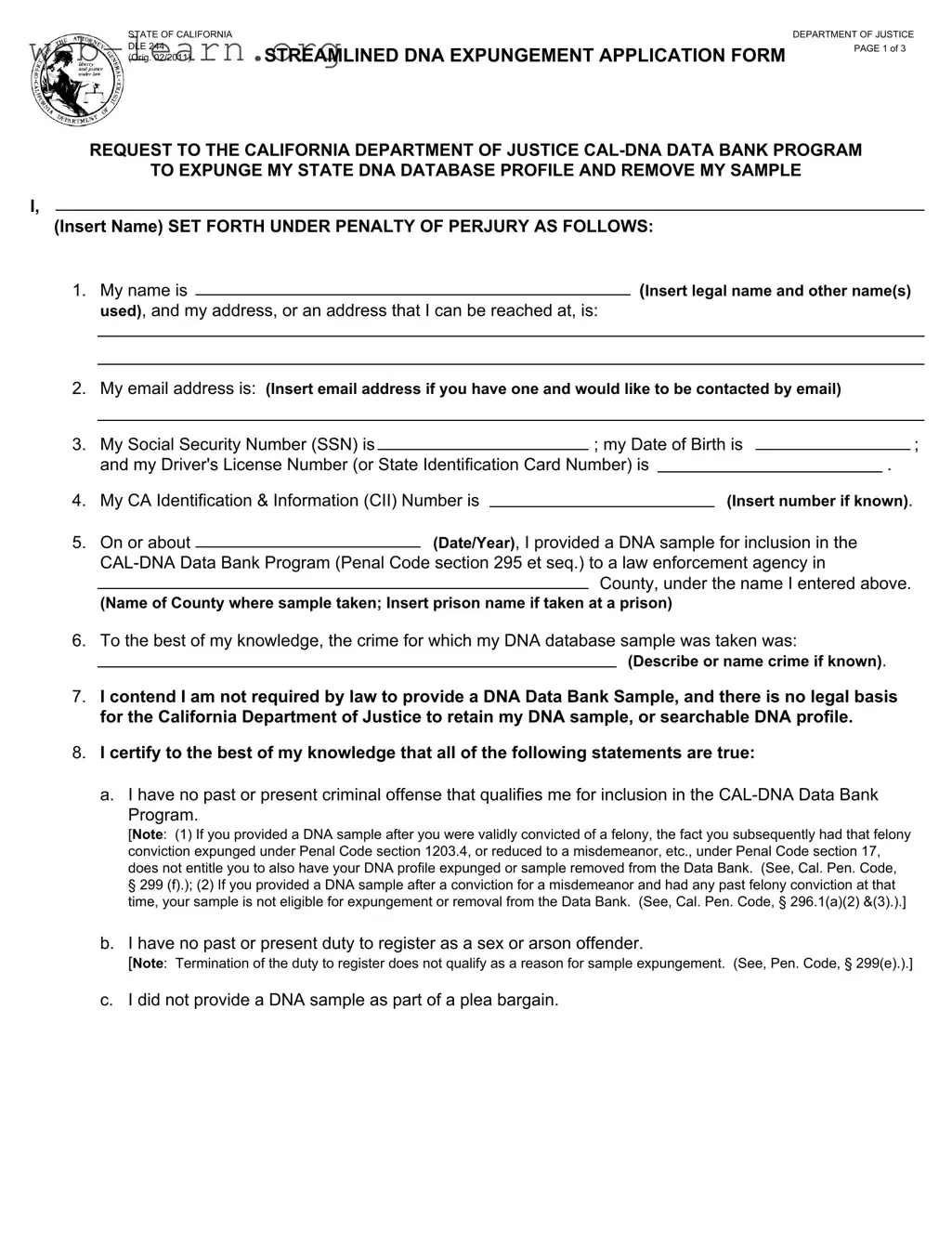
STATE OF CALIFORNIA DEPARTMENT OF JUSTICE
STREAMLINED DNA EXPUNGEMENT APPLICATION FORM
DLE 244
(Orig. 02/2011)
PAGE 1 of 3
REQUEST TO THE CALIFORNIA DEPARTMENT OF JUSTICE CAL-DNA DATA BANK PROGRAM
TO EXPUNGE MY STATE DNA DATABASE PROFILE AND REMOVE MY SAMPLE
I,
(Insert Name) SET FORTH UNDER PENALTY OF PERJURY AS FOLLOWS:
1. My name is (Insert legal name and other name(s)
used), and my address, or an address that I can be reached at, is:
2. My email address is: (Insert email address if you have one and would like to be contacted by email)
3. My Social Security Number (SSN) is ; my Date of Birth is ;
and my Driver's License Number (or State Identification Card Number) is .
4. My CA Identification & Information (CII) Number is (Insert number if known).
5. On or about (Date/Year), I provided a DNA sample for inclusion in the
CAL-DNA Data Bank Program (Penal Code section 295 et seq.) to a law enforcement agency in
County, under the name I entered above.
(Name of County where sample taken; Insert prison name if taken at a prison)
6. To the best of my knowledge, the crime for which my DNA database sample was taken was:
(Describe or name crime if known).
7. I contend I am not required by law to provide a DNA Data Bank Sample, and there is no legal basis
for the California Department of Justice to retain my DNA sample, or searchable DNA profile.
8. I certify to the best of my knowledge that all of the following statements are true:
a. I have no past or present criminal offense that qualifies me for inclusion in the CAL-DNA Data Bank
Program.
[Note: (1) If you provided a DNA sample after you were validly convicted of a felony, the fact you subsequently had that felony
conviction expunged under Penal Code section 1203.4, or reduced to a misdemeanor, etc., under Penal Code section 17,
does not entitle you to also have your DNA profile expunged or sample removed from the Data Bank. (See, Cal. Pen. Code,
§ 299 (f).); (2) If you provided a DNA sample after a conviction for a misdemeanor and had any past felony conviction at that
time, your sample is not eligible for expungement or removal from the Data Bank. (See, Cal. Pen. Code, § 296.1(a)(2) &(3).).]
b. I have no past or present duty to register as a sex or arson offender.
[Note: Termination of the duty to register does not qualify as a reason for sample expungement. (See, Pen. Code, § 299(e).).]
c. I did not provide a DNA sample as part of a plea bargain.
STATE OF CALIFORNIA DEPARTMENT OF JUSTICE
STREAMLINED DNA EXPUNGEMENT APPLICATION FORM
DLE 244
(Orig. 02/2011)
PAGE 2 of 3
9. I request that the California Department of Justice destroy my DNA sample and expunge my searchable
DNA database profile as provided for in Penal Code section 299, on the following grounds (CHECK ONE
AND ATTACH THE DOCUMENTATION DESCRIBED):
a.
No qualifying felony charges were or will be filed after my arrest.
[Attach Letter in Support of Expungement from a District Attorney or prosecutor, providing the case name
and number, and certifying that no charge(s) will be filed based on the arrest; or attach a certified or file-
stamped copy of a complaint reflecting that only misdemeanor charge(s) were filed based on the arrest.]
b.
The felony charge(s) which formed the basis of my DNA sample collection was dismissed.
[Attach a certified or file-stamped copy of the court docket or minute order dismissing the charge(s), or a trial
court's Clerk Certificate verifying this fact.]
c. The conviction which formed the basis of my DNA collection has been reversed and the case
dismissed. [Attach a certified or file-stamped copy of the court order(s) or opinion reversing the conviction
and dismissing the charge(s).]
d. I have been found factually innocent under Penal Code section 851.8 or Welfare and Institutions
Code section 781.5 of the offense which qualified me for inclusion in the CAL-DNA Data Bank
Program. [Attach a certified or file-stamped copy of the court docket or minute order making this
finding.]
e. I was acquitted or found not guilty of the offense which qualified me for inclusion in the CAL-DNA
Data Bank Program. [Attach a certified or file-stamped copy of the court docket or minute order stating this
finding.]
f. My previously sustained delinquency petition alleging an offense that would be a felony, if
committed by an adult, has been reversed and dismissed. [Attach a certified or file-stamped copy of
the court order(s) or opinion reversing the conviction and dismissing the charge(s).]
10. Additional information supporting my request for DNA sample expungement is as follows:
11. I declare under penalty of perjury that the foregoing is true and correct.
Executed on: at , State of .
(Date) (City) (State)
PRINT NAME:
SIGNATURE (person requesting DNA profile expungement and sample removal)
MAIL THE REQUEST FOR DNA SAMPLE EXPUNGEMENT TO:
Department of Justice CAL-DNA Data Bank Program
Attn. EXPUNGEMENT REQUESTS
1001 West Cutting Blvd., Suite 110
Richmond, CA 94804
STATE OF CALIFORNIA DEPARTMENT OF JUSTICE
STREAMLINED DNA EXPUNGEMENT APPLICATION FORM
DLE 244
(Orig. 02/2011)
PAGE 3 of 3
Privacy Notice
The information requested on this form is being requested by the State of California, Department of Justice (DOJ),
Division of Law Enforcement, CAL-DNA Data Bank Program, for the purpose of determining eligibility for DNA
sample/profile removal and expungement through use of DOJ's streamlined procedures. The maintenance of the
information collected on this form is authorized by Penal Code Section 299. All information requested on this form
is voluntary. However, failure to provide the requested information/documentation (e.g. identity, legal status and
criminal history), as applicable, to enable DOJ to make a determination regarding a sample/profile's eligibility
for removal/expungement, will likely result in denial of the DNA sample/profile removal and expungement request.
Your information provided on this form may be disclosed to federal, state and/or local law enforcement agencies,
probation and parole officers, your attorney, and attorneys for the Department of Justice, and/or courts.
Pursuant to Civil Code Section 1798.30 et seq., individuals have the right [with some exceptions] to access records
containing the personal information about themselves that are maintained by the agency. The CAL-DNA Data Bank
Program is the agency official responsible for the system of records that maintains the information provided on this
form. For more information regarding the location of your records and the categories of any persons who use the
information in those records, you may contact the CAL-DNA Data Bank Program, Department of Justice, at 1001
West Cutting Blvd., Suite 110, Richmond, CA 94804, or via telephone at (510) 620-3300.

Form Information

Fact Name Details
Purpose The DLE 244 form is used to request the expungement of a DNA sample and profile from the California Department of Justice's DNA database.
Governing Law This form is governed by California Penal Code Section 299, which outlines the procedures for DNA sample removal.
Eligibility Criteria Individuals must demonstrate that they are not required to provide a DNA sample, and there is no legal basis for retention of their DNA.
Documentation Required Applicants must attach supporting documents, such as court orders or letters from the District Attorney, to substantiate their request.
Submission Address The completed form should be mailed to the Department of Justice, CAL-DNA Data Bank Program, at 1001 West Cutting Blvd., Suite 110, Richmond, CA 94804.
Privacy Notice Information provided on the form is voluntary and may be disclosed to law enforcement and other agencies as needed.
Form Version The current version of the DLE 244 form was originally issued in February 2011.

Detailed Guide for Filling Out California Dle 244

After completing the California DLE 244 form, the next step is to submit it to the California Department of Justice. Ensure that all required information is filled out accurately and that any necessary documentation is attached to support your request. Once submitted, the Department of Justice will review your application to determine eligibility for expungement.

  1. Begin by entering your legal name and any other names you have used in the designated field.
  2. Provide your current address or an address where you can be reached.
  3. If you have an email address and wish to be contacted via email, insert it in the appropriate space.
  4. Fill in your Social Security Number (SSN), Date of Birth, and Driver's License Number (or State Identification Card Number).
  5. If known, include your California Identification & Information (CII) Number.
  6. State the date or year when you provided a DNA sample, and specify the law enforcement agency and county involved.
  7. Describe the crime for which your DNA sample was taken, if known.
  8. Indicate that you believe you are not required by law to provide a DNA sample and that there is no legal reason for the Department of Justice to keep your DNA sample or profile.
  9. Confirm the truth of the statements regarding your criminal history, including any past or present offenses.
  10. Check the appropriate box to indicate the grounds for your request for expungement and attach the necessary documentation as specified.
  11. Provide any additional information that supports your request for DNA sample expungement.
  12. Sign and date the form, including the city and state where you are signing.
  13. Mail the completed form and any attachments to the specified address for the Department of Justice.

Obtain Answers on California Dle 244

  1. What is the California DLE 244 form?

    The California DLE 244 form is a streamlined application used to request the expungement of a DNA sample and profile from the CAL-DNA Data Bank. This form is submitted to the California Department of Justice (DOJ) and is designed for individuals who believe they are eligible to have their DNA records removed.

  2. Who can use the DLE 244 form?

    Any individual who provided a DNA sample to law enforcement and believes they are not required by law to have that sample retained can use this form. Eligibility may depend on the nature of the offense and whether the individual has had their conviction dismissed or reversed.

  3. What information do I need to provide?

    You will need to provide personal information, including:

    • Your legal name and any other names used.
    • Your address and email address (if applicable).
    • Your Social Security Number, date of birth, and driver's license number.
    • Your California Identification & Information (CII) number, if known.
    • Details about the DNA sample collection, including the date, location, and nature of the offense.

  4. What documentation do I need to attach?

    You must attach supporting documentation that justifies your request for expungement. This may include:

    • A letter from a District Attorney confirming no charges will be filed.
    • Copies of court documents showing charges were dismissed.
    • Proof of acquittal or a finding of factual innocence.

  5. How do I submit the DLE 244 form?

    Once you have completed the form and gathered the necessary documentation, mail it to the following address:

    Department of Justice
    CAL-DNA Data Bank Program
    Attn. EXPUNGEMENT REQUESTS
    1001 West Cutting Blvd., Suite 110
    Richmond, CA 94804

  6. What happens after I submit my request?

    After submitting your request, the California Department of Justice will review your application and the attached documentation. They will determine your eligibility for expungement based on the information provided. You will be notified of their decision.

  7. What if my request is denied?

    If your request for expungement is denied, you may have the option to appeal the decision or seek further legal advice. It’s important to understand the reasons for the denial, as this may help you address any issues in a future application.

Common mistakes

Filling out the California DLE 244 form for DNA expungement is a critical process, yet many individuals make mistakes that can hinder their requests. One common error is failing to provide complete and accurate personal information. When applicants do not include their full legal name, address, and contact details, it can create confusion and delays. It's essential to ensure that all sections are filled out correctly to facilitate the processing of the application.

Another frequent mistake involves neglecting to attach necessary documentation. The form requires specific supporting documents based on the grounds for expungement. For instance, if an applicant claims that the felony charges were dismissed, they must include a certified copy of the court order. Without these attachments, the application may be rejected outright, prolonging the time it takes to achieve expungement.

Some individuals also misinterpret the eligibility criteria for expungement. It is crucial to understand that simply having a conviction expunged does not automatically qualify one for DNA removal. Many people mistakenly believe that if their felony conviction was reduced to a misdemeanor, they can have their DNA profile removed as well. This misunderstanding can lead to unnecessary frustration and a failed application.

Inaccurate or incomplete responses to questions about past criminal offenses can also be detrimental. Applicants might overlook the importance of disclosing any past or present criminal offenses that could affect their eligibility. This oversight can result in the denial of the application, as the California Department of Justice relies on truthful declarations to process expungement requests.

Lastly, failing to sign and date the application is a simple yet critical mistake. The form requires a declaration under penalty of perjury, and without a signature, the application is considered incomplete. This oversight can lead to unnecessary delays, as the Department of Justice will not process an unsigned form. Taking the time to review the application thoroughly before submission can help avoid these common pitfalls.

Documents used along the form

The California DLE 244 form is used to request the expungement of a DNA sample and profile from the state's database. Along with this form, several other documents may be necessary to support the application. Below is a list of these documents, each with a brief description.

  • Letter in Support of Expungement: This letter is typically written by a District Attorney or prosecutor. It certifies that no charges will be filed based on the arrest that led to the DNA sample collection.
  • Court Docket or Minute Order: A certified or file-stamped copy of the court's docket or minute order that shows the dismissal of the felony charges is required if the charges were dismissed.
  • Clerk Certificate: This certificate verifies the dismissal of charges and can be obtained from the trial court's clerk. It serves as official documentation for the expungement request.
  • Court Order or Opinion: If a conviction has been reversed, a certified or file-stamped copy of the court order or opinion stating this is necessary for the expungement process.
  • Finding of Factual Innocence: A certified or file-stamped copy of the court docket or minute order indicating a finding of factual innocence under Penal Code section 851.8 or Welfare and Institutions Code section 781.5 is needed.
  • Acquittal Documentation: If the individual was acquitted or found not guilty, a certified or file-stamped copy of the court docket or minute order stating this finding must be included.
  • Delinquency Petition Documentation: For cases involving a previously sustained delinquency petition, a certified or file-stamped copy of the court order reversing and dismissing the petition is required.
  • Additional Supporting Information: Any other relevant information that supports the request for DNA sample expungement should be included to strengthen the application.

Gathering these documents can help ensure a smoother expungement process. Each piece of documentation plays a crucial role in supporting the request and demonstrating eligibility for the removal of DNA records from the California database.

Similar forms

The California DLE 244 form is a specific application for expunging DNA records from the state's database. Several other documents serve similar purposes in various legal contexts, allowing individuals to request the removal or expungement of sensitive information. Here’s a list of documents that share similarities with the DLE 244 form:

  • California Petition for Expungement (Form CR-180): This document allows individuals to request the expungement of a criminal conviction from their record, similar to how the DLE 244 seeks to remove DNA profiles.
  • Application for Certificate of Rehabilitation: This application is for individuals seeking to have their criminal history recognized as rehabilitated, paralleling the DLE 244's intent to clear an individual's DNA records.
  • California Request for Sealing of Juvenile Records (Form JV-570): This form enables individuals to seal juvenile records, akin to how the DLE 244 aims to protect personal DNA information.
  • California Motion to Vacate Conviction: This motion requests that a court vacate a previous conviction, which is similar to the DLE 244's goal of erasing a DNA sample associated with a conviction.
  • California Petition for Restoration of Firearm Rights: This petition seeks to restore firearm rights after a conviction, resembling the DLE 244 in its effort to remove legal restrictions based on past offenses.
  • Application for Pardon: Individuals can apply for a pardon to remove the legal consequences of a conviction, similar to how the DLE 244 aims to remove DNA profiles.
  • California Motion for Post-Conviction Relief: This motion allows individuals to challenge their conviction, which can lead to expungement, akin to the DLE 244's expungement process for DNA records.
  • California Petition for Writ of Habeas Corpus: This legal document can be used to challenge unlawful detention, and while its focus is different, it reflects a similar pursuit of justice and record correction.
  • California Request for Relief from Sex Offender Registration: This request allows individuals to seek relief from the obligation to register as a sex offender, paralleling the DLE 244's focus on removing unwanted legal burdens.

Each of these documents serves a unique purpose but shares a common theme of seeking to rectify or remove past legal issues, thereby allowing individuals to move forward without the weight of their previous records.

Dos and Don'ts

When filling out the California DLE 244 form, it is important to approach the process with care. Here are seven key things to do and avoid to ensure your application is completed accurately and effectively:

  • Do use your full legal name as it appears on official documents.
  • Do provide a reliable contact address where you can be reached.
  • Do ensure that all required fields are filled out completely, including your Social Security Number and Date of Birth.
  • Do attach any necessary documentation that supports your request for expungement.
  • Do review your application for any errors or omissions before submitting.
  • Don't leave any sections blank; incomplete forms may lead to delays or rejections.
  • Don't submit false information or misrepresent your circumstances, as this could lead to legal consequences.

By following these guidelines, you can help ensure that your application is processed smoothly. Take your time and be thorough in your responses. If you have any questions, consider seeking assistance to clarify any uncertainties before you submit your form.

Misconceptions

Misconceptions about the California DLE 244 form can lead to confusion and missteps in the expungement process. Here are eight common misconceptions, along with clarifications:

  • Misconception 1: Anyone can expunge their DNA profile at any time.
  • This is incorrect. Only individuals who meet specific legal criteria can request expungement. If you provided a DNA sample after a felony conviction, you may not qualify.

  • Misconception 2: The form guarantees automatic removal of my DNA sample.
  • Submitting the form does not guarantee removal. The California Department of Justice will review your request and determine eligibility based on the information provided.

  • Misconception 3: I can submit the form without supporting documentation.
  • Supporting documents are essential. Without them, your request may be denied. Ensure you attach all necessary evidence to strengthen your case.

  • Misconception 4: Expungement means my DNA sample is permanently destroyed.
  • While expungement does lead to destruction, it’s important to understand that the process is legally defined and must be completed correctly to ensure your sample is indeed destroyed.

  • Misconception 5: I can request expungement for any past offense.
  • Not all offenses qualify for expungement. If you have a past felony conviction, your DNA sample may remain in the database despite any expungement of the conviction.

  • Misconception 6: The process is the same for all individuals.
  • Each case is unique. Factors such as the nature of the offense and prior convictions can affect eligibility and the required documentation.

  • Misconception 7: I can request expungement if I was never convicted.
  • While being acquitted or found not guilty may allow for expungement, you must provide proof of this outcome when submitting your request.

  • Misconception 8: I don’t need to worry about my personal information.
  • Your personal information is crucial for the process. The California Department of Justice requires accurate details to assess your eligibility for expungement.

Key takeaways

Filling out and using the California DLE 244 form requires careful attention to detail. Here are key takeaways to consider:

  • Accurate Information: Ensure that all personal details, including your name, address, and identification numbers, are accurately provided. Mistakes can lead to delays or denial of your application.
  • Eligibility Criteria: Understand the eligibility requirements for expungement. If you have a felony conviction or were required to provide a DNA sample due to a serious offense, you may not qualify.
  • Documentation Required: Attach necessary documents to support your request. This may include court records or letters from a District Attorney confirming that no charges will be filed.
  • Submission Process: Mail the completed form and supporting documents to the designated address. Ensure that you follow all instructions to avoid processing issues.
  • Privacy Considerations: Be aware that the information you provide may be shared with law enforcement and legal entities as part of the review process.
  • Legal Consequences: Remember that submitting false information can lead to legal penalties. It is crucial to certify the truthfulness of your statements under penalty of perjury.

By following these guidelines, individuals can navigate the expungement process more effectively and increase their chances of success.