Homepage Blank California Diligence Form
Outline

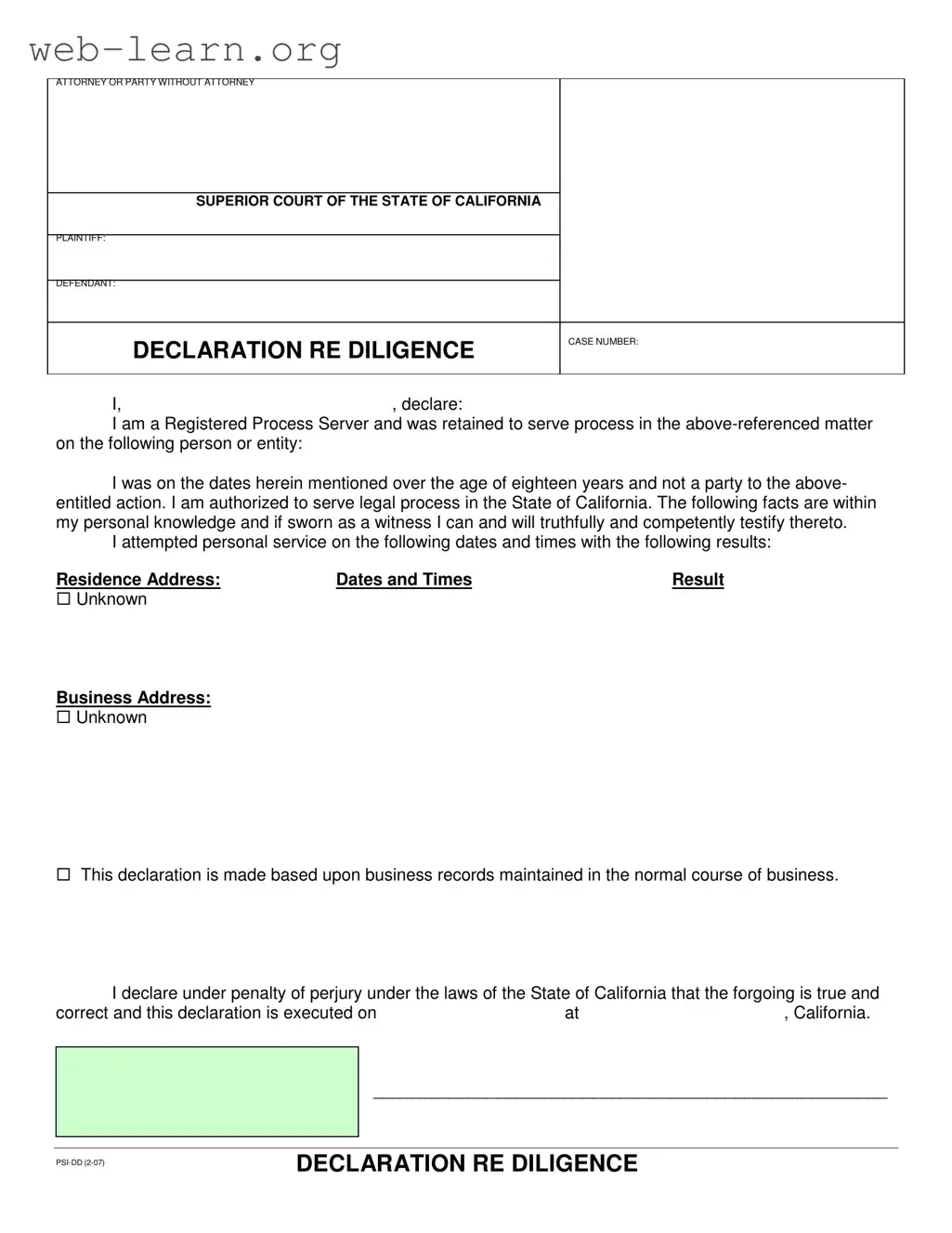
In the realm of legal proceedings, the California Diligence form plays a crucial role in ensuring that all parties involved are properly notified of actions against them. This form is primarily utilized by registered process servers tasked with delivering legal documents to defendants or other involved parties. Its significance lies in the requirement for the process server to document their attempts to serve these documents, thereby providing a transparent account of their efforts. The form includes essential details such as the names of the plaintiff and defendant, the case number, and a declaration from the process server affirming their authority to serve legal documents in California. Additionally, it captures the specific dates and times when service attempts were made, along with the results of those attempts. This declaration is not just a formality; it holds weight in court, as it is made under penalty of perjury, ensuring that the information provided is truthful and accurate. By maintaining a clear record of these attempts, the California Diligence form helps uphold the integrity of the legal process, offering reassurance that every effort has been made to notify the parties involved.

Sample - California Diligence Form

PSI-DD
(2-07)
DECLARATION RE DILIGENCE
ATTORNEY
OR
PARTY
WITHOUT
ATTORNEY
SUPERIOR COURT OF THE STATE OF CALIFORNIA
PLAINTIFF:
DEFENDANT:
DECLARATION RE DILIGENCE
CASE
NUMBER:
I, , declare:
I am a Registered Process Server and was retained to serve process in the above-referenced matter
on the following person or entity:
I was on the dates herein mentioned over the age of eighteen years and not a party to the above-
entitled action. I am authorized to serve legal process in the State of California. The following facts are within
my personal knowledge and if sworn as a witness I can and will truthfully and competently testify thereto.
I attempted personal service on the following dates and times with the following results:
Residence Address: Dates and Times Result
Unknown
Business Address:
Unknown
This declaration is made based upon business records maintained in the normal course of business.
I declare under penalty of perjury under the laws of the State of California that the forgoing is true and
correct and this declaration is executed on at , California.
______________________________________________________

Form Information

Fact Name Details
Purpose The California Diligence form is used to document attempts to serve legal process to a defendant or party involved in a court case.
Governing Law This form is governed by the California Code of Civil Procedure, specifically sections related to service of process.
Eligibility Only individuals over the age of eighteen and not parties to the action may serve process and complete this form.
Personal Knowledge The declarant must have personal knowledge of the attempts made to serve process and be able to testify to the facts if required.
Record Keeping The declaration is based on business records maintained in the normal course of business, ensuring accuracy and reliability.
Penalties Falsifying information on the form can result in penalties, including perjury charges under California law.
Execution The form must be executed in California, affirming the truthfulness of the declaration under penalty of perjury.

Detailed Guide for Filling Out California Diligence

Filling out the California Diligence form requires careful attention to detail. This form is essential for documenting attempts to serve legal process. Following the steps outlined below will help ensure that the form is completed accurately.

  1. Begin by identifying the section at the top of the form where you will input your information. Enter your name as the attorney or party without an attorney.
  2. Next, specify the name of the plaintiff and the defendant in the case. This information is crucial for the form to be relevant to the correct legal matter.
  3. In the designated area, fill in the case number associated with the legal action. This number helps to track the case in the court system.
  4. Proceed to the declaration section. Here, you will state your name and confirm that you are a Registered Process Server. Include the name of the person or entity you were retained to serve.
  5. Indicate your age, confirming that you are over eighteen years old and not a party to the action.
  6. Affirm your authorization to serve legal process in California. This establishes your qualifications for completing the task.
  7. Document the specific dates and times you attempted personal service. Be sure to note the results of each attempt in the corresponding section.
  8. Provide the residence and business addresses of the person or entity being served. If unknown, indicate that as well.
  9. Conclude the declaration by stating that the information provided is based on your personal knowledge and business records.
  10. Finally, sign and date the form, confirming that the information is true and correct under penalty of perjury. Include the location where you are signing the document.

Obtain Answers on California Diligence

  1. What is the California Diligence form?

    The California Diligence form is a legal document used to declare the efforts made to serve legal process to a party involved in a case. It is typically filled out by a registered process server who has attempted to deliver legal documents to the defendant or another relevant party.

  2. Who can fill out the California Diligence form?

    Only a registered process server or an attorney can fill out this form. The individual must be over the age of eighteen and not a party to the case in question. This ensures that the process server can provide an unbiased account of their attempts to serve the documents.

  3. What information is required on the form?

    The form requires specific information, including:

    • The names of the plaintiff and defendant.
    • The case number.
    • The dates and times when service attempts were made.
    • The results of those attempts.
    • The residence and business addresses of the party being served.
  4. What happens if the party cannot be served?

    If the party cannot be served after multiple attempts, the process server must document these efforts in the Diligence form. This may include noting times, dates, and any other relevant details. Courts may allow alternative methods of service if personal service is unsuccessful.

  5. Is the Diligence form legally binding?

    Yes, the Diligence form is a sworn declaration. By signing it, the process server affirms that the information provided is true and correct under penalty of perjury. This means that any false statements could lead to legal consequences.

  6. When should the California Diligence form be submitted?

    The form should be submitted to the court as soon as possible after the service attempts have been made. Timely submission is crucial, as it informs the court about the status of service and may affect the timeline of the case.

Common mistakes

Filling out the California Diligence form can be a straightforward process, but mistakes can easily happen. One common error is failing to provide complete information about the person or entity being served. It’s crucial to include the correct names and addresses. Missing or incorrect details can lead to delays and complications in the legal process.

Another frequent mistake is not including the specific dates and times of the service attempts. This section is vital as it demonstrates the effort made to serve the documents. Without this information, the court may question the validity of the service attempts. Make sure to document every attempt clearly and accurately.

People often overlook the importance of signing and dating the declaration. A signature is not just a formality; it affirms that the information provided is true and correct. Neglecting to sign or date the form can render it invalid, causing further issues down the line.

In some cases, individuals might forget to mention their status as a registered process server. This detail is essential because it establishes the authority of the person serving the documents. If this information is missing, it can raise doubts about the legitimacy of the service.

Additionally, relying solely on business records without personal verification can lead to inaccuracies. While business records are important, they should be backed up by personal knowledge. Ensure that you can confidently testify to the facts stated in the declaration.

Lastly, not reviewing the form before submission is a mistake that can be easily avoided. Taking a moment to double-check for errors can save time and prevent unnecessary complications. A careful review helps ensure that all sections are filled out correctly and completely.

Documents used along the form

The California Diligence form is a key document in the legal process, particularly for serving legal papers. However, it is often used alongside several other forms and documents that help ensure the process is thorough and compliant with state laws. Below is a list of these documents, each serving a specific purpose in the legal framework.

  • Proof of Service: This document confirms that legal papers were delivered to the intended recipient. It includes details such as the date, time, and method of service.
  • Summons: A legal document that notifies a defendant that a lawsuit has been filed against them. It outlines the time frame in which they must respond.
  • Complaint: This is the initial pleading that starts a lawsuit. It details the plaintiff's claims against the defendant and the relief sought.
  • Subpoena: A document that orders an individual to appear in court or produce documents. It is often used to gather evidence or witness testimony.
  • Notice of Acknowledgment of Receipt: This form is used when a party acknowledges receiving legal documents. It serves as proof that the documents were received.
  • Request for Entry of Default: This document requests the court to enter a default judgment against a defendant who has failed to respond to the complaint.
  • Declaration of Mailing: This form certifies that legal documents were mailed to the involved parties. It is important for establishing that all parties were informed.
  • Case Management Statement: A document that outlines the status of a case and any issues that need to be addressed in court. It helps streamline the legal process.

Understanding these documents can help navigate the legal system more effectively. Each form plays a vital role in ensuring that legal proceedings are conducted fairly and transparently.

Similar forms

The California Diligence form serves as a declaration of efforts made to serve legal documents. Several other documents share similarities with this form, primarily in their purpose of documenting attempts to serve process or provide verification of service. Below is a list of ten documents that resemble the California Diligence form:

  • Proof of Service: This document confirms that legal papers have been delivered to the intended recipient. It includes details such as the date, time, and method of service, similar to the California Diligence form's requirement for documenting attempts.
  • Declaration of Service: Much like the California Diligence form, this declaration outlines the specifics of how and when service was completed, including the identity of the person served and the circumstances surrounding the service.
  • Affidavit of Service: This is a sworn statement by the process server affirming that service was executed. It shares the same function as the Diligence form, providing a formal account of the service attempts.
  • Service of Process Request: This document initiates the process of serving legal papers. While it serves a different purpose, it is closely related to the Diligence form in that both involve the service of legal documents.
  • Notice of Service: Similar to the Diligence form, this notice informs parties involved that service has been attempted or completed, detailing the circumstances of the service.
  • Declaration of Attempted Service: This document is specifically focused on detailing the attempts made to serve a party when actual service has not been achieved, akin to the Diligence form’s focus on documenting efforts.
  • Return of Service: This is a document completed by the process server that provides evidence of service. It parallels the California Diligence form in its role of confirming the actions taken to serve documents.
  • Request for Alternate Service: When traditional service methods fail, this request outlines the need for alternative methods. It relates to the Diligence form by highlighting the challenges faced in serving documents.
  • Certificate of Service: This certificate verifies that a party has received documents. It is similar to the Diligence form in that it serves as an official record of service attempts.
  • Affidavit of Due Diligence: This affidavit asserts that reasonable efforts were made to serve a party, similar to the Diligence form’s emphasis on documenting the process server’s attempts.

Dos and Don'ts

When filling out the California Diligence form, it's essential to approach the task with care. Here are ten tips to help you navigate this process effectively.

  • Do ensure all information is accurate and complete. Double-check names, addresses, and dates.
  • Don't leave any fields blank. If a section does not apply, indicate that clearly.
  • Do provide specific dates and times of your attempts at service. This information is crucial.
  • Don't use vague language. Be precise about the results of your service attempts.
  • Do sign and date the declaration. Your signature verifies the truthfulness of the information provided.
  • Don't forget to include your credentials. Mention that you are a Registered Process Server.
  • Do maintain a professional tone throughout the document. Clarity and professionalism are key.
  • Don't include personal opinions or irrelevant information. Stick to the facts.
  • Do keep a copy of the completed form for your records. This can be helpful for future reference.
  • Don't rush through the form. Take your time to ensure everything is filled out correctly.

By following these guidelines, you can help ensure that your California Diligence form is completed properly, minimizing the risk of complications in your legal proceedings.

Misconceptions

Understanding the California Diligence form is crucial for anyone involved in legal proceedings. However, several misconceptions can lead to confusion. Here are nine common misconceptions:

  1. The form is only for attorneys. Many believe that only attorneys can use the California Diligence form. In fact, registered process servers and parties without attorneys can also utilize this form.
  2. It guarantees successful service of process. Some people think that completing the form ensures that the legal documents will be successfully served. However, the form merely documents the attempts made to serve the process.
  3. Personal service is the only option. There is a belief that personal service is the only method of serving documents. While personal service is preferred, other methods may be available under certain circumstances.
  4. The form is optional. Many assume that the California Diligence form is optional. In reality, it is often required to demonstrate due diligence in attempting to serve documents.
  5. All attempts must be documented on the form. Some think that every single attempt to serve must be included. However, only relevant and significant attempts need to be documented.
  6. Filing the form is the same as serving the documents. There is a misconception that submitting the form to the court is equivalent to serving the legal documents. The form only records the service attempts, not the service itself.
  7. Anyone can fill out the form. Some individuals believe that anyone can complete the California Diligence form. Only registered process servers or parties involved in the case should fill it out.
  8. The form can be completed after the service attempts. Many think that they can fill out the form at any time after the service attempts. However, it should be completed promptly to accurately reflect the service attempts.
  9. Providing false information has no consequences. There is a belief that inaccuracies on the form are inconsequential. In reality, providing false information can lead to legal repercussions and undermine the case.

Addressing these misconceptions is essential for ensuring proper legal procedures are followed. Understanding the California Diligence form can help avoid potential pitfalls in the legal process.

Key takeaways

Filling out and using the California Diligence form is an important step in the legal process. Here are some key takeaways to keep in mind:

  • Purpose of the Form: This form is used to document attempts to serve legal process to a defendant or party involved in a case.
  • Eligibility: Only registered process servers or individuals authorized to serve legal documents can fill out this form.
  • Personal Knowledge: The information provided must be based on personal knowledge. You should be able to testify about the facts if required.
  • Details Required: Include specific dates and times of service attempts, as well as the results of those attempts.
  • Residence and Business Addresses: Clearly state the addresses where service was attempted. If unknown, note that as well.
  • Documentation: The declaration is based on business records maintained in the normal course of business, which adds credibility.
  • Penalties: Be aware that providing false information can lead to penalties under California law.
  • Signature and Date: Ensure that the form is signed and dated to validate the declaration.
  • Filing: Submit the completed form to the appropriate court as part of the case documentation.

Understanding these points can help ensure that the California Diligence form is filled out correctly and used effectively in legal proceedings.