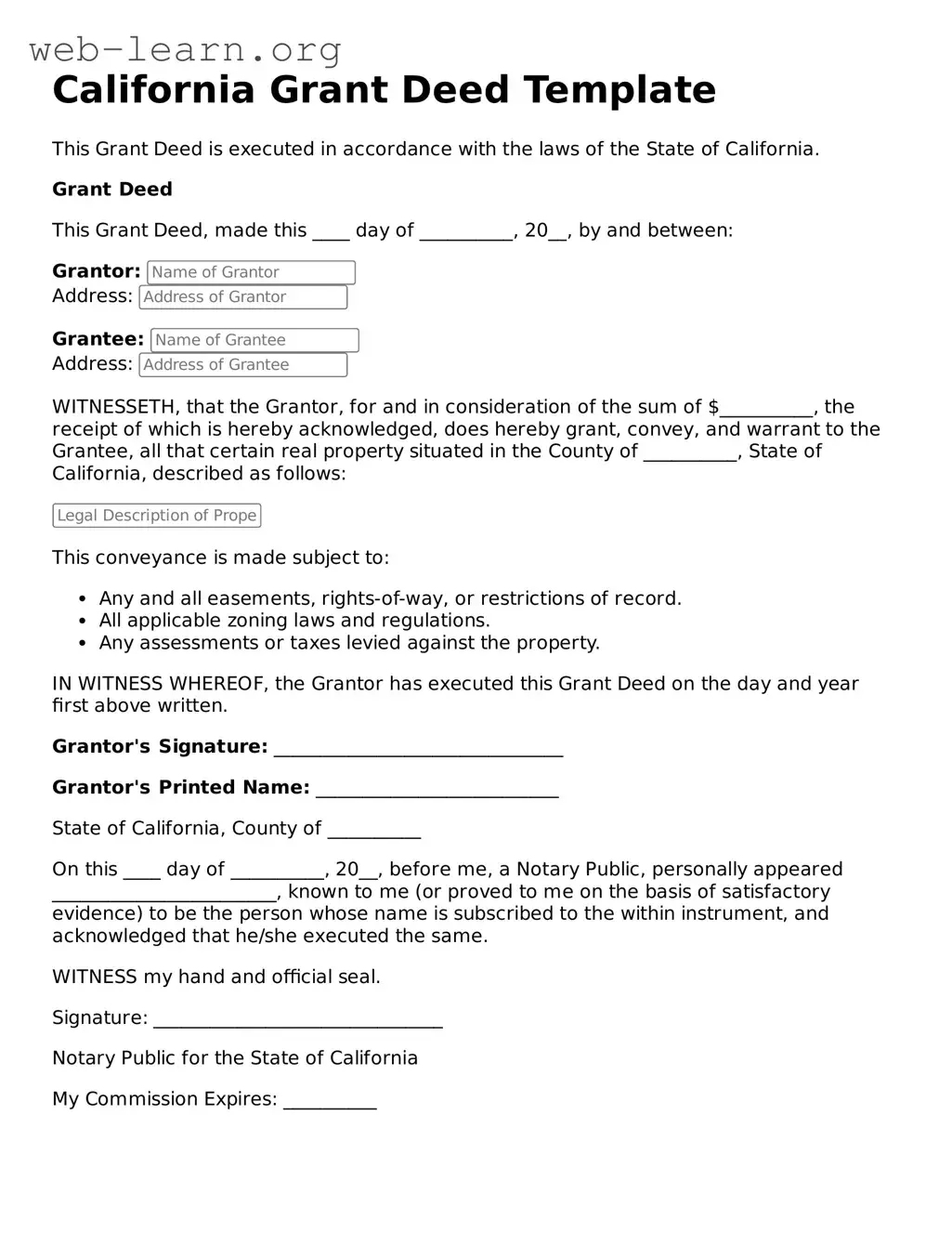
The California Deed form is a crucial legal document that facilitates the transfer of property ownership within the state. It serves as a written record that conveys real estate from one party to another, ensuring that the transaction is legally recognized. Various types of deeds exist, including grant deeds and quitclaim deeds, each serving different purposes depending on the nature of the transfer. Essential elements of the form include the names of the granter and grantee, a detailed description of the property, and the date of the transaction. Additionally, signatures of the parties involved, along with notarization, are required to validate the deed. Understanding the nuances of the California Deed form is vital for anyone involved in real estate transactions, as it not only protects the rights of the parties but also ensures compliance with state laws.
California Grant Deed Template
This Grant Deed is executed in accordance with the laws of the State of California.
Grant Deed
This Grant Deed, made this ____ day of __________, 20__, by and between:
Grantor:
Address:
Grantee:
Address:
WITNESSETH, that the Grantor, for and in consideration of the sum of $__________, the receipt of which is hereby acknowledged, does hereby grant, convey, and warrant to the Grantee, all that certain real property situated in the County of __________, State of California, described as follows:
This conveyance is made subject to:
IN WITNESS WHEREOF, the Grantor has executed this Grant Deed on the day and year first above written.
Grantor's Signature: _______________________________
Grantor's Printed Name: __________________________
State of California, County of __________
On this ____ day of __________, 20__, before me, a Notary Public, personally appeared ________________________, known to me (or proved to me on the basis of satisfactory evidence) to be the person whose name is subscribed to the within instrument, and acknowledged that he/she executed the same.
WITNESS my hand and official seal.
Signature: _______________________________
Notary Public for the State of California
My Commission Expires: __________
| Fact Name | Description |
|---|---|
| Definition | A California Deed form is a legal document used to transfer ownership of real property in California. |
| Types of Deeds | Common types include Grant Deed, Quitclaim Deed, and Warranty Deed. |
| Governing Law | The California Civil Code governs the use and requirements of deeds in California. |
| Signature Requirement | The deed must be signed by the grantor (the person transferring the property). |
| Notarization | Notarization is required for the deed to be recorded with the county. |
| Recording | To provide public notice, the deed should be recorded at the county recorder's office. |
| Transfer Tax | A documentary transfer tax may apply when the property is transferred. |
Once you have the California Deed form in hand, it's time to fill it out carefully. This process requires attention to detail to ensure that all necessary information is accurately recorded. After completing the form, you will need to have it notarized and then file it with the appropriate county office.
What is a California Deed form?
A California Deed form is a legal document used to transfer ownership of real property from one party to another within the state of California. It serves as a written record of the transaction and outlines the details of the transfer, including the names of the parties involved, a description of the property, and any conditions or restrictions related to the transfer.
What types of Deeds are available in California?
California recognizes several types of Deeds, each serving different purposes. The most common types include:
How do I fill out a California Deed form?
Filling out a California Deed form requires careful attention to detail. Here are some steps to follow:
Do I need to have the Deed notarized?
Yes, in California, a Deed must be notarized to be considered valid. Notarization serves as a safeguard against fraud, ensuring that the signatures on the document are authentic. It also helps to establish that the parties involved entered into the agreement willingly and with an understanding of its terms.
How do I record a California Deed?
After completing and notarizing the Deed, the next step is to record it with the county recorder’s office where the property is located. Recording the Deed provides public notice of the ownership transfer and protects the grantee's rights to the property. To record the Deed, follow these steps:
Filling out a California Deed form can seem straightforward, but many individuals make common mistakes that can lead to complications down the line. Understanding these pitfalls is essential for ensuring that property transfers are valid and legally binding.
One frequent error is failing to include the correct legal description of the property. A simple address may seem sufficient, but it often lacks the specificity needed to identify the property accurately. The legal description should include details such as parcel numbers or metes and bounds. Without this information, the deed may be deemed invalid.
Another mistake involves incorrect names or spellings. When listing the grantor and grantee, it is crucial to use their full legal names as they appear on official documents. Omissions or typos can create confusion and may lead to disputes over ownership. Always double-check the names before submitting the form.
Additionally, people often overlook the necessity of signatures. Both the grantor and any witnesses must sign the deed for it to be legally effective. Failing to obtain a signature from the grantor or neglecting to have a witness can invalidate the deed. It’s important to ensure that all required parties sign the document.
Not including the date of the transaction is another common oversight. The date serves as a critical reference point for the transfer of ownership. Omitting it can lead to ambiguity about when the transfer occurred, which can complicate matters in the future, especially if disputes arise.
Some individuals also forget to properly notarize the deed. In California, notarization is often necessary to verify the identities of the signers. A deed that is not notarized may face challenges in court, especially if ownership is disputed. Ensure that a qualified notary public witnesses the signing process.
Lastly, many people fail to record the deed with the county recorder’s office. While the deed may be valid between the parties involved, failing to record it can leave the property vulnerable to claims by third parties. Recording the deed provides public notice of ownership and protects the interests of the grantee.
When completing a property transfer in California, several additional forms and documents may be necessary to ensure a smooth transaction. Each document serves a specific purpose in the process of transferring ownership. Below is a list of commonly used forms that accompany the California Deed form.
Each of these documents plays a crucial role in ensuring that property transfers are conducted legally and efficiently. Understanding their purposes can help parties navigate the complexities of real estate transactions in California.
When filling out the California Deed form, it’s important to be careful and thorough. Here are some dos and don’ts to keep in mind:
Understanding the California Deed form is essential for anyone involved in real estate transactions in the state. However, several misconceptions often arise regarding its use and implications. Here’s a breakdown of eight common misunderstandings:
Many people believe that all deed forms serve the same purpose. In reality, there are different types of deeds, such as grant deeds, quitclaim deeds, and warranty deeds, each serving unique functions and offering varying levels of protection to the buyer.
While notarization is highly recommended and often required for recording, a deed can still be legally binding without it, provided it meets other necessary criteria.
Some individuals think that a deed is set in stone once signed. However, deeds can be amended or revoked under certain circumstances, especially if all parties agree to the changes.
While the primary function of a deed is to transfer property ownership, it can also be used to create easements or other property rights, which may not involve a complete transfer of ownership.
Recording a deed is not mandatory for it to be valid, but failing to record it can lead to disputes about ownership, especially if another party claims the property later.
This misconception overlooks that deeds are required for all types of real estate transactions, including commercial properties, land sales, and even transfers of property between family members.
Recording a deed does not make it immune to legal challenges. Issues such as fraud, lack of capacity, or other legal disputes can still arise, potentially invalidating the deed.
People often think that a generic deed form will suffice for any transaction. However, it’s crucial to use a deed that meets specific legal requirements and reflects the unique circumstances of the transaction to avoid complications.
By dispelling these misconceptions, individuals can navigate the complexities of real estate transactions more effectively and ensure that their interests are protected.
When filling out and using the California Deed form, it is essential to keep several key points in mind to ensure the process goes smoothly. Here are some important takeaways:
By keeping these points in mind, the process of filling out and using the California Deed form can be more efficient and effective.
Warranty Deed Colorado - It includes details about the property and the parties involved.
Warranty Deed Form Idaho - A Deed may be required for certain types of financial transactions involving property.