Homepage Blank California De 131 Form
Outline

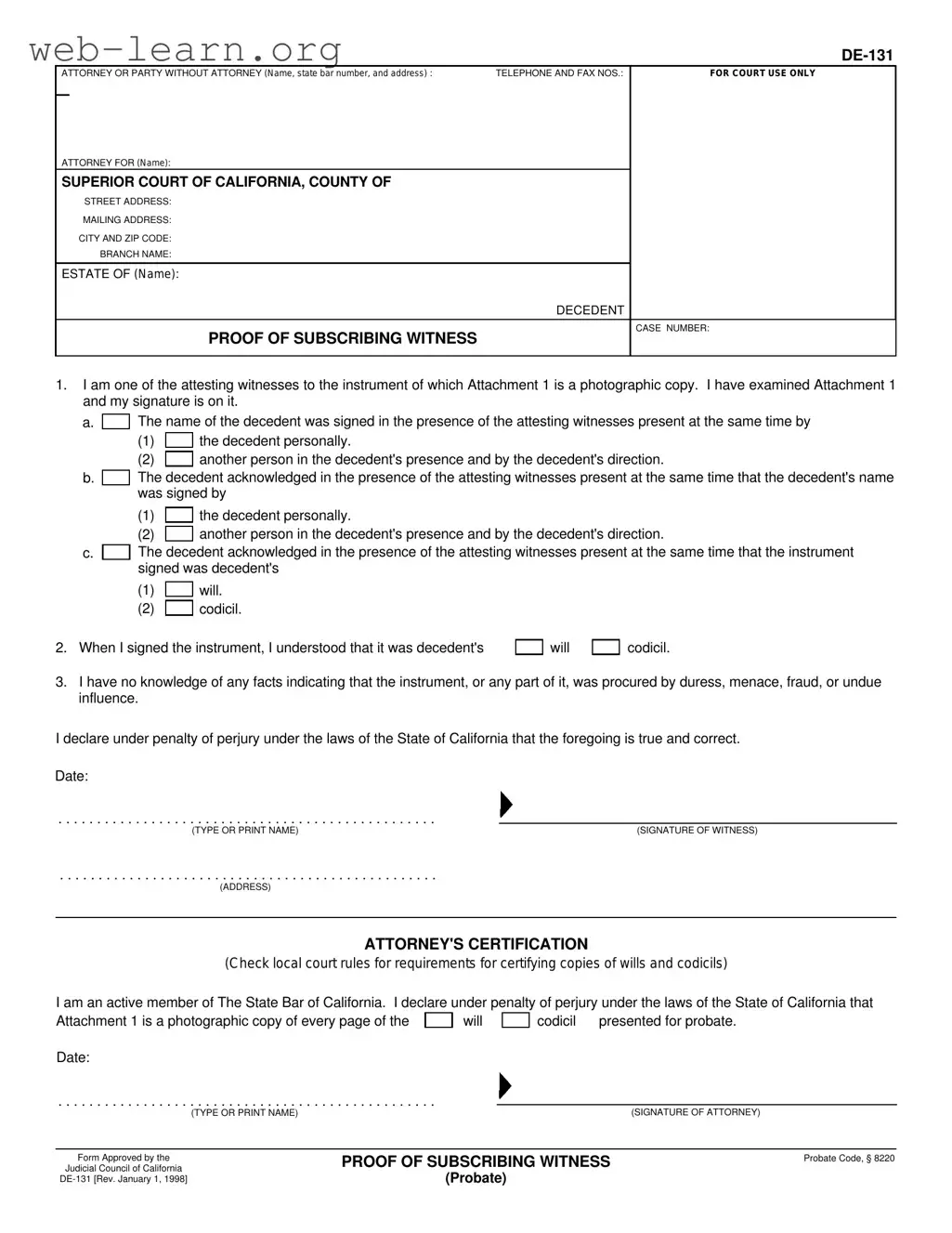
The California DE-131 form is an important document used in probate cases to verify the authenticity of a decedent's will or codicil. This form includes sections for both the attesting witness and the attorney, ensuring that the will has been properly executed and witnessed according to state laws. The witness must confirm their presence at the signing of the document and affirm that the decedent acknowledged the will as their own. Additionally, the witness must declare under penalty of perjury that they have no knowledge of any fraud or undue influence surrounding the signing of the will. The attorney completing the form also certifies that the attached document is a true photographic copy of the original will or codicil. By providing these assurances, the DE-131 form plays a crucial role in the probate process, helping to establish the validity of the decedent's final wishes.
Sample - California De 131 Form

Attachment 1 is a photographic copy of every page of the
FOR COURT USE ONLYTELEPHONE AND FAX NOS.:ATTORNEY OR PARTY WITHOUT ATTORNEY (Name, state bar number, and address) :
ATTORNEY FOR (Name):
SUPERIOR COURT OF CALIFORNIA, COUNTY OF
STREET ADDRESS:
MAILING ADDRESS:
CITY AND ZIP CODE:
BRANCH NAME:
ESTATE OF (Name):
DECEDENT
I am one of the attesting witnesses to the instrument of which Attachment 1 is a photographic copy. I have examined Attachment 1
and my signature is on it.
1.
The name of the decedent was signed in the presence of the attesting witnesses present at the same time by
a.
the decedent personally.
another person in the decedent's presence and by the decedent's direction.
The decedent acknowledged in the presence of the attesting witnesses present at the same time that the decedent's name
was signed by
b.
the decedent personally.
another person in the decedent's presence and by the decedent's direction.
The decedent acknowledged in the presence of the attesting witnesses present at the same time that the instrument
signed was decedent's
c.
will.
codicil.
codicil.will2. When I signed the instrument, I understood that it was decedent's
3. I have no knowledge of any facts indicating that the instrument, or any part of it, was procured by duress, menace, fraud, or undue
influence.
I declare under penalty of perjury under the laws of the State of California that the foregoing is true and correct.
Date:
. . . . . . . . . . . . . . . . . . . . . . . . . . . . . . . . . . . . . . . . . . . . . . . . .
(SIGNATURE OF WITNESS)(TYPE OR PRINT NAME)
. . . . . . . . . . . . . . . . . . . . . . . . . . . . . . . . . . . . . . . . . . . . . . . . .
(ADDRESS)
ATTORNEY'S CERTIFICATION
(Check local court rules for requirements for certifying copies of wills and codicils)
I am an active member of The State Bar of California. I declare under penalty of perjury under the laws of the State of California that
codicil presented for probate.
Date:
. . . . . . . . . . . . . . . . . . . . . . . . . . . . . . . . . . . . . . . . . . . . . . . . .
(SIGNATURE OF ATTORNEY)
(TYPE OR PRINT NAME)
Form Approved by the
Judicial Council of California
DE-131 [Rev. January 1, 1998]
PROOF OF SUBSCRIBING WITNESS
(Probate)
will
PROOF OF SUBSCRIBING WITNESS
CASE NUMBER:
DE-131
Probate Code, § 8220
(1)
(2)
(1)
(1)
(2)
(2)

Form Information

Fact Name Description
Purpose The DE-131 form is used to provide proof of subscribing witnesses for a will or codicil in California probate proceedings.
Governing Law This form is governed by the California Probate Code, specifically section 8220.
Witness Requirements At least two witnesses must attest to the signing of the will or codicil to validate the document.
Certification Attorneys must certify that the attached copy of the will or codicil is accurate and complete, ensuring compliance with local court rules.
Form Approval The DE-131 form is approved by the Judicial Council of California and was last revised on January 1, 1998.

Detailed Guide for Filling Out California De 131

Completing the California DE-131 form is an important step in the probate process. This form is used to provide proof of subscribing witnesses to a will or codicil. To ensure that the form is filled out correctly, follow the steps outlined below carefully.

  1. Begin by entering your name, state bar number, and address in the designated area at the top of the form. If you are not an attorney, leave this section blank.
  2. Next, provide your telephone and fax numbers, if applicable.
  3. In the section labeled "FOR COURT USE ONLY," leave it blank as this is reserved for court officials.
  4. Fill in the name of the attorney, if applicable, in the "ATTORNEY FOR" section.
  5. Enter the name of the decedent in the "ESTATE OF" section.
  6. Write the case number assigned to the estate in the "CASE NUMBER" field.
  7. Complete the "PROOF OF SUBSCRIBING WITNESS" section by confirming that you are one of the attesting witnesses. Check the appropriate boxes to indicate how the decedent’s name was signed.
  8. Indicate whether the instrument signed was the decedent's will or codicil by checking the correct box.
  9. In the next section, affirm that you understood the document was the decedent's will or codicil when you signed it.
  10. State that you have no knowledge of any facts indicating that the instrument was procured by duress, menace, fraud, or undue influence.
  11. Sign and date the form where indicated, ensuring that your name is printed or typed clearly beneath your signature.
  12. If you are the attorney, complete the "ATTORNEY'S CERTIFICATION" section by signing and printing your name, and include the date.

Once you have completed the form, review it to ensure all information is accurate and legible. After that, you can submit the form to the appropriate court as part of the probate process. It is advisable to keep a copy for your records before submission.

Obtain Answers on California De 131

  1. What is the purpose of the California DE-131 form?

    The California DE-131 form, known as the Proof of Subscribing Witness, serves an important function in the probate process. It is used to verify the authenticity of a decedent's will or codicil by providing evidence from a witness who was present when the document was signed. This form helps the court confirm that the will was executed properly and that the decedent was of sound mind at the time of signing.

  2. Who needs to fill out the DE-131 form?

    The DE-131 form must be completed by one of the witnesses who observed the decedent sign the will or codicil. This witness is often referred to as a "subscribing witness." The form requires the witness to declare that they were present during the signing and that they have no knowledge of any factors such as duress or fraud that could invalidate the will.

  3. What information is required on the DE-131 form?

    When filling out the DE-131 form, the witness must provide several key pieces of information:

    • The name of the decedent.
    • The case number associated with the probate proceedings.
    • A statement confirming the witness's presence during the signing of the will or codicil.
    • A declaration that the witness has no knowledge of any undue influence or coercion related to the signing.
    • The witness's signature, printed name, and address.
  4. What happens after the DE-131 form is submitted?

    Once the DE-131 form is completed and submitted to the court, it becomes part of the probate record. The court will review the form along with the will or codicil to ensure that all legal requirements have been met for the document to be valid. If everything is in order, the court will accept the will for probate, allowing the decedent's estate to be administered according to their wishes as outlined in the document.

Common mistakes

Filling out the California DE-131 form can be a complex task, and mistakes can lead to delays or complications in the probate process. One common error occurs when individuals fail to provide accurate information regarding the decedent. The form requires specific details about the decedent, including their full name and case number. Omitting or misspelling this information can create significant issues, as it may hinder the court's ability to process the form effectively.

Another frequent mistake involves the signature of the witness. The form must be signed by an attesting witness who was present during the signing of the will or codicil. If the witness does not sign the document, or if their signature is illegible, the court may question the validity of the document. It is essential that the witness clearly prints their name and provides a readable signature to avoid any confusion.

People often overlook the importance of the declaration under penalty of perjury. This declaration affirms the truthfulness of the information provided on the form. If individuals neglect to complete this section or fail to sign it, the court may reject the form outright. It is crucial to take this declaration seriously and ensure it is filled out completely.

In addition, individuals sometimes misinterpret the requirements for the attorney's certification. The attorney must be an active member of the State Bar of California and must certify that the attachment is a true photographic copy of the original will or codicil. Failing to include this certification or providing incorrect information about the attorney's status can lead to further complications.

Lastly, many people do not double-check the form for completeness before submission. Incomplete forms can lead to delays in the probate process. It is advisable to review the entire form to ensure that all required sections are filled out correctly and that no information is missing. Taking the time to carefully complete the DE-131 form can save individuals from unnecessary stress and complications in the future.

Documents used along the form

When dealing with the California DE-131 form, several other documents may also be necessary to complete the probate process. Each of these forms serves a specific purpose and is important for ensuring that the decedent's wishes are honored and the legal requirements are met.

  • DE-140: Petition for Probate - This form is used to initiate the probate process. It requests the court to appoint a personal representative to manage the decedent's estate and outlines the details of the estate, including its assets and liabilities.
  • DE-147: Notice of Petition to Administer Estate - After filing the petition, this notice must be sent to all interested parties. It informs them of the petition and provides details about the court hearing, allowing them to participate if they choose.
  • DE-121: Proof of Service - This document demonstrates that all required parties have been properly notified of the probate proceedings. It includes details on how and when the notices were served.
  • DE-222: Inventory and Appraisal - This form is used to provide a detailed account of the decedent’s assets. It is typically completed by the personal representative and must be filed with the court.
  • DE-295: Order for Final Distribution - This order is necessary when the estate is ready to be distributed to the beneficiaries. It outlines how the assets will be divided and ensures that all debts and taxes have been settled.
  • DE-310: Waiver of Account - Beneficiaries may use this form to waive the requirement for a formal accounting of the estate's administration. It allows for a more streamlined process if all parties agree.

Understanding these forms and their functions can facilitate a smoother probate process. Proper documentation ensures that the decedent's estate is handled according to their wishes and in compliance with California law.

Similar forms

The California DE-131 form serves a specific purpose in the probate process, particularly for the proof of subscribing witnesses. It shares similarities with several other legal documents that also facilitate the validation of wills and related instruments. Below are four documents that are similar to the DE-131 form, along with explanations of their similarities:

  • California DE-140 Form (Order for Probate): This form is used to request a court order to validate a will and appoint a personal representative. Like the DE-131, it requires proof of the will's validity and the signatures of witnesses.
  • California DE-135 Form (Proof of Holographic Will): This document serves to prove a holographic will, which is handwritten and does not require witnesses. Both forms aim to establish the authenticity of the decedent's intentions regarding their estate.
  • California DE-150 Form (Notice of Hearing on Petition to Probate Will): This form notifies interested parties about a hearing regarding the probate of a will. Similar to the DE-131, it is part of the probate process and ensures that all relevant parties are informed about the proceedings.
  • California DE-160 Form (Petition for Letters of Administration): This form is used to request the court to appoint an administrator when there is no will. Both the DE-131 and DE-160 are crucial in the probate process, ensuring proper legal procedures are followed for estate management.

Dos and Don'ts

When filling out the California DE-131 form, it is important to follow specific guidelines to ensure accuracy and compliance. Here are some key dos and don'ts:

  • Do provide your full name, state bar number, and address at the top of the form.
  • Do ensure that all information is typed or printed clearly to avoid any misunderstandings.
  • Do check the local court rules for any specific requirements related to certifying copies of wills and codicils.
  • Do sign and date the form in the designated areas to validate your declaration.
  • Don't leave any sections blank; every part of the form must be completed.
  • Don't use abbreviations or shorthand; clarity is essential.
  • Don't forget to review the form for any errors before submission.
  • Don't submit the form without ensuring that all required attachments are included.

Misconceptions

Understanding the California DE-131 form is essential for anyone involved in probate matters. However, several misconceptions can lead to confusion. Here are six common misunderstandings:

  • The DE-131 form is only for attorneys. This form can be used by both attorneys and individuals representing themselves in probate cases. It is designed for anyone who needs to provide proof of subscribing witnesses.
  • It is unnecessary if there are no witnesses. Even if there are no witnesses to the signing of the will, the DE-131 form may still be required to validate the document and ensure it meets legal standards.
  • The form guarantees the will's validity. Submitting the DE-131 does not guarantee that the will will be accepted as valid. The court will still review all evidence and documents submitted.
  • Only one witness is needed. While one witness can be sufficient in some cases, having multiple witnesses can strengthen the validity of the will and provide additional support in probate proceedings.
  • All signatures must be notarized. Notarization is not a requirement for the DE-131 form. Instead, the focus is on the attesting witnesses who can affirm the signing of the will.
  • The form is only for wills. The DE-131 form can also be used for codicils, which are amendments to existing wills. It serves the same purpose for both types of documents.

Clarifying these misconceptions can help individuals navigate the probate process more effectively. Understanding the requirements and purpose of the DE-131 form is crucial for ensuring that the wishes of the deceased are honored.

Key takeaways

Filling out the California DE-131 form can seem daunting at first, but understanding its key elements can make the process smoother. Here are some important takeaways to keep in mind:

  • The DE-131 form is used to provide proof of subscribing witnesses for a decedent's will or codicil.
  • It is essential to include accurate information about the decedent, including their name and case number.
  • Witnesses must confirm that they signed the will or codicil in the presence of the decedent.
  • Each witness should understand that they are affirming the authenticity of the document they are signing.
  • Witnesses must declare that they have no knowledge of any coercion or fraud related to the signing of the document.
  • It is important to date the form correctly to reflect when the witness signed it.
  • The attorney must also certify that the attachment is a true photographic copy of the will or codicil.
  • Double-check the local court rules regarding any specific requirements for certifying copies of wills and codicils.
  • Make sure to provide complete contact information for both the attorney and the witnesses.
  • Filing the DE-131 form is a critical step in the probate process, so ensure it is completed accurately to avoid delays.

By keeping these points in mind, you can navigate the process of filling out and using the DE-131 form with greater confidence and clarity.