Homepage Blank California Cv 71 Form
Outline

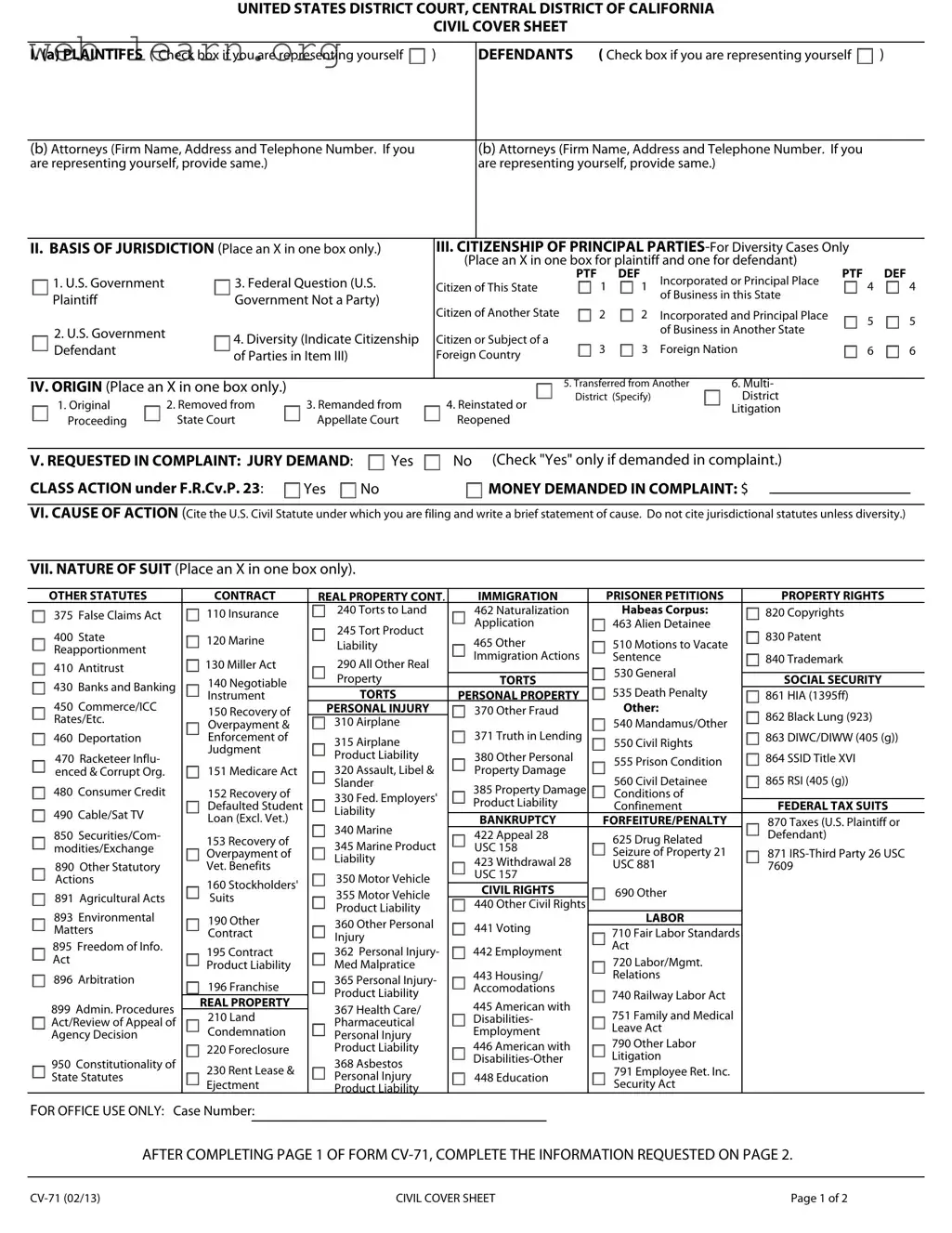
The California CV-71 form serves as a vital tool for initiating civil cases in the United States District Court for the Central District of California. This form, known as the Civil Cover Sheet, is essential for organizing key information about the parties involved, the nature of the case, and the basis for the court's jurisdiction. It requires the identification of plaintiffs and defendants, including their legal representatives, if applicable. Additionally, the CV-71 form prompts users to specify the basis of jurisdiction, whether it is a federal question or diversity of citizenship, which is crucial for determining the appropriate legal framework. The form also collects details about the citizenship of the principal parties, particularly in diversity cases, and asks for information regarding the origin of the case, such as whether it is original, removed, or transferred from another district. Furthermore, it includes sections for indicating the nature of the suit, the cause of action, and any jury demands, as well as the monetary amounts being claimed. By requiring this information upfront, the CV-71 streamlines the process for court staff and ensures that cases are properly categorized and tracked from the outset.
Sample - California Cv 71 Form

UNITED STATES DISTRICT COURT, CENTRAL DISTRICT OF CALIFORNIA
CIVIL COVER SHEET
I. (a) PLAINTIFFS (
Check box if you are representing yourself
DEFENDANTS (
(b)
Attorneys (Firm Name, Address and Telephone Number. If you
are representing yourself, provide same.)
II. BASIS OF JURISDICTION (
Place an X in one box only.)
1. U.S. Government
Plaintiff
3. Federal Question (U.S.
Government Not a Party)
2. U.S. Government
Defendant
4. Diversity (Indicate Citizenship
of Parties in Item III)
III. CITIZENSHIP OF PRINCIPAL PARTIES-For Diversity Cases Only
(Place an X in one box for plaintiff and one for defendant)
Citizen of This State
Citizen or Subject of a
Foreign Country
Citizen of Another State
PTF DEF
1 1
3
2
3
Incorporated or Principal Place
of Business in this State
Incorporated and Principal Place
of Business in Another State
Foreign Nation
DEFPTF
4 4
5 5
66
2
IV. ORIGIN (Place an X in one box only.)
1. Original
Proceeding
2. Removed from
State Court
3. Remanded from
Appellate Court
4. Reinstated or
Reopened
6. Multi-
District
Litigation
V. REQUESTED IN COMPLAINT: JURY DEMAND: Yes No
(Check "Yes" only if demanded in complaint.)
CLASS ACTION under F.R.Cv.P. 23:
No MONEY DEMANDED IN COMPLAINT: $ Yes
VI. CAUSE OF ACTION (Cite the U.S. Civil Statute under which you are filing and write a brief statement of cause. Do not cite jurisdictional statutes unless diversity.)
VII. NATURE OF SUIT (Place an X in one box only).
CONTRACT
TORTS
PRISONER PETITIONS
LABOR
REAL PROPERTY
PERSONAL INJURY
PERSONAL PROPERTY
IMMIGRATION
BANKRUPTCY
CIVIL RIGHTS
FORFEITURE/PENALTY
PROPERTY RIGHTS
SOCIAL SECURITY
FEDERAL TAX SUITS
375 False Claims Act
400 State
Reapportionment
410 Antitrust
430 Banks and Banking
490 Cable/Sat TV
480 Consumer Credit
460 Deportation
896 Arbitration
895 Freedom of Info.
Act
893 Environmental
Matters
891 Agricultural Acts
899 Admin. Procedures
Act/Review of Appeal of
Agency Decision
450 Commerce/ICC
Rates/Etc.
470 Racketeer Influ-
enced & Corrupt Org.
850 Securities/Com-
modities/Exchange
890 Other Statutory
Actions
110 Insurance
120 Marine
130 Miller Act
140 Negotiable
Instrument
150 Recovery of
Overpayment &
Enforcement of
Judgment
151 Medicare Act
152 Recovery of
Defaulted Student
Loan (Excl. Vet.)
153 Recovery of
Overpayment of
Vet. Benefits
160 Stockholders'
Suits
190 Other
Contract
195 Contract
Product Liability
196 Franchise
210 Land
Condemnation
220 Foreclosure
230 Rent Lease &
Ejectment
REAL PROPERTY CONT
.
240 Torts to Land
245 Tort Product
Liability
290 All Other Real
Property
310 Airplane
315 Airplane
Product Liability
320 Assault, Libel &
Slander
330 Fed. Employers'
Liability
340 Marine
345 Marine Product
Liability
350 Motor Vehicle
355 Motor Vehicle
Product Liability
360 Other Personal
Injury
362 Personal Injury-
Med Malpratice
365 Personal Injury-
Product Liability
367 Health Care/
Pharmaceutical
Personal Injury
Product Liability
368 Asbestos
Personal Injury
Product Liability
950 Constitutionality of
State Statutes
462 Naturalization
Application
465 Other
Immigration Actions
370 Other Fraud
371 Truth in Lending
380 Other Personal
Property Damage
385 Property Damage
Product Liability
422 Appeal 28
USC 158
423 Withdrawal 28
USC 157
441 Voting
442 Employment
443 Housing/
Accomodations
445 American with
Disabilities-
Employment
446 American with
Disabilities-Other
440 Other Civil Rights
448 Education
510 Motions to Vacate
Sentence
530 General
535 Death Penalty
540 Mandamus/Other
550 Civil Rights
555 Prison Condition
560 Civil Detainee
Conditions of
Confinement
625 Drug Related
Seizure of Property 21
USC 881
690 Other
710 Fair Labor Standards
Act
720 Labor/Mgmt.
Relations
740 Railway Labor Act
751 Family and Medical
Leave Act
790 Other Labor
Litigation
791 Employee Ret. Inc.
Security Act
820 Copyrights
830 Patent
840 Trademark
861 HIA (1395ff)
862 Black Lung (923)
863 DIWC/DIWW (405 (g))
864 SSID Title XVI
865 RSI (405 (g))
870 Taxes (U.S. Plaintiff or
Defendant)
871 IRS-Third Party 26 USC
7609
FOR OFFICE USE ONLY: Case Number:
AFTER COMPLETING PAGE 1 OF FORM CV-71, COMPLETE THE INFORMATION REQUESTED ON PAGE 2.
Habeas Corpus:
463 Alien Detainee
Other:
)
5. Transferred from Another
District (Specify)
OTHER STATUTES
TORTS
Check box if you are representing yourself
are representing yourself, provide same.)
(b)
Attorneys (Firm Name, Address and Telephone Number. If you
)
CV-71 (02/13) CIVIL COVER SHEET Page 1 of 2
UNITED STATES DISTRICT COURT, CENTRAL DISTRICT OF CALIFORNIA
CIVIL COVER SHEET
VIII(a). IDENTICAL CASES: Has this action been previously filed in this court and dismissed, remanded or closed?
NO YES
VIII(b). RELATED CASES:
Have any cases been previously filed in this court that are related to the present case?
NO YES
Civil cases are deemed related if a previously filed case and the present case:
(Check all boxes that apply)
A. Arise from the same or closely related transactions, happenings, or events; or
B. Call for determination of the same or substantially related or similar questions of law and fact; or
C. For other reasons would entail substantial duplication of labor if heard by different judges; or
D. Involve the same patent, trademark or copyright, and one of the factors identified above in a, b or c also is present.
IX. VENUE: (When completing the following information, use an additional sheet if necessary.)
(a) List the County in this District; California County outside of this District; State if other than California; or Foreign Country, in which EACH named
plaintiff resides.
Check here if the government, its agencies or employees is a named plaintiff. If this box is checked, go to item (b).
County in this District:*
California County outside of this District; State, if other than California; or Foreign
Country
(b) List the County in this District; California County outside of this District; State if other than California; or Foreign Country, in which EACH named
defendant resides.
Check here if the government, its agencies or employees is a named defendant. If this box is checked, go to item (c).
(c) List the County in this District; California County outside of this District; State if other than California; or Foreign Country, in which EACH claim arose.
NOTE: In land condemnation cases, use the location of the tract of land involved.
California County outside of this District; State, if other than California; or Foreign
Country
County in this District:*
California County outside of this District; State, if other than California; or Foreign
Country
County in this District:*
*Los Angeles, Orange, San Bernardino, Riverside, Ventura, Santa Barbara, or San Luis Obispo Counties
Note: In land condemnation cases, use the location of the tract of land involved
Notice to Counsel/Parties: The CV-71 (JS-44) Civil Cover Sheet and the information contained herein neither replace nor supplement the filing and service of pleadings or
other papers as required by law. This form, approved by the Judicial Conference of the United States in September 1974, is required pursuant to Local Rule 3-1 is not filed
but is used by the Clerk of the Court for the purpose of statistics, venue and initiating the civil docket sheet. (For more detailed instructions, see separate instructions sheet).
Key to Statistical codes relating to Social Security Cases:
861 HIA
862 BL
863 DIWW
863 DIWC
864 SSID
865 RSI
Nature of Suit Code Abbreviation Substantive Statement of Cause of Action
All claims for health insurance benefits (Medicare) under Title 18, Part A, of the Social Security Act, as amended. Also,
include claims by hospitals, skilled nursing facilities, etc., for certification as providers of services under the program.
(42 U.S.C. 1935FF(b))
All claims for "Black Lung" benefits under Title 4, Part B, of the Federal Coal Mine Health and Safety Act of 1969. (30 U.S.C.
923)
All claims filed by insured workers for disability insurance benefits under Title 2 of the Social Security Act, as amended; plus
all claims filed for child's insurance benefits based on disability. (42 U.S.C. 405 (g))
All claims filed for widows or widowers insurance benefits based on disability under Title 2 of the Social Security Act, as
amended. (42 U.S.C. 405 (g))
All claims for supplemental security income payments based upon disability filed under Title 16 of the Social Security Act, as
amended.
All claims for retirement (old age) and survivors benefits under Title 2 of the Social Security Act, as amended.
(42 U.S.C. 405 (g))
If yes, list case number(s):
DATE:
X. SIGNATURE OF ATTORNEY (OR SELF-REPRESENTED LITIGANT):
CV-71 (02/13) CIVIL COVER SHEET Page 2 of 2

Form Information

Fact Name Fact Description
Form Purpose The California CV 71 form serves as a Civil Cover Sheet for initiating civil cases in the United States District Court for the Central District of California.
Governing Law This form is governed by the Local Rule 3-1 of the United States District Court for the Central District of California.
Jurisdiction Basis Users must indicate the basis of jurisdiction by selecting one of the provided options, such as federal question or diversity.
Principal Parties The form requires the identification of the citizenship of the principal parties involved, particularly for diversity cases.
Nature of Suit Users must select the nature of the suit from a list that includes categories like civil rights, contract, and real property.
Identical Cases The form includes a section to check if the case has been previously filed in this court and whether it was dismissed or closed.
Signature Requirement A signature is required from the attorney or self-represented litigant, along with the date of signing, to validate the form.

Detailed Guide for Filling Out California Cv 71

Completing the California CV-71 form is an essential step in initiating a civil case in the United States District Court for the Central District of California. After filling out this form, you will need to submit it along with your complaint and any other required documents to the court. The following steps will guide you through the process of filling out the form correctly.

  1. Begin by indicating whether you are representing yourself or if you have an attorney. Check the appropriate box for PLAINTIFFS and DEFENDANTS.
  2. Provide the name, address, and telephone number of your attorney or, if self-represented, your own information in the designated fields.
  3. For BASIS OF JURISDICTION, place an X in one box that accurately reflects the basis for the court's jurisdiction over your case.
  4. If your case is based on diversity, complete the CITIZENSHIP OF PRINCIPAL PARTIES section by placing an X in the appropriate boxes for both the plaintiff and the defendant.
  5. Indicate the ORIGIN of your case by placing an X in one box that best describes how your case originated.
  6. In the REQUESTED IN COMPLAINT section, check "Yes" or "No" for jury demand and class action. Also, specify the amount of money demanded in the complaint.
  7. In the CAUSE OF ACTION section, cite the U.S. Civil Statute under which you are filing and provide a brief statement of the cause.
  8. For NATURE OF SUIT, place an X in one box that best describes the nature of your suit.
  9. Complete the IDENTICAL CASES section by answering whether this action has been previously filed in this court. If yes, list any case numbers.
  10. In the RELATED CASES section, indicate if there are any related cases. If yes, list the case numbers and check all applicable boxes that describe the relationship.
  11. For VENUE, list the counties where each plaintiff and defendant resides, as well as where each claim arose. Check the box if the government is involved.
  12. Finally, sign and date the form in the SIGNATURE OF ATTORNEY (OR SELF-REPRESENTED LITIGANT) section.

Obtain Answers on California Cv 71

  1. What is the purpose of the California CV-71 form?

    The California CV-71 form, also known as the Civil Cover Sheet, serves as a vital document when initiating a civil lawsuit in the United States District Court for the Central District of California. It helps streamline the court's administrative process by providing essential information about the case, including the parties involved, jurisdiction, and the nature of the suit. This form is not a substitute for other legal filings but is used for statistical purposes and to assist the court in managing its docket.

  2. Who needs to fill out the CV-71 form?

    Both plaintiffs and defendants are required to complete the CV-71 form. If you are representing yourself, you can check the appropriate box indicating self-representation. It's important to provide accurate information about your case, including your name, contact details, and the basis of jurisdiction. Attorneys representing clients must also include their firm name, address, and contact information on the form.

  3. What information is required on the CV-71 form?

    The CV-71 form asks for several key pieces of information:

    • Parties Involved: Names and contact details of plaintiffs and defendants.
    • Basis of Jurisdiction: Indicate whether the case is based on federal question jurisdiction or diversity jurisdiction.
    • Nature of Suit: Select the appropriate category that best describes your case.
    • Requested in Complaint: Include details such as jury demand and the amount of money demanded in the complaint.
    • Related Cases: If applicable, provide information about any related cases that have been previously filed.
  4. How does the CV-71 form affect my case?

    While the CV-71 form itself does not determine the outcome of your case, it plays a crucial role in the court's administrative processes. By accurately completing this form, you help the court categorize and manage your case effectively. This can lead to a more efficient legal process, as the court can quickly identify relevant information and track similar cases.

  5. Where can I obtain the CV-71 form?

    The CV-71 form can be easily accessed online through the United States District Court for the Central District of California's official website. You can download and print the form for your use. Additionally, the court's clerk office can provide physical copies if needed. Always ensure that you are using the most current version of the form to avoid any issues during your filing.

Common mistakes

Filling out the California CV-71 form can be a daunting task, and mistakes can lead to delays or complications in legal proceedings. One common error is failing to check the appropriate boxes in sections I and II. It is crucial to indicate whether you are representing yourself and to select the correct basis of jurisdiction. Omitting this information can result in the court not properly processing your case.

Another frequent mistake involves the citizenship details in section III. Individuals often forget to mark the citizenship of both the plaintiff and the defendant. This information is essential, especially in diversity cases, as it helps establish the court's jurisdiction. Incomplete or incorrect citizenship information can lead to jurisdictional challenges.

Many people also overlook the importance of accurately citing the cause of action in section VI. It is not enough to simply state the general nature of the case. Providing the specific U.S. Civil Statute under which the case is filed is necessary. Failure to do so may result in the case being dismissed or delayed as the court seeks clarification.

In section IX, venue information is often filled out incorrectly. Individuals may provide vague or incomplete addresses for the counties involved. It is important to specify the exact counties where each plaintiff and defendant resides, as well as where the claim arose. This information is vital for determining the appropriate venue for the case.

Additionally, many people neglect to complete section VIII regarding identical or related cases. If there have been previous cases filed that are related to the current case, this must be disclosed. Failing to mention related cases can lead to complications and may even affect the outcome of the current case.

Lastly, signatures are sometimes missing or improperly dated in section X. The form requires a signature from either the attorney or the self-represented litigant. Without a proper signature and date, the form may be considered incomplete, delaying the case further. It is essential to review the form thoroughly before submission to ensure all sections are accurately completed.

Documents used along the form

The California CV-71 form, known as the Civil Cover Sheet, is essential for initiating civil cases in the United States District Court for the Central District of California. This form provides the court with necessary information about the parties involved, the nature of the case, and jurisdictional details. Along with the CV-71, several other forms and documents are commonly used to ensure that the legal process runs smoothly. Below is a list of these documents, along with brief descriptions of their purposes.

  • Summons (Form AO 440): This document notifies the defendant that a lawsuit has been filed against them. It includes information on how to respond and the time frame for doing so.
  • Complaint: The complaint outlines the plaintiff's case, detailing the facts and legal reasons for the lawsuit. It sets forth the claims against the defendant and the relief sought.
  • Notice of Removal: If a case is moved from state court to federal court, this document explains why the case is being removed and includes the relevant information from the original state court filings.
  • Answer: This is the defendant's formal response to the complaint. It addresses each allegation made by the plaintiff and may include defenses or counterclaims.
  • Motion to Dismiss: This document requests the court to dismiss the case, usually based on a lack of legal grounds or jurisdiction. It argues why the plaintiff's claims should not proceed.
  • Case Management Statement: This form provides the court with information about the case's status and outlines the parties' positions on various issues. It helps in scheduling hearings and managing the case efficiently.
  • Pretrial Conference Statement: This document is submitted before a pretrial conference. It summarizes the case, including the issues to be resolved and any settlement discussions that have occurred.
  • Proposed Order: When filing motions, parties often submit a proposed order for the judge's consideration. This outlines the specific relief requested and the terms of the order.
  • Affidavit or Declaration: These are written statements made under oath, used to provide evidence or support for motions and other court documents.
  • Notice of Settlement: If the parties reach a settlement, this document informs the court of the settlement and may request the case to be dismissed or scheduled for a dismissal hearing.

These documents play a crucial role in the legal process, ensuring that all parties are informed and that the court has the necessary information to proceed. Properly completing and filing these forms can significantly impact the outcome of a case.

Similar forms

The California CV-71 form, known as the Civil Cover Sheet, serves as an essential document in civil cases. It shares similarities with several other legal documents used in various contexts. Below is a list of eight documents that are comparable to the CV-71 form, highlighting their similarities.

  • Federal Civil Cover Sheet (JS-44): This document is used in federal courts and serves a similar purpose as the CV-71. It collects basic information about the case, including parties involved and jurisdictional details.
  • State Civil Cover Sheet: Many state courts require a civil cover sheet that functions similarly to the CV-71. It outlines the parties, jurisdiction, and type of case being filed.
  • Notice of Removal: This document is filed when a case is moved from state court to federal court. It includes details about the case, similar to those found in the CV-71, to establish jurisdiction.
  • Complaint: While the complaint outlines the details of the case, it often includes jurisdictional information that is also summarized in the CV-71. Both documents are integral to initiating a civil action.
  • Answer: The answer responds to the complaint and may reference jurisdictional issues. Like the CV-71, it addresses the parties involved and the nature of the dispute.
  • Joint Case Management Statement: In some jurisdictions, this document is required before a case management conference. It includes information about the case and parties, akin to the details in the CV-71.
  • Pretrial Conference Statement: This document is submitted before a pretrial conference and includes case details and party information, similar to the CV-71's purpose of providing an overview of the case.
  • Case Information Statement: Often required in family law cases, this document provides essential information about the parties and the nature of the case, paralleling the CV-71's function in civil cases.

Dos and Don'ts

When filling out the California CV-71 form, there are important guidelines to follow. Here’s a list of things you should and shouldn’t do:

  • Do check the appropriate boxes for plaintiffs and defendants, especially if you are representing yourself.
  • Do provide complete and accurate information about your attorney or yourself, including firm name, address, and telephone number.
  • Do clearly indicate the basis of jurisdiction by marking only one box in Section II.
  • Do specify the citizenship of the principal parties if your case involves diversity jurisdiction.
  • Do cite the correct U.S. Civil Statute for your cause of action in Section VI.
  • Do ensure that all information is legible and neatly written to avoid confusion.
  • Don't leave any sections blank. Every part of the form must be completed to prevent delays.
  • Don't use legal jargon or complicated language; keep your statements clear and straightforward.
  • Don't forget to check the jury demand box only if you are requesting a jury trial in your complaint.
  • Don't submit the CV-71 form without ensuring that all details match your complaint.
  • Don't ignore the instructions provided with the form; they are there to help you.
  • Don't forget to sign and date the form before submitting it.

Misconceptions

Understanding the California CV-71 form is crucial for anyone involved in civil litigation. However, several misconceptions often arise regarding this form. Here are five common misunderstandings:

  • Misconception 1: The CV-71 form is optional.
  • This form is not optional; it is required for initiating civil cases in the U.S. District Court for the Central District of California. Failing to submit it can lead to delays or complications in your case.

  • Misconception 2: You can file the CV-71 form without providing complete information.
  • It is essential to provide accurate and complete information on the CV-71 form. Incomplete submissions can result in rejection or requests for additional information, slowing down the process.

  • Misconception 3: The CV-71 form determines the outcome of your case.
  • The CV-71 form does not influence the court's decision on your case. Its purpose is purely administrative, helping the court organize and manage cases efficiently.

  • Misconception 4: You can file the CV-71 form without legal representation.
  • While individuals can represent themselves, it is advisable to seek legal counsel when completing the CV-71 form. Legal experts can help ensure that all necessary details are correctly filled out.

  • Misconception 5: The CV-71 form is only for specific types of cases.
  • The CV-71 form is used for a wide range of civil cases, not just limited types. It covers various causes of action, making it applicable to many legal situations.

Key takeaways

When dealing with the California CV-71 form, understanding its components is crucial for a smooth filing process. Here are some key takeaways:

  • Accurate Information is Essential: Ensure that all fields, especially those regarding plaintiffs and defendants, are filled out correctly. This includes names, addresses, and contact information.
  • Jurisdiction Matters: Clearly indicate the basis of jurisdiction by selecting the appropriate box. This step is vital for determining where your case will be heard.
  • Nature of Suit: Select the correct nature of suit by placing an "X" in the appropriate box. This classification helps the court understand the type of case being presented.
  • Related Cases: If there are any related cases, it’s important to note them. This can help streamline the process and ensure that similar issues are addressed together.