Homepage Blank California Cr 126 Form
Outline

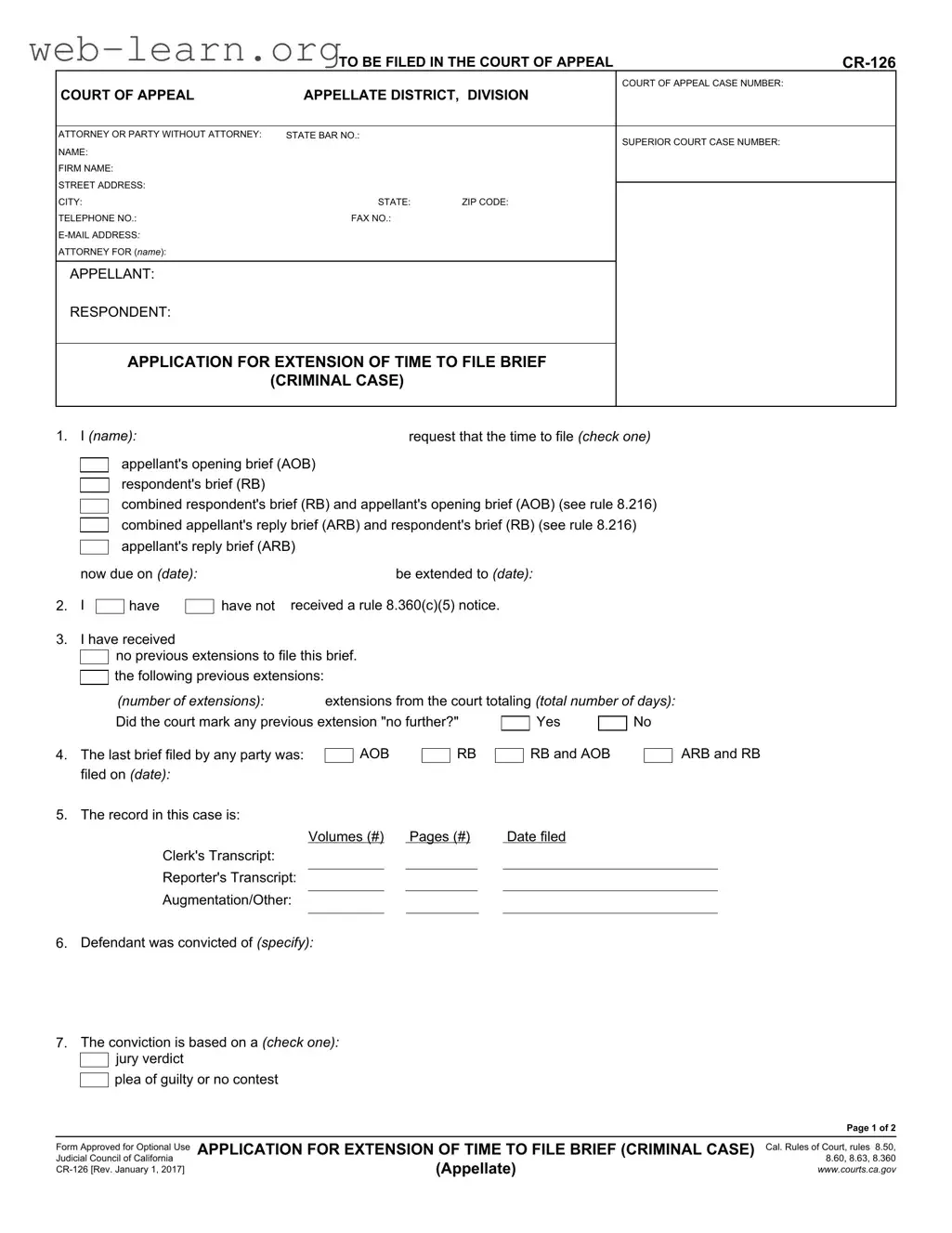
The California CR-126 form plays a crucial role in the appellate process for criminal cases, specifically when an appellant or respondent needs more time to submit their legal briefs. This form is designed for individuals who are either representing themselves or have an attorney, and it must be filed in the Court of Appeal. It includes essential details such as the case number, the parties involved, and the specific type of brief for which an extension is being requested—whether it’s the appellant's opening brief, the respondent's brief, or a combined version. Additionally, the form requires information about previous extensions, if any, and outlines the reasons for needing an extension. It also prompts users to declare under penalty of perjury that the information provided is accurate. This formal request is critical, as it ensures that the court is informed of any delays and can consider the circumstances surrounding the extension. Understanding how to properly complete and submit the CR-126 form can significantly impact the outcome of an appeal, making it an important tool for anyone navigating the complexities of the California legal system.
Sample - California Cr 126 Form

APPELLANT:
RESPONDENT:
SUPERIOR COURT CASE NUMBER:
APPLICATION FOR EXTENSION OF TIME TO FILE BRIEF
(CRIMINAL CASE)
CR-126
TO BE FILED IN THE COURT OF APPEAL
COURT OF APPEAL CASE NUMBER:
ATTORNEY OR PARTY WITHOUT ATTORNEY:
STATE: ZIP CODE:CITY:
STREET ADDRESS:
FIRM NAME:
NAME:
STATE BAR NO.:
TELEPHONE NO.: FAX NO.:
E-MAIL ADDRESS:
ATTORNEY FOR (name):
APPELLATE DISTRICT, DIVISION COURT OF APPEAL
APPLICATION FOR EXTENSION OF TIME TO FILE BRIEF (CRIMINAL CASE)
(Appellate)
Cal. Rules of Court, rules 8.50,
8.60, 8.63, 8.360
www.courts.ca.gov
Form Approved for Optional Use
Judicial Council of California
CR-126 [Rev. January 1, 2017]
I received a rule 8.360(c)(5) notice.
have not
have
I have received
1.
The record in this case is:
Volumes (#) Pages (#) Date filed
Clerk's Transcript:
Reporter's Transcript:
Augmentation/Other:
I (name):
now due on (date): be extended to (date):
(number of extensions):
extensions from the court totaling (total number of days):
request that the time to file (check one)
2.
3.
5.
Page 1 of 2
the following previous extensions:
no previous extensions to file this brief.
6.
Defendant was convicted of (specify):
The conviction is based on a (check one):
jury verdict
plea of guilty or no contest
7.
The last brief filed by any party was:
filed on (date):
4.
ARB and RBRB and AOBRBAOB
Did the court mark any previous extension "no further?"
Yes No
appellant's reply brief (ARB)
combined appellant's reply brief (ARB) and respondent's brief (RB) (see rule 8.216)
combined respondent's brief (RB) and appellant's opening brief (AOB) (see rule 8.216)
respondent's brief (RB)
appellant's opening brief (AOB)
EXTENSION OF TIME IS:
Granted
Denied
(SIGNATURE OF PRESIDING JUSTICE)
ORDER
to (date):
Date:
APPELLANT:
RESPONDENT
COURT OF APPEAL CASE NUMBER:
Order on Application is
on a separate document
below
APPLICATION FOR EXTENSION OF TIME TO FILE BRIEF (CRIMINAL CASE)
(Appellate)
CR-126 [Rev. January 1, 2017] Page 2 of 2
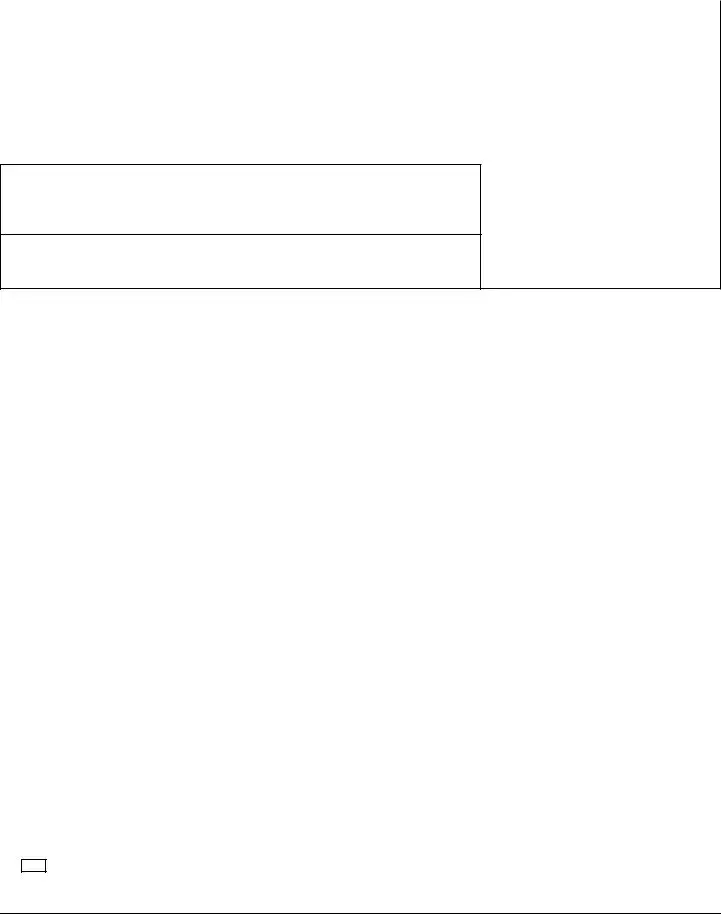
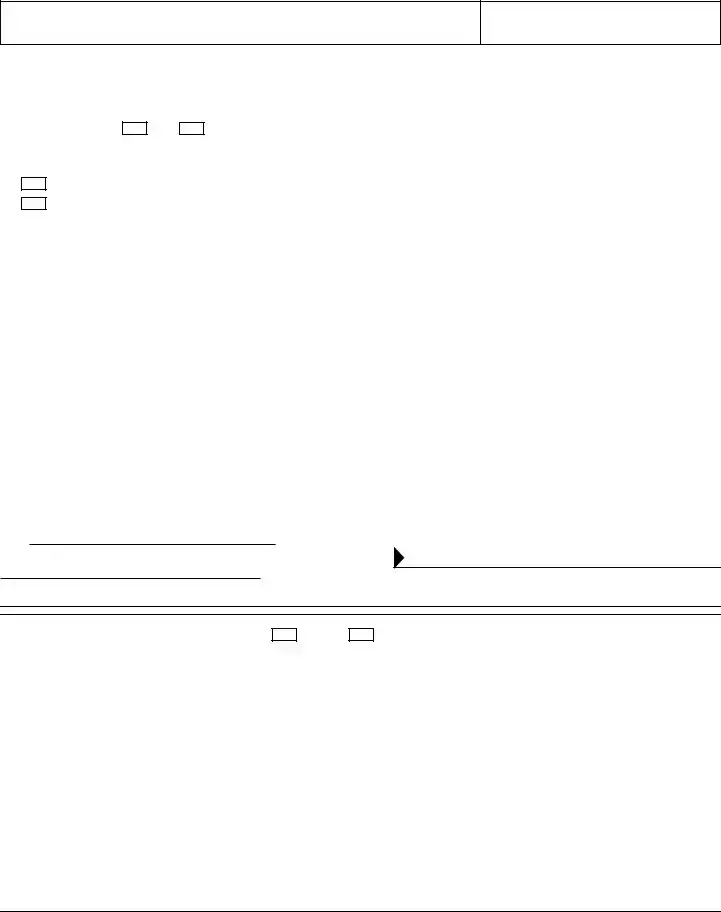
I declare under penalty of perjury under the laws of the State of California that the information above is true and correct.
(TYPE OR PRINT NAME)
(SIGNATURE OF PARTY OR ATTORNEY)
11.
(Please specify; see rule 8.63 for factors used in determining whether to grant extensions):
The defendant 9.
is
is not
on bail pending appeal.
The reasons that I need an extension to file this brief are stated
10.
below.
on a separate declaration. You may use Attached Declaration (Court of Appeal) (form APP-031) for this purpose.
The court imposed the following punishment:8.
A proof of service of this application on all those entitled to receive a copy of the brief under rule 8.360(d)(1), (2), and (3) is attached
(see rule 8.360(d)). You may use Proof of Service (Court of Appeal) (form APP-009) or Proof of Electronic Service (Court of
Appeal) (form APP-009E) for this purpose.
CR-126
Date:

Form Information

Fact Name Details
Purpose The CR-126 form is used to request an extension of time to file a brief in a criminal case within the California Court of Appeal.
Governing Laws This form is governed by California Rules of Court, specifically rules 8.50, 8.60, 8.63, and 8.360.
Filing Requirements Applicants must provide specific details, including the type of brief, due dates, and any previous extensions granted.
Signature Requirement The form must be signed by the party or attorney requesting the extension, affirming the truthfulness of the information provided.
Proof of Service A proof of service document must accompany the application, ensuring that all parties entitled to receive a copy of the brief are notified.
Optional Use The CR-126 form is approved for optional use, meaning it can be used at the discretion of the party involved in the appeal.

Detailed Guide for Filling Out California Cr 126

Completing the California CR-126 form is an essential step in requesting an extension of time to file a brief in a criminal case. After filling out the form, you will need to submit it to the appropriate court of appeal, ensuring that all necessary information is accurate and complete.

  1. Begin by entering the Court of Appeal Case Number at the top of the form.
  2. Specify the Appellate District and Division of the court.
  3. Fill in your name and State Bar Number if you are an attorney. If you are representing yourself, leave this section blank.
  4. Provide your firm name, street address, city, state, ZIP code, telephone number, fax number (if available), and email address (if available).
  5. Indicate who you are representing by filling in the name of the appellant or respondent.
  6. In section 1, write your name and check the appropriate box for the type of brief you are requesting an extension for.
  7. Enter the due date of the brief and the new requested due date.
  8. In section 2, indicate whether you have received a rule 8.360(c)(5) notice.
  9. Section 3 requires you to state if you have received any previous extensions. If so, provide the number of extensions and total days granted.
  10. In section 4, note the last brief filed by any party and the date it was filed.
  11. For section 5, provide details about the record in the case, including the number of volumes and pages.
  12. In section 6, specify the conviction details.
  13. In section 7, check whether the conviction was based on a jury verdict or a plea of guilty/no contest.
  14. Section 8 requires you to describe the punishment imposed by the court.
  15. Indicate whether the defendant is on bail pending appeal in section 9.
  16. In section 10, explain the reasons for needing an extension, either in the space provided or by attaching a separate declaration.
  17. Attach a proof of service in section 11 to confirm that all relevant parties have been notified of your application.
  18. Finally, sign and date the form at the bottom, printing your name below your signature.

Obtain Answers on California Cr 126

  1. What is the purpose of the California CR 126 form?

    The California CR 126 form is used to request an extension of time to file a brief in a criminal case before the Court of Appeal. This includes various types of briefs such as the appellant's opening brief, respondent's brief, and combined briefs. It ensures that the court is informed of the request for additional time and provides the necessary details to process it.

  2. Who should file the CR 126 form?

    The form should be filed by either the appellant or the respondent in a criminal case. If you are representing yourself, you can also file the form without an attorney. It is essential that the person filing the form has a legitimate reason for needing more time to submit their brief.

  3. What information is required on the CR 126 form?

    The form requires various pieces of information, including:

    • Your name and contact details.
    • The court of appeal case number and the superior court case number.
    • The type of brief for which you are requesting an extension.
    • The original due date and the requested new due date.
    • Details about any previous extensions and the last brief filed.
    • Information about the defendant's conviction and any imposed punishment.
  4. How do I know if I have received a notice under rule 8.360(c)(5)?

    This notice is sent to parties involved in the case and indicates specific requirements or deadlines. If you are unsure whether you have received this notice, check your records or consult with your attorney if you have one. If no notice was received, you should indicate that on the form.

  5. What should I do if I have previously received extensions?

    If you have received previous extensions, you must provide details on the CR 126 form. Specify the number of extensions granted and the total number of days those extensions provided. Be aware that the court may consider this information when deciding on your current request.

  6. What happens after I submit the CR 126 form?

    Once you submit the CR 126 form, the court will review your request. The presiding justice will either grant or deny the extension. You will receive a separate document detailing the court's order regarding your application.

  7. Is there a specific format for the reasons I need an extension?

    You can provide your reasons directly on the form or attach a separate declaration. If you choose to attach a declaration, you may use the Attached Declaration (Court of Appeal) form (APP-031). Ensure that your reasons are clear and comply with rule 8.63, which outlines factors the court considers when granting extensions.

Common mistakes

Filling out the California CR-126 form can be a daunting task. Many people make mistakes that can delay their application. One common error is failing to provide the correct court of appeal case number. This number is crucial for identifying the case. Without it, the court may not be able to process the request properly.

Another frequent mistake involves the selection of the type of brief. Applicants sometimes check more than one box for the brief they are requesting an extension for. This can lead to confusion and may result in the application being rejected. It is essential to choose only one option to ensure clarity.

Many individuals also overlook the section regarding previous extensions. It is important to accurately report any prior extensions received. If the applicant has received extensions, they must specify the number and total days granted. Failure to do so can lead to complications in the approval process.

People often forget to include the proof of service with their application. This document shows that all parties entitled to receive a copy of the brief have been notified. Without this proof, the application may be considered incomplete, which can delay the proceedings.

Additionally, applicants sometimes neglect to specify the reasons for requesting an extension. The form provides a space for this information, and it is vital to fill it out clearly. If the reasons are not adequately explained, the court may deny the request.

Another mistake is failing to sign the form. A signature is necessary to validate the application. Without it, the court will not accept the request, leading to unnecessary delays.

Some applicants do not check the date when the last brief was filed. This information is important for the court to understand the timeline of the case. Missing this detail can create confusion and hinder the review process.

Lastly, people sometimes forget to attach a separate declaration if they need to provide additional reasons for the extension. Using the appropriate form for this purpose is crucial. Neglecting to include this can result in a lack of supporting information for the request.

Documents used along the form

The California CR-126 form is an important document used in the appellate process for criminal cases. When filing this form, you may encounter several other documents that help support your application or provide necessary information to the court. Below is a list of commonly used forms and documents that often accompany the CR-126.

  • Attached Declaration (Court of Appeal) (form APP-031): This document allows you to explain the reasons for requesting an extension in detail. It can be crucial in helping the court understand your situation and the necessity of the extension.
  • Proof of Service (Court of Appeal) (form APP-009): This form verifies that all parties entitled to receive a copy of the brief have been properly notified. It is essential to ensure compliance with court rules regarding notification.
  • Appellant's Opening Brief (AOB): This is the initial brief filed by the appellant, outlining the arguments and legal basis for the appeal. It is a critical part of the appeal process.
  • Respondent's Brief (RB): This document is filed by the respondent and responds to the arguments presented in the appellant's opening brief. It provides the court with the respondent's perspective on the case.
  • Combined Respondent's Brief and Appellant's Opening Brief (RB and AOB): In some cases, these two briefs may be combined into a single document to streamline the process and reduce redundancy.
  • Appellant's Reply Brief (ARB): This brief is filed by the appellant in response to the respondent's brief. It allows the appellant to address any points made by the respondent and reinforce their original arguments.
  • Clerk's Transcript: This is an official record of all documents filed in the trial court, including pleadings, motions, and orders. It is essential for the appellate court to review the case's history.

Understanding these documents can help you navigate the appellate process more effectively. Each form plays a specific role in presenting your case to the court, ensuring that all parties have the necessary information to make informed decisions. If you have any questions about these documents or how to complete them, seeking assistance from a legal professional is advisable.

Similar forms

  • California CR-127 Form: Similar to the CR-126, this form is also used to request an extension of time to file a brief in a criminal appeal. It specifically addresses the appellant's opening brief and includes sections for detailing the reasons for the extension request.
  • California APP-031 Form: This form is utilized for submitting a declaration that supports the request for an extension. It allows the applicant to provide detailed reasons for needing additional time, similar to the CR-126's requirement for a statement of reasons.
  • California APP-009 Form: This form serves as proof of service, ensuring that all parties involved in the appeal are notified of the extension request. Like the CR-126, it emphasizes the importance of communication among parties.
  • California CR-100 Form: This form is used for filing a notice of appeal in a criminal case. While it initiates the appeal process, the CR-126 follows up on procedural aspects, such as requesting additional time for brief submission.
  • California CR-140 Form: This form is a notice of appeal in a misdemeanor case. It shares similarities with the CR-126 in that both are critical components of the appellate process, focusing on timelines and procedural requirements.
  • California CR-150 Form: Used for a request to augment the record on appeal, this form is related to the CR-126 in that both address procedural needs during the appeal process, albeit in different contexts.
  • California CR-155 Form: This form is for filing a reply brief in a criminal appeal. It complements the CR-126 by detailing the response to arguments made in other briefs, highlighting the ongoing nature of the appellate process.
  • California CR-160 Form: This form is used for filing a request for a certificate of probable cause. Like the CR-126, it addresses specific procedural requests within the context of a criminal appeal, focusing on timelines and necessary documentation.

Dos and Don'ts

When filling out the California CR-126 form, it is essential to follow certain guidelines to ensure a smooth process. Here’s a list of things you should and shouldn’t do:

  • Do double-check all personal information for accuracy.
  • Do clearly state the reasons for requesting an extension.
  • Do indicate whether you have received any previous extensions.
  • Do attach a proof of service for your application.
  • Do use the correct court case number.
  • Don't leave any sections blank; fill in all required fields.
  • Don't forget to sign and date the form before submission.

Following these guidelines will help ensure that your application is processed efficiently. Pay attention to details and adhere to the rules outlined in the form.

Misconceptions

Understanding the California CR-126 form is essential for anyone involved in a criminal appeal. However, several misconceptions often arise. Here are eight common misconceptions about this form:

  • The CR-126 form is only for criminal cases. Many believe this form is limited to criminal appeals, but it can also be relevant in certain civil cases where time extensions are needed.
  • You cannot request an extension if you have already received one. While there are restrictions, it is possible to request additional extensions if justified.
  • The form must be filed in person. Some people think that filing must occur in person at the court. However, many jurisdictions allow electronic submissions.
  • Only attorneys can file the CR-126 form. This is not true. Individuals representing themselves can also file this form.
  • It is unnecessary to explain the reasons for an extension. In fact, applicants must provide a valid reason for requesting an extension, which is crucial for approval.
  • Filing the form guarantees an extension will be granted. The court reviews each request, and approval is not guaranteed.
  • You can submit the CR-126 form without serving all parties. It is mandatory to serve all parties involved in the case with a copy of the application.
  • The CR-126 form is the only document needed for an extension. Often, additional documents, such as a proof of service or declaration, are required to support the request.

Clarifying these misconceptions can help individuals navigate the appeals process more effectively. Understanding the requirements and implications of the CR-126 form is essential for ensuring that all procedural rules are followed.

Key takeaways

When filling out and using the California CR-126 form, it is essential to keep the following key takeaways in mind:

  • Identify the Purpose: The CR-126 form is specifically designed for requesting an extension of time to file a brief in a criminal case. Ensure you clearly state which type of brief you are requesting an extension for.
  • Provide Accurate Information: Fill in all required fields accurately, including your name, contact details, and the relevant court case numbers. Incomplete or incorrect information may delay the process.
  • Check Previous Extensions: Indicate whether you have received any previous extensions for filing the brief. This information is crucial as it can affect the court's decision regarding your current request.
  • Explain the Need for Extension: Clearly articulate the reasons for needing additional time. You may attach a separate declaration if necessary, which allows you to provide more detailed explanations.
  • Proof of Service: Ensure that you attach proof of service, confirming that all parties entitled to receive a copy of the brief have been notified. This step is mandatory and helps maintain transparency in the legal process.