Homepage Blank California Complaint Form
Outline

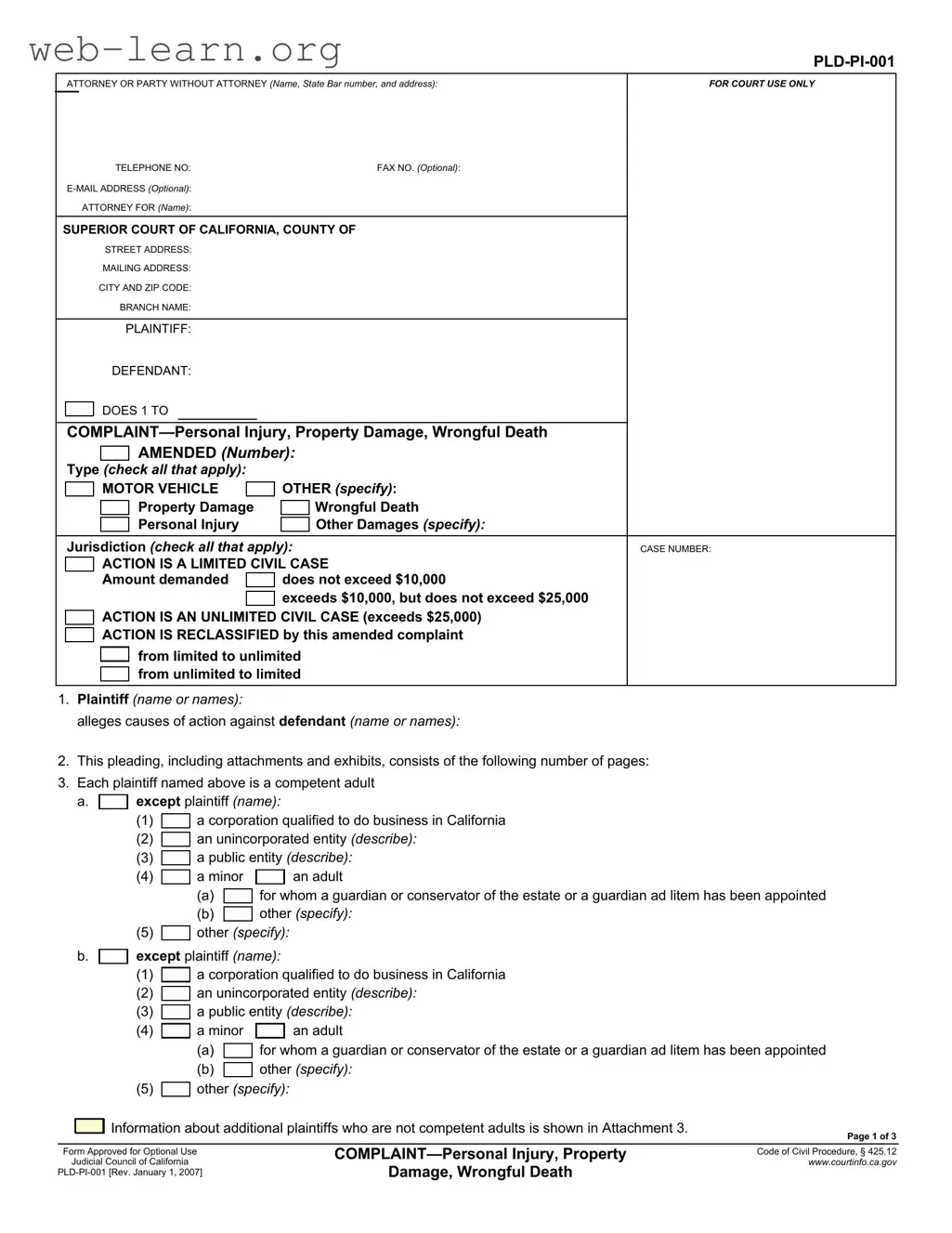
The California Complaint form serves as a crucial document for individuals seeking legal recourse in cases of personal injury, property damage, or wrongful death. It is designed to streamline the process of filing a complaint in the Superior Court of California. The form requires essential information, including the names and addresses of the plaintiff and defendant, as well as details about the nature of the complaint. Users must specify the type of case, whether it falls under limited civil or unlimited civil jurisdiction, and the amount of damages sought. Important sections allow for the identification of the parties involved, including the use of "Doe" defendants when the true names are unknown. Additionally, the form outlines the causes of action, such as motor vehicle accidents or general negligence, and provides space for detailing damages incurred, such as medical expenses or wage loss. By filling out this form accurately, plaintiffs can ensure their claims are presented clearly to the court, facilitating a more efficient legal process.


Sample - California Complaint Form

PLD-PI-001
FOR COURT USE ONLYATTORNEY OR PARTY WITHOUT ATTORNEY (Name, State Bar number, and address):
TELEPHONE NO: FAX NO. (Optional):
E-MAIL ADDRESS (Optional):
ATTORNEY FOR (Name):
STREET ADDRESS:
MAILING ADDRESS:
CITY AND ZIP CODE:
BRANCH NAME:
PLAINTIFF:
DEFENDANT:
DOES 1 TO
COMPLAINT—Personal Injury, Property Damage, Wrongful Death
AMENDED (Number):
Type (check all that apply):
OTHER (specify):MOTOR VEHICLE
Wrongful Death
Other Damages (specify):
Jurisdiction (check all that apply):
ACTION IS A LIMITED CIVIL CASE
CASE NUMBER:
Amount demanded
1. Plaintiff (name or names):
alleges causes of action against defendant (name or names):
2. This pleading, including attachments and exhibits, consists of the following number of pages:
3. Each plaintiff named above is a competent adult
a. except plaintiff (name):
(1)
(2)
(3)
(4) an adulta minor
(a)
(b)
(5) other (specify):
b. except plaintiff (name):
(1)
(2)
(3)
(4) an adulta minor
(a)
(b)
(5) other (specify):
Information about additional plaintiffs who are not competent adults is shown in Attachment 3.
Page 1 of 3
COMPLAINT—Personal Injury, Property
Damage, Wrongful Death
Form Approved for Optional Use
Judicial Council of California
PLD-PI-001 [Rev. January 1, 2007]
Code of Civil Procedure, § 425.12
www.courtinfo.ca.gov
Property Damage
Personal Injury
does not exceed $10,000
exceeds $10,000, but does not exceed $25,000
ACTION IS AN UNLIMITED CIVIL CASE (exceeds $25,000)
ACTION IS RECLASSIFIED by this amended complaint
from limited to unlimited
from unlimited to limited
a corporation qualified to do business in California
an unincorporated entity (describe):
a public entity (describe):
for whom a guardian or conservator of the estate or a guardian ad litem has been appointed
other (specify):
a corporation qualified to do business in California
an unincorporated entity (describe):
a public entity (describe):
for whom a guardian or conservator of the estate or a guardian ad litem has been appointed
other (specify):
SUPERIOR COURT OF CALIFORNIA, COUNTY OF
CASE NUMBER:
SHORT TITLE:
Plaintiff (name):4.
is doing business under the fictitious name (specify):
and has complied with the fictitious business name laws.
5. Each defendant named above is a natural person
a. except defendant (name): except defendant (name):c.
a business organization, form unknown
(1) a business organization, form unknown (1)
a corporation
a corporation(2) (2)
an unincorporated entity (describe):(3) (3)an unincorporated entity (describe):
a public entity (describe):
a public entity (describe):(4) (4)
other (specify):
(5) (5)other (specify):
b. except defendant (name): except defendant (name):d.
(1) (1)a business organization, form unknown a business organization, form unknown
a corporation
(2) (2) a corporation
(3) (3)an unincorporated entity (describe): an unincorporated entity (describe):
a public entity (describe): a public entity (describe):(4) (4)
other (specify):
(5) (5)other (specify):
Information about additional defendants who are not natural persons is contained in Attachment 5.
The true names of defendants sued as Does are unknown to plaintiff.
6.
Defendants who are joined under Code of Civil Procedure section 382 are (names):
7.
8. This court is the proper court because
a.
b.
c.
d.
9. Plaintiff is required to comply with a claims statute, and
a.
b.
COMPLAINT—Personal Injury, Property
Damage, Wrongful Death
PLD-PI-001 [Rev. January 1, 2007]
Page 2 of 3
at least one defendant now resides in its jurisdictional area.
the principal place of business of a defendant corporation or unincorporated association is in its jurisdictional area.
injury to person or damage to personal property occurred in its jurisdictional area.
other (specify):
has complied with applicable claims statutes, or
is excused from complying because (specify):
a.
b.
Doe defendants (specify Doe numbers): _________________________ were the agents or employees of other
named defendants and acted within the scope of that agency or employment.
Doe defendants (specify Doe numbers):_________________________ are persons whose capacities are unknown to
plaintiff.
PLD-PI-001
SHORT TITLE:
CASE NUMBER:
The following causes of action are attached and the statements above apply to each (each complaint must have one or more
causes of action attached):
Motor Vehiclea.
b. General Negligence
Intentional Tortc.
Products Liabilityd.
Premises Liabilitye.
Other (specify):f.
Plaintiff has suffered
a. wage loss
b. loss of use of property
hospital and medical expensesc.
general damaged.
property damagee.
f. loss of earning capacity
other damage (specify):g.
12. The damages claimed for wrongful death and the relationships of plaintiff to the deceased are
a.
b.
The relief sought in this complaint is within the jurisdiction of this court.
Plaintiff prays for judgment for costs of suit; for such relief as is fair, just, and equitable; and for
a.
(2)
The amount of damages is (in cases for personal injury or wrongful death, you must check (1)):
(1)
(2)
15. The paragraphs of this complaint alleged on information and belief are as follows (specify paragraph numbers):
Date:
(TYPE OR PRINT NAME) (SIGNATURE OF PLAINTIFF OR ATTORNEY)
COMPLAINT—Personal Injury, Property
Damage, Wrongful Death
PLD-PI-001 [Rev. January 1, 2007]
Page 3 of 3
listed in Attachment 12.
as follows:
(1) compensatory damages
punitive damages
according to proof
in the amount of: $
14.
13.
11.
10.
PLD-PI-001

Form Information

Fact Name Fact Details
Form Purpose The California Complaint form (PLD-PI-001) is used for initiating a lawsuit related to personal injury, property damage, or wrongful death claims.
Governing Law This form is governed by the California Code of Civil Procedure, specifically § 425.12.
Jurisdiction Types The form allows plaintiffs to specify if their case is a limited civil case (up to $25,000) or an unlimited civil case (exceeding $25,000).
Fictitious Business Names If a plaintiff is doing business under a fictitious name, they must indicate compliance with fictitious business name laws on the form.
Doe Defendants Plaintiffs can include Doe defendants, allowing them to sue unidentified parties whose true identities are unknown at the time of filing.

Detailed Guide for Filling Out California Complaint

Filling out the California Complaint form is a crucial step in initiating a legal action. This form allows individuals to formally present their grievances to the court. Proper completion is essential for the court to process the case efficiently.

  1. Obtain the form: Download or print the California Complaint form (PLD-PI-001) from the official court website.
  2. Fill in your information: In the top section, provide your name, address, telephone number, and email address. If you have an attorney, include their information as well.
  3. Identify the court: Write the name of the Superior Court of California, the county, and the branch name where you are filing the complaint.
  4. Enter the case details: Fill in the case number, if known, and check the appropriate boxes to indicate whether the case is limited or unlimited civil.
  5. List the parties: Provide the names of the plaintiff(s) and defendant(s). Specify if any of the defendants are unknown (using "Doe" designations).
  6. Describe the nature of the complaint: Indicate the type of complaint by checking the relevant boxes, such as personal injury or wrongful death.
  7. Detail jurisdiction: Explain why the court has jurisdiction over the case by checking the appropriate reasons provided.
  8. Attach causes of action: Specify the causes of action you are alleging by listing them. Attach additional pages if necessary.
  9. Specify damages: Describe the damages you are claiming, including any relevant financial losses or injuries.
  10. Sign the form: At the bottom, type or print your name and sign the form to certify that the information is accurate.

After completing the form, review it for accuracy and completeness. Once satisfied, file it with the appropriate court and pay any required filing fees. Keep copies for your records and follow any additional instructions provided by the court.

Obtain Answers on California Complaint

  1. What is the purpose of the California Complaint form?

    The California Complaint form is used to initiate a civil lawsuit in the Superior Court of California. It outlines the plaintiff's claims against the defendant, detailing the nature of the complaint, the parties involved, and the relief sought. This form is essential for formally presenting a case to the court.

  2. Who can file a Complaint using this form?

    Any individual or entity that has a legal claim can file a Complaint using this form. This includes competent adults, corporations, unincorporated entities, and public entities. If a plaintiff is a minor or has a guardian, the appropriate information must be provided in the form.

  3. What types of cases can be filed using the California Complaint form?

    This form is specifically designed for cases involving personal injury, property damage, and wrongful death. The plaintiff must indicate the type of claim by checking the appropriate boxes on the form. Additional details about the nature of the damages can also be specified.

  4. How does a plaintiff determine the jurisdiction of the court?

    The plaintiff must establish that the court has jurisdiction over the case. This can be determined by factors such as the residence of at least one defendant, the location of the principal place of business of a defendant, or where the injury or damage occurred. The appropriate jurisdictional information must be included in the Complaint.

  5. What information must be included in the Complaint?

    The Complaint must include the names of the parties involved, the causes of action, the damages claimed, and the relief sought. It should also specify if the plaintiff has complied with any applicable claims statutes. Additionally, if there are any Doe defendants, their identities must be indicated as well.

Common mistakes

Filling out the California Complaint form can be a daunting task, and many individuals make common mistakes that can lead to delays or complications in their case. One frequent error is neglecting to provide complete contact information for the attorney or party without an attorney. This section is crucial for the court to reach out if necessary. Omitting a phone number or email address can hinder communication, so it’s important to double-check that all fields are filled out accurately.

Another common mistake is failing to specify the correct type of case. The form allows for multiple options, such as personal injury, property damage, or wrongful death. If you check the wrong box, it could mislead the court about the nature of your complaint. Always ensure that you select all applicable types to avoid confusion.

Many people overlook the importance of clearly identifying all parties involved in the case. When listing plaintiffs and defendants, it’s essential to provide full names and accurate descriptions. For instance, if a defendant is a corporation, it should be identified as such. Incomplete or incorrect names can lead to issues with service of process, which is vital for the case to proceed.

Additionally, some individuals fail to indicate whether the case is classified as limited or unlimited. This classification affects the court’s jurisdiction and the potential remedies available. Make sure to select the appropriate category based on the amount in controversy. Misclassification can lead to your case being dismissed or sent to the wrong court.

Another mistake often made is not providing sufficient detail about the causes of action. Each cause of action should be clearly stated and attached to the complaint. If you simply state that you have attached a cause of action without specifying which ones, it may create confusion. Clarity and completeness are essential for the court to understand the basis of your claims.

Some individuals also forget to include information about any Doe defendants. If you are unsure of the names of all defendants, you must indicate this clearly. Failure to do so may result in a lack of accountability for those parties. Specify any Doe numbers and their relation to the case to ensure they are included in the proceedings.

Another area where errors frequently occur is in the jurisdictional statements. It’s important to clearly outline why the chosen court has jurisdiction over the case. Failing to provide a valid reason can lead to challenges regarding the court’s authority to hear the case. Make sure to check all applicable options that justify the court’s jurisdiction.

Lastly, many people neglect to sign and date the complaint form. A missing signature can render the document invalid. Always ensure that the form is signed by the plaintiff or their attorney, and include the date of signing. This small step is crucial for the form to be officially recognized by the court.

Documents used along the form

The California Complaint form is a crucial document in initiating a civil lawsuit. However, several other forms and documents often accompany it to ensure a complete and effective filing. Each of these documents serves a specific purpose in the legal process. Below is a list of some commonly used forms alongside the California Complaint form.

  • Summons: This document notifies the defendant that a lawsuit has been filed against them. It includes information about the court, the parties involved, and instructions on how to respond.
  • Proof of Service: This form proves that the defendant has been officially served with the complaint and summons. It details how, when, and where the service occurred.
  • Case Information Statement: This document provides the court with essential information about the case, including the nature of the dispute and the parties involved. It helps the court manage the case effectively.
  • Notice of Case Assignment: This form informs the parties about which judge has been assigned to the case. It outlines the timeline for various stages of the legal proceedings.
  • Request for Dismissal: If a plaintiff decides to withdraw their complaint, this form is used to officially dismiss the case. It must be filed with the court to finalize the dismissal.
  • Interrogatories: These are written questions sent by one party to another, requiring a written response. They help gather information relevant to the case and are often used in the discovery phase.

Understanding these accompanying documents is vital for anyone involved in a civil lawsuit in California. Each form plays a significant role in ensuring that the legal process is followed correctly and that all parties are informed and prepared for the proceedings ahead.

Similar forms

The California Complaint form serves as a foundational document in legal proceedings, particularly in personal injury, property damage, and wrongful death cases. Several other documents share similarities with this form, often reflecting similar structures or purposes. Here are nine documents that are comparable to the California Complaint form:

  • Summons: This document informs the defendant of the legal action and requires them to respond. Like the complaint, it includes information about the parties involved and the nature of the case.
  • Cross-Complaint: Similar to the original complaint, this document is filed by a defendant against the plaintiff or other parties. It outlines the defendant's claims and reasons for the lawsuit.
  • Notice of Motion: This document is used to request a court hearing on a specific issue. It shares the need for clear identification of the parties and the legal basis for the request, much like the complaint.
  • Petition: Often used in family law cases, a petition outlines the requesting party's claims and desired outcomes. It mirrors the complaint in structure and purpose, focusing on initiating legal action.
  • Answer: This document responds to the allegations made in the complaint. It contains defenses and counterclaims, similar to how a complaint outlines claims against a defendant.
  • Request for Admissions: This document seeks to establish certain facts as true, which can simplify the issues in dispute. It requires clarity and specificity, akin to the detailed nature of a complaint.
  • Interrogatories: These are formal questions posed by one party to another to gather information. Like the complaint, they require careful drafting to ensure clarity and relevance to the case.
  • Declaration: This document allows a party to present facts under penalty of perjury. It shares the requirement of providing detailed information to support claims, similar to the complaint.
  • Settlement Agreement: While typically used to resolve disputes outside of court, it often includes the same parties and claims as the original complaint, reflecting the issues at stake.

Each of these documents plays a crucial role in the legal process, sharing similarities with the California Complaint form in their structure, purpose, or the information they convey.

Dos and Don'ts

When filling out the California Complaint form, it is crucial to approach the task with care and attention to detail. Here are seven essential dos and don’ts to guide you through the process.

  • Do ensure that all names are spelled correctly. Accuracy is vital to avoid delays in your case.
  • Do provide complete contact information for all parties involved. This includes addresses and phone numbers.
  • Do check the jurisdictional requirements. Make sure the court you are filing in is appropriate for your case.
  • Do attach all necessary documents. Ensure that any exhibits or attachments are clearly labeled and included.
  • Don’t leave any sections blank. If a section does not apply, indicate that clearly instead of omitting it.
  • Don’t use legal jargon. Keep your language simple and straightforward to ensure clarity.
  • Don’t forget to sign and date the form. An unsigned form may be rejected, causing unnecessary delays.

Following these guidelines can significantly enhance the likelihood of a smooth filing process. Take your time, double-check your work, and ensure that everything is in order before submission.

Misconceptions

Misconceptions about the California Complaint form can lead to confusion and errors in legal proceedings. Here are ten common misconceptions, along with clarifications:

  • The form is only for personal injury cases. Many believe the California Complaint form is exclusively for personal injury claims. In reality, it can also be used for property damage and wrongful death cases.
  • You must be an attorney to fill out the form. While attorneys often handle complaints, individuals can also complete the form without legal representation. It is essential to ensure accuracy and completeness.
  • All defendants must be named at the time of filing. Some think that every defendant must be identified initially. However, the form allows for "Doe" defendants, whose true identities may be unknown at the time of filing.
  • The complaint must be filed in the county where the plaintiff resides. Many assume that the plaintiff's residence dictates the filing location. In fact, the complaint should be filed in the county where the injury occurred or where the defendant resides.
  • Filing a complaint guarantees a court hearing. Some believe that submitting the complaint automatically results in a court hearing. However, the court must first review the complaint for sufficiency and jurisdiction.
  • You cannot amend the complaint after filing. There is a misconception that once a complaint is filed, it cannot be changed. In reality, amendments are permitted under certain conditions, allowing for corrections or additional claims.
  • Only the plaintiff needs to sign the complaint. It is often thought that only the plaintiff's signature is necessary. If an attorney represents the plaintiff, their signature is also required on the form.
  • The amount of damages claimed is irrelevant. Some individuals believe that the specific amount of damages does not matter. However, the form requires a clear statement of the damages sought, as it affects jurisdiction.
  • You cannot attach additional documents. There is a misconception that the complaint must stand alone. In fact, attachments are allowed and often necessary to support claims made in the complaint.
  • Once filed, the complaint can be ignored until the court date. Some think they can neglect the complaint after filing. However, ongoing communication and compliance with court requirements are crucial until the case is resolved.

Understanding these misconceptions can help individuals navigate the legal process more effectively. It is vital to approach the California Complaint form with accurate information to avoid potential setbacks in your case.

Key takeaways

Filling out the California Complaint form requires attention to detail and accuracy. Here are some key takeaways to consider:

  • Identify the Parties: Clearly state the names of the plaintiff(s) and defendant(s). If applicable, include any fictitious names and indicate the type of each party, such as a corporation or public entity.
  • Specify the Nature of the Complaint: Check all relevant boxes to indicate the type of complaint, such as personal injury, property damage, or wrongful death. This helps the court understand the basis of the lawsuit.
  • Jurisdiction Matters: Ensure you check the appropriate jurisdiction box. This determines whether the case is classified as limited or unlimited civil, based on the amount in controversy.
  • Attach Necessary Documents: Include any causes of action and attachments that support your claims. Each complaint must have at least one cause of action attached.
  • Pray for Relief: Clearly state what you are seeking from the court. This could include compensatory damages, punitive damages, or other forms of relief.

Completing the form correctly is essential for a smooth legal process. Take your time to review all entries before submission.