Homepage Blank California Civil Form
Outline

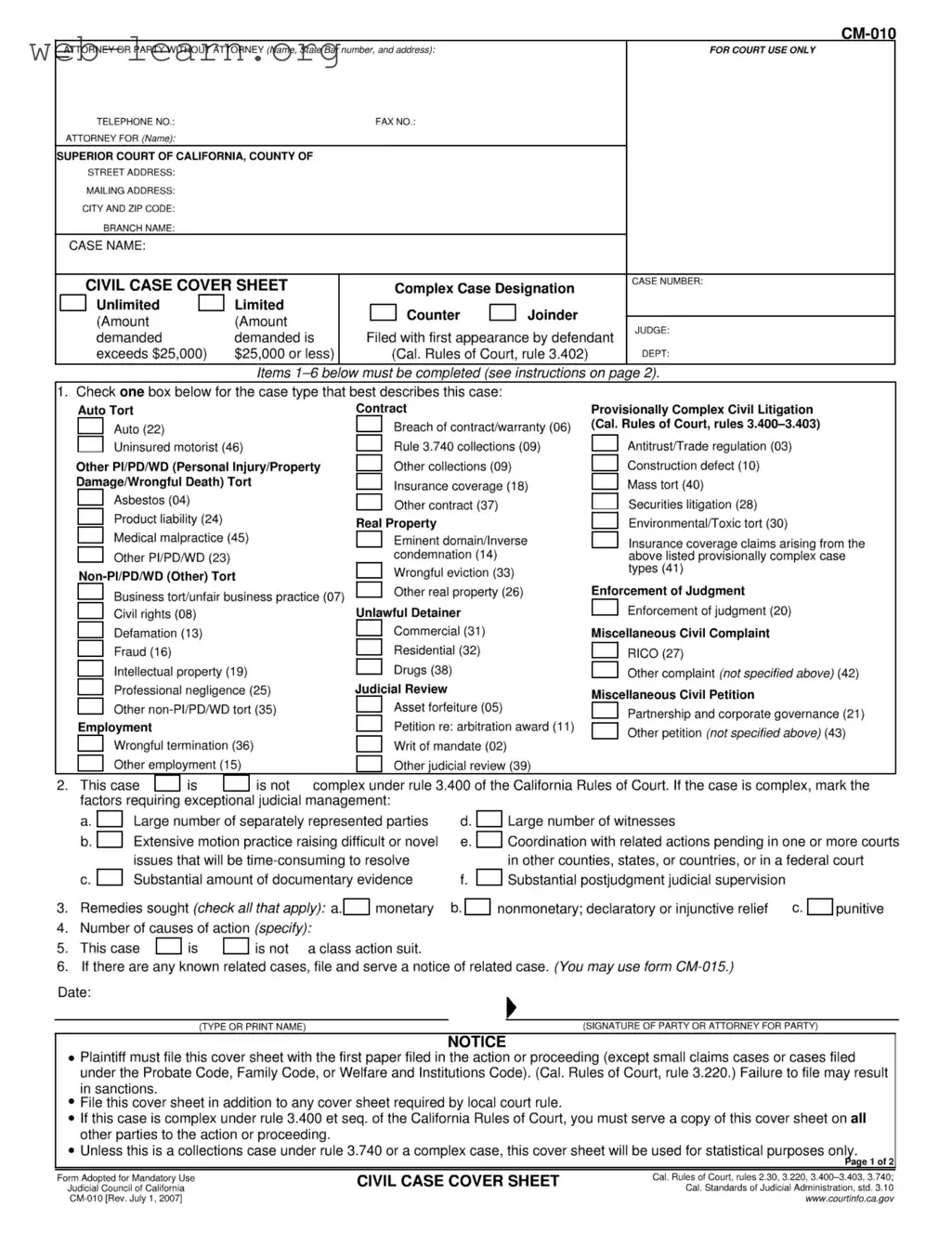
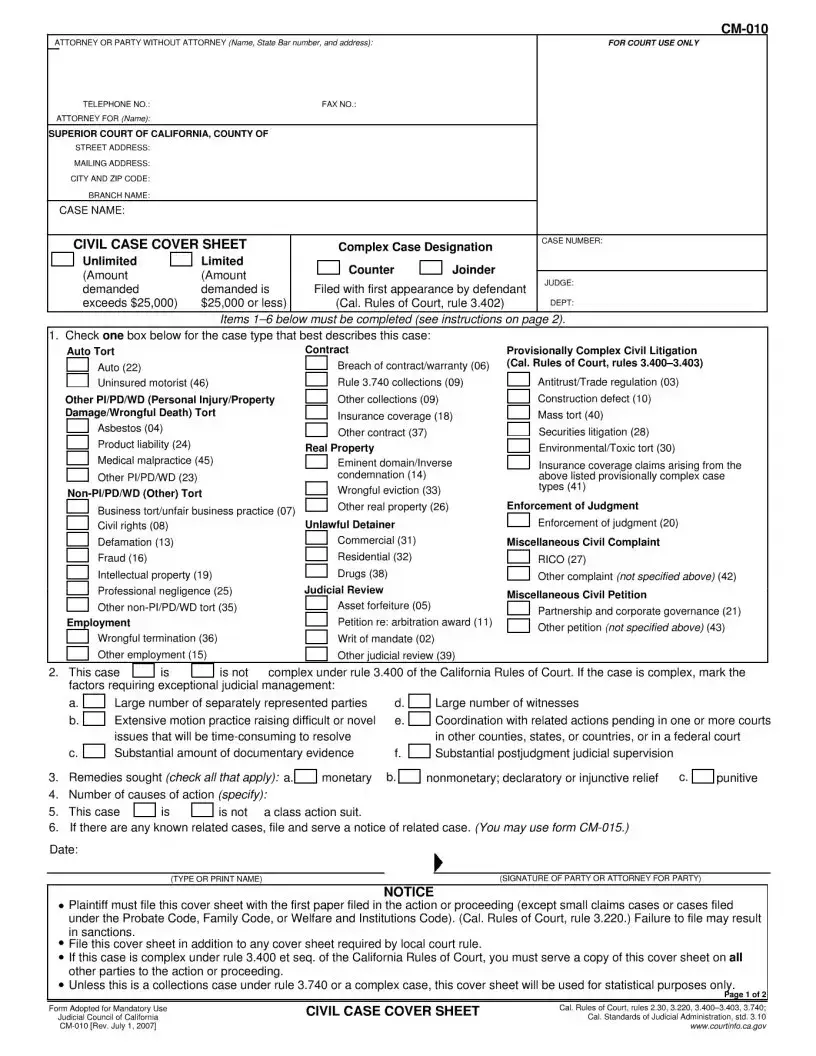
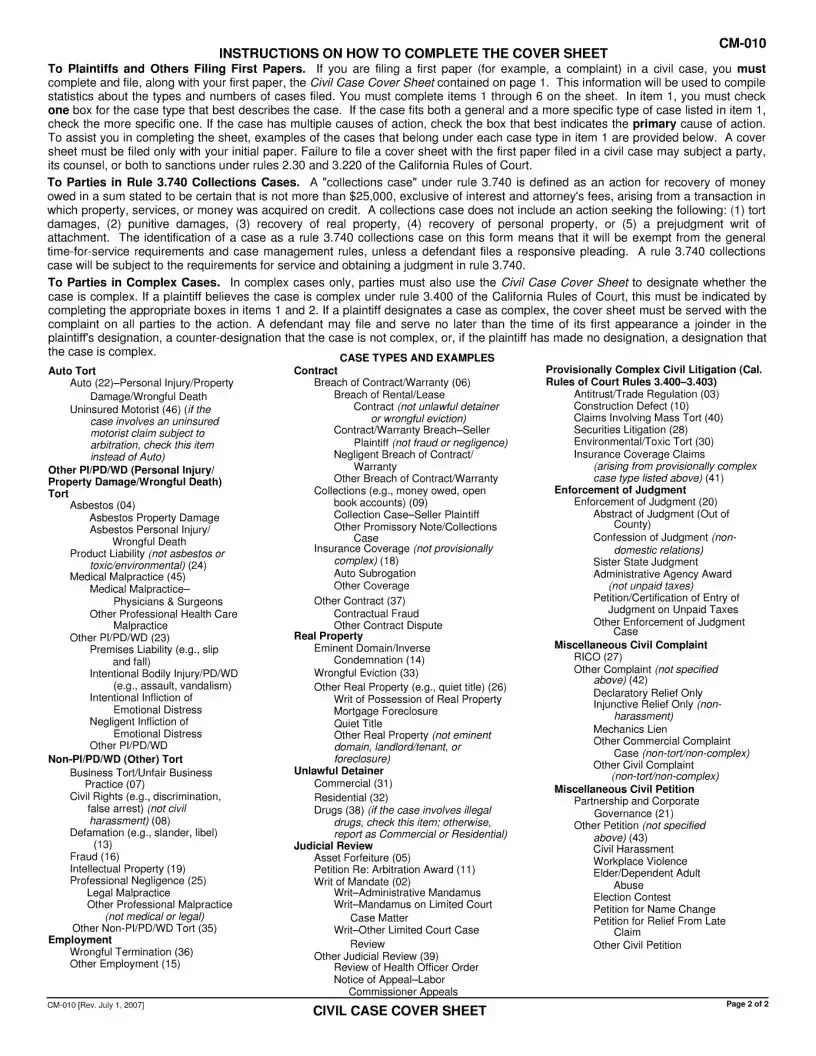
The California Civil Form, specifically the Civil Case Cover Sheet (CM-010), is a crucial document that must be filed when initiating a civil case in the Superior Court of California. This form serves multiple purposes, including categorizing the case type, determining whether it is complex, and outlining the remedies sought. When completing the form, individuals must provide essential information such as their name, contact details, and the case name. The form requires the selection of a case type from various categories, including auto torts, contracts, real property, and employment disputes, among others. Additionally, it assesses whether the case is complex, based on factors like the number of parties involved and the amount of evidence. The form also prompts the filer to indicate if the case is a class action or if there are related cases. Filing this cover sheet is mandatory and must accompany the first paper submitted to the court. Failure to do so can lead to sanctions, emphasizing its importance in the judicial process.
Sample - California Civil Form

Form Information

Fact Name Details
Form Title Civil Case Cover Sheet (CM-010)
Governing Law California Rules of Court, rules 2.30, 3.220, 3.400-3.403
Purpose This form is required to be filed with the first paper in a civil case to assist in statistical compilation.
Complex Case Designation The form allows parties to designate if a case is complex under rule 3.400.
Filing Requirement Failure to file the cover sheet may result in sanctions as per California Rules of Court.
Case Type Selection Parties must check a box indicating the case type that best describes their case.
Remedies Sought Parties can indicate whether they seek monetary or non-monetary remedies.
Number of Causes of Action Parties must specify the number of causes of action in their case.
Related Cases If there are known related cases, a notice of related case must be filed and served.
Mandatory Use This form has been adopted for mandatory use by the Judicial Council of California.

Detailed Guide for Filling Out California Civil

Filling out the California Civil form is an essential step in initiating a civil case. This form collects important information about the case and helps the court manage it effectively. Below are the steps to complete the Civil Case Cover Sheet (CM-010).

  1. Begin by entering your information in the section labeled ATTORNEY OR PARTY WITHOUT ATTORNEY. Include your name, State Bar number, address, telephone number, and fax number if applicable.
  2. Specify the name of the attorney representing you, if applicable.
  3. Fill in the SUPERIOR COURT OF CALIFORNIA, COUNTY OF section with the relevant county information.
  4. Provide the street address and mailing address for the court, along with the city and ZIP code.
  5. Indicate the BRANCH NAME of the court.
  6. In the CASE NAME section, write the name of the case as it will be filed.
  7. Check the box that indicates whether your case is Unlimited (exceeds $25,000) or Limited ($25,000 or less).
  8. Identify if your case is a Complex Case by checking the appropriate box.
  9. Fill in the CASE NUMBER, JUDGE, and DEPT sections as applicable.
  10. Complete items 1 through 6 as instructed. Start with item 1 by checking the box that best describes your case type.
  11. In item 2, indicate whether your case is complex or not, and if it is, check the factors that apply.
  12. For item 3, check all remedies you are seeking, whether monetary, nonmonetary, or both.
  13. Specify the number of causes of action in item 4.
  14. In item 5, indicate whether your case is a class action suit.
  15. Complete item 6 if there are any known related cases, and file the necessary notice.
  16. Finally, print your name and sign the form where indicated.

Obtain Answers on California Civil

  1. What is the purpose of the California Civil Case Cover Sheet?

    The California Civil Case Cover Sheet is a required document that must be filed with the first paper in a civil case. Its primary purpose is to provide the court with essential information about the nature of the case. This helps in organizing and managing cases more effectively. The cover sheet is also used for statistical purposes to track the types of cases being filed in the court system.

  2. Who must complete and file the cover sheet?

    Any plaintiff or party filing a first paper in a civil case must complete and submit the cover sheet. This includes complaints and other initial documents. It is important to note that failing to file the cover sheet can lead to sanctions against the party or their attorney.

  3. What information is required on the cover sheet?

    The cover sheet requires several key pieces of information:

    • The type of case being filed (e.g., auto tort, breach of contract).
    • Whether the case is complex under California Rules of Court.
    • The remedies sought, such as monetary or non-monetary relief.
    • The number of causes of action.
    • Whether the case is a class action suit.

    All items from 1 to 6 must be completed accurately to ensure proper processing.

  4. What happens if I do not file the cover sheet?

    If the cover sheet is not filed with the initial paper, the court may impose sanctions. This can include delays in the case or additional penalties. Therefore, it is crucial to ensure that the cover sheet is included with your first filing.

  5. Are there any exceptions to filing the cover sheet?

    Yes, there are specific exceptions. The cover sheet is not required for small claims cases or cases filed under the Probate Code, Family Code, or Welfare and Institutions Code. However, for all other civil cases, the cover sheet must be filed to comply with court rules.

Common mistakes

Filling out the California Civil form can be straightforward, but many people make common mistakes that can lead to complications. One frequent error is failing to check the correct case type in item 1. This section requires you to select the box that best describes your case. If you choose a more general category instead of a specific one, it may not accurately represent your case, which can affect how it is processed.

Another mistake often made is neglecting to complete all required items. Items 1 through 6 must be filled out as instructed. Omitting information, especially in these key sections, can lead to delays or even sanctions. Always double-check that you have provided all necessary details before submitting the form.

Many individuals also overlook the importance of indicating whether the case is complex. In item 2, you must specify if the case meets the criteria for complexity under rule 3.400. Failing to do so could result in mismanagement of the case, particularly if it requires exceptional judicial oversight.

Another common oversight is not providing a clear number of causes of action in item 4. This section asks for the number of legal claims being made. If this information is vague or incorrect, it could create confusion in court and complicate the proceedings.

Lastly, people often forget to serve a notice of related cases when applicable. If there are known related cases, it is crucial to file and serve a notice using form CM-015. Ignoring this step can lead to issues with case management and may affect the outcome of your case.

Documents used along the form

The California Civil form, specifically the Civil Case Cover Sheet (CM-010), is a crucial document that helps categorize civil cases filed in California courts. However, it is often accompanied by several other forms and documents that serve various purposes throughout the legal process. Below is a list of some commonly used forms and documents that may be filed alongside the Civil Case Cover Sheet.

  • CM-015: Notice of Related Case - This form is used to inform the court and other parties of any related cases that may affect the current case. Filing this notice helps the court manage cases more effectively and avoid conflicting judgments.
  • PLD-PI-001: Personal Injury Complaint - This is the standard form used to initiate a personal injury lawsuit. It outlines the plaintiff’s claims against the defendant and the basis for seeking damages.
  • PLD-PI-002: Personal Injury Complaint (Auto Accident) - Specifically designed for auto accident cases, this form details the circumstances of the accident and the injuries sustained, making it easier for the court to understand the context of the claim.
  • UD-100: Unlawful Detainer Complaint - This form is used in eviction cases, allowing landlords to formally initiate the process of removing a tenant from a rental property. It includes details about the lease agreement and the reasons for eviction.
  • CM-040: Application for Waiver of Court Fees - Individuals who cannot afford court fees may use this form to request a waiver. It requires the applicant to provide financial information to demonstrate their inability to pay.
  • MC-030: Declaration - A declaration is a written statement made under penalty of perjury. This form is often used to provide evidence or support for motions and other filings in a case.
  • POS-030: Proof of Service - This document serves as proof that legal documents have been properly served to the other party. It is essential for ensuring that all parties are aware of the proceedings and can respond appropriately.
  • FL-300: Request for Order - In family law cases, this form is used to request a court order regarding various matters, such as child custody, support, or visitation. It outlines the specific relief being sought from the court.

Each of these forms plays a vital role in the legal process, ensuring that cases are filed correctly and that all parties are informed and able to participate. Understanding the purpose of each document can help individuals navigate the complexities of the legal system more effectively.

Similar forms

  • Civil Case Cover Sheet (CM-010): This form serves as an initial document in civil cases, similar to the California Civil form. It helps categorize the case type and ensures that all relevant information is provided to the court at the outset.
  • Notice of Related Case (CM-015): This document is used to inform the court of any related cases. Like the California Civil form, it helps maintain organization and clarity in the court's records, especially when multiple cases are interconnected.
  • Summons (SUM-100): The summons notifies the defendant of the legal action against them. Both the summons and the California Civil form are essential for initiating a lawsuit, ensuring that all parties are aware of the proceedings.
  • Complaint (PLD-050): This document outlines the plaintiff's claims against the defendant. Similar to the California Civil form, the complaint must be filed with the court and serves as a foundational document in civil litigation.
  • Proof of Service (POS-040): This form confirms that legal documents have been properly delivered to the involved parties. Like the California Civil form, it is crucial for maintaining the integrity of the legal process by ensuring all parties are informed.
  • Case Management Statement (CM-110): This document is filed to provide the court with a summary of the case's status and any upcoming issues. Similar to the California Civil form, it helps facilitate communication between the court and the parties involved, promoting efficient case management.

Dos and Don'ts

When filling out the California Civil form, there are some important things to keep in mind. Here’s a list of what you should and shouldn’t do:

  • Do read the instructions carefully before starting. Understanding the requirements will save you time.
  • Do fill out all required fields completely. Missing information can delay your case.
  • Do check the box that best describes your case type. This helps the court categorize your case correctly.
  • Do keep a copy of the completed form for your records. You may need it later.
  • Do file the cover sheet with your first paper. This is a crucial step in the process.
  • Don’t skip any items on the form. Each section is important for processing your case.
  • Don’t provide inaccurate information. This can lead to complications and possible sanctions.
  • Don’t assume you can submit the form without checking for errors. Double-check your work.
  • Don’t forget to serve a copy of the cover sheet to all parties involved if your case is complex.
  • Don’t file the form late. Timeliness is key to keeping your case on track.

Misconceptions

When it comes to the California Civil Case Cover Sheet, several misconceptions can lead to confusion. Let’s clear the air on some of the most common misunderstandings.

  1. It's only for large cases. Many people think the cover sheet is only necessary for high-stakes cases. In reality, it’s required for all civil cases, regardless of the amount involved, except for small claims or specific family-related cases.
  2. Filing the cover sheet is optional. Some believe that submitting the cover sheet is optional. However, it is mandatory to file this cover sheet with your first paper in a civil case. Failing to do so can result in sanctions.
  3. All cases are considered complex. There’s a misconception that every case qualifies as complex. The cover sheet includes a specific section to indicate whether a case is complex under California Rules of Court. Only select cases will meet this criteria.
  4. It’s just for statistics. While it’s true that the information is used for statistical purposes, the cover sheet also serves legal functions. It helps the court manage cases efficiently and ensures that all parties are informed about the nature of the case.
  5. Only lawyers need to fill it out. Many assume that only attorneys are responsible for completing the cover sheet. In fact, any party filing a civil case, including self-represented individuals, must complete and file this document.

Understanding these points can help streamline the filing process and ensure compliance with California's legal requirements. Always remember that being informed is the first step toward successful navigation of the legal system.

Key takeaways

When filling out and using the California Civil form (CM-010), it's essential to follow specific guidelines to ensure proper processing. Here are five key takeaways:

  • Complete All Required Sections: Ensure that items 1 through 6 are filled out accurately. This includes selecting the appropriate case type and indicating whether the case is complex.
  • Understand Case Designation: If your case qualifies as complex, mark the relevant factors that necessitate exceptional judicial management. This can affect how the case is handled in court.
  • Filing Requirements: The Civil Case Cover Sheet must be filed with your first paper in the action, excluding small claims and specific family law cases. Failing to do so may lead to penalties.
  • Statistical Purposes: For most cases, this cover sheet is primarily used for collecting statistical data. However, if it's a collections case under rule 3.740, it has different implications regarding service and judgment.
  • Notification of Related Cases: If there are known related cases, you must file a notice of related case. This helps the court manage cases that may be interconnected.