Homepage Blank California Ch 800 Form
Outline

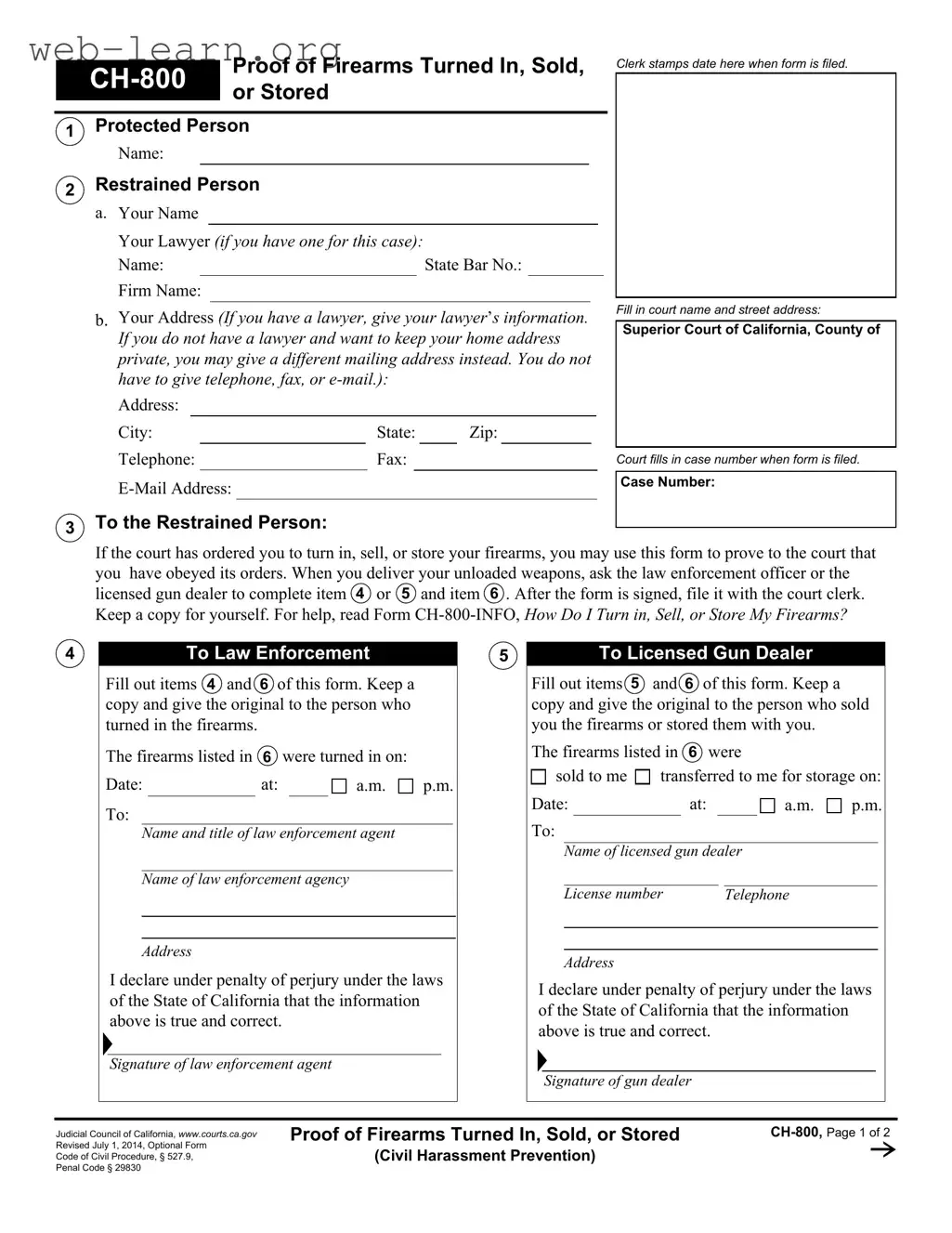
The California CH-800 form serves as a crucial document for individuals who have been ordered by the court to turn in, sell, or store their firearms. This form provides a structured way to demonstrate compliance with such court orders. It includes sections for both the protected person and the restrained person, ensuring that all necessary information is clearly documented. The form requires details such as names, addresses, and case numbers, along with specific information about the firearms involved, including their make, model, and serial numbers. When firearms are turned in or sold, law enforcement officers or licensed gun dealers must complete relevant sections of the form, confirming the transaction and the date it occurred. Once the form is signed, it must be filed with the court clerk, and it is essential for individuals to retain a copy for their records. For further assistance, individuals can refer to Form CH-800-INFO, which provides guidance on the process of turning in, selling, or storing firearms. This form not only helps ensure legal compliance but also promotes safety and accountability in firearm ownership.
Sample - California Ch 800 Form

Signature of law enforcement agent
If the court has ordered you to turn in, sell, or store your firearms, you may use this form to prove to the court that
you have obeyed its orders. When you deliver your unloaded weapons, ask the law enforcement officer or the
licensed gun dealer to complete item or and item . After the form is signed, file it with the court clerk.
Keep a copy for yourself. For help, read Form CH-800-INFO, How Do I Turn in, Sell, or Store My Firearms?
To Law Enforcement
5
Fill out items and of this form. Keep a
copy and give the original to the person who sold
you the firearms or stored them with you.
Fill out items and of this form. Keep a
copy and give the original to the person who
turned in the firearms.
The firearms listed in were
The firearms listed in were turned in on:
To:
To:
I declare under penalty of perjury under the laws
of the State of California that the information
above is true and correct.
I declare under penalty of perjury under the laws
of the State of California that the information
above is true and correct.
CH-800, Page 1 of 2
Proof of Firearms Turned In, Sold, or Stored
(Civil Harassment Prevention)
Judicial Council of California, www.courts.ca.gov
Revised July 1, 2014, Optional Form
Code of Civil Procedure, § 527.9,
Penal Code § 29830
3
4
4 5
CH-800
Proof of Firearms Turned In, Sold,
or Stored
6
4 6
6
5
6
6
1
Protected Person
2
Restrained Person
To the Restrained Person:
Your Lawyer (if you have one for this case):
Your Address (If you have a lawyer, give your lawyers information.
If you do not have a lawyer and want to keep your home address
private, you may give a different mailing address instead. You do not
have to give telephone, fax, or e-mail.):
a.
b
.
Name and title of law enforcement agent
Name:
Your Name
Name: State Bar No.:
Clerk stamps date here when form is filed.
Fill in court name and street address:
Superior Court of California, County of
Court fills in case number when form is filed.
Case Number:
Firm Name:
Address:
City: State: Zip:
Telephone:
Fax:
Date: at:
a.m.
p.m.
Date: at:
a.m. p.m.
Name of law enforcement agency
Address
Name of licensed gun dealer
License number
Telephone
E-Mail Address:
To Licensed Gun Dealer
Address
Signature of gun dealer
sold to me transferred to me for storage on:
I filed a Proof of Firearms Turned In, Sold, or Stored for those firearms with the court on (date):
I am filing the proof for those firearms along with this proof.
I have not yet filed the proof for the other firearms. (Explain why not):
Revised July 1, 2014
CH-800, Page 2 of 2
Firearms
Do you have, own, possess, or control any other firearms besides the firearms listed in ?
If you answered yes, have you turned in, sold, or stored those other firearms?
If yes, check one of the boxes below:
I declare under penalty of perjury under the laws of the State of California that the information above is true and
correct.
6
7
6
Serial NumberModel
b.
c.
d.
e.
Make
a.
b.
c.
a.
Check here if you turned in, sold, or stored more firearms. Attach a sheet of paper and write “CH-800,
Item 6—Firearms Turned In, Sold, or Stored” for a title. Include make, model, and serial number of each
firearm. You may use Form MC-025, Attachment.
Yes
No
Yes
No
Check here if there is not enough space below for your answer. Put your complete answer on
the attached sheet of paper or Form MC-025 and write “Attachment 7c” for a title.
Case Number:
Date:
Type or print your name
Sign your name
Proof of Firearms Turned In, Sold, or Stored
(Civil Harassment Prevention)
For your protection and privacy, please press the Clear
This Form button after you have printed the form.

Form Information

Fact Name Description
Purpose The CH-800 form is used to prove to the court that a person has complied with orders to turn in, sell, or store firearms.
Governing Laws This form is governed by the California Code of Civil Procedure, § 527.9 and Penal Code § 29830.
Filing Requirements After completing the form, it must be filed with the court clerk, and a copy should be kept for personal records.
Law Enforcement Involvement Law enforcement officers or licensed gun dealers must complete specific sections of the form to confirm the transaction of firearms.

Detailed Guide for Filling Out California Ch 800

Completing the California CH-800 form requires careful attention to detail. This form serves as proof of firearms that have been turned in, sold, or stored as mandated by a court order. Following these steps will help ensure that the form is filled out correctly and submitted properly.

  1. Begin by entering the Protected Person's Name in the designated space.
  2. Fill in the Restrained Person's Name and your name if applicable.
  3. If you have a lawyer, provide their name, State Bar number, and firm name. If not, leave this section blank.
  4. Complete your address, including city, state, and zip code. If you wish to keep your home address private, you may provide a different mailing address instead. You do not need to include your telephone, fax, or email address.
  5. Indicate the court name and street address where the case is being heard. This is typically the Superior Court of California, County of [insert county name].
  6. Leave the Case Number blank for the court to fill in when the form is filed.
  7. Proceed to fill out item 4 or 5 based on whether you are turning in firearms to law enforcement or a licensed gun dealer. Ensure that the date and time of the transaction are recorded.
  8. In item 6, list the firearms that were turned in, sold, or stored. Include the make, model, and serial number for each firearm. If there are more firearms than space allows, attach a separate sheet titled “CH-800, Item 6—Firearms Turned In, Sold, or Stored.”
  9. Answer the question in item 7 regarding any other firearms you may own. If applicable, indicate whether you have turned them in, sold, or stored those firearms. Provide additional details as necessary.
  10. Finally, declare under penalty of perjury that the information provided is true and correct. Sign and print your name and include the date.

After completing the form, it is important to file it with the court clerk. Retain a copy for your records. For further assistance, refer to Form CH-800-INFO, which provides guidance on the process of turning in, selling, or storing firearms.

Obtain Answers on California Ch 800

  1. What is the purpose of the California CH-800 form?

    The California CH-800 form serves as proof that an individual has complied with a court order regarding firearms. If a court has mandated that a person turn in, sell, or store their firearms, this form documents that action. It is crucial for individuals to provide this proof to the court to demonstrate adherence to the order.

  2. Who needs to fill out the CH-800 form?

    The person who is subject to the court order, referred to as the "restrained person," must fill out the form. If they have legal representation, their attorney's information should also be included. Additionally, law enforcement officers or licensed gun dealers involved in the transaction must complete specific sections of the form to confirm that the firearms have been turned in, sold, or stored.

  3. What information is required on the CH-800 form?

    The form requires several key pieces of information:

    • The names and addresses of both the protected and restrained persons.
    • The court's name and address, along with the case number.
    • Details about the firearms, including make, model, and serial numbers.
    • Confirmation from law enforcement or a licensed gun dealer regarding the transaction.

    It is important that all information is accurate and complete, as any discrepancies could lead to complications in the legal process.

  4. What should I do after completing the CH-800 form?

    Once you have filled out the form, it is essential to file it with the court clerk. Keep a copy for your records. If you have turned in firearms to law enforcement or sold them to a licensed dealer, ensure that they complete the relevant sections of the form. This signed document will serve as your proof of compliance with the court's order.

Common mistakes

Filling out the California CH-800 form can be a straightforward process, but many individuals make mistakes that can lead to complications. Understanding these common errors can help ensure that your submission is accurate and complete.

One frequent mistake is failing to provide complete information in the Protected Person Name and Restrained Person sections. It's essential to ensure that names are spelled correctly and that all required fields are filled in. Inaccuracies can lead to delays in processing your form.

Another common error is neglecting to include your lawyer's information if you have legal representation. If you are represented, the form requires the attorney's name, State Bar number, and firm name. Omitting this information can create confusion about who is handling your case.

Many individuals also mistakenly provide their home address instead of a mailing address, particularly if they wish to keep their residence private. If you do not want your home address disclosed, make sure to provide an alternative mailing address. This can protect your privacy while still complying with the form’s requirements.

Another oversight occurs in the section where you fill in the court name and street address. Ensure that you accurately enter the name of the court and its address. Errors in this section can lead to your form being misdirected or not filed properly.

When it comes to the firearms section, many people fail to list all firearms accurately. It's crucial to include the make, model, and serial number for each firearm turned in, sold, or stored. If you have more firearms than can fit in the designated space, remember to attach a separate sheet as instructed.

Some individuals overlook the requirement to have law enforcement or a licensed gun dealer complete the appropriate sections of the form. This step is vital as it provides proof that the firearms were indeed turned in, sold, or stored as mandated by the court.

Another mistake is not keeping a copy of the completed form. After filing, it's essential to retain a copy for your records. This can serve as proof that you complied with the court's order, should any questions arise in the future.

Additionally, individuals often forget to declare if they possess any other firearms not listed on the form. If you own additional firearms, you must indicate whether you have turned them in, sold, or stored them. Failing to disclose this information can lead to legal repercussions.

Lastly, many people neglect to sign and date the form. This step is crucial, as the signature affirms that the information provided is true and correct. Without a signature, the form may be considered incomplete and could be rejected by the court.

By being mindful of these common mistakes, individuals can navigate the process of filling out the California CH-800 form more effectively. Attention to detail can make a significant difference in ensuring compliance with court orders.

Documents used along the form

When dealing with firearms in the context of legal proceedings, several forms and documents may accompany the California CH-800 form. Each of these documents serves a specific purpose and plays a crucial role in ensuring compliance with court orders. Below is a brief overview of five such forms that are often used in conjunction with the CH-800.

  • Form CH-800-INFO: This informational guide provides instructions on how to properly turn in, sell, or store firearms as mandated by the court. It outlines the steps individuals must follow to ensure they comply with the law.
  • Form MC-025: This is an attachment form that can be used when additional space is needed to list firearms. If an individual has more firearms than can fit on the CH-800, they can utilize this form to provide the necessary details.
  • Proof of Service: This document serves to confirm that the CH-800 form has been properly delivered to the relevant parties, including the restrained person. It ensures that all involved are aware of the actions taken regarding the firearms.
  • Declaration of Service: Similar to the Proof of Service, this form provides a sworn statement that outlines how and when the CH-800 was served. It adds an extra layer of verification to the process.
  • Case Management Statement: This document may be required in some cases to provide the court with an overview of the status of the case. It can help in scheduling hearings and managing the overall process effectively.

Understanding these accompanying forms is essential for individuals navigating the legal landscape surrounding firearms. Each document plays a vital role in ensuring that the process is handled appropriately and that the rights and responsibilities of all parties are respected.

Similar forms

  • California Form CH-800-INFO: This document provides guidance on how to properly turn in, sell, or store firearms, similar to the CH-800 form in its purpose of ensuring compliance with court orders regarding firearms.
  • California Form DV-800: This form serves as proof of firearms turned in or sold in domestic violence cases, akin to the CH-800 form, which also addresses firearms in the context of restraining orders.
  • California Form MC-025: This is an attachment form that can be used to provide additional information when the space on the main form is insufficient, similar to how the CH-800 allows for additional details about firearms.
  • California Form DV-140: This form is used to request a domestic violence restraining order and includes provisions for firearm restrictions, paralleling the CH-800's focus on firearm compliance in such cases.
  • California Form DV-120: This document is used to respond to a request for a domestic violence restraining order and may address firearm possession, similar to the CH-800's context of firearm management.
  • California Form FL-300: This form is utilized for requesting orders in family law cases, including those involving firearm restrictions, much like the CH-800 addresses firearms in restraining order situations.
  • California Form FL-320: This is a request for a domestic violence restraining order in family law matters, which can also relate to firearm possession, mirroring the CH-800's focus on firearms in legal contexts.
  • California Form GV-100: This form is used for a gun violence restraining order, directly relating to the CH-800's purpose of documenting compliance with firearm restrictions.
  • California Form GC-100: This form is utilized for guardianship proceedings and may include questions about firearm possession, similar to the CH-800's focus on ensuring compliance with firearm laws.

Dos and Don'ts

When filling out the California CH-800 form, it is essential to approach the task with care. Here are five important things to do and avoid during the process:

  • Do ensure accuracy: Double-check all information entered on the form. Any errors can lead to complications or delays.
  • Do provide complete contact information: If you have a lawyer, include their details. If you wish to keep your home address private, provide an alternative mailing address.
  • Do follow instructions carefully: Adhere to the guidelines provided in the form and refer to Form CH-800-INFO if you need assistance.
  • Do keep a copy: After filing the form, retain a copy for your records. This can be helpful for future reference.
  • Do file on time: Submit the form promptly to avoid any legal repercussions or misunderstandings.
  • Don't rush the process: Take your time to fill out the form. Hasty submissions can lead to mistakes.
  • Don't leave fields blank: Ensure all required fields are filled out completely. Missing information can cause delays.
  • Don't forget to sign: Your signature is crucial. Without it, the form may be considered invalid.
  • Don't ignore deadlines: Be aware of any deadlines associated with the court orders regarding firearms.
  • Don't hesitate to ask for help: If you have questions or concerns, seek assistance from legal professionals or support services.

Misconceptions

Understanding the California CH-800 form is crucial for those involved in legal proceedings regarding firearms. However, several misconceptions can lead to confusion. Here are six common misunderstandings:

  • The CH-800 form is only for turning in firearms. Many believe this form is solely for surrendering firearms, but it also serves as proof for selling or storing firearms as ordered by the court.
  • You must provide your home address on the form. Individuals often think they must disclose their home address. In reality, if privacy is a concern, you can provide a different mailing address instead.
  • Filing the CH-800 form is optional. Some people assume that submitting this form is a choice. However, if the court has mandated the turn-in, sale, or storage of firearms, filing this form is a requirement to demonstrate compliance.
  • Only law enforcement can fill out the form. A common belief is that only law enforcement officers can complete the CH-800. In fact, licensed gun dealers can also fill out the necessary sections when firearms are sold or stored.
  • The form does not need to be signed. Some individuals think that a signature is not necessary. However, the form must be signed by the law enforcement agent or the licensed gun dealer to be valid.
  • All firearms must be listed on the form. There is a misconception that every firearm owned must be included. While you need to list the firearms involved in the case, you can provide additional details on a separate sheet if there are more firearms.

Being aware of these misconceptions can help individuals navigate the requirements of the CH-800 form more effectively and ensure compliance with court orders.

Key takeaways

  • Understand the Purpose: The California CH-800 form serves as proof that you have complied with a court order to turn in, sell, or store firearms. This is crucial for demonstrating your adherence to legal requirements.
  • Complete the Form Accurately: Ensure all sections of the form are filled out correctly, including your name, address, and the details of the firearms. Inaccuracies can lead to complications in your case.
  • Engage Law Enforcement or Licensed Dealers: When you turn in or sell your firearms, have a law enforcement officer or licensed gun dealer complete the relevant sections of the form. Their signatures are essential for validation.
  • File the Form Promptly: After the form is signed, submit it to the court clerk as soon as possible. Keeping a copy for your records is also important for future reference.
  • Additional Firearms: If you own other firearms not listed on the form, you must disclose this information. Be prepared to explain how you have handled those firearms, whether through filing additional proofs or other means.