Homepage Blank California Certificate Rehabilitation Form
Outline

The California Certificate of Rehabilitation form serves as a vital tool for individuals seeking to demonstrate their rehabilitation after felony convictions. This legal document allows applicants to petition the court for a declaration of rehabilitation, which can ultimately lead to a pardon from the Governor. The form requires detailed information about the applicant's felony history, including dates of conviction, charges, and the nature of the sentences received. Applicants must also provide a residency history, confirming their continuous residence in California for a minimum of five years prior to filing. Furthermore, the form includes a declaration where the applicant affirms their commitment to living an honest and upright life since their convictions. This process not only aids individuals in clearing their records but also plays a significant role in reintegrating them into society. By completing this form, applicants take a significant step toward reclaiming their rights and moving forward with their lives.


Sample - California Certificate Rehabilitation Form

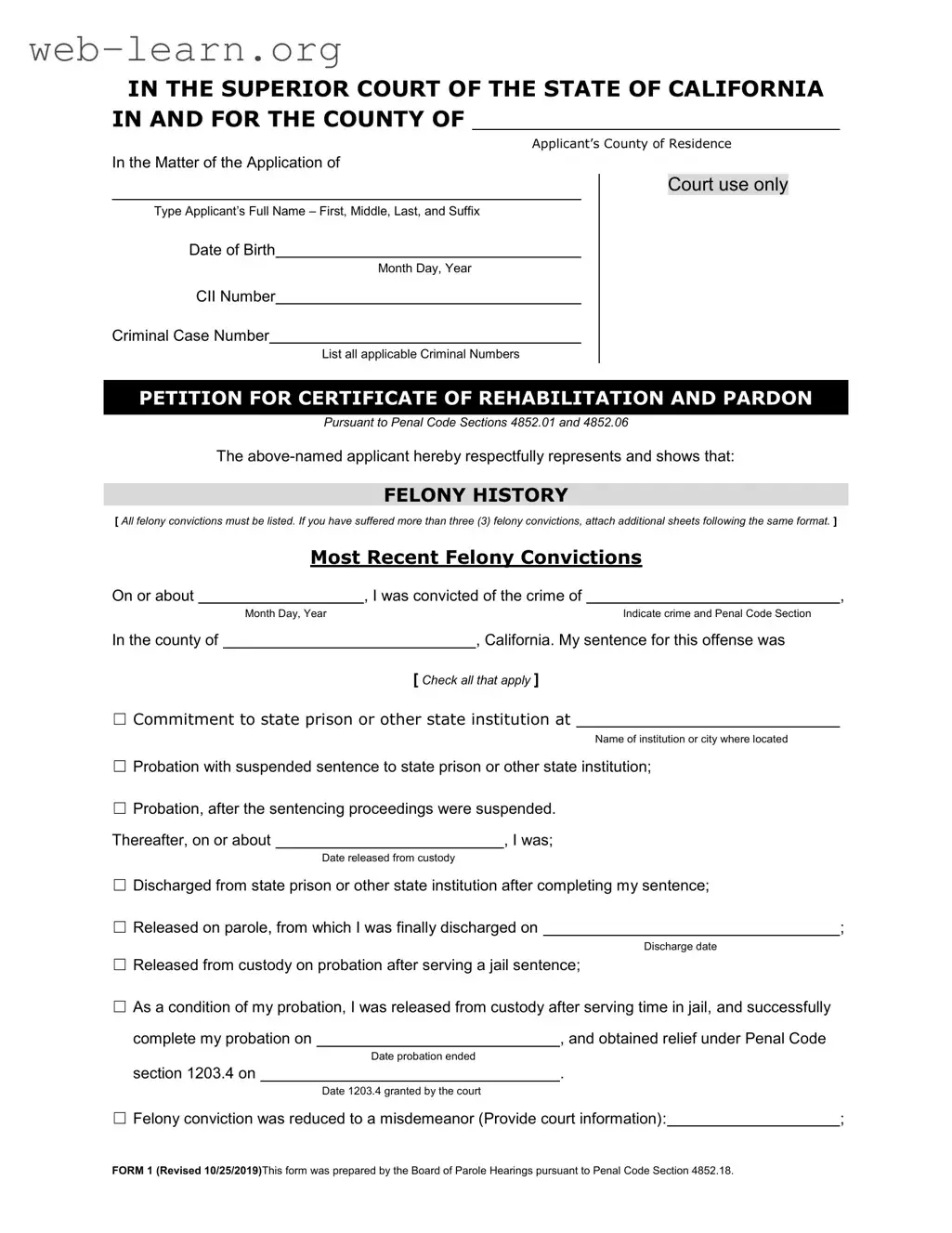
IN THE SUPERIOR COURT OF THE STATE OF CALIFORNIA
IN AND FOR THE COUN
TY OF
Applicant’s County of Residence
In the Matter of the Application of
Type Applicant’s Full Name – First, Middle, Last, and Suffix
Date of Birth
Month Day, Year
CII Number
Criminal Case Number
List all applicable Criminal Numbers
Court use only
PETITION FOR CERTIFICATE OF REHABILITATION AND PARDON
Pursuant to Penal Code Sections 4852.01 and 4852.06
The above-named applicant hereby respectfully represents and shows that:
FELONY HISTORY
[ All felony convictions must be listed. If you have suffered more than three (3) felony convictions, attach additional sheets following the same format. ]
Most Recent Felony Convictions
On or about , I was convicted of the crime of ,
Month Day, Year Indicate crime and Penal Code Section
In the county of , California. My sentence for this offense was
[
Check all that apply ]
Commi
tment to state prison or other state institution
at
Name of institution or city where located
Probation with suspended sentence to state prison or other state institution;
P
robation, after the sentencing proceedings were suspended
.
Thereafter, on or about , I was;
Date released from custody
Discharged from state prison or other state institution after completing my sentence;
Rel
eased on parole, from which I was f
inally discharged on ;
Discharge date
Released from custody on probation after serving a jail sentence;
A
s a condition of my probation, I was released from custody after serving time in jail, and successfull
y
complete my probation on , and obtained relief under Penal Code
Date probation ended
section 1203.4 on .
Date 1203.4 granted by the court
Felony conviction was reduced to a misdemeanor (Provide court information): ;
FORM 1 (Revised 10/25/2019)This form was prepared by the Board of Parole Hearings pursuant to Penal Code Section 4852.18.
Second Most Recent Felony Convictions
On or about , I was convicted of the crime of ,
Month Day, Year Indicate crime and Penal Code Section
In the county of , California. My sentence for this offense was
[
Check all that apply ]
Commit
ment to state prison or other state institution
at
Name of institution or city where located
Probation with suspended sentence to state prison or other state institution;
P
robation, after the sentencing proceedings were suspended
.
Thereafter, on or about , I was;
Date released from custody
Discharged from state prison or other state institution after completing my sentence;
Rel
eased on parole, from which I was fi
nally discharged on ;
Discharge date
Released from custody on probation after serving a jail sentence;
A
s a condition of my probation, I was released from custody after serving time in jail, and successfull
y
Com
plete my probation on , and obt
ained relief under Penal Code
Date probation ended
Section 1203.4 on .
Date 1203.4 granted by the court
Felony conviction was reduced to a misdemeanor (Provide court information): ;
Third Most Recent Felony Conviction
On or about , I was convicted of the crime of ,
Month Day, Year Indicate crime and Penal Code Section
In the county of , California. My sentence for this offense was:
[
Check all that apply ]
Commitment to state prison or other state institution
at
Name of institution or city where located
Probation with suspended sentence to state prison or other state institution;
P
robation, after the sentencing proceedings were suspended
.
Thereafter, on or about , I was;
Date released from custody
Discharged from state prison or other state institution after completing my sentence;
Rel
eased on parole, from which I was fi
nally discharged on ;
Discharge date
Released from custody on probation after serving a jail sentence;
A
s a condition of my probation, I was released from custody after serving time in jail, and successfull
y
c
omplete my probation on , and
obtained relief under Penal Code
Date probation ended
section 1203.4 on .
Date 1203.4 granted by the court
Felony conviction was reduced to a misdemeanor (Provide court information): ;
FORM 1 (Revised 10/25/2019)This form was prepared by the Board of Parole Hearings pursuant to Penal Code Section 4852.18.
RESIDENCY HISTORY
I am now a resident of the State of California, and I have continuously resided in the State of California
from , to the present date.
Month Day, Year
APPLICANTS DECLARATION
During the period of my rehabilitation, I have lived an honest and upright life, conducted myself with
sobriety and industry, and exhibited good moral character. I have conformed to and obeyed all the laws of
the land.(Pen. Code, § 4852.05.)
WHEREFORE, Your petitioner prays that the Court make its order and decree declaring that the
petitioner has been rehabilitated; and for a certificate of rehabilitation recommending that the Governor of
the State of California grant petitioner a full pardon; and that for such purpose, a time be appointed for the
hearing of the foregoing petition; and that other and necessary proper orders may be made in the
premises.
Applicants Signature Month Day, Year
Applicants Street Address
Applicants City, State and ZIP Code
Applicants Driver License Number
Applicants Email Address
Applicants Home Phone Number
Applicants Work Phone Number
Applicants Cell Phone Number
FORM 1 (Revised 10/25/2019)This form was prepared by the Board of Parole Hearings pursuant to Penal Code Section 4852.18.
FORM 1 INSTRUCTIONS
1. Obtain Your Criminal Records
T
o complete this form, you will need information regarding each of your felony convictions, includin
g
the
date of each conviction, the specific charge or charges for which you were convicted, the count
y
of
the conviction, and the sentence that was given. In addition, you will need to know the date tha
t
y
ou were released from prison or jail and/or discharged from parole or probation
.
T
his information may be obtained through the court in which the conviction(s) took place, or you ma
y
ob
tain a copy of your state criminal record through the California Department of Justice. You ma
y
on
ly obtain your own records from the Department of Justice. Information regarding this request ma
y
be
obtained through the Office of the Attorney General website
at
htt
ps://oag.ca.gov/fingerprints/record-review. Regardless of the number of convictions, you will b
e
f
iling only a single petition.
2. Co
nfirm Your Eligibilit
y
Y
ou are ineligible for a certificate of rehabilitation if any of the following are true
:
Y
ou were convicted only of misdemeanors (other than sex offenses defined in Pena
l
Code
section 290, which were subsequently expunged) (Pen. Code, §4852.01, (b)
.)
You were convicted of specific sex crimes involving minor children as enumerated under
Penal Code sections 286, subdivision (c), 288, 288a, subdivision (c), 288.5, and 289,
s
ubdivision (j). (Pen. Code, § 4852.01, (c).
)
Y
ou are serving mandatory life parole. (Pen. Code, § 4852.01, (c)
.)
You were sent to state prison under a death sentence. (Pen. Code, § 4852.01, (c).)
Y
ou are currently in military service. (Pen. Code, § 4852.01, (c)
.)
Mi
nimum Period of Rehabilitation
In order to be granted a certificate of rehabilitation you must satisfy a minimum period of
rehabilitation. In every case, you must have resided continuously for five years in this state prior to
filing the petition. (Pen. Code, § 4852.06) The period of rehabilitation begins to run upon your
discharge from custody or upon release on parole or probation, whichever is sooner. (Pen. Code, §
4852.03, (a).) The period of rehabilitation shall constitute five years residence in this state, plus a
period of time determined by the following rules:
An additional four years in the case of any person convicted of violating Section 18
7
(murder), 209 (aggravated kidnapping), 219 (derailing or wrecking a train), 4500 (assault
wi
th force likely to cause great bodily injury), or 12310 (use of explosives or destructiv
e
de
vices causing death, mayhem, or great bodily injury) of the Penal Code, or subdivisi
on
(a) of
Section 1672 of the Military and Veterans Code (acting or failing to act so as
to
c
ause another person’s death), or any other offense which carries a life sentence. (Pen
.
Code
, § 4852.03, (a)(
1).)
A
n additional five years in the case of any person convicted of any offense or attempte
d
of
fense for which sex offender registration is required pursuant to Penal Code 29
0,
ex
cept for convictions for violations of subdivision (b), (c), or (d) of Section 311.
2
(
possession or distribution of media depicting a minor engaging in sexual conduct), or o
f
S
ection 311.3 (sexual exploitation of a child), 311.10 (advertising obscene matt
er
de
picting a minor engaging in sexual conduct), or 314 (indecent exposure). For thos
e
c
onvictions, two years shall be added to the five years imposed by this section. (Pen
.
Code, § 4852.03, (a)(2).)
FORM 1 (Revised 10/25/2019)This form was prepared by the Board of Parole Hearings pursuant to Penal Code Section 4852.18.
An additional two years in the case of any person convicted of committing any offense
not listed above and which does not carry a life sentence. (Pen. Code, §4852.03, (a)(3).)
Additionally, the trial court hearing your application for a certificate of rehabilitation may
add additional years if you served consecutive sentences. The amount of additional time
will not exceed the sum of the maximum penalties for all your crimes. (Pen. Code, §
4852.03, (a)(4).)
Felony Probation
If you were released on felony probation and successfully completed probation, you must obtain relief
under Penal Code Section 1203.4 before applying for a Certificate of Rehabilitation.
3. File Your Documents
After completing the Petition for Certificate of Rehabilitation and Pardon, you must file it with the
superior court in the county of conviction or in your county of residency. (Pen. Code, § 4852.06.)
You are entitled to be represented by an attorney of your own selection, or by the public
defender. (Pen. Code, § 4852.08.)
You are entitled to receive assistance from all rehabilitative agencies including officers from
adult probation and parole, and for persons under the age of 30 years, from the Division of
Juvenile Facilities. (Pen. Code, § 4852.04)
It is unlawful for anyone, other than an attorney, to accept any fee, money or anything of value
for their services in representing you in this proceeding. (Pen. Code, § 4852.2.)
You are not required to pay filing fees of any kind in connection with this proceeding. (Pen.
Code, § 4852.09.)
4. Notice of Filing
When the court sets a hearing date on your petition, you are required to give notice of that date at
least 30 days before the hearing. You must formally notify the District Attorney for each county in
which you have been convicted, the county in which the petition is filed, and the Governor's Office.
(Pen. Code, § 4852.07.) For more information on the notice requirements, please reference the
Notice of Filing of Petition for Certificate of Rehabilitation and Pardon.
5. After a Certificate of Rehabilitation is Issued
A certificate of rehabilitation is not an automatic pardon; it is only an automatic application for a
pardon. In the event that a certificate of rehabilitation is issued by a court, the certificate of
rehabilitation shall be reviewed by the Board of Parole Hearings within one year. Thereafter, the
Board shall issue a recommendation as to whether the Governor should pardon that individual. (Pen.
Code, § 4852.16, (b).)
FORM 1 (Revised 10/25/2019)This form was prepared by the Board of Parole Hearings pursuant to Penal Code Section 4852.18.

Form Information

Fact Name Details
Governing Laws The California Certificate of Rehabilitation is governed by Penal Code Sections 4852.01 and 4852.06.
Eligibility Criteria Applicants must have been discharged from custody and must meet specific residency and rehabilitation requirements.
Minimum Residency Requirement A minimum of five continuous years of residency in California is required before filing the petition.
Felony Convictions All felony convictions must be listed in the application, including details of the crime and sentencing.
Application Filing The completed petition must be filed with the superior court in the county of conviction or the applicant's county of residency.
Legal Representation Applicants have the right to be represented by an attorney or a public defender during the process.
Notice Requirements At least 30 days' notice must be given to the District Attorney and the Governor's Office before the hearing date.
Outcome of Application A Certificate of Rehabilitation is not an automatic pardon but serves as an application for one, which will be reviewed by the Board of Parole Hearings.

Detailed Guide for Filling Out California Certificate Rehabilitation

Filling out the California Certificate Rehabilitation form is a significant step in your journey towards rehabilitation. After completing the form, you will submit it to the appropriate court, which will then review your application and schedule a hearing. Be prepared to provide necessary documentation and follow any additional instructions from the court.

  1. Obtain your criminal records. Gather information about each felony conviction, including the date, specific charges, county of conviction, and sentence. You can get this information from the court where the conviction occurred or from the California Department of Justice.
  2. Confirm your eligibility. Ensure you meet the criteria for applying. You cannot apply if you have only misdemeanor convictions, certain sex crimes, are serving life parole, or are currently in military service.
  3. Complete the form. Fill out all sections accurately, including your felony history, residency history, and personal declaration. Make sure to provide all required details for each conviction.
  4. File your documents. Submit the completed petition to the superior court in the county of conviction or your county of residence. You are not required to pay any filing fees.
  5. Notify relevant parties. Once the court sets a hearing date, inform the District Attorney for each county of conviction, the county where you filed, and the Governor's Office at least 30 days before the hearing.
  6. Prepare for the hearing. Be ready to present your case and provide any additional information the court may request.
  7. Understand the outcome. If the court issues a certificate of rehabilitation, it will be reviewed by the Board of Parole Hearings, which will make a recommendation to the Governor regarding a pardon.

Obtain Answers on California Certificate Rehabilitation

  1. What is the California Certificate of Rehabilitation?

    The California Certificate of Rehabilitation is a legal document that serves as proof of a person's rehabilitation after serving a felony conviction. It is intended for individuals who have demonstrated good moral character and have completed their sentence, including any parole or probation. The certificate can help restore certain rights, such as the right to vote or own a firearm, and it acts as an automatic application for a pardon from the Governor.

  2. Who is eligible to apply for a Certificate of Rehabilitation?

    To be eligible for a Certificate of Rehabilitation, you must meet specific criteria:

    • You must have been convicted of a felony.
    • You must have resided continuously in California for at least five years prior to filing your petition.
    • You must have completed your sentence, including any parole or probation.
    • You cannot be currently serving a life sentence or have certain disqualifying convictions, such as specific sex crimes against minors.
  3. How do I complete the application process?

    The application process involves several steps:

    • Gather your criminal records, which include details of all felony convictions.
    • Confirm your eligibility based on the outlined criteria.
    • Complete the Petition for Certificate of Rehabilitation and Pardon form.
    • File your petition with the superior court in the county of conviction or your county of residence.
    • Notify the District Attorney and the Governor's Office about your hearing date.
  4. What happens after I submit my application?

    Once your application is submitted, the court will set a hearing date. You must provide notice of this date to the relevant parties at least 30 days prior to the hearing. During the hearing, the court will review your petition and may grant the Certificate of Rehabilitation. If granted, this certificate will be sent to the Board of Parole Hearings, which will review it and make a recommendation to the Governor regarding a pardon.

  5. Is there a fee to apply for a Certificate of Rehabilitation?

    No, there are no filing fees associated with applying for a Certificate of Rehabilitation. This process is designed to be accessible to individuals seeking to demonstrate their rehabilitation and reintegrate into society.

Common mistakes

Filling out the California Certificate Rehabilitation form can be a daunting task. Many people make mistakes that can delay their application or lead to denial. One common mistake is failing to provide complete and accurate information about felony convictions. Each felony conviction must be listed, including the date, crime, and sentence. Missing even one conviction can complicate the process.

Another frequent error is not confirming eligibility before submitting the form. Individuals may assume they qualify without checking if they meet the criteria outlined in the law. For instance, those with only misdemeanor convictions or specific sex crimes involving minors are ineligible. Understanding these requirements beforehand can save time and effort.

People often overlook the residency history section. It’s essential to clearly state the period of continuous residency in California. If this information is vague or incorrect, it can raise questions about the application’s validity. Additionally, some applicants fail to mention any additional time required for specific convictions, which can lead to misunderstandings about their rehabilitation period.

Another common pitfall is neglecting to seek help with the process. Many applicants do not take advantage of available resources, such as legal assistance or rehabilitative agencies. This can lead to incomplete applications or misunderstandings of the requirements. Seeking guidance can make the process smoother and more efficient.

Lastly, applicants sometimes forget to file their documents correctly. After completing the form, it must be filed with the appropriate court. Failing to do so can result in delays or even denial of the application. It's crucial to follow all filing instructions carefully to ensure that the petition is properly submitted.

Documents used along the form

The California Certificate of Rehabilitation form is an important document for individuals seeking to demonstrate their rehabilitation after felony convictions. Along with this form, several other documents may be necessary to support the application process. Below is a list of commonly used forms and documents that can assist in this endeavor.

  • Criminal Records Request - This document is essential for obtaining your criminal history. You can request your records from the California Department of Justice to ensure you have accurate information about your felony convictions.
  • Proof of Residency - This may include utility bills, lease agreements, or other official documents that confirm your continuous residence in California for the required five-year period prior to filing.
  • Application for Relief Under Penal Code Section 1203.4 - If you completed probation successfully, this application is necessary to obtain relief from your felony convictions, which can help in the rehabilitation process.
  • Notice of Filing of Petition - This document notifies relevant parties, including the District Attorney and the Governor’s Office, about your petition for a Certificate of Rehabilitation. It must be filed at least 30 days before your hearing.
  • Character References - Letters from employers, community leaders, or family members can provide insight into your rehabilitation and moral character. These references can strengthen your case.
  • Evidence of Rehabilitation - Documentation such as certificates from educational programs, employment records, or proof of community service can demonstrate your commitment to leading a law-abiding life.
  • Petition for Pardon - If your Certificate of Rehabilitation is granted, this petition may be submitted to seek a full pardon from the Governor, further clearing your criminal record.
  • Petition for Certificate of Rehabilitation and Pardon - This is the primary form you will complete, detailing your felony history and requesting the court's recognition of your rehabilitation.
  • Hearing Notice - After filing your petition, you must provide a notice of the hearing date to the required parties, ensuring everyone involved is informed about the proceedings.
  • Legal Representation Agreement - If you choose to have legal representation, this document outlines your agreement with an attorney or public defender who will assist you in the process.

Gathering these documents can significantly enhance your application for a Certificate of Rehabilitation. Each piece of information serves to illustrate your journey toward rehabilitation and your commitment to becoming a productive member of society. It is vital to ensure all documents are accurate and complete to facilitate a smooth application process.

Similar forms

The California Certificate of Rehabilitation form shares similarities with several other legal documents aimed at addressing criminal records and rehabilitation. Here are seven documents that are comparable, along with explanations of how they relate to the Certificate of Rehabilitation:

  • Petition for Expungement: This document allows individuals to request the removal of a criminal conviction from their record. Like the Certificate of Rehabilitation, it aims to provide individuals with a fresh start by clearing their criminal history, although expungement typically applies to misdemeanors or certain felony convictions.
  • Application for Pardon: This document is a formal request to the Governor for forgiveness of a crime. Similar to the Certificate of Rehabilitation, it seeks to restore rights lost due to a felony conviction, but a pardon is a more comprehensive form of clemency.
  • Request for Certificate of Good Conduct: This certificate is issued to individuals who have completed their sentence and demonstrates rehabilitation. It is similar to the Certificate of Rehabilitation as both serve to affirm an individual's good standing in society post-conviction.
  • Application for Record Sealing: This document allows individuals to request that their criminal records be sealed from public view. Like the Certificate of Rehabilitation, it provides a pathway for individuals to move on from their past mistakes without the stigma of a criminal record.
  • Post-Conviction Relief Petition: This petition is filed to seek relief from the consequences of a criminal conviction, such as a reduced sentence or modification of terms. It shares a common goal with the Certificate of Rehabilitation, which is to help individuals reintegrate into society.
  • Request for Reduction of Felony to Misdemeanor: This document allows individuals to petition the court to reduce a felony conviction to a misdemeanor. Similar to the Certificate of Rehabilitation, it aims to lessen the impact of a criminal conviction on an individual’s life.
  • Application for Commutation of Sentence: This application is submitted to request a reduction in the length of a sentence. Like the Certificate of Rehabilitation, it focuses on the individual’s progress and rehabilitation, potentially leading to an earlier release from the consequences of their actions.

Dos and Don'ts

When filling out the California Certificate Rehabilitation form, it is essential to follow specific guidelines to ensure a smooth process. Here are nine important do's and don'ts:

  • Do gather all necessary information about your felony convictions, including dates, charges, and sentences.
  • Do confirm your eligibility before submitting the form to avoid delays.
  • Do ensure that you have resided continuously in California for at least five years prior to filing.
  • Do file your completed petition with the appropriate superior court.
  • Do provide formal notice of the hearing date to the necessary parties at least 30 days in advance.
  • Don't omit any felony convictions from your application, as all must be listed.
  • Don't submit your application if you are currently serving a life parole or have been sentenced to death.
  • Don't expect the certificate of rehabilitation to automatically grant a pardon; it only initiates the process.
  • Don't pay any fees for filing, as this process is fee-exempt.

Misconceptions

  • Misconception 1: A Certificate of Rehabilitation automatically expunges criminal records.
  • This is not true. A Certificate of Rehabilitation does not erase criminal records; it only serves as a recommendation for a pardon from the Governor.

  • Misconception 2: Anyone can apply for a Certificate of Rehabilitation.
  • Only individuals with felony convictions can apply. Those with only misdemeanor convictions, except certain sex offenses, are ineligible.

  • Misconception 3: You need to have completed parole or probation to apply.
  • This is incorrect. You must have completed your sentence, but you can apply as soon as you are discharged from custody or released from parole or probation.

  • Misconception 4: The process is quick and easy.
  • The process can take time. You must gather your criminal history, file documents, and attend a hearing, which may require advance notice to various parties.

  • Misconception 5: A Certificate of Rehabilitation guarantees a pardon.
  • A Certificate of Rehabilitation does not guarantee a pardon. It is simply the first step in the process, which includes further review by the Board of Parole Hearings.

  • Misconception 6: You must pay filing fees to submit your petition.
  • No filing fees are required for this process. It is important to know that you should not have to pay any fees related to filing your petition.

  • Misconception 7: You can apply for a Certificate of Rehabilitation anytime.
  • You must meet specific residency requirements. You need to have lived continuously in California for at least five years before applying.

Key takeaways

  • Gather your criminal records before starting the application. You will need details about each felony conviction, including dates, charges, and sentences.

  • Check your eligibility. You cannot apply if you have only misdemeanor convictions, certain sex crimes involving minors, or if you are currently serving a life sentence.

  • Ensure you meet the minimum rehabilitation period. You must have lived in California for at least five years after your release from custody or completion of parole/probation.

  • Complete the form accurately. All felony convictions must be listed, and if you have more than three, attach additional sheets in the same format.

  • File your completed petition with the superior court in your county of residence or where you were convicted.

  • Notification is crucial. You must inform the District Attorney and the Governor's Office at least 30 days before your hearing.

  • Understand that a certificate of rehabilitation does not guarantee a pardon. It serves as an application for one.

  • Seek assistance if needed. You can be represented by an attorney or receive help from rehabilitative agencies.

  • Remember, there are no filing fees associated with this process, making it more accessible for applicants.