Homepage Blank California Cdph 4461 Form
Outline

The California CDPH 4461 form, officially known as the Family PACT Program Client Eligibility Certification (CEC), plays a crucial role in ensuring access to family planning services for eligible individuals. Designed by the California Department of Public Health, this form gathers essential information about a client's family size, income, and health care insurance status. By answering questions regarding their current Medi-Cal benefits, private insurance, and confidentiality preferences, applicants can determine their eligibility for the Family PACT Program. Providers are required to maintain a copy of this form in the client's medical record, which aids in compliance and tracking. Additionally, the form includes sections for personal identification, income verification, and declarations regarding the accuracy of the information provided. The data collected not only assists in eligibility determinations but also contributes to health outcome monitoring and program evaluations, ensuring that the needs of the community are met effectively. Understanding the nuances of this form is vital for individuals seeking family planning assistance, as it lays the foundation for accessing necessary health services.
Sample - California Cdph 4461 Form

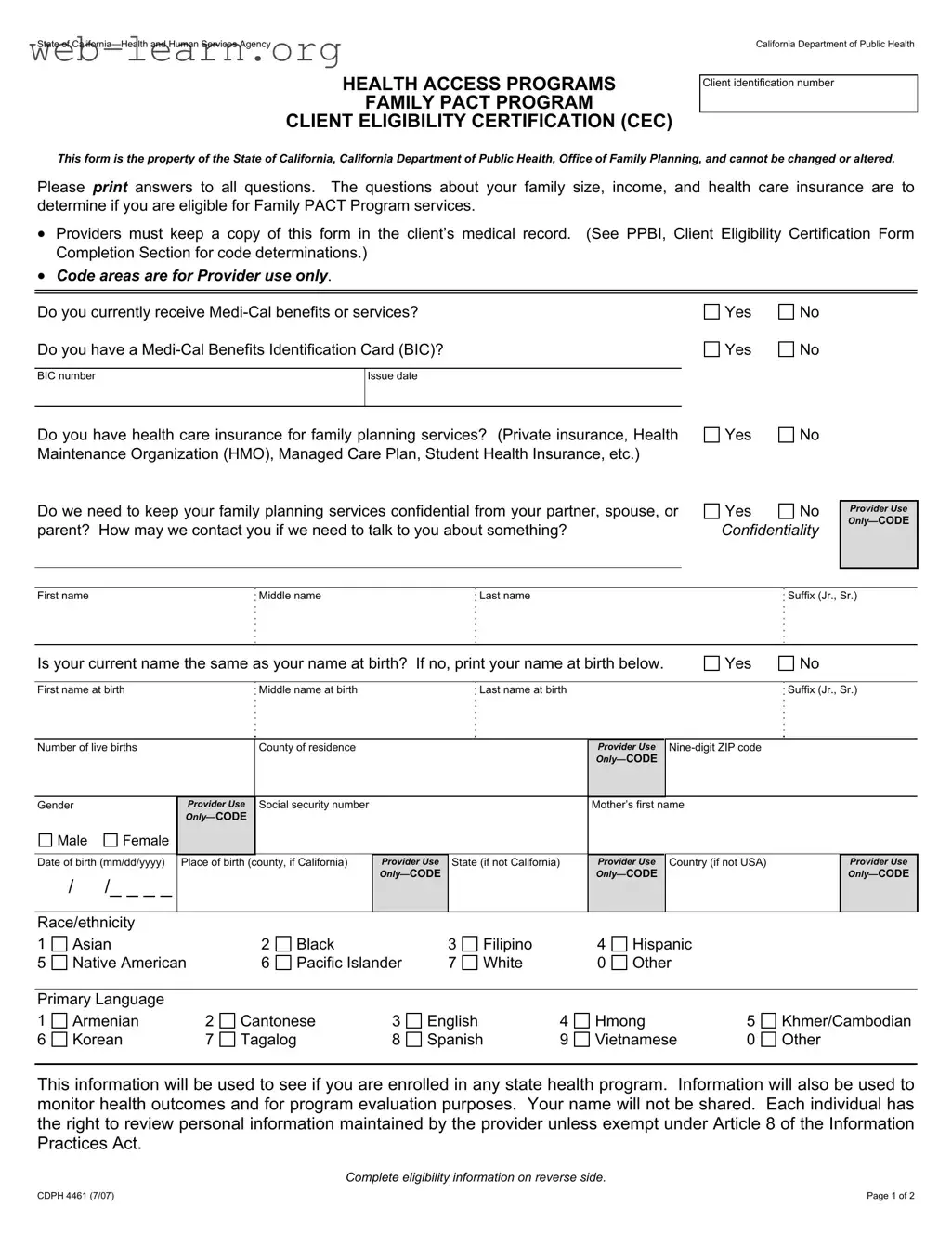
State of California—Health and Human Services Agency California Department of Public Health
Complete eligibility information on reverse side.
CDPH 4461 (7/07) Page 1 of 2
HEALTH ACCESS PROGRAMS
FAMILY PACT PROGRAM
CLIENT ELIGIBILITY CERTIFICATION (CEC)
Client identification number
This form is the property of the State of California, California Department of Public Health, Office of Family Planning, and cannot be changed or altered.
Please print answers to all questions. The questions about your family size, income, and health care insurance are to
determine if you are eligible for Family PACT Program services.
Providers must keep a copy of this form in the client’s medical record. (See PPBI, Client Eligibility Certification Form
Completion Section for code determinations.)
Code areas are for Provider use only.
Do you currently receive Medi-Cal benefits or services?
Yes No
Do you have a Medi-Cal Benefits Identification Card (BIC)?
Yes No
BIC number Issue date
Do you have health care insurance for family planning services? (Private insurance, Health
Maintenance Organization (HMO), Managed Care Plan, Student Health Insurance, etc.)
Yes No
Do we need to keep your family planning services confidential from your partner, spouse, or
parent? How may we contact you if we need to talk to you about something?
Yes No
Confidentiality
Provider Use
Only—CODE
First name Middle name Last name Suffix (Jr., Sr.)
Is your current name the same as your name at birth? If no, print your name at birth below. Yes No
First name at birth Middle name at birth Last name at birth Suffix (Jr., Sr.)
Number of live births County of residence
Provider Use
Only—CODE
Nine-digit ZIP code
Gender
Male Female
Provider Use
Only—CODE
Social security number Mother’s first name
Date of birth (mm/dd/yyyy)
/ /_ _ _ _
Place of birth (county, if California)
Provider Use
Only—CODE
State (if not California)
Provider Use
Only—CODE
Country (if not USA)
Provider Use
Only—CODE
Race/ethnicity
1
Asian 2 Black 3 Filipino 4 Hispanic
5
Native American 6 Pacific Islander 7 White 0 Other
Primary Language
1
Armenian 2 Cantonese 3 English 4 Hmong 5 Khmer/Cambodian
6
Korean 7 Tagalog 8 Spanish 9 Vietnamese 0 Other
This information will be used to see if you are enrolled in any state health program. Information will also be used to
monitor health outcomes and for program evaluation purposes. Your name will not be shared. Each individual has
the right to review personal information maintained by the provider unless exempt under Article 8 of the Information
Practices Act.
CDPH 4461 (7/07) Page 2 of 2
Eligibility Determination: Please list all family members (self, spouse, and children) living in your household and supported by
the family income. List the source of any earned or unearned income and the amount of income, including income from
employment, self-employment, tips, commissions, pensions, social security, child and/or spousal support, ongoing insurance
payments, disability, Veterans Affairs, unemployment benefits, etc.
Name Relationship to You Age Source of Income
Gross Monthly Income
(Before taxes or deductions.)
(Self)
Family size:
Total family income $
I declare under penalty of perjury that the information I have given on this form is true, correct, and complete. I
understand that the giving of false information may make me ineligible for this program.
Signature (or mark) of applicant Date Signature of witness to mark or interpreter Date
FOR PROVIDER USE ONLY
Provider certification: Eligible for Family PACT Program
Ineligible for Family PACT Program (Give applicant Fair Hearing Rights.)
Medi-Cal client eligible for Family PACT verified:
Limited scope Unmet share-of-cost
Based upon the information provided by the applicant and according to state and federal requirements, I certify that the
applicant identified on this Client Eligibility Certification is eligible to receive family planning services under the Family PACT
Program. If ineligible, the client has received a copy of this form which includes the Fair Hearing Rights.
Print name Signature Date
Annual Certification: If client is decertified (no longer eligible)
Date
Reason code (see Provider
Manual)
Fair Hearing Rights
Any applicant for, or recipient of, services under the Family PACT Program has a right to a hearing conducted by the California Department of
Public Health regarding eligibility or receipt of services. An applicant or recipient does not have a right to contest changes made to the
eligibility standards or benefits of the Family PACT Program.
First level review: If you wish to appeal either your denial of eligibility or receipt of services, please send your name, telephone number,
address, and reason why you are requesting a review to the First Level Review address below. A request for a first level review must be
postmarked within 20 working days of the denial of eligibility or services. The Office of Family Planning may request additional information by
telephone or in writing from the provider or the applicant before issuing a decision.
Formal hearing: You may appeal the decision of the first level review within five working days of your receipt of the decision of the first level
review by sending your name, telephone number, address, and reason for the appeal to the Formal Hearing address below. At the hearing,
you may be represented by a friend, relative, lawyer, or other person of your choice. A representative of the provider will be present to
explain the reasons for denying eligibility. If you want an interpreter provided at the hearing, please specify the language in your letter
requesting a hearing.
First Level Review Formal Hearing
California Department of Public Health California Department of Public Health
Office of Family Planning Office of Regulations and Hearings
MS 8400 MS 0507
P.O. Box 997420 P.O. Box 997377
Sacramento, CA 95899-7420 Sacramento, CA 95899-7377

Form Information

Fact Name Fact Description
Form Purpose The CDPH 4461 form is used to determine eligibility for the Family PACT Program services.
Governing Law This form is governed by California Health and Safety Code Section 24000.
Client Information Clients must provide personal details, including family size, income, and health care insurance status.
Confidentiality Clients can request confidentiality for their family planning services from partners or family members.
Provider Responsibilities Providers are required to keep a copy of the completed form in the client's medical record.
Eligibility Review Clients have the right to appeal decisions regarding their eligibility for services.
Signature Requirement Applicants must sign the form, declaring the information provided is true and complete.

Detailed Guide for Filling Out California Cdph 4461

Completing the California CDPH 4461 form is a crucial step in determining your eligibility for Family PACT Program services. Follow the steps carefully to ensure that all required information is accurately provided.

  1. Begin by entering your client identification number at the top of the form.
  2. Indicate whether you currently receive Medi-Cal benefits or services by checking "Yes" or "No."
  3. If you have a Medi-Cal Benefits Identification Card (BIC), provide the BIC number and the issue date.
  4. Answer if you have health care insurance for family planning services. Check "Yes" or "No."
  5. Specify if you need to keep your family planning services confidential from your partner, spouse, or parent.
  6. Provide your preferred contact method for communication.
  7. Fill in your first name, middle name, last name, and suffix (if applicable).
  8. Indicate if your current name is the same as your name at birth. If not, provide your name at birth.
  9. State your number of live births and select your gender (Male or Female).
  10. Enter your county of residence and social security number.
  11. Provide your mother's first name and your date of birth in the format mm/dd/yyyy.
  12. Indicate your place of birth (county if in California) and the state or country if not in California.
  13. Select your race/ethnicity from the provided options.
  14. Choose your primary language from the given list.
  15. List all family members living in your household, including yourself, spouse, and children. Provide their relationship to you, age, source of income, and gross monthly income.
  16. Calculate your total family income and family size.
  17. Sign and date the form, confirming that the information provided is true and complete.
  18. If applicable, have a witness sign and date the form.

After completing the form, ensure that it is submitted to the appropriate provider. They will review your information and determine your eligibility for the Family PACT Program. Keep a copy for your records, as it may be needed for future reference.

Obtain Answers on California Cdph 4461

  1. What is the purpose of the California CDPH 4461 form?

    The California CDPH 4461 form, also known as the Client Eligibility Certification (CEC), is used to determine eligibility for the Family PACT Program. This program provides family planning services to eligible individuals. The form collects essential information about the applicant's family size, income, and health care insurance status. By gathering this information, the program can assess whether the applicant qualifies for services.

  2. Who needs to complete the CDPH 4461 form?

    Any individual seeking family planning services through the Family PACT Program must complete the CDPH 4461 form. This includes self, spouse, and children living in the household who are supported by the family income. It is important for applicants to provide accurate and complete information to ensure proper eligibility determination.

  3. What information is required on the form?

    The form requires various details, including:

    • Client identification number
    • Personal information such as name, date of birth, and place of birth
    • Details about family members living in the household
    • Sources and amounts of income for each family member
    • Health insurance status and confidentiality preferences

    All answers must be printed clearly, and it is crucial to provide truthful information, as false statements may lead to ineligibility.

  4. What happens if my application is denied?

    If your application for the Family PACT Program is denied, you have the right to appeal the decision. The process involves two steps:

    • First Level Review: You must submit a request for review within 20 working days of the denial. Include your contact information and the reason for the appeal.
    • Formal Hearing: If you disagree with the outcome of the first level review, you can appeal again within five working days. At this hearing, you can be represented by someone of your choice.

    It is important to follow the instructions carefully and meet all deadlines to ensure your appeal is considered.

Common mistakes

Filling out the California CDPH 4461 form can be straightforward, but many make common mistakes that can lead to delays or ineligibility. One frequent error is failing to provide complete information. Each section of the form requires specific details about your family size, income, and health care insurance. Omitting any of these details can result in an incomplete application, leading to processing delays.

Another mistake is incorrect income reporting. Applicants often miscalculate their gross monthly income or fail to list all sources of income. This includes income from employment, self-employment, and other forms such as social security or child support. Ensure that all income sources are accounted for, as discrepancies can jeopardize eligibility.

Confusion about confidentiality is also a common issue. Some applicants do not clearly indicate whether they need their family planning services to remain confidential from partners or family members. This information is crucial for the provider to ensure your privacy. Be explicit in your response to avoid any misunderstandings.

Additionally, many individuals overlook the importance of signing the form. Without a signature, the application is not valid. This applies to both the applicant and any witnesses. Make sure that all necessary signatures are present before submitting the form to prevent delays in processing.

Lastly, failing to review the form before submission can lead to numerous errors. It is essential to double-check all entries for accuracy. Take the time to read through the completed form to ensure that all information is correct and complete. This simple step can save time and avoid potential issues with your application.

Documents used along the form

The California CDPH 4461 form is essential for determining eligibility for the Family PACT Program, which provides family planning services. However, several other documents may be required or useful in conjunction with this form. Understanding these documents can help ensure a smoother application process and better access to the services you need.

  • Medi-Cal Application Form: This form is used to apply for Medi-Cal benefits, which can include a range of health services. If you are already receiving Medi-Cal, it may streamline your eligibility for the Family PACT Program.
  • Proof of Income Documentation: Applicants often need to provide documentation such as pay stubs, tax returns, or bank statements to verify their income. This information is crucial for determining eligibility based on family size and income.
  • Confidentiality Request Form: If you wish to keep your family planning services confidential from certain individuals, this form allows you to formally request confidentiality. It ensures that your information is protected according to your preferences.
  • Family Size Declaration: This document outlines the members of your household who are supported by your income. It helps clarify your family structure and is necessary for accurate eligibility assessment.
  • Fair Hearing Request Form: If your application for Family PACT services is denied, this form allows you to formally request a review of your eligibility. It’s important for ensuring your rights are protected and that you have a chance to appeal the decision.
  • Client Rights and Responsibilities Document: This document outlines your rights as a client receiving services under the Family PACT Program. It’s important to understand these rights to ensure you receive fair treatment and access to services.

By being aware of these additional forms and documents, you can better navigate the application process for the Family PACT Program. Each document serves a specific purpose and contributes to a comprehensive understanding of your eligibility and rights. Always ensure that you have the necessary documentation ready to support your application and protect your interests.

Similar forms

The California CDPH 4461 form serves as a critical tool for determining eligibility for the Family PACT Program. Several other documents share similarities with this form in terms of purpose and required information. Here’s a list of five such documents:

  • Medi-Cal Application Form: This form collects personal and financial information to assess eligibility for Medi-Cal services, much like the CDPH 4461 form does for Family PACT. Both forms require details about household income and family size.
  • WIC Program Application: The Women, Infants, and Children (WIC) program application gathers information about family income and household members to determine eligibility for nutritional support. This mirrors the eligibility assessment found in the CDPH 4461.
  • CalFresh Application: Similar to the CDPH 4461, the CalFresh application requires applicants to disclose their household income and size to determine eligibility for food assistance. Both forms emphasize the importance of accurate income reporting.
  • Health Insurance Marketplace Application: This application assesses eligibility for health insurance subsidies. It requires personal and financial information akin to the CDPH 4461, focusing on household size and income.
  • Medicaid Eligibility Verification Form: This form is used to verify ongoing eligibility for Medicaid services. Like the CDPH 4461, it requests comprehensive personal and financial details to confirm eligibility status.

Dos and Don'ts

When filling out the California CDPH 4461 form, there are several important practices to keep in mind. Here’s a list of what you should and shouldn’t do:

  • Do print your answers clearly. This ensures that the information is legible and reduces the chance of errors.
  • Do include all family members supported by your income. This is crucial for determining eligibility.
  • Do provide accurate information regarding your income sources. Honesty is vital, as false information can lead to ineligibility.
  • Do keep a copy of the completed form for your records. This can be helpful for future reference.
  • Don't leave any required fields blank. Incomplete forms can delay the processing of your application.
  • Don't alter the form in any way. It is important to use the form as provided to avoid complications.

Misconceptions

There are several misconceptions surrounding the California CDPH 4461 form. Understanding these can help applicants navigate the process more effectively. Below are nine common misconceptions:

  • This form is only for women. The CDPH 4461 form is applicable to all individuals seeking family planning services, regardless of gender.
  • Filling out the form guarantees eligibility. Completing the form does not automatically ensure eligibility for the Family PACT Program; eligibility is determined based on the provided information and program criteria.
  • The information is not confidential. All information submitted on the form is kept confidential and will not be shared without consent.
  • You need to have health insurance to apply. Individuals without health insurance can still apply for services through the Family PACT Program.
  • Only low-income individuals can qualify. While income is a factor, various criteria determine eligibility, and applicants from different income levels may qualify.
  • Once denied, you cannot appeal. Applicants have the right to appeal a denial of eligibility or services through a formal process.
  • The form must be filled out perfectly. While accuracy is important, minor mistakes can often be corrected during the review process.
  • All personal information will be publicly available. Personal information is protected and used solely for eligibility determination and program evaluation.
  • You cannot receive help filling out the form. Applicants can seek assistance from providers or advocates when completing the form.

By addressing these misconceptions, individuals can better understand the purpose of the CDPH 4461 form and the services available through the Family PACT Program.

Key takeaways

  • Complete the form accurately. Use clear and legible handwriting to ensure that all information is easily understood.

  • Keep a copy of the form. Providers are required to maintain a copy in the client’s medical record for reference.

  • Confidentiality is important. Indicate if you need your family planning services to be kept confidential from your partner, spouse, or parent.

  • Be thorough when listing income. Include all sources of income, such as employment, social security, and any support payments.

  • Understand your rights. If you are denied eligibility, you have the right to appeal the decision through a first level review and a formal hearing.

  • Submit the form on time. Ensure that it is completed and submitted within the required timeframe to avoid delays in processing your application.