Homepage Blank California Cd 130 Form
Outline

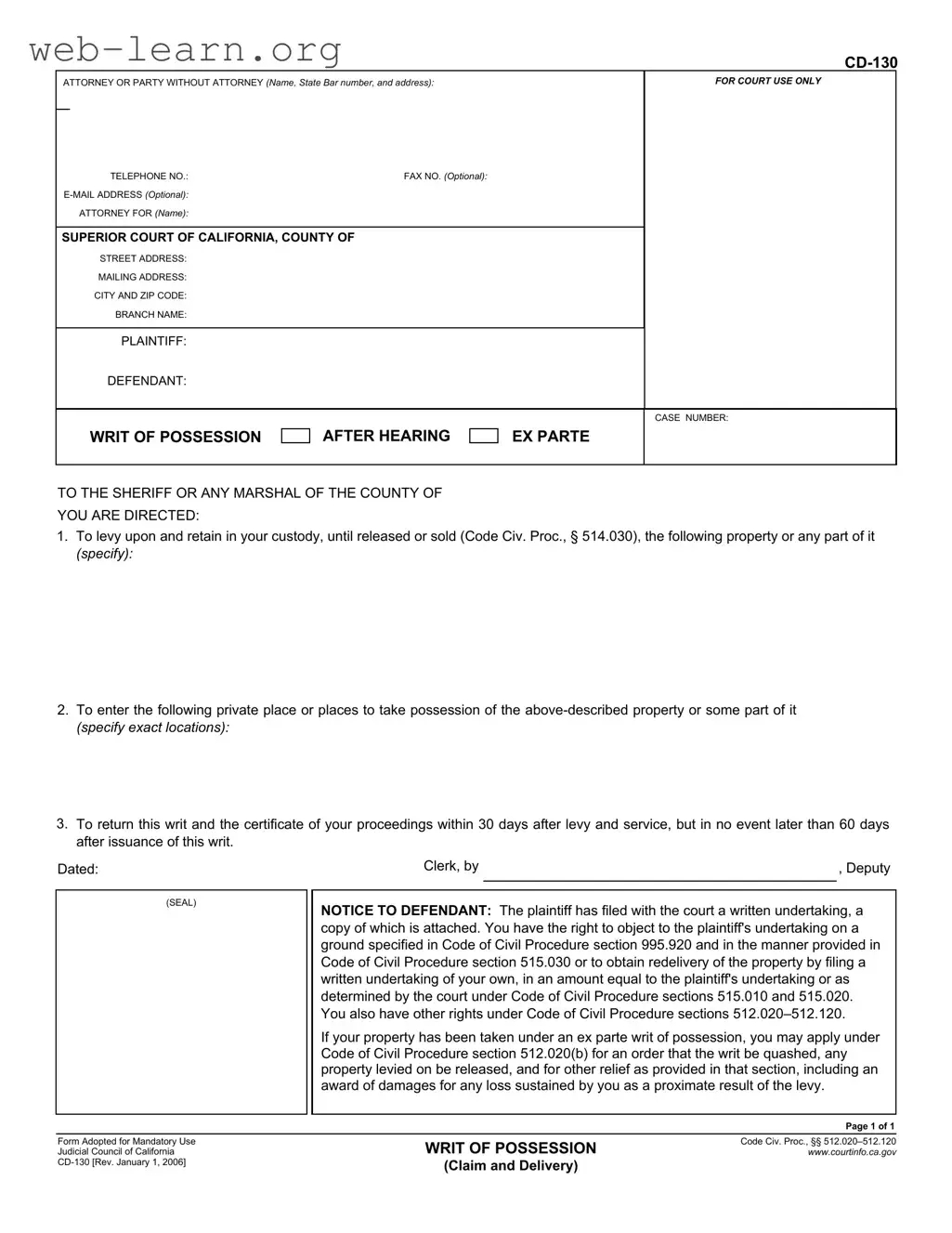
The California CD 130 form plays a crucial role in the legal process surrounding the writ of possession, particularly in matters concerning property disputes. This form is utilized when a plaintiff seeks to obtain a court order allowing them to reclaim property from a defendant after a hearing. Key details required on the form include the names and contact information of both the attorney and the parties involved, as well as the specific property in question. The document directs the sheriff or marshal to levy upon the specified property, ensuring it is retained until further court action is taken. Additionally, it outlines the obligation to return the writ and a certificate of proceedings within a designated timeframe. Importantly, the form also informs the defendant of their rights, including the ability to contest the plaintiff's undertaking or to seek redelivery of the property through a written undertaking of their own. The CD 130 serves not only as a procedural tool but also as a means to safeguard the rights of all parties involved, emphasizing the importance of understanding its implications in property law.
Sample - California Cd 130 Form

AFTER HEARING
WRIT OF POSSESSION
EX PARTE
YOU ARE DIRECTED:
Dated:
Clerk, by
(SEAL)
, Deputy
NOTICE TO DEFENDANT: The plaintiff has filed with the court a written undertaking, a
copy of which is attached. You have the right to object to the plaintiff's undertaking on a
ground specified in Code of Civil Procedure section 995.920 and in the manner provided in
Code of Civil Procedure section 515.030 or to obtain redelivery of the property by filing a
written undertaking of your own, in an amount equal to the plaintiff's undertaking or as
determined by the court under Code of Civil Procedure sections 515.010 and 515.020.
You also have other rights under Code of Civil Procedure sections 512.020–512.120.
Code Civ. Proc., §§ 512.020–512.120
www.courtinfo.ca.gov
WRIT OF POSSESSION
(Claim and Delivery)
To levy upon and retain in your custody, until released or sold (Code Civ. Proc., § 514.030), the following property or any part of it
(specify):
To enter the following private place or places to take possession of the above-described property or some part of it
(specify exact locations):
3.
To return this writ and the certificate of your proceedings within 30 days after levy and service, but in no event later than 60 days
after issuance of this writ.
1.
TO THE SHERIFF OR ANY MARSHAL OF THE COUNTY OF
Form Adopted for Mandatory Use
Judicial Council of California
CD-130 [Rev. January 1, 2006]
Page 1 of 1
CD-130
FOR COURT USE ONLY
ATTORNEY OR PARTY WITHOUT ATTORNEY (Name, State Bar number, and address):
FAX NO. (Optional):
SUPERIOR COURT OF CALIFORNIA, COUNTY OF
TELEPHONE NO.:
E-MAIL ADDRESS (Optional):
ATTORNEY FOR (Name):
STREET ADDRESS:
MAILING ADDRESS:
CITY AND ZIP CODE:
BRANCH NAME:
PLAINTIFF:
DEFENDANT:
CASE NUMBER:
2.
If your property has been taken under an ex parte writ of possession, you may apply under
Code of Civil Procedure section 512.020(b) for an order that the writ be quashed, any
property levied on be released, and for other relief as provided in that section, including an
award of damages for any loss sustained by you as a proximate result of the levy.

Form Information

Fact Name Description
Form Purpose The CD-130 form is used to request a Writ of Possession after a court hearing, allowing the sheriff or marshal to seize property.
Governing Law This form is governed by the California Code of Civil Procedure, specifically sections 512.020 to 512.120.
Who Can File Either a party represented by an attorney or a self-represented party can file this form with the court.
Property Description The form requires a detailed description of the property to be seized, ensuring clarity for law enforcement.
Timeframe for Return The sheriff or marshal must return the writ and a certificate of proceedings within 30 days after the levy, but no later than 60 days after issuance.
Defendant's Rights Defendants have the right to object to the plaintiff's undertaking and can seek redelivery of the property through their own written undertaking.
Form Adoption The CD-130 form has been adopted for mandatory use by the Judicial Council of California, ensuring uniformity across the state.

Detailed Guide for Filling Out California Cd 130

Filling out the California CD-130 form is a straightforward process, but attention to detail is essential. This form is used in specific legal situations, and the information provided will guide the court in its decisions. Make sure you have all necessary information on hand before you begin.

  1. At the top of the form, fill in your name, State Bar number (if applicable), and address in the section labeled ATTORNEY OR PARTY WITHOUT ATTORNEY.
  2. Provide your telephone number. If you have a fax number and/or email address, include those in the optional fields.
  3. In the ATTORNEY FOR section, enter the name of the party you are representing.
  4. Next, fill in the SUPERIOR COURT OF CALIFORNIA, COUNTY OF section with the appropriate county name.
  5. Complete the STREET ADDRESS and MAILING ADDRESS fields for the court, along with the CITY AND ZIP CODE.
  6. Specify the BRANCH NAME of the court, if applicable.
  7. In the PLAINTIFF and DEFENDANT sections, enter the names of the involved parties.
  8. For the CASE NUMBER, write in the number assigned to your case.
  9. In the section that begins with To levy upon and retain, describe the property you wish to levy. Be as specific as possible.
  10. In the next section, specify the exact locations where you will enter to take possession of the property.
  11. Finally, date the form and sign it. If applicable, have the Clerk sign and seal the document.

Once you have completed the form, ensure that you have copies for your records. You will need to submit the original form to the court and follow any additional instructions provided by the court regarding the next steps in your case.

Obtain Answers on California Cd 130

  1. What is the purpose of the California CD 130 form?

    The California CD 130 form is a legal document used to request a writ of possession after a hearing. This writ allows a plaintiff to obtain possession of property that has been disputed in a legal case. The form directs the sheriff or marshal to seize the specified property and hold it until further orders from the court. It is essential in cases where a party believes they have a right to the property in question and seeks to enforce that right through legal means.

  2. Who can file the CD 130 form?

    Typically, the CD 130 form is filed by an attorney representing a plaintiff in a civil case. However, a party without an attorney may also file it if they are representing themselves. It is crucial that the individual filing the form understands the legal implications and requirements associated with obtaining a writ of possession.

  3. What information is required on the CD 130 form?

    The form requires several key pieces of information, including:

    • The name and address of the attorney or party filing the form.
    • The case number assigned by the court.
    • A detailed description of the property to be seized.
    • The specific locations where the property can be found.

    Accurate information is vital, as any errors could delay the process or lead to complications in the enforcement of the writ.

  4. What rights does a defendant have upon receiving a writ of possession?

    Upon receiving a writ of possession, the defendant has several rights. They can:

    • Object to the plaintiff's undertaking by filing a written response.
    • Request the return of their property by submitting their own undertaking.
    • Seek to quash the writ and obtain relief for any damages incurred due to the levy.

    These rights are outlined in various sections of the California Code of Civil Procedure, ensuring that defendants have avenues to protect their interests.

  5. What happens after the writ of possession is issued?

    Once the writ is issued, the sheriff or marshal is responsible for executing it. They must levy the specified property and retain it in custody. The officer must return the writ and a certificate of their actions to the court within 30 days of the levy, but no later than 60 days from the issuance of the writ. This timeline is crucial for ensuring that all parties are kept informed and that the legal process continues smoothly.

  6. How can a defendant challenge the writ of possession?

    A defendant can challenge the writ of possession by filing an application under specific provisions of the Code of Civil Procedure. They may seek an order to quash the writ, release any property that has been levied, and possibly claim damages for losses sustained due to the levy. It is advisable for defendants to consult with a legal professional to navigate this process effectively.

Common mistakes

Filling out the California CD-130 form can be a daunting task, and many people make common mistakes that can lead to delays or complications in their case. One frequent error is failing to include all required contact information. The form asks for the name, address, and contact details of the attorney or party filing. Omitting any of this information can cause confusion and may result in the court being unable to reach the filer.

Another mistake often seen is neglecting to specify the property involved. The section that requires a description of the property must be filled out clearly and accurately. If the property is not described in sufficient detail, it may hinder the effectiveness of the writ, leaving both parties uncertain about what is being claimed.

Many individuals also overlook the importance of providing exact locations for property seizure. The form asks for specific addresses or descriptions of private places where the property is located. Failing to provide this information can lead to complications during enforcement, as the sheriff or marshal may not know where to go.

Additionally, some filers forget to sign and date the form. This might seem trivial, but a missing signature can render the document invalid. Always double-check that the form is signed and dated before submission to avoid unnecessary delays.

People sometimes misinterpret the notice to defendants. It’s crucial to understand the rights outlined in the notice section of the form. Misunderstanding these rights can lead to missed opportunities for the defendant to respond or object appropriately.

Another common oversight is not returning the writ and certificate of proceedings within the specified time frame. The form clearly states that these documents must be returned within 30 days after levy and service. Missing this deadline can have serious implications for the case.

In some cases, filers forget to attach the required written undertaking. This document is essential as it provides a guarantee to the court regarding the property in question. Without it, the court may not proceed with the writ.

Lastly, many individuals fail to keep copies of the completed form for their records. Having a copy is vital for tracking the progress of the case and for reference in future proceedings. Always make sure to retain a copy of any legal documents submitted to the court.

Documents used along the form

The California CD-130 form is a critical document used in legal proceedings involving the writ of possession. It allows a plaintiff to request the court to direct law enforcement to seize property after a hearing. Several other forms and documents often accompany this form, each serving a unique purpose in the legal process. Below is a list of these related documents.

  • CD-135: Ex Parte Application for Writ of Possession - This document is filed by the plaintiff to request an immediate order for possession of property without notifying the defendant. It outlines the reasons for the urgent need for possession.
  • CD-140: Notice of Motion - This form notifies the defendant of the upcoming court motion regarding the writ of possession. It includes details about the date, time, and location of the hearing.
  • CD-145: Declaration in Support of Ex Parte Application - A supporting document that provides evidence and reasons justifying the need for an ex parte writ. The plaintiff must include factual information to persuade the court.
  • CD-150: Undertaking - This form is used by the plaintiff to provide a financial guarantee to the court. It ensures that the plaintiff will compensate the defendant for any damages if the writ is later found to have been improperly issued.
  • CD-155: Request for Order to Quash Writ - A document that the defendant can file to challenge the writ of possession. It requests the court to annul the writ based on specific legal grounds.
  • CD-160: Certificate of Service - This form confirms that all relevant parties have been properly notified about the proceedings. It includes details about how and when service was completed.
  • CD-165: Response to Motion for Writ of Possession - The defendant uses this document to respond to the plaintiff's motion for a writ. It allows the defendant to present their side of the case and argue against the issuance of the writ.

Each of these documents plays a vital role in ensuring that the legal process is fair and transparent. Understanding their functions can help both plaintiffs and defendants navigate the complexities of property disputes in California.

Similar forms

The California CD-130 form is a legal document used for obtaining a writ of possession after a hearing. It shares similarities with several other legal forms. Here are five documents that are comparable to the CD-130 form, along with a brief explanation of how they are alike:

  • Writ of Attachment (Form AT-130): Like the CD-130, this form allows a plaintiff to request the court to seize a defendant's property to secure a judgment. Both documents require specific details about the property and the parties involved.
  • Writ of Execution (Form EJ-130): This form is used to enforce a judgment by allowing the seizure of a debtor's property. Similar to the CD-130, it directs law enforcement to take possession of property to satisfy a court order.
  • Claim and Delivery (Form CD-140): This document enables a party to reclaim specific personal property that is wrongfully held by another. Both forms involve the recovery of property and outline the rights of the parties involved.
  • Notice of Motion and Motion (Form FL-300): This form is often used in family law cases to request a court order. Like the CD-130, it requires detailed information and outlines the rights of the parties, though it is typically used for different types of disputes.
  • Ex Parte Application (Form EX-PARTE): This form allows a party to request immediate relief from the court without waiting for a regular hearing. Both the CD-130 and ex parte applications can lead to immediate actions by the court, emphasizing urgency in legal matters.

Dos and Don'ts

When filling out the California CD-130 form, it is essential to follow specific guidelines to ensure accuracy and compliance. Below is a list of six things you should and shouldn't do during this process.

  • Do provide your complete name, address, and contact information at the top of the form.
  • Do clearly specify the property you wish to levy upon in the designated section.
  • Do ensure that all required signatures are included before submitting the form.
  • Do keep a copy of the completed form for your records.
  • Don't leave any sections blank; fill in all necessary information.
  • Don't forget to check the filing deadlines to avoid any delays in your case.

By adhering to these guidelines, you can help ensure a smoother process when submitting the CD-130 form.

Misconceptions

Misconceptions about the California CD-130 form can lead to confusion for both plaintiffs and defendants involved in legal proceedings. Below are nine common misconceptions clarified for better understanding.

  • The CD-130 form is only for attorneys. This form can be used by both attorneys and self-represented parties. Individuals without legal representation can also file this form.
  • The CD-130 form guarantees possession of property. Filing this form does not automatically ensure possession. A hearing must take place, and the court must grant the writ.
  • You cannot contest a writ of possession. Defendants have the right to contest the writ by filing a written undertaking or applying to quash the writ, as outlined in the relevant codes.
  • The form is only applicable in certain counties. The CD-130 form is valid throughout California. It is not limited to specific counties or jurisdictions.
  • Once filed, the process is immediate. There are timelines involved. After the writ is issued, the sheriff or marshal has specific timeframes to act, and the defendant also has time to respond.
  • The plaintiff must provide a bond before filing. While a bond is required, it is not a prerequisite for filing the CD-130 form itself. The plaintiff must submit an undertaking, which is separate from the filing process.
  • Defendants cannot recover damages. If property is wrongfully taken, defendants can seek damages as a result of the levy, as specified in the Code of Civil Procedure.
  • The CD-130 form is the same as a standard eviction notice. This form serves a different purpose. It is specifically for obtaining a writ of possession following a hearing, not for general eviction proceedings.
  • All property can be seized under the writ. The writ only applies to specific property as described in the form. Not all assets are subject to seizure.

Understanding these misconceptions can help individuals navigate the legal process more effectively and protect their rights.

Key takeaways

Here are some important points to consider when filling out and using the California CD-130 form:

  • Understand the Purpose: The CD-130 form is used to request a writ of possession after a hearing. It allows the plaintiff to take possession of specific property.
  • Correct Information: Ensure that all names, addresses, and case numbers are filled out accurately. Mistakes can lead to delays or complications.
  • Property Description: Clearly describe the property you wish to levy. Include specific details to avoid confusion during enforcement.
  • Location Details: Specify the exact locations where the property is located. This is crucial for the sheriff or marshal to execute the writ.
  • Timeliness: Return the writ and the certificate of proceedings within 30 days after the levy and service. The total time frame should not exceed 60 days from issuance.
  • Defendant's Rights: The defendant has the right to object to the plaintiff’s undertaking. They can also file their own undertaking for the return of the property.
  • Legal References: Familiarize yourself with the relevant sections of the Code of Civil Procedure. Sections 512.020–512.120 outline important rights and procedures.
  • Seek Legal Advice: If you are unsure about any part of the process, consider consulting with a legal professional to ensure your rights are protected.