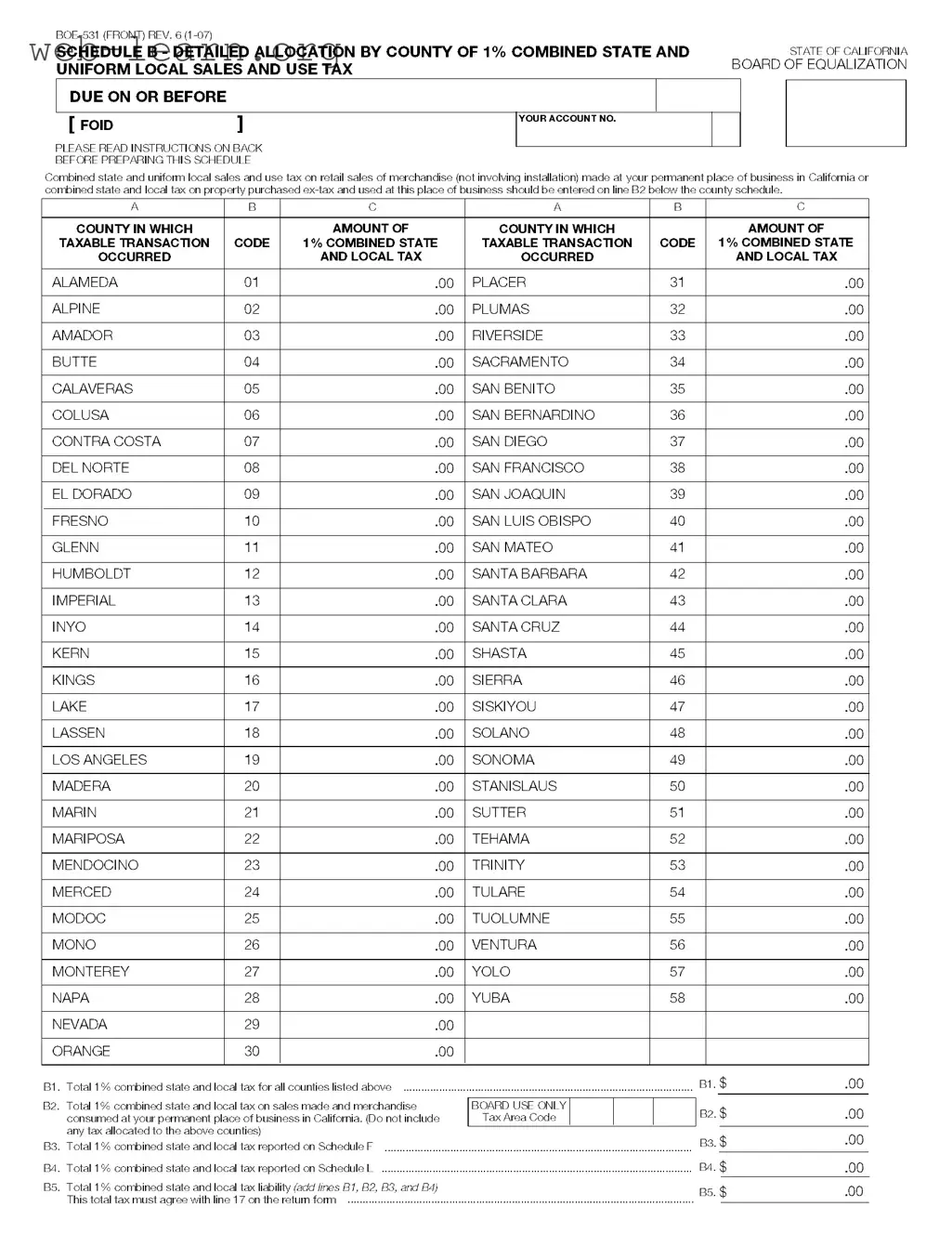
Homepage Blank California Boe 531 Form
Outline

The California BOE-531 form is an essential document for businesses operating within the state, specifically designed to report the combined state and uniform local sales and use tax. This form is particularly important for those who engage in retail sales of merchandise and must accurately allocate tax liabilities across various counties. It provides a structured way to detail the amount of tax due based on where taxable transactions occur, ensuring compliance with state regulations. The form consists of several sections, including a county allocation schedule that lists all counties in California, allowing businesses to specify the tax amounts attributable to each location. Additionally, it includes instructions for different types of businesses, such as auctioneers and vending machine operators, clarifying how to report their specific tax obligations. By completing the BOE-531 form, businesses can ensure that they meet their tax responsibilities while contributing to local and state funding. Understanding the nuances of this form can simplify the tax reporting process and help avoid potential penalties for non-compliance.
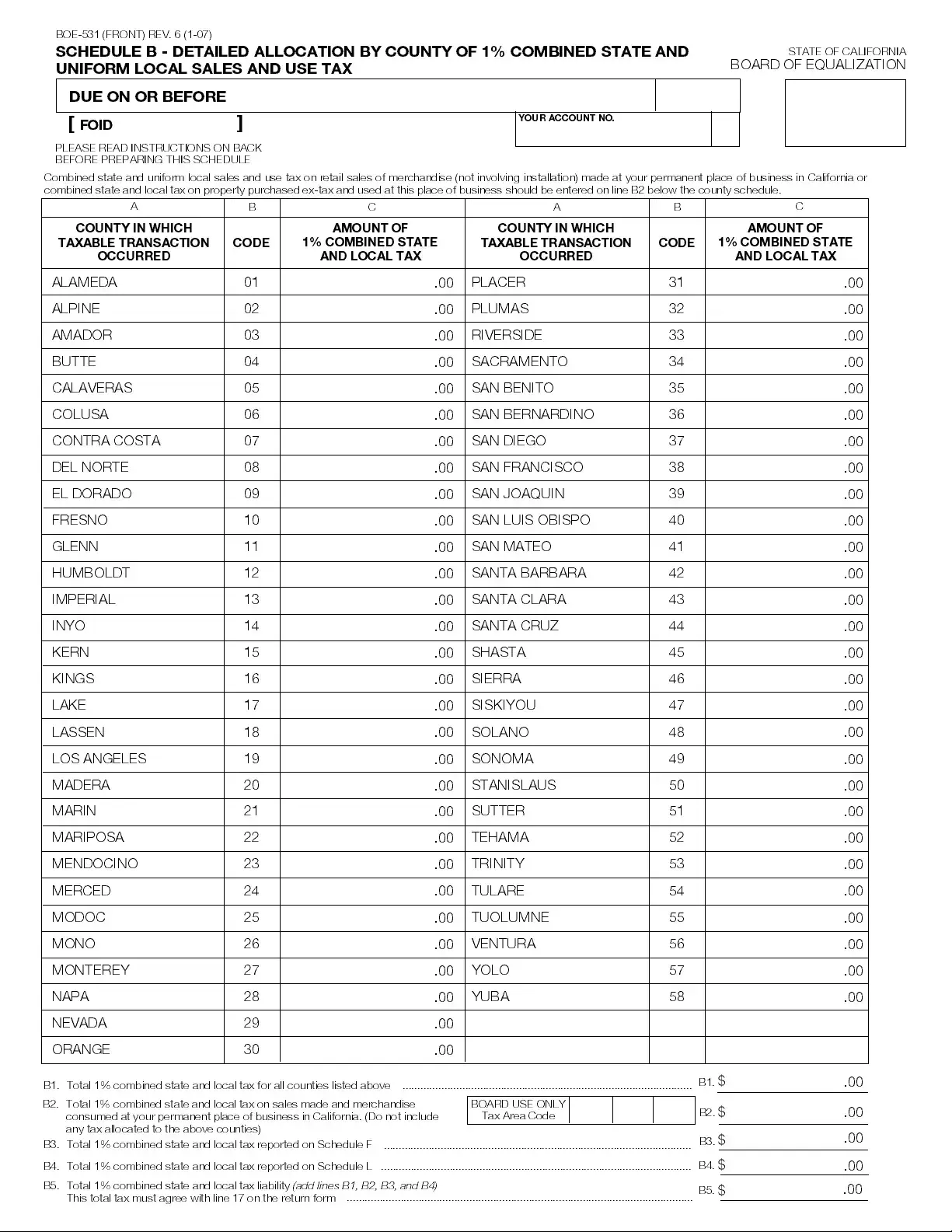
Sample - California Boe 531 Form

BOE-531 (FRONT) REV. 6 (1-07)
STATE OF CALIFORNIA
BOARD OF EQUALIZATION
SCHEDULE B - DETAILED ALLOCATION BY COUNTY OF 1% COMBINED STATE AND
UNIFORM LOCAL SALES AND USE TAX
DUE ON OR BEFORE
YOUR ACCOUNT NO.
]
[
FOID
PLEASE READ INSTRUCTIONS ON BACK
BEFORE PREPARING THIS SCHEDULE
Combined state and uniform local sales and use tax on retail sales of merchandise (not involving installation) made at your permanent place of business in California or
combined state and local tax on property purchased ex-tax and used at this place of business should be entered on line B2 below the county schedule.
C
A
B C A B
AMOUNT OF
1% COMBINED STATE
AND LOCAL TAX
AMOUNT OF
1% COMBINED STATE
AND LOCAL TAX
COUNTY IN WHICH
TAXABLE TRANSACTION
OCCURRED
COUNTY IN WHICH
TAXABLE TRANSACTION
OCCURRED
CODE CODE
ALAMEDA
ALPINE
AMADOR
BUTTE
CALAVERAS
COLUSA
CONTRA COSTA
DEL NORTE
EL DORADO
FRESNO
GLENN
HUMBOLDT
IMPERIAL
INYO
KERN
KINGS
LAKE
LASSEN
LOS ANGELES
MADERA
MARIN
MARIPOSA
MENDOCINO
MERCED
MODOC
MONO
MONTEREY
NAPA
NEVADA
ORANGE
01
02
03
04
05
06
07
08
09
10
11
12
13
14
15
16
17
18
19
20
21
22
23
24
25
26
27
28
29
30
PLACER
PLUMAS
RIVERSIDE
SACRAMENTO
SAN BENITO
SAN BERNARDINO
SAN DIEGO
SAN FRANCISCO
SAN JOAQUIN
SAN LUIS OBISPO
SAN MATEO
SANTA BARBARA
SANTA CLARA
SANTA CRUZ
SHASTA
SIERRA
SISKIYOU
SOLANO
SONOMA
STANISLAUS
SUTTER
TEHAMA
TRINITY
TULARE
TUOLUMNE
VENTURA
YOLO
YUBA
31
32
33
34
35
36
37
38
39
40
41
42
43
44
45
46
47
48
49
50
51
52
53
54
55
56
57
58
.00
.00
.00
.00
.00
.00
.00
.00
.00
.00
.00
.00
.00
.00
.00
.00
.00
.00
.00
.00
.00
.00
.00
.00
.00
.00
.00
.00
.00
.00
.00
.00
.00
.00
.00
.00
.00
.00
.00
.00
.00
.00
.00
.00
.00
.00
.00
.00
.00
.00
.00
.00
.00
.00
.00
.00
.00
.00
$
B1.
.00
B1. Total 1% combined state and local tax for all counties listed above
.................................................................................................
BOARD USE ONLY
Tax Area Code
B2. Total 1% combined state and local tax on sales made and merchandise
consumed at your permanent place of business in California. (Do not include
any tax allocated to the above counties)
B2.
$
.00
.00
$
B3.
B3. Total 1% combined state and local tax reported on Schedule F
.......................................................................................................
B4.
$
B4. Total 1% combined state and local tax reported on Schedule L ........................................................................................................
.00
B5. Total 1% combined state and local tax liability
(add lines B1, B2, B3, and B4)
This total tax must agree with line 17 on the return form
.00
B5.
$
....................................................................................................................
BOE-531 (BACK) REV. 6 (1-07)
SCHEDULE B
DETAILED ALLOCATION BY COUNTY OF COMBINED STATE
AND UNIFORM LOCAL SALES AND USE TAX
If your business activities come within one or more of the categories listed below, part or all of your state and local sales and use tax
should be allocated among the counties listed on Schedule B,
Detailed Allocation by County of Uniform Local Sales and Use Tax.
Enter in Column C, after the name of the appropriate county, the amount of local tax allocable to the county according to the
instructions below that are applicable to your business.
1.
AUCTIONEERS
(Ref. Regulations 1802 and 1803)
For auction events at temporary sales locations where taxable gross sales are $500,000 or more, the combined state and local sales
tax should be reported on the BOE-530-B,
Combined State and Local Tax Allocation for Temporary Sales Locations and Certain
Auctioneers.
For all other auction events at temporary sales locations, the amount of combined state and local sales tax on sales
made away from your permanent place of business should be entered in Column C of this form, opposite the name of each county
in which auctions were held. Enter on line B2 any amount of combined state and local tax that is applicable to auction sales,
over-the-counter sales or other transactions at your permanent place of business.
2.
OUT-OF-STATE RETAILERS WHO HAVE BEEN AUTHORIZED BY THIS BOARD TO OPERATE
UNDER
SECTION 6015
(Regulation 1802)
Enter in Column C the amount of combined state and local tax on sales made by representatives who operate from locations in
each county.
3.
VENDING MACHINE OPERATORS
(Regulations 1574 and 1802)
Enter in Column C, the amount of combined state and local tax on sales made from vending machines located in each county. Enter
on line B2 any amount of combined state and local tax which is applicable to sales of equipment or other transactions at your
permanent place of business.
4.
OUT-OF-STATE SELLERS ENGAGED IN BUSINESS IN CALIFORNIA
(Regulations 1802 and 1803)
Sales of goods negotiated out of state and delivered from a
stock of goods in state
should be entered on Line B2 of this form.
Sales negotiated out of state by sellers (who are engaged in business in California) that are delivered from locations out of state with
title passing to a California purchaser at a point outside of California are subject to combined state and local
use tax
and
should be
entered in Column C opposite the county of destination.
OUT-OF-STATE SELLERS NOT ENGAGED IN BUSINESS IN CALIFORNIA
(Regulations 1802 and 1803)
Sellers
not engaged in business in California,
but who voluntarily collect and report use tax may report transactions of $500,000
or more on Schedule F,
Detailed Allocation of 1% Combined State and Uniform Local Sales and Use Tax,
in accordance with the
above, or continue to report on Schedule B.
CONSTRUCTION CONTRACTORS
(Regulation 1806)
5.
A contractor must report the combined state and local tax with respect to materials and fixtures involved in construction contracts
according to the county location of the jobsite where use occurred. Enter this tax in Column C opposite the appropriate county.
Enter on line B2 any amount of combined state and local tax applicable to retail store sales or regular retail sales at your permanent
place of business which do not involve a construction contract.
6.
PERSONS MAKING EX-TAX PURCHASES FOR USE AT LOCATIONS WHERE A SELLER'S
PERMIT IS NOT REQUIRED
(Regulation 1803)
A person who purchases tangible personal property without payment of combined state and uniform local tax is liable for combined
state and local use tax on such purchases. If the property is used at a location for which a seller's permit
is not
required, and is a
purchase of less than $500,000, enter the amount in Column C of this form opposite the county where the property is used. If
property is used at a location for which a seller's permit
is not
required and is a purchase of $500,000 or more, local tax should be
reported on Schedule F,
Detailed Allocation of 1% Combined State and Uniform Local Sales and Use Tax.
Line B2.
COMBINED STATE AND LOCAL TAX AT PERMANENT PLACE OF BUSINESS.
Enter here the amount of combined state
and local tax on sales made and merchandise consumed at your permanent place of business in California. Do not include any
combined state and local use tax reported by counties in Column C. In addition, enter the 1% combined state and local tax from
sales of goods negotiated out of state and delivered from an in-state stock of goods.
NOTE: If you are furnished with Schedule C,
Detailed Allocation by Suboutlet of Combined State and Uniform Local Sales and Use
Tax,
the amount entered on line B2 must agree with the total amount of Combined State and Local Tax shown on Schedule C.
7.
MOTOR VEHICLE LEASES
If you are a lessor of motor vehicles who is not required to use Schedule F, you should report the 1% combined state and local tax
on Schedule B (the tax should be reported in the county where the vehicle is registered).
8.
BAD DEBT LENDERS
If you are claiming a deduction for Bad Debt-Lender, you are required to complete Schedule L. In most cases, the Schedule L total
needs to be entered on line "B4" as a negative number. However, if bad debt-lender recoveries exceed losses, the Schedule L total
would be a positive amount.
For transactions of $500,000 or more by sellers engaged in business in California, the combined state and local use tax should be
reported on Schedule F,
Detailed Allocations of 1% Combined State and Uniform Local Sales and Use Tax
.

Form Information

Fact Name Details
Form Purpose The California BOE 531 form is used to report the 1% combined state and local sales and use tax on retail sales made at a permanent business location in California.
Governing Law This form is governed by California Revenue and Taxation Code Sections 6011 and 6012, which outline the requirements for sales and use tax reporting.
Filing Frequency Businesses must file the BOE 531 form on a quarterly basis, aligning with the state’s sales tax reporting schedule.
County Allocation The form allows businesses to allocate sales tax collected by county, ensuring that tax revenues are distributed appropriately among local jurisdictions.
Instructions Specific instructions are provided on the back of the form, detailing how to accurately complete the schedule based on business activities.
Tax Liability Calculation Total tax liability is calculated by summing the amounts reported on various lines, ensuring that the total matches the return form.
Special Cases Special provisions apply for auctioneers, out-of-state retailers, and vending machine operators, which may affect how taxes are reported on the form.

Detailed Guide for Filling Out California Boe 531

Completing the California BOE-531 form involves providing detailed information about sales and use tax allocated by county. After filling out this form, you will need to submit it along with your tax return to the California Board of Equalization by the specified deadline.

  1. Obtain the California BOE-531 form from the California Board of Equalization website or your local office.
  2. Locate your account number, which is typically found on previous correspondence from the Board of Equalization.
  3. Begin with the county schedule. For each county where taxable transactions occurred, enter the county name in Column A.
  4. In Column B, write the corresponding code for each county. A list of county codes is provided on the form.
  5. In Column C, input the amount of 1% combined state and local tax for each county listed. This should reflect the total tax collected from sales made in that county.
  6. Calculate the total 1% combined state and local tax for all counties listed in the designated space labeled B1.
  7. Enter the total 1% combined state and local tax on sales made and merchandise consumed at your permanent place of business in line B2.
  8. If applicable, report the total 1% combined state and local tax from Schedule F in line B3.
  9. If applicable, report the total 1% combined state and local tax from Schedule L in line B4.
  10. Add the amounts from lines B1, B2, B3, and B4 to determine your total 1% combined state and local tax liability in line B5.
  11. Ensure that the total from line B5 matches line 17 on your return form.

Obtain Answers on California Boe 531

  1. What is the BOE-531 form?

    The BOE-531 form is a document used in California to report the combined state and local sales and use tax due on retail sales of merchandise. This form helps businesses allocate tax amounts based on where taxable transactions occurred.

  2. Who needs to file the BOE-531 form?

    Any business that makes retail sales of merchandise in California is required to file this form. This includes businesses with a permanent place of business in the state, as well as certain out-of-state retailers who are authorized to operate in California.

  3. How do I fill out the BOE-531 form?

    To complete the BOE-531, you will need to enter the amount of 1% combined state and local tax for each county where taxable transactions occurred. Make sure to read the instructions provided on the back of the form for guidance specific to your business activities.

  4. What information is required on the form?

    The form requires the following information:

    • Your account number.
    • The counties where taxable transactions took place.
    • The corresponding tax amounts for each county.
    • Total combined state and local tax amounts.
  5. What if I have sales in multiple counties?

    If your business operates in multiple counties, you will need to report the tax amounts for each county separately on the BOE-531. Be sure to include the correct county codes and tax amounts in the designated columns.

  6. Are there special rules for auctioneers?

    Yes, auctioneers have specific reporting requirements. If your auction sales reach $500,000 or more at temporary locations, you must report the tax on a different form, BOE-530-B. For smaller auctions, report the tax on the BOE-531 form for each county where sales occurred.

  7. What is the deadline for filing the BOE-531?

    The BOE-531 must be filed by the due date of your sales and use tax return. Make sure to check the California Board of Equalization’s website for specific deadlines to avoid any penalties.

  8. Where can I get help if I have questions about the form?

    If you have questions, you can contact the California Board of Equalization directly or consult a tax professional. They can provide assistance tailored to your specific situation and ensure that you complete the form correctly.

Common mistakes

Filling out the California BOE-531 form can be a straightforward process, but many people make common mistakes that can lead to delays or issues with their tax filings. One frequent error is not reading the instructions carefully. The form has specific guidelines on how to report sales and use tax, and skipping this step can result in incorrect entries.

Another common mistake is failing to enter the correct county codes. Each county has a designated code, and using the wrong one can complicate the allocation of taxes. It’s essential to double-check these codes against the list provided on the form.

Many individuals also forget to total their amounts correctly. After entering the tax amounts for each county, it’s crucial to ensure that the total on line B1 matches the sum of the individual entries. A simple math error can lead to discrepancies that may require additional follow-up.

Some people neglect to report sales made at their permanent place of business. This is a vital part of the form. If these sales are not included, the total tax liability will be understated, which can lead to penalties.

In addition, individuals often overlook the need to report sales from vending machines. If your business includes vending operations, make sure to include those sales in the appropriate section of the form. Failing to do so can result in an inaccurate tax calculation.

Another mistake is not including the correct amounts for sales made out of state. If your business involves transactions that cross state lines, it’s important to follow the specific reporting guidelines to avoid errors.

Some filers forget to check their figures against previous submissions. Consistency is key. If there are significant discrepancies from previous years, it may raise red flags with the Board of Equalization.

Lastly, a common oversight is not submitting the form on time. Missing the deadline can lead to penalties and interest charges. Ensure that you keep track of important dates and submit your form promptly to avoid these issues.

By being aware of these common mistakes, you can take steps to ensure that your California BOE-531 form is completed accurately and submitted on time.

Documents used along the form

The California BOE-531 form is a critical document for businesses reporting sales and use tax. However, several other forms and documents often accompany it to ensure compliance with state tax regulations. Below is a list of these related documents, each serving a specific purpose.

  • BOE-530-B: This form is used for reporting combined state and local sales tax for auction events held at temporary sales locations, particularly when taxable gross sales exceed $500,000.
  • Schedule F: This document provides detailed allocations of the 1% combined state and local sales and use tax for businesses engaged in significant transactions, ensuring accurate reporting across counties.
  • BOE-401-A: The seller's permit application form, which businesses must complete to obtain a permit for collecting sales tax in California.
  • BOE-401-E: This is the application for a seller’s permit for out-of-state retailers, allowing them to legally collect sales tax while doing business in California.
  • BOE-401-DS: A form used to report and pay use tax on purchases made from out-of-state sellers that do not collect California sales tax.
  • BOE-501: The sales and use tax return form that businesses file to report their total sales and tax collected during a specific period.
  • BOE-552: This form is used for requesting a refund of overpaid sales or use tax, allowing businesses to reclaim excess amounts paid to the state.
  • BOE-100: The application for a certificate of registration, which is necessary for businesses to operate legally and collect sales tax in California.

Understanding these forms and their purposes is essential for accurate tax reporting and compliance. Each document plays a vital role in the broader context of sales and use tax management in California.

Similar forms

  • BOE-530-B: This form is used for reporting combined state and local sales tax for temporary sales locations and certain auctioneers. Similar to BOE-531, it requires allocation of tax by county based on sales made at specific locations.
  • Schedule F: This schedule provides detailed allocations of combined state and local sales and use tax. Like BOE-531, it focuses on tax liabilities and requires reporting based on sales activities within California.
  • BOE-401-A: This form is for reporting sales and use tax returns for businesses. It shares the purpose of tax reporting with BOE-531, focusing on taxable transactions and their allocation.
  • BOE-401-DS: This document is for the use tax return for sellers. It is similar in that it requires businesses to report their tax obligations based on sales made and the counties involved.
  • BOE-401-GS: This form is for general sellers of tangible goods. It has a similar function to BOE-531 in terms of reporting sales tax and allocating it by county.
  • BOE-401-CT: This return is for contractors and is used to report sales tax on materials used in construction. It also requires allocation of tax similar to the BOE-531.
  • BOE-401-RE: This form is for reporting sales tax for real estate transactions. It functions similarly to BOE-531 by requiring allocation of tax based on the nature of the transaction.
  • BOE-501: This document is for reporting use tax on purchases. It shares a common goal with BOE-531 in that both require businesses to report tax based on their activities in California.
  • BOE-533: This form is for reporting tax on sales of vehicles and vessels. It is similar to BOE-531 in that it involves the allocation of tax based on specific sales transactions.
  • BOE-540: This form is for individual income tax returns. While primarily focused on income, it also requires taxpayers to report any applicable sales and use taxes, mirroring the allocation process found in BOE-531.

Dos and Don'ts

Filling out the California BOE-531 form can seem daunting, but with the right approach, you can navigate it smoothly. Here are some helpful tips on what to do and what to avoid when completing this important document.

  • Do read the instructions carefully before starting. Understanding the requirements can save you time and prevent mistakes.
  • Do ensure that you have accurate records of all taxable transactions. Accurate data is key to filling out the form correctly.
  • Do double-check the county codes. Each county has a specific code that must be entered correctly to avoid errors.
  • Do include all relevant sales and use tax amounts. Make sure to account for all applicable transactions to ensure compliance.
  • Don't skip any sections. Every part of the form is important, and missing information can lead to complications.
  • Don't guess on tax amounts. If you're unsure, consult a tax professional or refer to the guidelines provided by the Board of Equalization.
  • Don't wait until the last minute to file. Allow yourself ample time to gather information and complete the form accurately.
  • Don't forget to keep a copy of the completed form for your records. This can be helpful for future reference or in case of an audit.

By following these dos and don’ts, you can streamline the process of filling out the BOE-531 form and ensure that you meet your tax obligations with confidence.

Misconceptions

Misconceptions about the California BOE 531 form can lead to confusion and errors in tax reporting. Here are six common misunderstandings, along with clarifications to help ensure accurate compliance.

  • Misconception 1: The BOE 531 form is only for large businesses.
  • This form is required for any business that makes taxable sales in California, regardless of size. Small businesses must also report their sales and use tax accurately.

  • Misconception 2: Only physical locations in California need to file the BOE 531.
  • Even businesses operating from out of state must file if they make sales to California customers. This includes online retailers and vendors who ship products to California.

  • Misconception 3: The form is only for retail sales of tangible goods.
  • The BOE 531 form applies to various types of transactions, including those involving services and digital products, depending on the nature of the sale.

  • Misconception 4: All counties in California have the same tax rates.
  • California has different local tax rates, and businesses must allocate their sales tax according to the specific counties where sales occurred. This can affect the total tax liability reported on the form.

  • Misconception 5: It’s unnecessary to report tax for temporary sales locations.
  • Sales made at temporary locations, such as fairs or markets, must be reported separately. Businesses should use the appropriate sections of the BOE 531 to ensure compliance.

  • Misconception 6: Once submitted, the BOE 531 form cannot be amended.
  • Businesses can amend the form if errors are discovered after submission. It is crucial to correct any inaccuracies promptly to avoid penalties.

Key takeaways

When filling out the California BOE-531 form, there are several important points to keep in mind. Understanding these key takeaways can help ensure accurate reporting and compliance with state tax regulations.

  • Identify the Taxable Transactions: The form is specifically for reporting the combined state and local sales and use tax on retail sales of merchandise made at your permanent business location in California.
  • County Allocation: You must allocate the sales and use tax amounts to the appropriate counties where the taxable transactions occurred. Each county has a unique code that you will need to reference.
  • Accurate Reporting: Ensure that the total amount of 1% combined state and local tax reported on the form matches the total tax liability on your return form. This includes totals from various schedules.
  • Special Categories: Certain categories of businesses, such as auctioneers and vending machine operators, have specific instructions for reporting their sales and use tax. Be sure to follow the guidelines applicable to your business type.
  • Out-of-State Transactions: If you engage in business with out-of-state sellers, be aware of how to report these transactions. Different rules apply based on whether the seller is engaged in business in California or not.
  • Review Instructions: Always read the instructions provided on the back of the form before filling it out. This will help clarify any uncertainties and ensure compliance with all reporting requirements.