Homepage Blank California Audit Form
Outline

The California Audit Complaint Form serves as a vital tool for individuals seeking to report issues related to workers’ compensation claims. This form allows complainants to provide detailed information about their grievances, which may include late payments, denial of claims, or failure to pay medical bills. A key feature of the form is the option for confidentiality; if a complainant wishes to keep their identity private, they can indicate this preference, ensuring that their complaint is not shared with any parties involved. The Department of Industrial Relations (DIR) utilizes the information submitted not only to monitor claims administrators but also to assist in law enforcement and conduct research on the workers’ compensation system. The form requires essential details such as the claims administrator's name and address, the injured worker's name, claim number, and specifics regarding the nature of the complaint. Complainants are encouraged to be as precise as possible, providing supporting documentation when available. This structured approach facilitates a thorough review of the issues at hand, ultimately aiming to enhance the integrity and efficiency of the workers’ compensation process in California.

Sample - California Audit Form

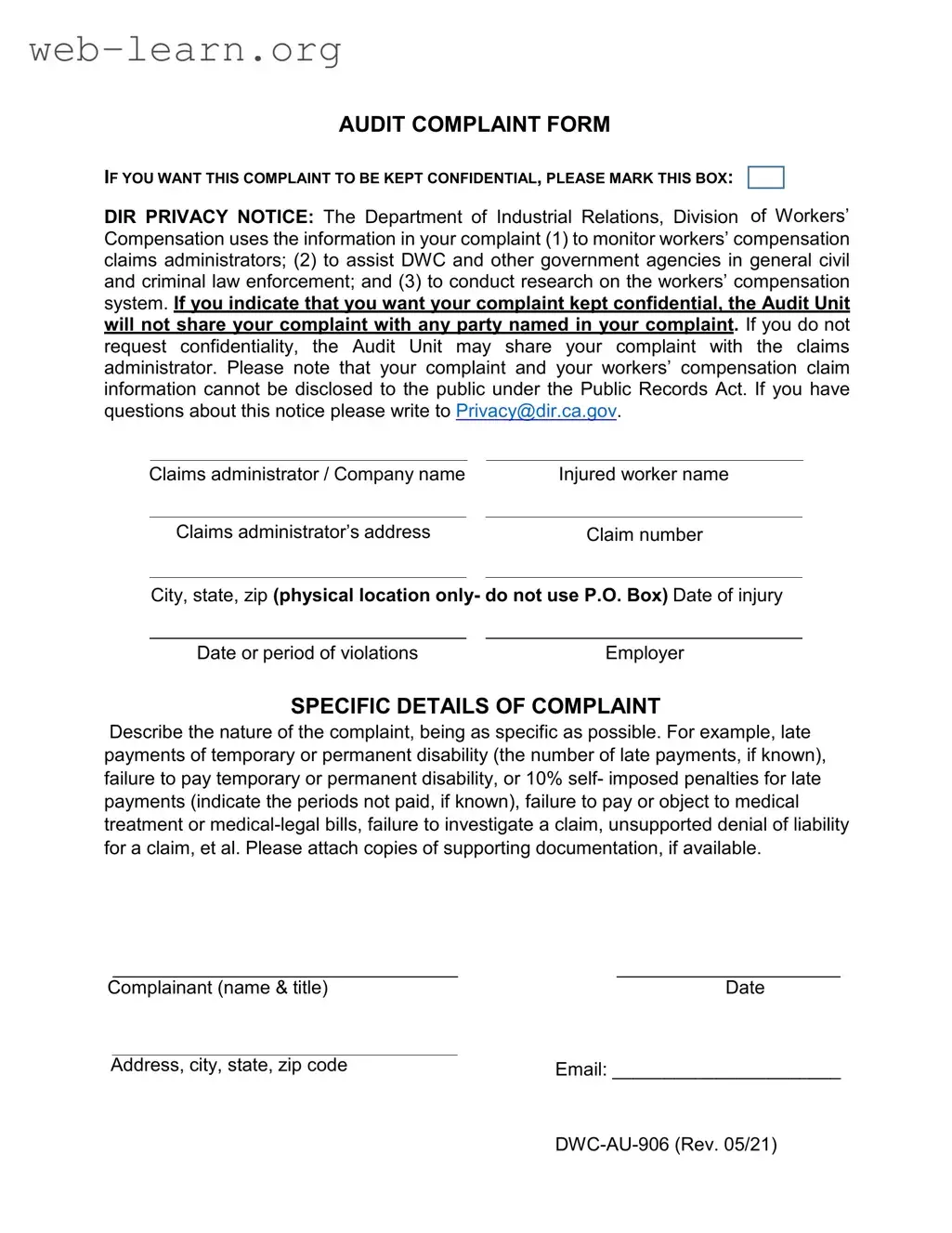
AUDIT COMPLAINT FORM
IF YOU WANT THIS COMPLAINT TO BE KEPT CONFIDENTIAL, PLEASE MARK THIS BOX:
DIR PRIVACY NOTICE: The Department of Industrial Relations, Division
of Workers’
Compensation uses the information in your complaint (1) to monitor workers’ compensation
claims administrators; (2) to assist DWC and other government agencies in general civil
and criminal law enforcement; and (3) to conduct research on the workers’ compensation
system. If you indicate that you want your complaint kept confidential, the Audit Unit
will not share your complaint with any party named in your complaint. If you do not
request confidentiality, the Audit Unit may share your complaint with the claims
administrator. Please note that your complaint and your workers’ compensation claim
information cannot be disclosed to the public under the Public Records Act. If you have
questions about this notice please write to Privacy@dir.ca.gov.
Claims administrator / Company name
Claims administrator’s address
Injured worker name
Claim number
City, state, zip (physical location only- do not use P.O. Box) Date of injury
Date or period of violations Employer
SPECIFIC DETAILS OF COMPLAINT
Describe the nature of the complaint, being as specific as possible. For example, late
payments of temporary or permanent disability (the number of late payments, if known),
failure to pay temporary or permanent disability, or 10% self- imposed penalties for late
payments (indicate the periods not paid, if known), failure to pay or object to medical
treatment or medical-legal bills, failure to investigate a claim, unsupported denial of liability
for a claim, et al. Please attach copies of supporting documentation, if available.
Complainant (name & title)
Address, city, state, zip code
Date
Email: ______________________
DWC-AU-906 (Rev. 05/21)

Form Information

Fact Name Description
Purpose of the Form The California Audit Complaint Form is used to report issues related to workers’ compensation claims, ensuring compliance and accountability from claims administrators.
Confidentiality Option Complainants can request confidentiality. If selected, the Audit Unit will not share the complaint with any party named in it.
Use of Information The information provided in the complaint helps monitor claims administrators, assists in law enforcement, and supports research on the workers’ compensation system.
Public Disclosure Under the Public Records Act, complaints and associated workers’ compensation claim information cannot be disclosed to the public.
Required Information Complainants must provide specific details such as the claims administrator's name, address, and the nature of the complaint.
Supporting Documentation It is encouraged to attach copies of supporting documents that substantiate the claims made in the complaint.
Contact Information For questions regarding the privacy notice, individuals can contact the Department of Industrial Relations at [email protected].
Governing Laws This form is governed by California Labor Code Section 129.5, which outlines the rights of injured workers in the workers' compensation system.
Form Revision Date The current version of the form is DWC-AU-906, revised in May 2021.

Detailed Guide for Filling Out California Audit

Filling out the California Audit form is a straightforward process. After you complete the form, it will be submitted to the appropriate department for review. Be sure to provide as much detail as possible to ensure your complaint is understood and addressed appropriately.

  1. Obtain the Form: Access the California Audit Complaint Form online or request a physical copy from the Department of Industrial Relations.
  2. Confidentiality Option: If you wish for your complaint to be confidential, mark the designated box at the top of the form.
  3. Fill in Claims Administrator Information: Write the name and address of the claims administrator or company involved in your complaint.
  4. Provide Injured Worker Details: Enter the name of the injured worker and their claim number. Include the city, state, and zip code, ensuring you use a physical address and not a P.O. Box.
  5. Include Date of Injury: Indicate the date of the injury or the period during which violations occurred.
  6. Employer Information: Fill in the name of the employer associated with the claim.
  7. Describe the Complaint: In detail, explain the nature of your complaint. Include specifics like late payments, failure to pay, or any other relevant issues. Mention any known periods of violation and attach supporting documentation if available.
  8. Complainant Information: Provide your name and title, along with your address, city, state, and zip code.
  9. Email Address: Enter your email address for any follow-up communication.

Obtain Answers on California Audit

  1. What is the purpose of the California Audit Complaint Form?

    The California Audit Complaint Form is designed to allow individuals to report issues related to workers’ compensation claims. This form helps the Department of Industrial Relations (DIR) monitor claims administrators, enforce civil and criminal laws, and conduct research on the workers' compensation system. By submitting this form, you can bring attention to problems such as late payments or denial of claims.

  2. How can I keep my complaint confidential?

    If you wish for your complaint to remain confidential, simply mark the designated box on the form. When you do this, the Audit Unit will not share your complaint with any parties named in your submission. However, if you choose not to request confidentiality, your complaint may be shared with the claims administrator involved in your case.

  3. What information do I need to provide on the form?

    You will need to fill out various details, including:

    • Claims administrator or company name
    • Claims administrator’s address
    • Your name as the injured worker
    • Your claim number
    • Physical address (no P.O. Box)
    • Date of injury
    • Date or period of violations
    • Employer's name

    Additionally, you should provide a detailed description of your complaint, outlining specific issues and attaching any supporting documentation if available.

  4. What types of complaints can I report?

    The form allows you to report a variety of issues, including but not limited to:

    • Late payments of temporary or permanent disability
    • Failure to pay for medical treatment or medical-legal bills
    • Unsupported denial of liability for a claim
    • Failure to investigate a claim
    • Self-imposed penalties for late payments

    Be as specific as possible when describing your complaint to ensure it is addressed appropriately.

  5. Can I submit supporting documents with my complaint?

    Yes, attaching supporting documentation is encouraged. Providing evidence can strengthen your complaint and help the Audit Unit understand the specifics of your situation. This may include payment records, correspondence with the claims administrator, or any other relevant documents.

  6. What happens after I submit the complaint form?

    Once your complaint is submitted, the Audit Unit will review the information provided. They may reach out for additional details if necessary. Your complaint will be used to monitor the claims administrator and may lead to further investigation if warranted.

  7. How is my privacy protected when submitting a complaint?

    Your complaint and any related workers’ compensation claim information are protected under the Public Records Act. This means that the information you provide cannot be disclosed to the public. If you have any concerns about privacy, you can contact the DIR at [email protected] for further clarification.

Common mistakes

Filling out the California Audit Complaint Form can be a straightforward process, but many people make common mistakes that can lead to complications. One frequent error is not marking the confidentiality box when desired. If you want your complaint to remain confidential, it’s crucial to check that box. Otherwise, your complaint may be shared with the claims administrator, which could affect your situation.

Another mistake is failing to provide complete information about the claims administrator. This includes the company name and address. Omitting these details can slow down the review process. Make sure to double-check this information for accuracy. Additionally, many people forget to include the specific details of their complaint. Vague descriptions can lead to misunderstandings. Instead, be as detailed as possible about the nature of your complaint.

People often overlook the importance of including supporting documentation. Attach any relevant documents that back up your claims, such as payment records or correspondence. This evidence can strengthen your case and provide clarity to those reviewing your complaint. Additionally, forgetting to include your contact information is another common mistake. Ensure your name, title, and email address are clearly written. This allows the Audit Unit to reach you if they need further information.

Some individuals also neglect to specify the date of injury and the period of violations. These dates are essential for the Audit Unit to understand the timeline of events. Providing this information helps them assess your situation more effectively. Lastly, not reviewing the form before submission can lead to errors. Take a moment to go over your completed form. This simple step can save you from unnecessary delays and ensure that your complaint is processed smoothly.

Documents used along the form

The California Audit form is a key document for reporting issues related to workers’ compensation claims. Alongside this form, several other documents may be necessary to support the audit process. Each of these documents plays a role in providing clarity and context to the complaint being filed.

  • Claim Form (DWC-1): This form initiates the workers’ compensation claim process. It captures essential details about the injured worker, the injury, and the employer. It is often required to establish the basis for the claim.
  • Medical Reports: These documents provide evidence of the injury and the treatment received. They can include diagnoses, treatment plans, and progress notes from healthcare providers. Medical reports are crucial for assessing the validity of claims.
  • Payment Records: These records show the payments made to the injured worker. They may include checks, statements, or receipts. Payment records help verify claims of late or missed payments.
  • Correspondence: Any written communication between the injured worker and the claims administrator can be important. This may include emails, letters, or notices regarding the claim status or payment issues. Such correspondence can clarify the timeline and nature of disputes.
  • Employer’s Report of Injury: This document is filled out by the employer to report the injury to their insurance carrier. It provides details about the incident and is used to assess the employer's compliance with reporting requirements.

These documents, when used in conjunction with the California Audit form, can help create a comprehensive picture of the situation. Gathering all relevant information is essential for a thorough review of the complaint.

Similar forms

The California Audit form serves a specific purpose in the realm of workers' compensation, but it shares similarities with several other important documents. Here’s a look at four documents that bear resemblance to the California Audit form, highlighting their commonalities:

  • Complaint Form for Workers’ Compensation Claims: Like the California Audit form, this document allows individuals to report issues related to their workers’ compensation claims. Both forms require specific details about the complaint and the parties involved, ensuring that all necessary information is captured for review.
  • Incident Report Form: This form is used to document workplace incidents that may lead to claims. Similar to the Audit form, it emphasizes the importance of detailed descriptions and supporting documentation to facilitate investigations and resolutions.
  • Request for Information Form: This document is often used to gather additional details regarding a claim or complaint. Both forms aim to clarify issues and gather relevant information, allowing for a thorough examination of the circumstances surrounding a claim.
  • Medical Treatment Authorization Request: This request is crucial for obtaining approval for medical services related to a workers’ compensation claim. It shares the need for precise information and documentation, paralleling the California Audit form’s focus on detail and clarity in reporting issues.

Understanding these similarities can help individuals navigate the often complex landscape of workers’ compensation claims and ensure their concerns are adequately addressed.

Dos and Don'ts

When filling out the California Audit form, it is essential to follow specific guidelines to ensure your complaint is processed effectively. Below are five important dos and don'ts to consider.

  • Do mark the box if you want your complaint to remain confidential.
  • Do provide complete and accurate information about the claims administrator and your details.
  • Do be as specific as possible when describing the nature of your complaint.
  • Do attach any supporting documentation that can strengthen your case.
  • Do include your contact information for follow-up questions.
  • Don't use a P.O. Box for your physical address; only provide a physical location.
  • Don't leave any sections of the form blank; fill in all required fields.
  • Don't include irrelevant information that does not pertain to your complaint.
  • Don't submit your complaint without reviewing it for accuracy.
  • Don't forget to keep a copy of the completed form for your records.

Misconceptions

Misconceptions about the California Audit form can lead to confusion and frustration for those seeking to file a complaint. Here are six common misconceptions:

  • Confidentiality is automatic. Many people believe that their complaints are automatically confidential. However, you must specifically request confidentiality by marking the designated box on the form.
  • All complaints are public information. Some assume that their complaints can be accessed by the public. In reality, the information in your complaint is protected from public disclosure under the Public Records Act.
  • Only serious complaints can be filed. Individuals often think that only major issues warrant a complaint. In fact, even minor violations, such as late payments, can be reported.
  • The Audit Unit will investigate all complaints. Some believe that every complaint will lead to an investigation. While the Audit Unit reviews complaints, not all will result in action.
  • You must provide extensive documentation. Many feel overwhelmed by the need for supporting documents. While documentation can strengthen your case, it is not always required to file a complaint.
  • Filing a complaint will harm my claim. Some worry that submitting a complaint may negatively impact their workers’ compensation claim. However, the Audit Unit is committed to confidentiality, and your complaint will not be shared with the claims administrator if you request confidentiality.

Key takeaways

When filling out and using the California Audit form, keep the following key takeaways in mind:

  • Confidentiality Option: If you want your complaint to remain confidential, ensure you mark the designated box. This prevents the Audit Unit from sharing your complaint with any parties named.
  • Information Usage: The information provided in your complaint serves multiple purposes, including monitoring claims administrators and aiding in law enforcement. Understanding this can help you gauge the importance of your submission.
  • Public Disclosure: Your complaint and related workers’ compensation information are protected from public disclosure under the Public Records Act. This offers a layer of privacy for your concerns.
  • Specificity is Key: When describing the nature of your complaint, be as specific as possible. Include details like the number of late payments or specific violations to strengthen your case.
  • Supporting Documentation: Attach any relevant supporting documents to your complaint. This can enhance the credibility of your claims and assist in the investigation process.