Homepage Blank California Attorney Complaint Form
Outline

The California Attorney Complaint form serves as a crucial tool for individuals seeking to address grievances against attorneys licensed to practice in the state. This form is designed to streamline the process of filing a complaint with the Office of the Chief Trial Counsel, which is responsible for investigating allegations of unethical conduct. To initiate a complaint, individuals must complete the form thoroughly, providing essential details such as their contact information, the attorney's name and address, and specifics regarding the nature of the complaint. Important elements include a description of the alleged misconduct, any relevant documentation—such as fee agreements and correspondence—and the context of the legal matter involved. Additionally, the form requests information about the size of the law firm and any previous complaints made against the attorney. By gathering this information, the State Bar can effectively evaluate the complaint and determine whether further investigation is warranted. It is essential to understand that while the State Bar can discipline attorneys for violations of professional conduct, it does not provide legal advice or assist with individual disputes. Instead, the form serves as a formal mechanism for individuals to voice their concerns and seek accountability within the legal profession.


Sample - California Attorney Complaint Form

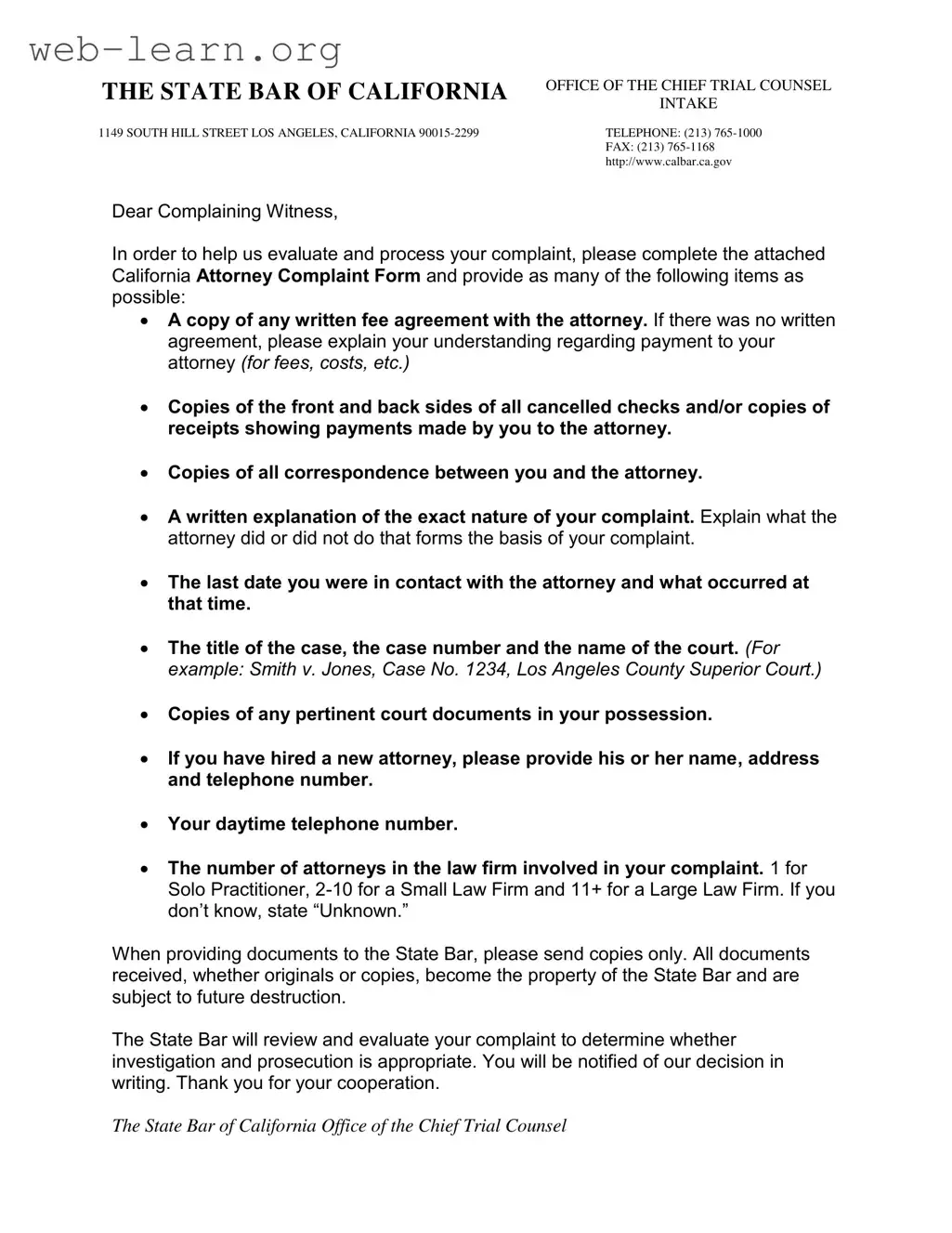
THE STATE BAR OF CALIFORNIA
OFFICE OF THE CHIEF TRIAL COUNSEL
INTAKE
1149 SOUTH HILL STREET LOS ANGELES, CALIFORNIA 90015-2299 TELEPHONE: (213) 765-1000
FAX: (213) 765-1168
http://www.calbar.ca.gov
Dear Complaining Witness,
In order to help us evaluate and process your complaint, please complete the attached
California Attorney Complaint Form and provide as many of the following items as
possible:
· A copy of any written fee agreement with the attorney. If there was no written
agreement, please explain your understanding regarding payment to your
attorney (for fees, costs, etc.)
· Copies of the front and back sides of all cancelled checks and/or copies of
receipts showing payments made by you to the attorney.
· Copies of all correspondence between you and the attorney.
· A written explanation of the exact nature of your complaint. Explain what the
attorney did or did not do that forms the basis of your complaint.
· The last date you were in contact with the attorney and what occurred at
that time.
· The title of the case, the case number and the name of the court. (For
example: Smith v. Jones, Case No. 1234, Los Angeles County Superior Court.)
· Copies of any pertinent court documents in your possession.
· If you have hired a new attorney, please provide his or her name, address
and telephone number.
· Your daytime telephone number.
· The number of attorneys in the law firm involved in your complaint. 1 for
Solo Practitioner, 2-10 for a Small Law Firm and 11+ for a Large Law Firm. If you
don’t know, state “Unknown.”
When providing documents to the State Bar, please send copies only. All documents
received, whether originals or copies, become the property of the State Bar and are
subject to future destruction.
The State Bar will review and evaluate your complaint to determine whether
investigation and prosecution is appropriate. You will be notified of our decision in
writing. Thank you for your cooperation.
The State Bar of California Office of the Chief Trial Counsel
THE STATE BAR OF CALIFORNIA
Instructions for Filing a Complaint Against a California Attorney
Fill out all spaces on the California Attorney Complaint Form completely. Provide
your name, address, zip code and telephone numbers (work and home).
Please mail, do not fax, your complaint form to the Office of the Chief Trial
Counsel/Intake, State Bar of California, 1149 South Hill Street, Los Angeles, California
90015-2299.
Be sure to give the full and complete name of the attorney you are complaining about.
Also, provide his address and telephone number. If you wish to complain about more
than one attorney, use a separate form for each attorney. If any of the blank spaces do
not apply to your case, write N/A (Not Applicable). Be sure to date and sign the form.
Please note #7 on the form and answer if known. If you do not know, state “Unknown.”
On a separate sheet of paper, tell us about your complaint against the attorney. We also
need to know the background of your case:
· What type of case is it?
· When did you hire the attorney?
· How did you choose the attorney?
· When did you meet the attorney?
· What was your agreement?
· Was the agreement verbal or in writing?
· Other pertinent information?
· Tell us in your own words what has happened so far in this case.
Some Things You Should Know
The Office of the Chief Trial Counsel (OCTC) reviews complaints of unethical conduct
by attorneys licensed to practice in California. Should OCTC prosecute allegations
contained in your complaint, you may be required to testify before the State Bar Court in
order to prove charges against the attorney(s) involved. Below is a list of what the State
Bar can and cannot do when it considers a complaint against an attorney:
· The State Bar can discipline or recommend that an attorney be disciplined only
for a violation of the State Bar Act or the Rules of Professional Conduct.
· The State Bar cannot advise or otherwise help you in any matters connected with
your complaint or in any other dispute in which you may be involved. For
example, it cannot decide whether an attorney’s particular fee is reasonable.
Attorney fees are not reimbursable simply because you are dissatisfied with the
services of your attorney or because the work was not completed. Some local
Bar Associations have a Fee Arbitration Committee. The State Bar’s Fee
Arbitration program is available should your local bar association not provide fee
arbitration. Attorneys are required to participate in fee arbitration initiated by their
clients, and fee arbitration is an informal, confidential and lower cost forum for
resolving fee disputes between lawyers and their clients.
· The State Bar cannot give you the name of a particular attorney to help you. If
you do not have an attorney and wish to hire one, contact a Lawyer Referral
Service in your area. The State Bar pamphlet “How Can I Find & Hire the Right
Lawyer” is available on the State Bar’s Web site, www.calbar.ca.gov (go to
Consumer Pamphlets).
· The law limits the authority of the State Bar. It cannot act as your lawyer. For
example, it cannot give you legal advice, or perform any other legal services for
you (such as pursuing damages or other legal action against the attorney(s)
involved in your complaint). You may have legal remedies available to you but
the State Bar cannot advise you what your rights are in a given situation or what
you should do. The State Bar is not a court that can provide civil remedies to you.
· If the State Bar files charges in the State Bar Court and obtains an order of
discipline, additional remedies such as restitution also may be ordered. In
addition, the State Bar has a Client Security Fund (CSF), which reimburses
specific monetary loss. Reimbursement covers the loss of money or property
resulting from lawyer dishonesty (but not simply because the lawyer acted
incompetently, committed malpractice or failed to take certain actions). To qualify
for CSF reimbursement, you must be able to show that the money or property
actually came into the lawyer's possession and that the loss was caused by the
lawyer's dishonest conduct. For example, the types of dishonest conduct that
may lead to reimbursement from CSF are theft or embezzlement, failure to
refund advanced attorney fees where the lawyer performed no services, the
borrowing of money from a client without intention to repay the money, obtaining
money or property from a client by representing that it would be used for
investment purposes when no investment is made, and an act of intentional
dishonesty or deceit that directly leads to the loss of money or property that
actually came into the lawyer’s possession. CSF cannot process applications for
reimbursement until final discipline has been ordered against the attorney by the
California Supreme Court.
THE STATE BAR OF CALIFORNIA
CALIFORNIA ATTORNEY COMPLAINT FORM
Read instructions before filling in this form.
Date:
(1) Your contact information:
Your name:
Your address:
Your city, state & zip code:
Your email address:
Your telephone numbers:
Home Work Cell
(2) Attorney’s contact information: Please provide the name, address and telephone
number of the attorney(s) you are complaining about. (NOTE: If you are complaining
about more than one attorney, include the information requested in items #2 through
#7 for each attorney. Use separate sheets if necessary.
Attorney’s name:
Attorney’s address:
Attorneys city, state & zip code:
Attorney’s telephone number:
(3)
Have you or a member of your family complained about this attorney(s) previously?
Yes No
If “Yes”, please state to whom the previous complaint was made, approximate
date of complaint and disposition.
(4) Did you employ the attorney? Yes No
If “Yes,” give the approximate date you employed the attorney(s) and the
amount, if any, paid to the attorney(s).
Date employed: Amount paid (if any): $
If “No,” what is your connection with the attorney(s)? Explain briefly.
(5) Include with this form (on a separate piece of paper) a statement of what the
attorney(s) did or did not do which is the basis of your complaint. Please state the
facts as you understand them. Do not include opinions or arguments. If you
employed the attorney(s), state what you employed the attorney(s) to do. Sign and
date each separate piece of paper. Additional information may be requested. (Attach
copies of pertinent documents such as a copy of the fee agreement, cancelled
checks or receipts and relevant correspondence.)
(6) If your complaint is about a lawsuit, answer the following, if known:
a. Name of court (For example, Superior or Municipal Court, and name of the county)
b. Title of the suit (For example, Smith v. Jones)
c. Case number of the suit
d. Approximate date the suit was filed
e. If you are not a party to this suit, what is your connection with it? Explain briefly.
(7) Size of law firm complained about:
1 Attorney
2 10 Attorneys
11 + Attorneys
Government Attorney
Unknown
Mail to:
Office of the Chief Trial Counsel/Intake
The State Bar of California
1149 South Hill Street
Los Angeles, California 90015-2299
Signature _____________________________________________________

Form Information

Fact Name Details
Purpose of the Form The California Attorney Complaint Form is designed to help individuals formally lodge complaints against attorneys for unethical conduct.
Submission Guidelines Complaints must be mailed to the Office of the Chief Trial Counsel in Los Angeles. Fax submissions are not accepted.
Required Information Complainants must provide personal contact information, details about the attorney, and a clear explanation of the complaint.
Documentation It is essential to include copies of any relevant documents, such as fee agreements and correspondence, to support the complaint.
Legal Authority The form operates under the State Bar Act and the Rules of Professional Conduct, which govern attorney behavior in California.
State Bar Limitations The State Bar cannot provide legal advice or assist in resolving disputes, as its role is strictly regulatory.

Detailed Guide for Filling Out California Attorney Complaint

Filling out the California Attorney Complaint form requires careful attention to detail. Once completed, the form should be mailed to the State Bar of California for review. This process is essential for addressing concerns about attorney conduct and ensuring that your complaint is properly evaluated.

  1. Obtain the California Attorney Complaint Form from the State Bar of California's website or through their office.
  2. Fill out your contact information completely, including your name, address, city, state, zip code, email address, and telephone numbers (home, work, and cell).
  3. Provide the attorney's contact information, including their full name, address, city, state, zip code, and telephone number. If you are complaining about more than one attorney, use a separate form for each.
  4. Indicate if you or a family member have previously complained about this attorney. If yes, provide details about the previous complaint.
  5. State whether you employed the attorney. If yes, include the approximate date of employment and the amount paid, if any. If no, briefly explain your connection to the attorney.
  6. On a separate sheet of paper, write a statement detailing what the attorney did or did not do that forms the basis of your complaint. Stick to the facts and avoid opinions or arguments. Include any relevant information about your case, such as the type of case, when you hired the attorney, and any agreements made.
  7. If your complaint relates to a lawsuit, provide additional details including the name of the court, title of the suit, case number, approximate date the suit was filed, and your connection to the suit if you are not a party to it.
  8. Indicate the size of the law firm involved in your complaint by selecting one of the options: 1 attorney, 2-10 attorneys, 11+ attorneys, government attorney, or unknown.
  9. Sign and date the form and any additional sheets of paper you have included.
  10. Mail the completed form and any supporting documents to the Office of the Chief Trial Counsel/Intake at the address provided: 1149 South Hill Street, Los Angeles, California 90015-2299.

Obtain Answers on California Attorney Complaint

  1. What is the purpose of the California Attorney Complaint Form?

    The California Attorney Complaint Form is designed to allow individuals to formally report unethical conduct by attorneys licensed to practice in California. By completing this form, a complainant provides the necessary information and documentation to the State Bar of California's Office of the Chief Trial Counsel. This office reviews complaints to determine if further investigation or action is warranted.

  2. What information do I need to provide when filing a complaint?

    When filling out the complaint form, you should include:

    • Your contact information (name, address, phone number)
    • The attorney's contact information (name, address, phone number)
    • A detailed statement explaining the nature of your complaint
    • Any relevant documents, such as fee agreements, receipts, and correspondence
    • Details about the case involved, including case title and number

    Completing the form thoroughly helps the State Bar evaluate your complaint effectively.

  3. Can I submit original documents with my complaint?

    No, you should only send copies of documents when filing your complaint. The State Bar will not return any documents submitted, as they become property of the State Bar and may be destroyed in the future. Therefore, it is crucial to keep your original documents for your records.

  4. What happens after I submit my complaint?

    Once the State Bar receives your complaint, it will review and evaluate the information provided. You will be notified in writing about the decision regarding your complaint. If the complaint warrants further investigation, the State Bar may take appropriate action against the attorney involved.

  5. What types of issues can the State Bar address?

    The State Bar can take disciplinary action against attorneys for violations of the State Bar Act or the Rules of Professional Conduct. However, it cannot assist with personal disputes, such as determining the reasonableness of attorney fees or providing legal advice. If you have a fee dispute, consider seeking resolution through a local Bar Association's Fee Arbitration Committee.

  6. Is there any financial assistance available if I suffered a loss due to an attorney's misconduct?

    Yes, the State Bar has a Client Security Fund (CSF) that may reimburse specific monetary losses caused by an attorney's dishonest conduct. However, to qualify for reimbursement, you must demonstrate that the loss resulted from the attorney's dishonesty, such as theft or embezzlement. The CSF cannot process applications until there has been a final discipline order against the attorney.

  7. How do I find a new attorney if I need legal representation?

    If you require legal assistance, the State Bar cannot recommend specific attorneys. Instead, you can contact a Lawyer Referral Service in your area. The State Bar also offers resources, such as pamphlets on finding and hiring the right lawyer, which can be found on their website.

Common mistakes

Filling out the California Attorney Complaint form requires attention to detail. One common mistake is failing to provide complete contact information. It is essential to include your name, address, and telephone numbers. Incomplete information can delay the processing of your complaint. Make sure all fields are filled accurately.

Another frequent error is neglecting to detail the attorney's information. Providing the full name, address, and telephone number of the attorney you are complaining about is critical. Omitting any of this information can hinder the investigation process. If you have multiple attorneys to complain about, use a separate form for each.

Many individuals also overlook the importance of including relevant documents. Attach copies of any written fee agreements, cancelled checks, and correspondence. These documents help substantiate your claims. Without them, your complaint may lack the necessary support for evaluation.

Additionally, failing to clearly explain the nature of your complaint is a common pitfall. The form requires a written explanation of what the attorney did or did not do that led to your complaint. Be specific and factual. Vague descriptions can lead to misunderstandings and may result in the dismissal of your complaint.

Another mistake is not providing a timeline of events. Indicate the last date you were in contact with the attorney and describe what occurred. A clear timeline helps the State Bar understand the context of your complaint. If this information is missing, it may complicate the review process.

Some complainants forget to sign and date the form. This step is crucial for the validity of your complaint. An unsigned form may be considered incomplete and could be returned for correction. Ensure that all necessary signatures are included before submission.

Finally, individuals sometimes fail to follow the submission guidelines. The form must be mailed to the correct address and not faxed. Adhering to the submission instructions is vital for ensuring your complaint is received and processed without unnecessary delays.

Documents used along the form

The California Attorney Complaint Form is an essential document for individuals wishing to file a complaint against an attorney. Along with this form, several other documents can enhance the complaint process. Below is a list of commonly used forms and documents that may accompany the complaint.

  • Written Fee Agreement: This document outlines the terms of payment and services between the client and the attorney. It is crucial for establishing the expectations and obligations of both parties.
  • Cancelled Checks or Receipts: Providing copies of payments made to the attorney helps demonstrate the financial transactions involved. These documents can support claims related to fees and services rendered.
  • Correspondence Records: Copies of all communications between the client and the attorney can clarify the interactions and issues faced. This includes emails, letters, and messages that may be relevant to the complaint.
  • Written Explanation of the Complaint: A detailed account of the issues with the attorney is necessary. This should include specific actions or inactions that led to the complaint, presented in a clear and factual manner.
  • Court Documents: Any relevant court filings or judgments related to the case in question can provide context and support for the complaint. This includes case numbers and titles.
  • Contact Information for New Attorney: If the client has since hired a new attorney, providing their contact details can be helpful for follow-up or clarification on the case.
  • Daytime Telephone Number: Including a reliable phone number allows the State Bar to reach the complainant easily for any further information or clarification needed during the review process.

Gathering these documents can significantly strengthen the complaint and assist the State Bar in its evaluation. It is important to ensure all information is accurate and complete to facilitate a thorough review of the case.

Similar forms

The California Attorney Complaint form shares similarities with several other legal documents designed to address grievances and facilitate communication in legal contexts. Below is a list of ten documents that are comparable, along with explanations of their similarities.

  • Client Grievance Form: This document allows clients to formally express their dissatisfaction with an attorney's services, similar to the California Attorney Complaint form which seeks to gather specific details about the complaint.
  • Legal Malpractice Complaint: Clients can file this complaint when they believe their attorney has failed to perform competently. Both documents require a detailed account of the alleged misconduct.
  • Bar Association Complaint Form: State bar associations often have their own complaint forms for reporting unethical behavior. Like the California form, these documents collect information about the attorney's actions and the client's experience.
  • Fee Dispute Resolution Form: This form is used when clients dispute legal fees charged by their attorney. It similarly requires documentation and a clear statement of the issue at hand.
  • Consumer Complaint Form: Many states offer consumer complaint forms for various services, including legal services. These forms often ask for a narrative of the issue, akin to the narrative required in the California Attorney Complaint form.
  • Request for Investigation Form: This form is submitted to regulatory bodies when individuals believe a professional has violated regulations. It parallels the California form in its purpose to initiate an inquiry into professional conduct.
  • Legal Aid Complaint Form: Legal aid organizations often have forms for clients to report issues with their representation. Both forms aim to document the nature of the complaint and the context surrounding it.
  • Judicial Complaint Form: Individuals can use this form to report misconduct by judges. Both documents emphasize the need for detailed information and evidence to support the claims made.
  • Professional Conduct Complaint Form: Similar to the California Attorney Complaint form, this document is used to report violations of professional standards by various licensed professionals, requiring detailed accounts of the alleged misconduct.
  • Whistleblower Complaint Form: This form is used to report unethical or illegal activities within an organization. It shares a similar structure in that it requires a detailed explanation of the complaint and supporting documentation.

Dos and Don'ts

When filling out the California Attorney Complaint form, it's important to follow specific guidelines to ensure your complaint is processed effectively. Below are six things you should and shouldn't do:

  • Do: Fill out all sections of the form completely. Provide your full name, address, and contact numbers.
  • Do: Include copies of any relevant documents, such as fee agreements and correspondence with the attorney.
  • Do: Clearly explain the nature of your complaint in your own words.
  • Do: Mail the completed form to the designated address rather than faxing it.
  • Don't: Leave any blank spaces on the form. If a section does not apply, write "N/A."
  • Don't: Submit original documents. Only send copies, as originals will not be returned.

Misconceptions

Misconceptions about the California Attorney Complaint form can lead to confusion and frustration for those seeking to file a complaint. Here are nine common misconceptions:

  1. The form is only for serious misconduct. Many believe that only severe violations warrant a complaint. However, any ethical concern regarding an attorney’s conduct can be reported.
  2. Complaints can be submitted anonymously. While confidentiality is respected, the State Bar requires your contact information to follow up on your complaint.
  3. The State Bar can provide legal advice. Some people think that by filing a complaint, they will receive legal guidance. The State Bar does not offer legal advice or representation.
  4. Filing a complaint guarantees a refund. Many assume that if they are dissatisfied with their attorney, they will automatically get their money back. The State Bar does not reimburse fees simply due to dissatisfaction.
  5. The State Bar can resolve disputes between clients and attorneys. Some believe that the State Bar acts as a mediator. In reality, it can only discipline attorneys for violations of the law or ethical rules.
  6. All complaints result in disciplinary action. Individuals may think that every filed complaint will lead to sanctions against the attorney. The State Bar evaluates each case and may determine no action is necessary.
  7. Submitting the form is the only step needed. Some people think that filling out the form alone is sufficient. Detailed documentation and a clear explanation of the complaint are essential for effective processing.
  8. The complaint process is quick. Many expect a swift resolution. In reality, the review process can take time, as thorough investigations are necessary.
  9. Complaints can be filed via fax or email. Some assume that electronic submissions are acceptable. The State Bar specifically requests that complaints be mailed in.

Understanding these misconceptions can help individuals navigate the complaint process more effectively and manage their expectations.

Key takeaways

Understanding the California Attorney Complaint Form is essential for anyone considering filing a complaint against an attorney. Here are some key takeaways that can help streamline the process:

  • Complete all sections of the form thoroughly. Ensure that you provide your contact information, as well as the attorney's details, including their name, address, and phone number.
  • Attach relevant documentation. Include copies of any written fee agreements, cancelled checks, receipts, and correspondence related to your case. This information will support your complaint.
  • Clearly outline your complaint. On a separate sheet, provide a detailed explanation of what the attorney did or did not do that prompted your complaint. Include specific facts and avoid opinions.
  • Understand the limitations of the State Bar. The State Bar can only discipline attorneys for violations of the State Bar Act or the Rules of Professional Conduct. They cannot provide legal advice or assist in resolving disputes over fees.