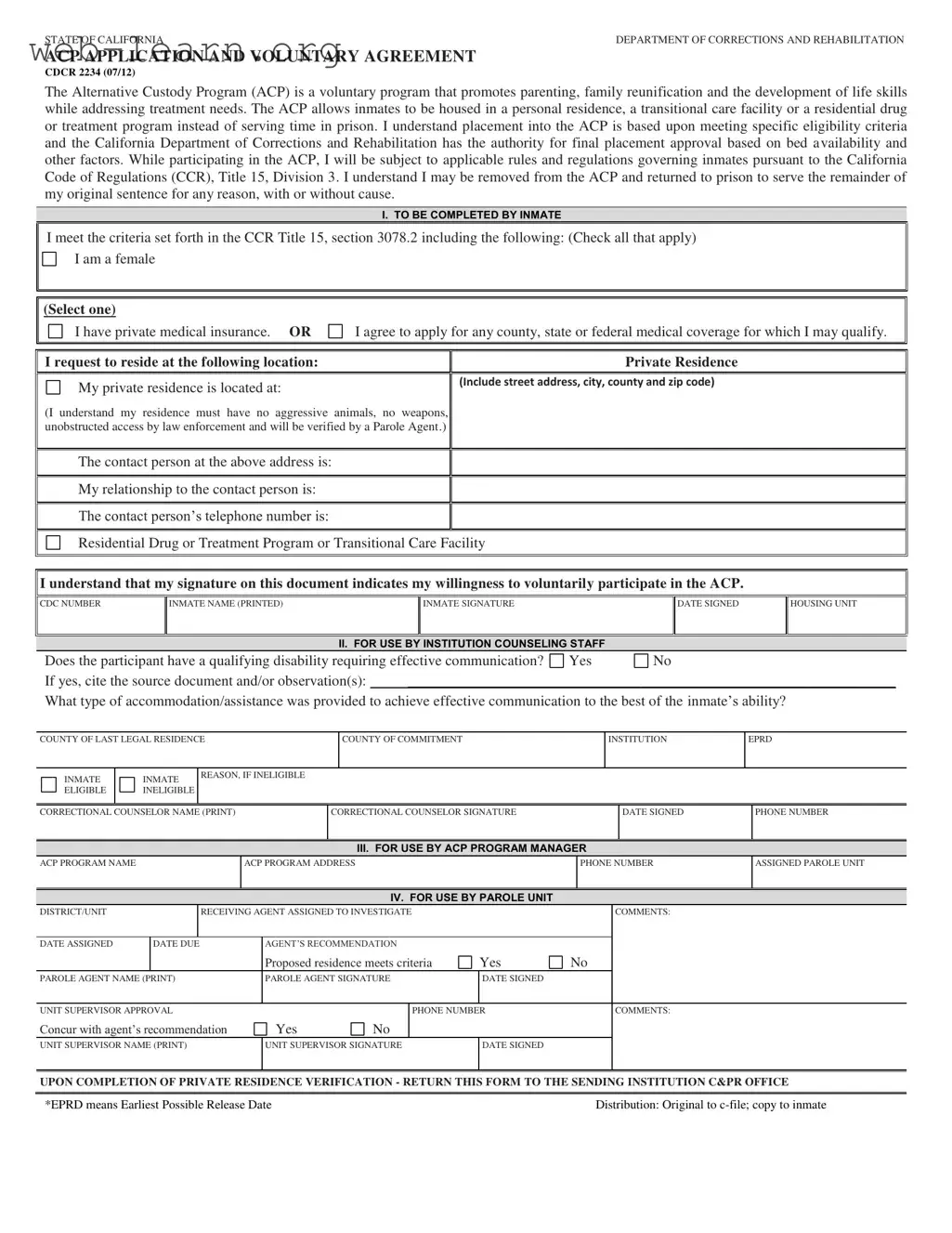
Homepage Blank California Alternative Custody Form
Outline

The California Alternative Custody Program (ACP) offers a transformative opportunity for eligible inmates seeking to reunite with their families while developing essential life skills. This voluntary program allows participants to serve their time in more supportive environments, such as their personal residences, transitional care facilities, or residential drug treatment programs, rather than within the confines of a traditional prison. The ACP is designed to address the treatment needs of inmates, fostering an atmosphere conducive to personal growth and family bonding. However, eligibility for this program is not universal; specific criteria must be met, and the final approval rests with the California Department of Corrections and Rehabilitation, which considers factors like bed availability. While enrolled in the ACP, participants must adhere to established rules and regulations, ensuring that the program maintains its integrity and effectiveness. Inmates must also understand that they can be returned to prison at any time for various reasons, emphasizing the importance of compliance and commitment to the program. The application process involves detailed information about the inmate's background, living arrangements, and any necessary accommodations, ensuring that the transition into alternative custody is as smooth as possible.

Sample - California Alternative Custody Form

STATE OF CALIFORNIA
DEPARTMENT OF CORRECTIONS AND REHABILITATION
ACP APPLICATION AND VOLUNTARY AGREEMENT
CDCR 2234 (07/12)
The Alternative Custody Program (ACP) is a voluntary program that promotes parenting, family reunification and the development of life skills
while addressing treatment needs. The ACP allows inmates to be housed in a personal residence, a transitional care facility or a residential drug
or treatment program instead of serving time in prison. I understand placement into the ACP is based upon meeting specific eligibility criteria
and the California Department of Corrections and Rehabilitation has the authority for final placement approval based on bed availability and
other factors. While participating in the ACP, I will be subject to applicable rules and regulations governing inmates pursuant to the California
Code of Regulations (CCR), Title 15, Division 3. I understand I may be removed from the ACP and returned to prison to serve the remainder of
my original sentence for any reason, with or without cause.
I. TO BE COMPLETED BY INMATE
I meet the criteria set forth in the CCR Title 15, section 3078.2 including the following: (Check all that apply)
I am a female
(Select one)
OR
I have private medical insurance.
I request to reside at the following location:
Private Residence
My private residence is located at:
(I understand my residence must have no aggressive animals, no weapons,
unobstructed access by law enforcement and will be verified by a Parole Agent.)
(Include street address, city, county and zip code)
The contact person at the above address is:
My relationship to the contact person is:
The contact person’s telephone number is:
Residential Drug or Treatment Program or Transitional Care Facility
I understand that my signature on this document indicates my willingness to voluntarily participate in the ACP.
CDC NUMBER
INMATE NAME (PRINTED)
INMATE SIGNATURE
DATE SIGNED
HOUSING UNIT
II. FOR USE BY INSTITUTION COUNSELING STAFF
Does the participant have a qualifying disability requiring effective communication? Yes No
If yes, cite the source document and/or observation(s): ___________________________________________________________________
What type of accommodation/assistance was provided to achieve effective communication to the best of the inmate’s ability?
COUNTY OF LAST LEGAL RESIDENCE
COUNTY OF COMMITMENT
INSTITUTION
EPRD
INMATE
ELIGIBLE
INMATE
INELIGIBLE
REASON, IF INELIGIBLE
CORRECTIONAL COUNSELOR NAME (PRINT)
CORRECTIONAL COUNSELOR SIGNATURE
DATE SIGNED
PHONE NUMBER
III. FOR USE BY ACP PROGRAM MANAGER
ACP PROGRAM NAME
ACP PROGRAM ADDRESS
PHONE NUMBER
ASSIGNED PAROLE UNIT
IV. FOR USE BY PAROLE UNIT
DISTRICT/UNIT
RECEIVING AGENT ASSIGNED TO INVESTIGATE
COMMENTS:
DATE ASSIGNED
DATE DUE
AGENT’S RECOMMENDATION
Proposed residence meets criteria Yes No
PAROLE AGENT NAME (PRINT)
PAROLE AGENT SIGNATURE
DATE SIGNED
UNIT SUPERVISOR APPROVAL
Concur with agent’s recommendation
Yes No
PHONE NUMBER
COMMENTS:
UNIT SUPERVISOR NAME (PRINT)
UNIT SUPERVISOR SIGNATURE
DATE SIGNED
UPON COMPLETION OF PRIVATE RESIDENCE VERIFICATION - RETURN THIS FORM TO THE SENDING INSTITUTION C&PR OFFICE
*EPRD means Earliest Possible Release Date Distribution: Original to c-file; copy to inmate

Form Information

Fact Name Details
Program Purpose The Alternative Custody Program (ACP) aims to support parenting, family reunification, and the development of life skills while addressing treatment needs for inmates.
Housing Options Inmates can be housed in a personal residence, a transitional care facility, or a residential drug or treatment program instead of serving time in prison.
Eligibility Criteria Eligibility for the ACP is determined by specific criteria outlined in the California Code of Regulations (CCR), Title 15, section 3078.2.
Authority and Removal The California Department of Corrections and Rehabilitation has the final authority for placement approval. Inmates may be removed from the ACP and returned to prison for any reason, with or without cause.

Detailed Guide for Filling Out California Alternative Custody

After completing the California Alternative Custody form, the next steps involve submitting the form to the appropriate authorities for review. This process ensures that all necessary information is evaluated, and eligibility is determined based on the criteria set forth by the California Department of Corrections and Rehabilitation.

  1. Obtain the form: Access the California Alternative Custody Program (ACP) application form, CDCR 2234, from the California Department of Corrections and Rehabilitation website or your institution.
  2. Fill in your personal information: Write your CDC number, printed name, and signature in the designated areas at the top of the form. Include the date you are signing the form.
  3. Check eligibility criteria: Indicate whether you meet the criteria by checking all applicable boxes. Confirm if you are female and whether you have private medical insurance or agree to apply for medical coverage.
  4. Provide your requested residence: Specify the address of your private residence, including street address, city, county, and zip code. Ensure that you understand the requirements for the residence.
  5. Identify a contact person: Fill in the name of the contact person at your residence, your relationship to that person, and their telephone number.
  6. Sign the form: Ensure you sign and date the form at the bottom, confirming your willingness to participate in the ACP.
  7. Submit the form: Return the completed form to the appropriate institution counseling staff for further processing and evaluation.

Obtain Answers on California Alternative Custody

  1. What is the California Alternative Custody Program (ACP)?

    The California Alternative Custody Program (ACP) is a voluntary initiative designed to support inmates in their roles as parents and to promote family reunification. It also focuses on helping inmates develop essential life skills while addressing their treatment needs. Instead of serving time in prison, eligible inmates can be housed in a personal residence, a transitional care facility, or a residential drug or treatment program.

  2. Who is eligible to participate in the ACP?

    To qualify for the ACP, inmates must meet specific criteria outlined in the California Code of Regulations (CCR), Title 15, section 3078.2. This includes being female, having private medical insurance, or agreeing to apply for available medical coverage. Additionally, the inmate must provide a suitable residence that meets safety and access requirements.

  3. What are the requirements for the residence where an inmate will stay?

    The chosen residence must adhere to certain conditions: it should not have aggressive animals, must be free of weapons, and should allow unobstructed access for law enforcement. The residence will be verified by a Parole Agent to ensure compliance with these requirements.

  4. Can an inmate be removed from the ACP once they are approved?

    Yes, participation in the ACP is not guaranteed for the entire duration. Inmates can be removed from the program and returned to prison to serve the remainder of their original sentence for various reasons, which may include violations of program rules or other circumstances.

  5. What happens if an inmate has a disability?

    If an inmate has a qualifying disability that requires effective communication, the institution’s counseling staff must document this. They will also provide necessary accommodations to ensure the inmate can effectively participate in the program.

  6. What is the role of the Parole Agent in the ACP?

    The Parole Agent plays a crucial role in the ACP. They are responsible for investigating the proposed residence, ensuring it meets all criteria, and making recommendations regarding the inmate's placement in the program. Their approval is essential for the inmate to participate.

  7. What should inmates do if they want to apply for the ACP?

    Inmates interested in applying for the ACP must complete the required application form, indicating their willingness to participate voluntarily. They must also provide information about their proposed residence and any relevant medical coverage they may have or need to apply for.

  8. How can family members or friends support an inmate applying for the ACP?

    Family members or friends can assist by ensuring the proposed residence meets the ACP requirements. They can also help the inmate gather necessary documentation, such as medical insurance information, and provide emotional support throughout the application process.

Common mistakes

When filling out the California Alternative Custody form, many individuals make common mistakes that can delay or jeopardize their application. One frequent error is failing to check all applicable eligibility criteria. The form requires inmates to indicate if they meet specific conditions, such as being female or having private medical insurance. Missing even one box can lead to complications in the approval process.

Another mistake is providing incomplete or incorrect information regarding the proposed residence. The form asks for the full street address, city, county, and zip code. Omitting any of these details can result in rejection. Additionally, it's crucial to ensure that the residence meets the program’s safety requirements, such as having no aggressive animals or weapons.

Some applicants neglect to include a contact person at their proposed residence. This oversight can hinder the verification process. The form requires not just the contact person's name, but also their relationship to the inmate and a valid telephone number. Failing to provide this information can cause delays in the application review.

Inmates often forget to sign and date the form, which is a critical step. Without a signature, the application is considered incomplete. It's essential to double-check that the signature matches the printed name to avoid any confusion.

Another common error involves misunderstanding the eligibility requirements. Some inmates may assume they qualify without fully reviewing the criteria listed in the California Code of Regulations. This misunderstanding can lead to submitting an application that is ultimately deemed ineligible.

Additionally, applicants may overlook the section regarding disabilities and effective communication. If applicable, it’s vital to provide details about any accommodations that were made. Ignoring this section can result in unnecessary complications.

Some individuals fill out the form hastily, leading to typographical errors or unclear handwriting. Such mistakes can cause confusion and may require additional follow-up. Taking the time to write clearly and review the form can help prevent these issues.

Another mistake is not keeping a copy of the completed form. Without a record, it can be challenging to track the application status or provide additional information if needed. Keeping a copy is a simple but effective way to stay organized.

Lastly, failing to follow up after submitting the form can be detrimental. Applicants should be proactive in checking the status of their application to ensure it is being processed. Delays can occur, and staying informed can help address any issues quickly.

Documents used along the form

The California Alternative Custody Program (ACP) is a significant initiative designed to support inmates in their journey towards rehabilitation while allowing them to maintain family connections. Several forms and documents accompany the ACP application to ensure a comprehensive evaluation of eligibility and compliance with program requirements. Below is a list of related documents that are often utilized in conjunction with the California Alternative Custody form.

  • Inmate Eligibility Assessment Form: This document evaluates whether an inmate meets the specific criteria for participation in the ACP, including factors such as age, gender, and health status.
  • Residency Verification Form: This form is used to confirm the proposed residence for the inmate's placement, ensuring it meets safety and accessibility standards as required by the program.
  • Medical Evaluation Form: A comprehensive assessment of the inmate's health needs, this document is essential for determining eligibility for medical accommodations during the ACP.
  • Parole Plan Document: This outlines the inmate's plan for supervision upon release, including details about employment, housing, and family support, which are critical for successful reintegration.
  • Behavioral Assessment Report: This report evaluates the inmate’s behavior and psychological state, providing insight into their readiness for alternative custody and potential risks involved.
  • Informed Consent Form: This document ensures that the inmate understands the terms and conditions of participating in the ACP, including the possibility of being returned to prison if necessary.
  • Support Network Documentation: This includes letters or statements from family members or community support services, affirming their willingness to assist the inmate during their time in the ACP.

These documents collectively facilitate the assessment and approval process for inmates seeking to participate in the California Alternative Custody Program. They ensure that all necessary information is gathered to support the inmate's transition while prioritizing safety and compliance with program regulations.

Similar forms

The California Alternative Custody form shares similarities with several other legal documents designed for specific custody and rehabilitation purposes. Here are eight documents that are comparable:

  • Parole Application Form: Like the Alternative Custody Program (ACP), this form is used by inmates seeking to transition from incarceration to community supervision. Both processes focus on reintegration and rehabilitation.
  • Probation Application: This document allows individuals convicted of a crime to serve their sentence under supervision in the community, similar to how the ACP allows inmates to serve time outside prison while adhering to specific conditions.
  • Residential Treatment Program Agreement: Inmates participating in this program, much like the ACP, agree to reside in a treatment facility to address substance abuse or mental health issues, promoting recovery and reintegration.
  • Home Confinement Agreement: This document outlines the terms under which an individual can serve their sentence at home, paralleling the ACP's focus on maintaining family connections and community ties.
  • Work Release Program Application: Inmates apply for this program to work in the community while serving their sentence. Both the work release and ACP emphasize skill development and community involvement.
  • Compassionate Release Application: This document allows inmates with serious health issues to be released early, similar to how the ACP considers individual circumstances for placement outside of prison.
  • Transitional Housing Application: This form is for individuals transitioning from incarceration to independent living, much like the ACP's aim to facilitate a smooth return to society.
  • Family Reunification Plan: This document outlines strategies for maintaining family connections during incarceration. Both the ACP and this plan focus on the importance of family support in the rehabilitation process.

Dos and Don'ts

When filling out the California Alternative Custody form, it is important to follow specific guidelines to ensure a smooth application process. Here are six things you should and shouldn't do:

  • Do check all eligibility criteria carefully before submitting the form.
  • Don't leave any required fields blank; incomplete forms may delay processing.
  • Do provide accurate and detailed information about your residence and contact person.
  • Don't provide misleading or false information, as this can lead to disqualification.
  • Do ensure that your signature is present and dated at the end of the form.
  • Don't forget to verify that the proposed residence meets all necessary criteria before submission.

Misconceptions

Misconceptions about the California Alternative Custody form can lead to confusion and misinformed decisions. Here are nine common misunderstandings:

  • Misconception 1: The Alternative Custody Program (ACP) is mandatory.
  • The ACP is entirely voluntary. Inmates can choose whether or not to participate based on their circumstances and eligibility.

  • Misconception 2: All inmates are eligible for the ACP.
  • Eligibility is determined by specific criteria outlined in the California Code of Regulations. Not every inmate will meet these requirements.

  • Misconception 3: Participation guarantees early release from prison.
  • While the ACP may allow for a different living arrangement, it does not guarantee that an inmate will be released earlier than their original sentence.

  • Misconception 4: The ACP is a form of parole.
  • The ACP is distinct from parole. It allows inmates to serve their time in a different environment, but they remain under the authority of the California Department of Corrections and Rehabilitation.

  • Misconception 5: Inmates can choose any location for residence.
  • Inmates must propose a residence that meets specific criteria, including safety and accessibility for law enforcement verification.

  • Misconception 6: Once accepted, inmates cannot be removed from the ACP.
  • Inmates can be removed from the ACP at any time for various reasons, including violations of rules or regulations.

  • Misconception 7: The ACP does not require any supervision.
  • Inmates in the ACP remain subject to rules and regulations governing inmates, and their activities are monitored by parole agents.

  • Misconception 8: Medical insurance is not necessary for ACP participation.
  • Inmates must either have private medical insurance or agree to apply for government medical coverage to qualify for the program.

  • Misconception 9: The ACP is only for female inmates.
  • While the form mentions female inmates, the ACP is available to eligible inmates of all genders, provided they meet the criteria.

Key takeaways

Key Takeaways for Filling Out and Using the California Alternative Custody Form

  • The Alternative Custody Program (ACP) is voluntary and focuses on parenting, family reunification, and life skills development.
  • Inmates can be housed in a personal residence, transitional care facility, or residential drug treatment program.
  • Eligibility criteria must be met, and final placement approval is determined by the California Department of Corrections and Rehabilitation.
  • While in the ACP, inmates must follow the rules set forth in the California Code of Regulations.
  • Inmates can be removed from the ACP and returned to prison for any reason, with or without cause.
  • Inmates must provide accurate information about their private residence, including address and contact person details.
  • Effective communication accommodations must be noted if the inmate has a qualifying disability.
  • Once the form is completed and verified, it should be returned to the sending institution's C&PR office for processing.