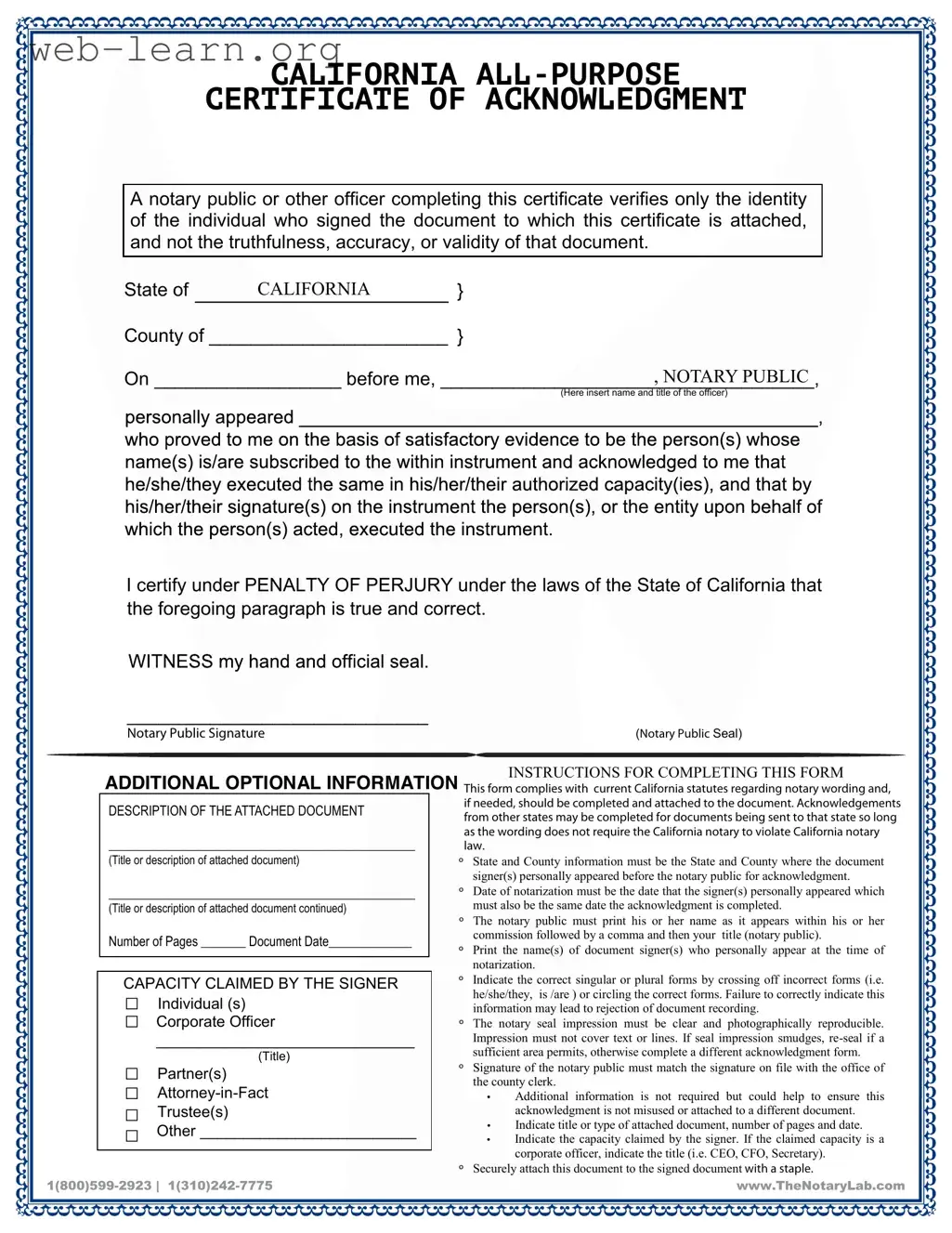
Homepage Blank California Acknowledgement Certificate Form
Outline

The California Acknowledgement Certificate form serves a vital role in the notarization process, ensuring that the identities of individuals signing a document are verified. This form is essential for establishing the legitimacy of signatures, as it confirms that the signers appeared before a notary public or other authorized officer. The notary's role is limited to verifying identity; they do not assess the truthfulness or validity of the document itself. Key elements of the form include the state and county where the notarization occurs, the date of the signing, and the names of the individuals involved. Additionally, the notary must provide their signature and official seal, which must be clear and legible. The form allows for optional information, such as a description of the attached document and the capacity in which the signer is acting, which can aid in preventing misuse. Overall, the California Acknowledgement Certificate is a straightforward yet crucial tool in the legal process, ensuring that documents are properly executed and recognized.
Sample - California Acknowledgement Certificate Form

1(800)599-2923 | 1(310)242-7775 www.TheNotaryLab.com
ADDITIONAL OPTIONAL INFORMATION
CAPACITY CLAIMED BY THE SIGNER
Individual (s)
Corporate Officer
______________________________
(Title)
Partner(s)
Attorney-in-Fact
Trustee(s)
Other _________________________
INSTRUCTIONS FOR COMPLETING THIS FORM
This form complies with current California statutes regarding notary wording and,
if needed, should be completed and attached to the document. Acknowledgements
from other states may be completed for documents being sent to that state so long
as the wording does not require the California notary to violate California notary
law.
º State and County information must be the State and County where the document
signer(s) personally appeared before the notary public for acknowledgment.
º Date of notarization must be the date that the signer(s) personally appeared which
must also be the same date the acknowledgment is completed.
º The notary public must print his or her name as it appears within his or her
commissi
on followed by a comma and then your title (notary public).
º Print the name(s) of document signer(s) who personally appear at the time of
notarization.
º Indicate the correct singular or plural forms by crossing off incorrect forms (i.e.
he/she/they, is /are ) or circling the correct forms. Failure to correctly indicate this
information may lead to rejection of document recording.
º The notary seal impression must be clear and pho
tographically reproducible.
Impression must not cover text or lines. If seal impression smudges, re-seal if a
sufficient area permits, otherwise complete a different acknowledgment form.
º Signature of the notary public must match the signature on file with the office of
the county clerk.
Additional information is not required but could help to ensure this
acknowledgment is not misused or attached to a different document.
Indic
ate title or type of attached document, number of pages and date.
Indicate the capacity claimed by the signer. If the claimed capacity is a
corporate officer, indicate the title (i.e. CEO, CFO, Secretary).
º Securely attach this document to the signed document with a staple.
DESCRIPTION OF THE ATTACHED DOCUMENT
________________________________________________
(Title or description of attached document)
________________________________________________
(Title or description of attached document continued)
Number of Pages _______ Document Date_____________
_____________________________
Notary Public Signature
(Notary Public Seal)
A notary public or other officer completing this certificate verifies only the identity
of the individual who signed the document to which this certificate is attached,
and not the truthfulness, accuracy, or validity of that document.
State of
County of _______________________
On __________________ before me, ____________________________________,
I certify under PENALTY OF PERJURY under the laws of the State of California that
the foregoing paragraph is true and correct.
(Here insert name and title of the officer)
the
CALIFORNIA
, NOTARY PUBLIC
CALIFORNIA ALL-PURPOSE
CERTIFICATE OF ACKNOWLEDGMENT

Form Information

Fact Name Description
Purpose of the Certificate This form is used to verify the identity of individuals signing a document, not the document's content.
Governing Law The California Acknowledgment Certificate is governed by California Civil Code Section 1185.
Notary's Role A notary public must ensure the signer appears in person and provides satisfactory evidence of their identity.
Date Requirements The date of notarization must match the date when the signer appears before the notary.
Seal Requirements The notary's seal must be clear and should not obscure any text on the certificate.
Signature Matching The notary's signature on the certificate must match the signature on file with the county clerk.
Optional Information While additional information can be included, it is not mandatory for the acknowledgment to be valid.

Detailed Guide for Filling Out California Acknowledgement Certificate

Filling out the California Acknowledgment Certificate form is an important step in ensuring that your document is properly notarized. After completing the form, it will be attached to the document that requires acknowledgment. This form verifies the identity of the signer and confirms that they executed the document in their authorized capacity.

  1. Begin by entering the State and County where the notarization takes place in the designated spaces.
  2. Write the Date of notarization, which must match the date the signer appears before the notary.
  3. In the line for Notary Public Name, print your name as it appears on your notary commission, followed by a comma and your title (Notary Public).
  4. In the section for Signer’s Name, print the name(s) of the individual(s) who personally appeared before you.
  5. Indicate the Capacity Claimed by the Signer. Cross off incorrect forms and circle the correct ones, ensuring that the singular or plural forms are used correctly.
  6. In the Description of the Attached Document section, provide a title or description of the document being acknowledged.
  7. Indicate the Number of Pages of the attached document and the Document Date.
  8. Ensure that your Notary Seal Impression is clear and does not cover any text or lines. If the seal is smudged, re-seal if possible, or complete a new acknowledgment form.
  9. Sign the form in the Notary Public Signature section, ensuring that your signature matches the one on file with the county clerk.
  10. Finally, securely attach this completed acknowledgment form to the signed document with a staple.

Obtain Answers on California Acknowledgement Certificate

  1. What is the purpose of the California Acknowledgment Certificate form?

    The California Acknowledgment Certificate form is used by notaries public to verify the identity of individuals signing a document. It serves as proof that the signer appeared before the notary and acknowledged their signature on the document. Importantly, the notary does not verify the truthfulness or accuracy of the document itself.

  2. Who can complete this form?

    This form can be completed by a notary public or other authorized officers. These individuals are trained to confirm the identity of the signer and to ensure that the acknowledgment process adheres to California law.

  3. What information is required on the form?

    To properly complete the form, the following information is needed:

    • The state and county where the signer appeared.
    • The date of notarization, which must match the date the signer appeared.
    • The name and title of the notary public.
    • The names of the signers who appeared before the notary.
    • The capacity claimed by the signer, such as individual, corporate officer, or attorney-in-fact.
  4. What if the signer is a corporate officer?

    If the signer is acting as a corporate officer, it is essential to indicate their title, such as CEO or Secretary. This ensures clarity about the authority under which they are signing the document.

  5. How should the notary seal be applied?

    The notary seal must be clear and easily reproducible. It should not cover any text or lines on the form. If the seal is smudged or unclear, the notary should reapply it if possible or complete a new acknowledgment form.

  6. Is additional information required on the form?

    While additional information is not mandatory, including details such as the title of the attached document, the number of pages, and the document date can help prevent misuse of the acknowledgment. This extra information can also facilitate smoother processing of the document.

  7. What happens if the form is not completed correctly?

    If the form is filled out incorrectly, it may lead to rejection when the document is submitted for recording. This could delay the process and require the signer to obtain a new acknowledgment. It is crucial to ensure all information is accurate before finalizing the document.

  8. Can I use this form for documents from other states?

    Yes, acknowledgments from other states can be completed as long as the wording does not conflict with California notary laws. If you are sending a document to another state, make sure to check their specific requirements.

  9. How should the Acknowledgment Certificate be attached to the document?

    The Acknowledgment Certificate should be securely attached to the signed document, typically with a staple. This ensures that the acknowledgment stays with the document it pertains to, preventing any mix-up.

  10. What is the penalty for providing false information on the form?

    Providing false information on the Acknowledgment Certificate can result in serious legal consequences. Notaries are required to certify under penalty of perjury that the information they provide is true and correct. Misrepresentation can lead to criminal charges and loss of notary commission.

Common mistakes

Filling out the California Acknowledgment Certificate form might seem straightforward, but many people make common mistakes that can lead to complications. One frequent error is neglecting to provide the correct State and County information. It’s essential to list the specific state and county where the signer personally appeared. If this information is incorrect or missing, it could invalidate the acknowledgment.

Another common mistake involves the date of notarization. This date must match the day the signer appears before the notary. If the dates don’t align, the document may face rejection. It's crucial to double-check that you are entering the correct date in the appropriate section of the form.

People often overlook the importance of the notary's name. The notary must print their name exactly as it appears on their commission, followed by a comma and the title “notary public.” Failing to do this correctly can lead to confusion and potential issues with the document's validity.

Additionally, many individuals forget to indicate the capacity claimed by the signer. This section requires careful attention to detail. It's important to mark the correct singular or plural forms by crossing off incorrect options or circling the right ones. An oversight here can result in the document being rejected for not accurately reflecting the signer’s role.

Another mistake is related to the notary seal impression. The seal must be clear and not cover any text or lines. If the impression is smudged, it’s crucial to either re-seal it, if possible, or complete a new acknowledgment form. A blurry seal can lead to questions about the document's authenticity.

Sometimes, people forget to securely attach the acknowledgment to the signed document. Using a staple is recommended to ensure that both documents stay together. If the acknowledgment is detached, it may be considered invalid.

Lastly, individuals often skip the optional information section. While it’s not required, providing details like the title or type of attached document, number of pages, and document date can help clarify the acknowledgment's purpose. This additional information can prevent misunderstandings down the line.

By avoiding these common mistakes, you can ensure that your California Acknowledgment Certificate form is completed correctly. Taking the time to review each section carefully can save you from potential headaches in the future.

Documents used along the form

The California Acknowledgment Certificate form is an essential document used in the notarization process. It verifies the identity of individuals who sign a document but does not guarantee the truthfulness of the content. Alongside this form, several other documents and forms are often utilized to ensure proper legal procedures are followed. Below is a list of some of these important forms.

  • Notary Journal: This is a record kept by the notary public documenting each notarization performed. It includes details such as the date, type of document, and identification of the signer.
  • Power of Attorney: This legal document allows one person to act on behalf of another in legal or financial matters. It often requires notarization to be valid.
  • Grant Deed: This document transfers ownership of real property from one party to another. A notary may be needed to witness the signing of this deed.
  • Affidavit: An affidavit is a written statement confirmed by oath or affirmation. Notarization helps ensure the authenticity of the document and the truthfulness of the statements made.
  • Living Trust: This document outlines how a person’s assets will be managed during their lifetime and distributed after death. Notarization can help validate the trust's creation and execution.
  • Quitclaim Deed: This type of deed transfers any interest one person has in a property to another without making any promises about the title. Notarization is often required for the deed to be legally effective.
  • Marriage License: This official document permits a couple to marry. Some jurisdictions require notarization to validate the license.
  • Release of Liability: This document protects one party from legal claims made by another. Notarization can help confirm that all parties understand and agree to the terms of the release.

Each of these documents plays a significant role in various legal processes. Understanding their purposes and how they relate to the California Acknowledgment Certificate can help individuals navigate the complexities of legal documentation with greater ease.

Similar forms

The California Acknowledgment Certificate form serves a specific purpose in verifying the identity of individuals signing a document. Several other documents share similarities with this form, often relating to the acknowledgment of signatures or the verification of identity. Below is a list of nine documents that are similar to the California Acknowledgment Certificate, along with a brief explanation of how they relate to it.

  • Notary Acknowledgment Form: This document, used in many states, serves the same purpose as the California Acknowledgment Certificate by confirming the identity of the signers and their acknowledgment of the document.
  • Jurats: A jurat is a notarial act where the signer swears or affirms the truthfulness of the contents of a document. Like the acknowledgment, it requires the presence of the signer before the notary.
  • Affidavit: An affidavit is a written statement confirmed by oath or affirmation. While it serves a different purpose, it often includes a notary's acknowledgment of the signer’s identity.
  • Certificate of Authentication: This document verifies the authenticity of a signature or document. It is similar in that it often involves the notary confirming the identity of the signer.
  • Power of Attorney (POA): When a POA is notarized, the notary acknowledges the identity of the principal. This process is akin to the acknowledgment certificate in that it verifies who is signing.
  • Deed Acknowledgment: This specific acknowledgment is used for real estate transactions. It confirms that the grantor signed the deed willingly, similar to the California form's verification of signature acknowledgment.
  • Signature Guarantee: This is used primarily in financial transactions to verify a signature. The notary or guarantor confirms the identity of the signer, similar to the acknowledgment process.
  • Marriage License Acknowledgment: In some jurisdictions, a notary may acknowledge the identities of individuals applying for a marriage license, akin to the verification process in the California form.
  • Corporate Resolutions: These documents often require notarization to verify the identity of individuals signing on behalf of a corporation, paralleling the acknowledgment of identity found in the California Acknowledgment Certificate.

Dos and Don'ts

Completing the California Acknowledgment Certificate form can be straightforward if you keep a few important points in mind. Here’s a list of what to do and what to avoid to ensure your acknowledgment is valid and accepted.

  • Do ensure that the State and County information reflects where the signer personally appeared before the notary public.
  • Do use the correct date of notarization, which must match the date the signer appeared.
  • Do print the notary's name exactly as it appears on their commission, followed by a comma and the title "notary public."
  • Do clearly indicate the capacity claimed by the signer, ensuring that singular and plural forms are correctly marked.
  • Don't let the notary seal impression cover any text or lines; it must be clear and reproducible.
  • Don't forget to securely attach the acknowledgment to the signed document with a staple to prevent misplacement.

By following these guidelines, you can help ensure that your California Acknowledgment Certificate is completed correctly and will stand up to scrutiny. Proper attention to detail can save time and prevent complications down the line.

Misconceptions

Understanding the California Acknowledgment Certificate form can be crucial for anyone dealing with legal documents. However, several misconceptions often arise. Here are six common misunderstandings:

  • Notaries verify the truthfulness of documents. Many people think that when a notary public completes an acknowledgment, they are confirming the accuracy of the document's contents. In reality, a notary only verifies the identity of the signer and does not assess the truthfulness or validity of the document itself.
  • All notaries can perform the same functions. Not all notaries have the same authority. Some may have additional certifications or specific training that allows them to perform various tasks, while others may be limited in what they can do. It’s essential to understand the qualifications of the notary you are working with.
  • The acknowledgment can be completed after signing the document. A common misconception is that the acknowledgment can be filled out after the document has been signed. However, the notary must complete the acknowledgment at the same time the signer appears before them.
  • Any notary can notarize documents for any state. While a California notary can complete acknowledgments for documents being sent to other states, they must adhere to the specific wording required by California law. Some states have different requirements that may not align with California's standards.
  • Additional information on the form is unnecessary. Some individuals believe that filling out optional sections of the acknowledgment form is not important. However, including additional details, like the title of the attached document, can help prevent misunderstandings or misuses of the acknowledgment.
  • The notary seal is not important. Many underestimate the significance of a clear and reproducible notary seal. A smudged or unclear seal can lead to rejection of the document, so ensuring that the seal is properly applied is crucial.

By dispelling these misconceptions, individuals can navigate the process of using the California Acknowledgment Certificate more effectively and confidently.

Key takeaways

When filling out and using the California Acknowledgment Certificate form, there are several important points to keep in mind. Understanding these key takeaways can help ensure the process goes smoothly and the document is valid.

  • Identity Verification Only: The notary public's role is solely to verify the identity of the signer. They do not assess the truthfulness or accuracy of the document itself.
  • Correct Information is Crucial: Ensure that the state and county information reflects where the signer appeared before the notary. This detail is essential for the acknowledgment to be valid.
  • Date Matters: The date of notarization must match the date the signer appears. Any discrepancy could lead to complications.
  • Notary's Signature and Seal: The notary public must sign and affix their seal clearly. A smudged seal can render the acknowledgment invalid, so if this happens, it's best to complete a new acknowledgment form.
  • Capacity Claimed by Signer: It is important to indicate the correct capacity in which the signer is acting, whether as an individual, corporate officer, or another role. Misrepresentation here may result in rejection of the document.

By paying close attention to these details, you can help ensure that your California Acknowledgment Certificate is completed correctly and serves its intended purpose.