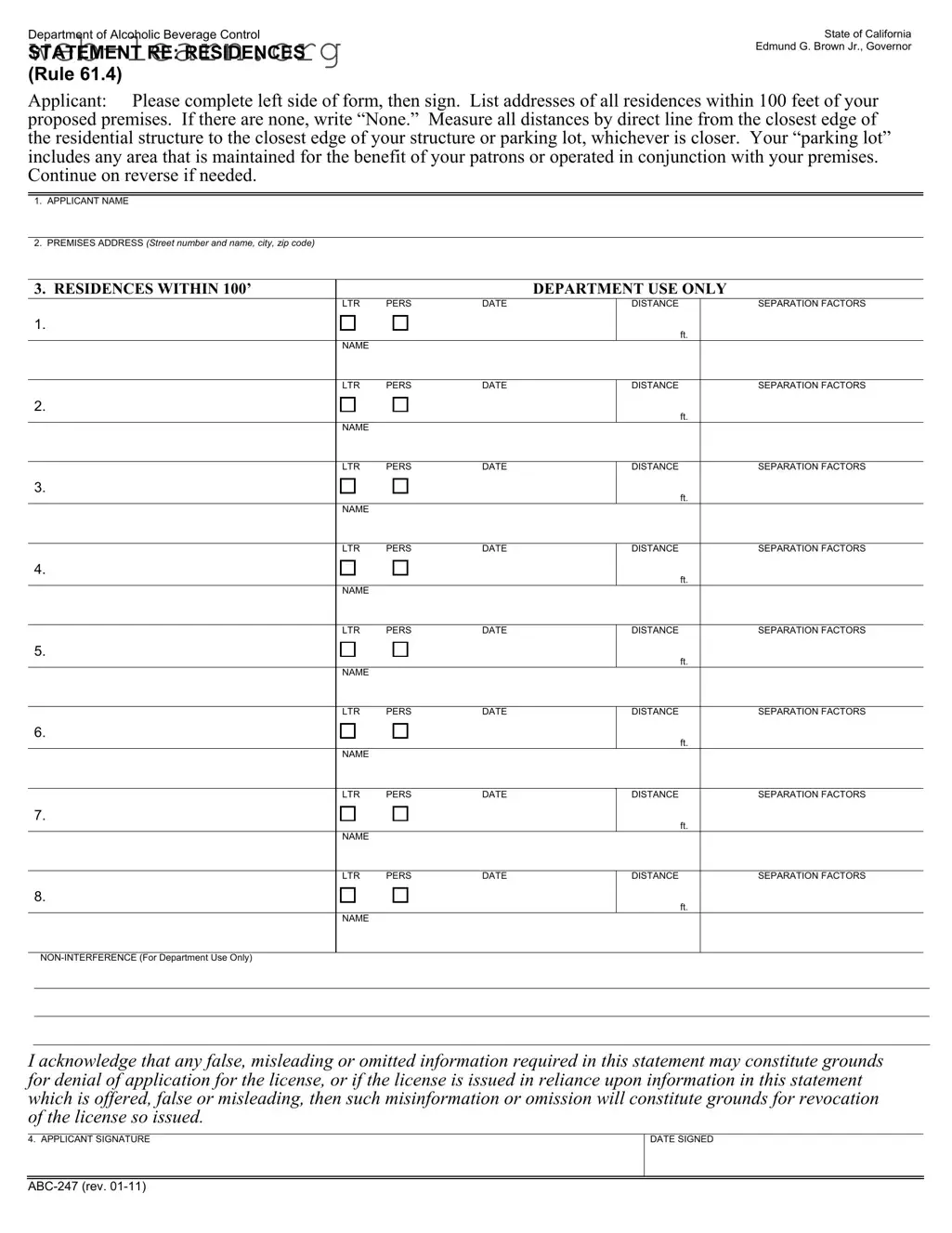
The California ABC 247 form is an essential document for anyone looking to apply for a retail alcohol license in the state. This form is particularly focused on understanding the proximity of the proposed premises to residential areas. One of the key aspects of this form is the requirement to list all residences located within 100 feet of the proposed location. If there are no residences nearby, applicants simply write "None." The form guides applicants to measure distances accurately, ensuring that they measure from the closest edge of the residential structure to the nearest edge of their own premises or parking lot. This distance is crucial because, according to California regulations, a retail license cannot be issued if the premises or its parking area falls within this 100-foot radius of a residence. Additionally, the form includes a section for the applicant's signature, affirming the accuracy of the provided information. Misleading or omitted details can lead to denial or revocation of the license. By completing this form correctly, applicants can help ensure that their business operations will not interfere with the enjoyment of nearby residents, which is a significant consideration for the Department of Alcoholic Beverage Control.
| Fact Name | Details |
|---|---|
| Governing Law | Rule 61.4, Chapter 1, Title 4, California Code of Regulations governs the ABC-247 form. |
| Purpose | The form is used to disclose residences within 100 feet of a proposed premises. |
| Applicant Responsibility | The applicant must complete the left side of the form and provide necessary signatures. |
| Distance Measurement | Distances must be measured in a direct line from the closest edge of the residential structure to the proposed premises. |
| Parking Lot Definition | The term "parking lot" includes areas maintained for patrons or operated in conjunction with the premises. |
| Residences Definition | A residence includes single-family homes, condos, residential hotels, motels, or mobile homes. |
| False Information Consequences | Providing false or misleading information can lead to denial or revocation of the license. |
| Application Timeline | The rule does not apply if the premises have been licensed and operated within the last 90 days. |
| Non-Interference Clause | The department may issue a license if the applicant proves that the business will not disturb residents. |
| Form Revision Date | The current version of the form is ABC-247, revised on January 11. |
Completing the California ABC 247 form is a crucial step in your application process. This form requires you to provide information about residences near your proposed premises. Following the steps below will help ensure that you fill out the form accurately and completely.
After you have filled out the form, it will be submitted along with your formal application. This information will help the Department of Alcoholic Beverage Control assess your application and determine if your business can operate without disturbing nearby residents.
What is the purpose of the California ABC 247 form?
The California ABC 247 form is used to assess the proximity of a proposed business premises to residential areas. It helps determine if the business will interfere with the quiet enjoyment of nearby residents. This is important for obtaining a retail alcohol license in California.
Who needs to fill out the ABC 247 form?
Any applicant seeking a retail alcohol license must complete this form. This includes businesses that are applying for a new license or transferring an existing license to a new location.
What information is required on the form?
Applicants must provide their name, the address of the proposed premises, and a list of all residences within 100 feet of the premises. If there are no residences nearby, applicants should simply write “None.”
How is the distance to residences measured?
Distances are measured in a straight line from the closest edge of the residential structure to the closest edge of the proposed business premises or its parking lot. The shortest distance is what counts.
What happens if I provide false information?
Providing false, misleading, or omitted information can lead to the denial of your application. If the license is issued based on incorrect information, it may be revoked later.
Are there exceptions to the 100-foot rule?
Yes, if the premises have been licensed and operated with the same type of license within the last 90 days, the 100-foot rule does not apply. Additionally, if you can prove that your business won't disturb residents, the department may still issue a license.
What types of residences are considered?
A residence can be a single-family home, condo, residential hotel, motel, or mobile home. The key factor is that it must be a place where people actually live.
What should I do if I need more space to list residences?
If you run out of space on the front of the form, you can continue your list on the reverse side. Make sure to provide complete and accurate information.
How do I submit the ABC 247 form?
The completed form should be submitted along with your formal application for a retail alcohol license. Ensure that you sign and date the form before submission.
Completing the California ABC 247 form is a crucial step for anyone seeking to obtain a retail license for alcoholic beverages. However, many applicants make mistakes that can jeopardize their application. Understanding these common pitfalls can help ensure a smoother process.
One prevalent mistake involves inaccurate measurement of distances. The form requires applicants to measure the distance from the closest edge of a residential structure to their premises or parking lot. Some individuals may misinterpret this requirement, measuring from the wrong point or using an indirect route rather than a direct line. This can lead to significant discrepancies, potentially resulting in the denial of the application.
Another frequent error is failing to list all residences within the required 100 feet. Applicants sometimes overlook nearby homes or mistakenly believe that only prominent residences need to be included. The instruction is clear: if there are residences within this distance, they must be documented. Writing “None” when there are actually residences can be seen as misleading, which could lead to serious consequences, including denial or revocation of the license.
Additionally, some applicants neglect to sign the form. The signature is not merely a formality; it serves as an acknowledgment of the information provided. Without it, the application may be considered incomplete. This simple oversight can delay the process and create unnecessary complications.
Lastly, misunderstanding the definition of a “residence” can lead to confusion. Applicants might incorrectly assume that only single-family homes qualify, but the definition encompasses a variety of living situations, including condos and mobile homes. Failing to recognize this broad definition can result in incomplete or inaccurate submissions, further complicating the application process.
By being aware of these common mistakes, applicants can take proactive steps to ensure their California ABC 247 form is filled out correctly, thus enhancing their chances of a successful application.
The California ABC 247 form is a critical document in the process of applying for a retail alcohol license. It ensures that applicants provide necessary information regarding the proximity of their premises to residential areas. Along with this form, several other documents may be required to complete the application process. Below is a list of commonly associated forms and documents.
These forms and documents are essential in ensuring compliance with California's alcohol licensing regulations. Properly completing and submitting all required paperwork can facilitate a smoother application process and increase the likelihood of approval.
California ABC 208 Form: Similar to the ABC 247, this form requires applicants to provide details about their business location and its proximity to residential areas. Both forms aim to ensure that the operation of alcoholic beverage establishments does not disrupt local residents.
California ABC 221 Form: This form is used for applications involving the transfer of ownership of an alcohol license. Like the ABC 247, it assesses the impact of the business on nearby residences, ensuring compliance with local regulations.
California ABC 100 Form: This is the application for a new alcohol license. It also requires information about the proposed location and its surroundings, similar to how the ABC 247 focuses on residences within a specific distance.
California ABC 201 Form: This form is for a temporary alcohol license. It includes requirements regarding the location's proximity to residences, paralleling the ABC 247's focus on maintaining community standards.
California ABC 400 Form: Used for a change of location of an existing license, this form also requires details about residential proximity, ensuring that the new location does not negatively affect nearby homes.
California ABC 250 Form: This form is for a special event permit. It requires information about the event's location and its impact on nearby residences, similar to the considerations made in the ABC 247.
California ABC 272 Form: This form is used for a license renewal. It assesses whether the business continues to comply with residential proximity rules, much like the ABC 247's evaluation of new applications.
California ABC 253 Form: This form is for a license modification. It requires information on how changes to the business might affect nearby residences, similar to the focus of the ABC 247 on residential areas.
California ABC 222 Form: This form deals with the transfer of a license from one location to another. It also considers the impact on residential areas, ensuring that the new location complies with local regulations.
California ABC 223 Form: This form is for a license cancellation. It includes provisions that evaluate how the cancellation might affect the surrounding residential community, similar to the considerations outlined in the ABC 247.
When filling out the California ABC 247 form, it is essential to follow certain guidelines to ensure a smooth application process. Here are nine things you should and shouldn't do:
Adhering to these guidelines will help ensure that your application is processed without unnecessary delays or complications.
Understanding the California ABC 247 form is essential for anyone applying for a retail license in the state. However, there are several misconceptions that can lead to confusion. Here’s a breakdown of ten common misunderstandings about this form:
By clearing up these misconceptions, applicants can navigate the licensing process more effectively and increase their chances of success. Understanding the nuances of the ABC 247 form is key to a smooth application experience.
When filling out and using the California ABC 247 form, keep the following key takeaways in mind:
By following these guidelines, you can ensure a smoother process when submitting the ABC 247 form.