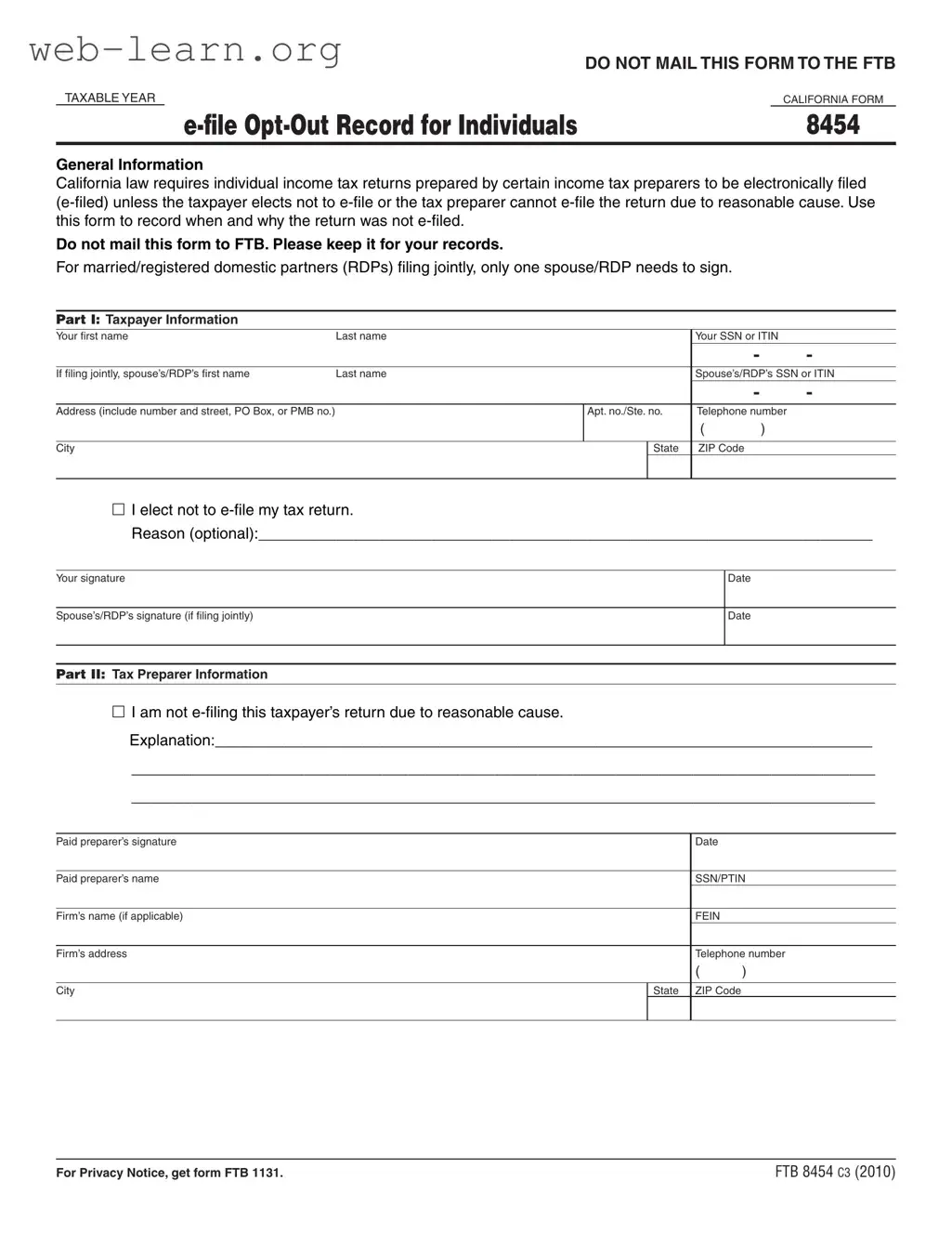
Homepage Blank California 8454 Form
Outline

The California 8454 form serves as an essential document for individuals who choose not to electronically file their state income tax returns. Under California law, many tax preparers are required to e-file returns unless the taxpayer opts out or there is a reasonable cause preventing e-filing. This form is specifically designed to capture the details surrounding this decision. Taxpayers must provide personal information, including their Social Security Number or Individual Taxpayer Identification Number, as well as that of their spouse or registered domestic partner if filing jointly. Additionally, the form requires a signature from the taxpayer, and if applicable, from their spouse or partner. Part II of the form focuses on the tax preparer's information, allowing them to explain the reasonable cause for not e-filing. Importantly, taxpayers must retain this form for their records and are instructed not to mail it to the Franchise Tax Board (FTB). The California 8454 form thus plays a crucial role in ensuring compliance with state tax regulations while providing a mechanism for those who prefer traditional filing methods.
Sample - California 8454 Form

Your first name Last name Your SSN or ITIN
If filing jointly, spouse’s/RDP’s first name Last name Spouse’s/RDP’s SSN or ITIN
Address (include number and street, PO Box, or PMB no.) Apt. no./Ste. no. Telephone number
( )
City State ZIP Code
I elect not to e-file my tax return.
Reason (optional):_______________________________________________________________________
Part I: Taxpayer Information
e-file Opt-Out Record for Individuals
TAXABLE YEAR
CALIFORNIA FORM
8454
DO NOT MAIL THIS FORM TO THE FTB
For Privacy Notice, get form FTB 1131. FTB 8454 C3 (2010)
Your signature Date
Spouse’s/RDP’s signature (if filing jointly) Date
Part II: Tax Preparer Information
I am not e-filing this taxpayer’s return due to reasonable cause.
Explanation:____________________________________________________________________________
______________________________________________________________________________________
______________________________________________________________________________________
Paid preparer’s signature Date
Paid preparer’s name SSN/PTIN
Firm’s name (if applicable) FEIN
Firm’s address Telephone number
( )
City State ZIP Code
- -
General Information
California law requires individual income tax returns prepared by certain income tax preparers to be electronically filed
(e-filed) unless the taxpayer elects not to e-file or the tax preparer cannot e-file the return due to reasonable cause. Use
this form to record when and why the return was not e-filed.
Do not mail this form to FTB. Please keep it for your records.
For married/registered domestic partners (RDPs) filing jointly, only one spouse/RDP needs to sign.
- -

Form Information

Fact Name Description
Purpose The California Form 8454 is used to document a taxpayer's choice to opt out of e-filing their tax return.
Governing Law California law mandates that individual income tax returns prepared by certain tax preparers must be e-filed unless an exception is noted.
Filing Requirement This form must be kept for personal records and should not be mailed to the Franchise Tax Board (FTB).
Joint Filers If married or in a registered domestic partnership, only one spouse or partner needs to sign the form.
Reason for Opting Out Taxpayers can optionally provide a reason for choosing not to e-file their return.
Tax Preparer's Role The tax preparer must explain the reasonable cause for not e-filing if applicable, and must sign the form.
Privacy Notice For information on privacy, taxpayers should refer to form FTB 1131.

Detailed Guide for Filling Out California 8454

Completing the California 8454 form is a straightforward process. This form is essential for individuals who choose not to e-file their tax returns. After filling it out, keep it for your records, as it should not be mailed to the Franchise Tax Board (FTB).

  1. Start with Part I: Taxpayer Information.
  2. Enter your first name and last name in the designated fields.
  3. Provide your Social Security Number (SSN) or Individual Taxpayer Identification Number (ITIN).
  4. If filing jointly, fill in your spouse’s or registered domestic partner’s (RDP’s) first name and last name.
  5. Input your spouse’s or RDP’s SSN or ITIN.
  6. Complete your address, including the street number, street name, PO Box, or PMB number, and apartment or suite number if applicable.
  7. Fill in your telephone number.
  8. Provide your city, state, and ZIP code.
  9. Check the box indicating that you elect not to e-file your tax return.
  10. Optionally, state your reason for not e-filing in the provided space.
  11. Sign and date the form in the designated areas.
  12. If filing jointly, have your spouse or RDP sign and date the form as well.
  1. Move to Part II: Tax Preparer Information.
  2. Check the box indicating that you are not e-filing this taxpayer’s return due to reasonable cause.
  3. Provide an explanation for the reasonable cause in the space provided.
  4. Have the paid preparer sign and date the form.
  5. Fill in the paid preparer’s name and their SSN or Preparer Tax Identification Number (PTIN).
  6. If applicable, include the firm’s name and Federal Employer Identification Number (FEIN).
  7. Complete the firm’s address, telephone number, city, state, and ZIP code.

Obtain Answers on California 8454

  1. What is the California 8454 form?

    The California 8454 form, also known as the e-file Opt-Out Record for Individuals, is a document that allows taxpayers to officially state their decision not to e-file their individual income tax returns. California law generally requires certain tax returns to be filed electronically, but this form provides an option for those who choose not to e-file for specific reasons.

  2. Who needs to use the California 8454 form?

    This form is intended for individual taxpayers who are preparing their tax returns with the help of a paid tax preparer. If your tax preparer cannot e-file your return due to reasonable cause, or if you simply prefer not to e-file, you should complete this form.

  3. Do I need to mail the California 8454 form to the FTB?

    No, you do not need to mail this form to the Franchise Tax Board (FTB). Instead, you should keep it for your records. It serves as documentation of your choice not to e-file your tax return.

  4. What information do I need to provide on the form?

    The form requires several pieces of information:

    • Your name and Social Security Number (SSN) or Individual Taxpayer Identification Number (ITIN).
    • Your spouse's or registered domestic partner's name and SSN or ITIN, if filing jointly.
    • Your address, including city and ZIP code.
    • A signature from you and your spouse or partner if applicable.
    • Details from your tax preparer, including their name and signature.
  5. What reasons can I provide for opting out of e-filing?

    While you are not required to provide a reason for opting out, you may include one if you wish. Common reasons might include personal preference, lack of access to necessary technology, or specific issues related to your tax situation that prevent e-filing.

  6. Is it necessary for both spouses to sign the form if filing jointly?

    No, only one spouse or registered domestic partner needs to sign the form if you are filing jointly. This simplifies the process and allows for easier completion of the form.

  7. What should I do with the California 8454 form after completing it?

    After you fill out the California 8454 form, keep it in your records. It is important to have this documentation in case any questions arise about your filing choice in the future.

  8. Where can I find more information about privacy regarding my information on the form?

    For details about privacy and how your information is handled, you can refer to the Privacy Notice by obtaining form FTB 1131. This document outlines how your personal information is protected during the tax filing process.

Common mistakes

When filling out the California 8454 form, many people make common mistakes that can lead to confusion or delays. One frequent error is failing to provide complete taxpayer information. It’s crucial to include both the taxpayer's and the spouse's or registered domestic partner's full names and Social Security Numbers (SSNs) or Individual Taxpayer Identification Numbers (ITINs). Omitting any of this information can cause issues with processing.

Another mistake is not signing the form. Even if only one spouse or registered domestic partner needs to sign when filing jointly, both signatures are required if they are opting out of e-filing for different reasons. Missing a signature can render the form invalid and may lead to complications when filing the tax return.

Some people forget to indicate their choice not to e-file. The checkbox for opting out must be marked clearly. If this step is overlooked, the tax preparer may proceed with e-filing, which is not the taxpayer's intention. Clarity in this section is vital to ensure that the return is processed according to the taxpayer's wishes.

Additionally, providing an incomplete or vague reason for opting out can lead to questions from the tax preparer or the tax authority. If a reason is included, it should be clear and specific. A well-explained reason helps in understanding the context of the decision and can prevent unnecessary follow-ups.

Another common oversight is neglecting to include the tax preparer’s information if applicable. If a paid preparer is involved, their name, signature, and identification number must be filled out completely. Failing to do this can lead to delays or issues with accountability.

Lastly, some individuals mistakenly think they need to mail the form to the Franchise Tax Board (FTB). This form is for record-keeping purposes only and should not be sent to the FTB. Keeping a copy for personal records is essential, as it may be needed for future reference.

Documents used along the form

The California 8454 form serves an important purpose for taxpayers who choose not to e-file their income tax returns. It records the decision and the reasons behind it, ensuring that both the taxpayer and the tax preparer have a clear understanding of the situation. In addition to this form, there are several other documents that are often used in conjunction with the California 8454. Each of these documents plays a vital role in the tax preparation process, providing necessary information and context.

  • California Form 540: This is the standard individual income tax return form for residents of California. Taxpayers use this form to report their income, claim deductions, and calculate their tax liability. It is essential for anyone filing taxes in the state.
  • California Form 540NR: This form is for non-residents or part-year residents of California. It allows individuals who do not meet the residency requirements to report their California-source income and pay any taxes owed.
  • California Form 1099: This series of forms is used to report various types of income other than wages, salaries, and tips. Taxpayers may receive a 1099 form if they have earned income from freelance work, interest, dividends, or other sources. It is crucial for accurate income reporting.
  • California Schedule A: This form is used to itemize deductions for taxpayers who choose not to take the standard deduction. It helps individuals detail their deductible expenses, which can reduce their taxable income significantly.
  • California Form FTB 1131: This is a privacy notice that informs taxpayers about how their personal information will be handled by the Franchise Tax Board. It is important for understanding the confidentiality of the information provided in tax documents.

Understanding these forms and documents can help taxpayers navigate the complexities of filing their income taxes in California. Each piece of paperwork plays a specific role, ensuring that taxpayers comply with state laws while also protecting their rights and privacy. By being informed, individuals can make better decisions regarding their tax preparation and filing processes.

Similar forms

The California 8454 form serves a specific purpose in the tax filing process. Several other documents share similarities with this form, particularly in their function and requirements. Here are five such documents:

  • IRS Form 8948: This form is used to indicate that a taxpayer has chosen not to e-file their federal tax return. Like the California 8454, it records the reason for opting out of electronic filing and must be kept for the taxpayer's records.
  • California Form 540: This is the standard individual income tax return for California residents. While it is primarily used for reporting income, it also contains sections that allow taxpayers to indicate their filing preferences, including e-filing options.
  • IRS Form 4868: This form is an application for an automatic extension of time to file a federal tax return. It requires a signature and can be filed electronically or on paper, similar to the California 8454, which must be retained and not submitted to the state.
  • California Form 3519: This form is used to report the California estimated tax payment for individuals. It includes taxpayer information and must be retained for records, paralleling the California 8454's requirement to keep a copy.
  • IRS Form 1040: This is the standard individual income tax return for federal taxes. While it does not specifically address e-filing preferences, it serves as the primary document for reporting income and tax obligations, much like the California 8454 is used to document the decision not to e-file.

Dos and Don'ts

When filling out the California 8454 form, it’s essential to approach the process with care. Here’s a list of things you should and shouldn’t do to ensure accuracy and compliance.

  • Do double-check your personal information, including your name and Social Security Number (SSN) or Individual Taxpayer Identification Number (ITIN).
  • Do clearly indicate your reason for opting out of e-filing if you choose to do so.
  • Do ensure that only one spouse or registered domestic partner (RDP) signs the form when filing jointly.
  • Do keep the completed form for your records instead of mailing it to the Franchise Tax Board (FTB).
  • Don't leave any sections of the form blank, especially those that require your signature and date.
  • Don't forget to provide accurate contact information for your tax preparer, including their name and phone number.

By following these guidelines, you can navigate the process of completing the California 8454 form with confidence and ease.

Misconceptions

Many individuals have misconceptions about the California 8454 form, which can lead to confusion during tax season. Below are nine common misunderstandings regarding this form.

  • It must be mailed to the FTB. Many believe that the 8454 form needs to be submitted to the Franchise Tax Board (FTB). In reality, it is not to be mailed; taxpayers should keep it for their records.
  • All taxpayers need to fill it out. Some think that every taxpayer must complete this form. However, it is only necessary for those who are opting out of e-filing their returns.
  • Both spouses must sign the form. There is a misconception that both spouses must sign if filing jointly. In fact, only one spouse or registered domestic partner (RDP) is required to sign.
  • The form is only for e-filing issues. Some individuals assume the form is solely related to e-filing problems. It also serves to document the taxpayer's decision not to e-file, regardless of the reason.
  • It is only for individual tax returns. Many think this form is exclusively for individual tax returns. However, it can also apply to certain joint filings by married couples or RDPs.
  • Reasons for opting out must be provided. Some believe they are required to give a reason for not e-filing. While providing a reason is optional, it can help clarify the situation.
  • Tax preparers cannot refuse to e-file. There is a misconception that tax preparers must always e-file. They can refuse if there is reasonable cause, which should be documented on the form.
  • It is a complicated form. Many people think the 8454 is complex. In reality, it is straightforward and requires only basic information from the taxpayer and their preparer.
  • It is not necessary to keep a copy. Some individuals believe they can discard the form after completing it. It is important to retain a copy for personal records in case of future inquiries.

Understanding these misconceptions can help taxpayers navigate the process more effectively and ensure compliance with California tax regulations.

Key takeaways

The California Form 8454 serves as an important document for individuals opting out of electronic filing for their income tax returns. Understanding its purpose and proper usage is essential for compliance with state tax regulations. Below are key takeaways regarding the form.

  • Mandatory Electronic Filing: California law requires that certain individual income tax returns be e-filed unless a taxpayer opts out.
  • Opt-Out Documentation: Form 8454 is used to document the decision not to e-file, along with the reason for this choice.
  • No Mailing Required: Taxpayers should not mail this form to the Franchise Tax Board (FTB); it is intended for personal records.
  • Joint Filers: For married couples or registered domestic partners filing jointly, only one signature is necessary on the form.
  • Taxpayer Information: The form requires detailed taxpayer information, including names, Social Security Numbers (SSNs), and addresses.
  • Optional Reason for Opting Out: While providing a reason for opting out is optional, it may be beneficial for record-keeping.
  • Tax Preparer Section: If a tax preparer is involved, they must complete their section, including their signature and firm details.
  • Reasonable Cause for Non-E-Filing: The preparer must indicate if they are not e-filing due to reasonable cause and provide an explanation.
  • Privacy Notice: Taxpayers should refer to Form FTB 1131 for information regarding privacy practices.
  • Record Keeping: It is crucial to retain this form for personal records in case of future inquiries or audits by tax authorities.