Homepage Blank California 597 W Form
Outline

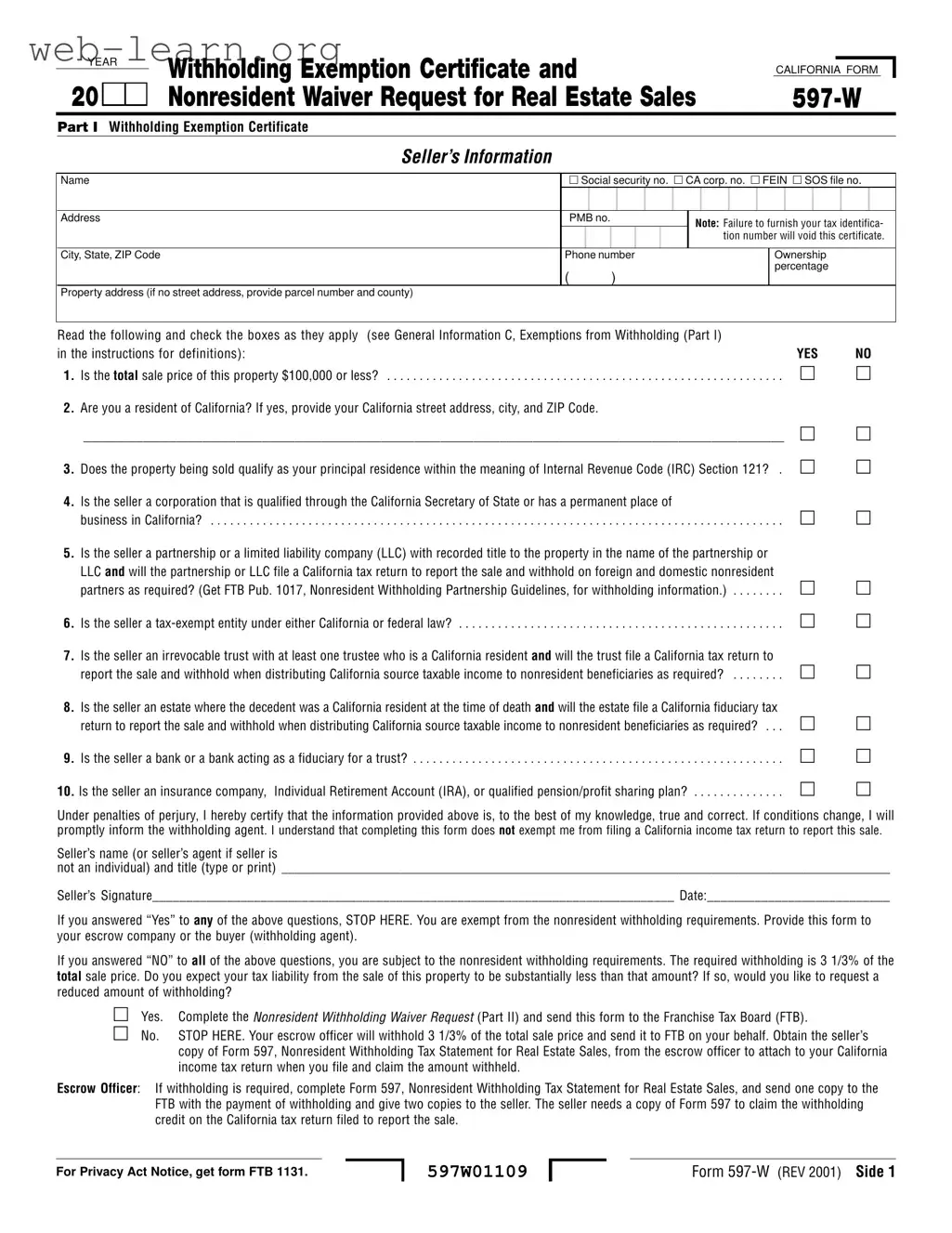
The California 597 W form is an essential document for anyone involved in the sale of real estate in California, particularly for nonresidents. This form serves two primary purposes: it acts as a Withholding Exemption Certificate and a Nonresident Waiver Request. Sellers must provide their personal information, including their name, social security number, and address, along with details about the property being sold. The form includes a series of questions that help determine whether the seller qualifies for an exemption from the state's nonresident withholding requirements. For instance, sellers need to indicate if the sale price is $100,000 or less, or if the property served as their principal residence. If sellers answer "yes" to any of these qualifying questions, they can stop there, as they would be exempt from withholding. However, if they answer "no" to all, they may be subject to a withholding rate of 3 1/3% of the total sale price. Additionally, there is an option to request a reduced withholding amount if the seller believes their tax liability will be significantly lower than the standard withholding. Completing the 597 W form accurately is crucial, as it not only affects the withholding process but also ensures compliance with California tax regulations.

Sample - California 597 W Form

Form 597-W (REV 2001) Side 1597W01109
Withholding Exemption Certificate and
Nonresident Waiver Request for Real Estate Sales
YEAR
Name Social security no. CA corp. no. FEIN SOS file no.
Address PMB no.
City, State, ZIP Code Phone number Ownership
percentage
()
Property address (if no street address, provide parcel number and county)
CALIFORNIA FORM
597-W
Part I Withholding Exemption Certificate
Read the following and check the boxes as they apply (see General Information C, Exemptions from Withholding (Part I)
in the instructions for definitions): YES NO
1. Is the total sale price of this property $100,000 or less? . . . . . . . . . . . . . . . . . . . . . . . . . . . . . . . . . . . . . . . . . . . . . . . . . . . . . . . . . . . . .
첸첸
2. Are you a resident of California? If yes, provide your California street address, city, and ZIP Code.
__________________________________________________________________________________________________________ 첸첸
3. Does the property being sold qualify as your principal residence within the meaning of Internal Revenue Code (IRC) Section 121? . 첸첸
4. Is the seller a corporation that is qualified through the California Secretary of State or has a permanent place of
business in California? . . . . . . . . . . . . . . . . . . . . . . . . . . . . . . . . . . . . . . . . . . . . . . . . . . . . . . . . . . . . . . . . . . . . . . . . . . . . . . . . . . . . . . . . 첸첸
5. Is the seller a partnership or a limited liability company (LLC) with recorded title to the property in the name of the partnership or
LLC and will the partnership or LLC file a California tax return to report the sale and withhold on foreign and domestic nonresident
partners as required? (Get FTB Pub. 1017, Nonresident Withholding Partnership Guidelines, for withholding information.) . . . . . . . .
첸첸
6. Is the seller a tax-exempt entity under either California or federal law? . . . . . . . . . . . . . . . . . . . . . . . . . . . . . . . . . . . . . . . . . . . . . . . . . . 첸첸
7. Is the seller an irrevocable trust with at least one trustee who is a California resident and will the trust file a California tax return to
report the sale and withhold when distributing California source taxable income to nonresident beneficiaries as required? . . . . . . . . 첸첸
8. Is the seller an estate where the decedent was a California resident at the time of death and will the estate file a California fiduciary tax
return to report the sale and withhold when distributing California source taxable income to nonresident beneficiaries as required? . . . 첸첸
9. Is the seller a bank or a bank acting as a fiduciary for a trust? . . . . . . . . . . . . . . . . . . . . . . . . . . . . . . . . . . . . . . . . . . . . . . . . . . . . . . . . . 첸첸
10. Is the seller an insurance company, Individual Retirement Account (IRA), or qualified pension/profit sharing plan? . . . . . . . . . . . . . . 첸첸
Under penalties of perjury, I hereby certify that the information provided above is, to the best of my knowledge, true and correct. If conditions change, I will
promptly inform the withholding agent. I understand that completing this form does not exempt me from filing a California income tax return to report this sale.
Seller’s name (or seller’s agent if seller is
not an individual) and title (type or print) ____________________________________________________________________________________________
Seller’s Signature_____________________________________________________________________________ Date:___________________________
If you answered “Yes” to any of the above questions, STOP HERE. You are exempt from the nonresident withholding requirements. Provide this form to
your escrow company or the buyer (withholding agent).
If you answered “NO” to all of the above questions, you are subject to the nonresident withholding requirements. The required withholding is 3 1/3% of the
total sale price. Do you expect your tax liability from the sale of this property to be substantially less than that amount? If so, would you like to request a
reduced amount of withholding?
Yes. Complete the
Nonresident Withholding Waiver Request
(Part II) and send this form to the Franchise Tax Board (FTB).
No. STOP HERE. Your escrow officer will withhold 3 1/3% of the total sale price and send it to FTB on your behalf. Obtain the seller’s
copy of Form 597, Nonresident Withholding Tax Statement for Real Estate Sales, from the escrow officer to attach to your California
income tax return when you file and claim the amount withheld.
Escrow Officer: If withholding is required, complete Form 597, Nonresident Withholding Tax Statement for Real Estate Sales, and send one copy to the
FTB with the payment of withholding and give two copies to the seller. The seller needs a copy of Form 597 to claim the withholding
credit on the California tax return filed to report the sale.
For Privacy Act Notice, get form FTB 1131.
20
Seller’s Information
Note: Failure to furnish your tax identifica-
tion number will void this certificate.
Side 2 Form 597-W (REV 2001) 597W01209
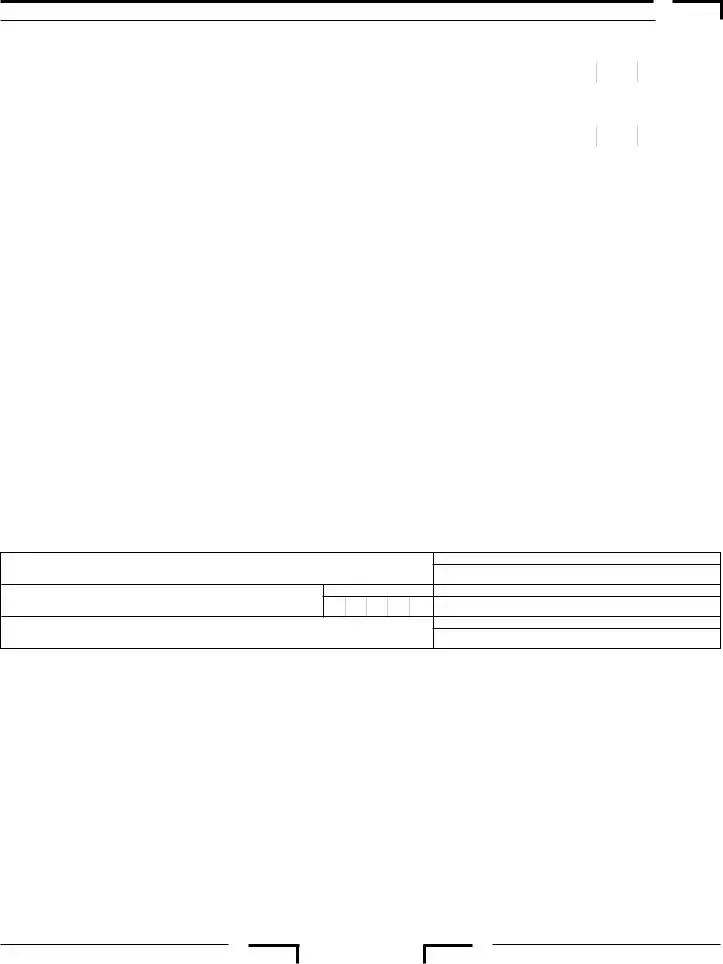
State in detail your reason for requesting a withholding waiver or reduced withholding. If there is more than one nonresident seller, attach a separate
sheet listing additional nonresident seller’s information. See instructions for examples of situations for which a waiver or reduced withholding is
allowed and for the required information and documentation.
Attach additional sheets if needed. The FTB cannot make a determination on your request unless you provide all required information and
documentation. See instructions.
Under penalties of perjury, I hereby certify that the information provided above is, to the best of my knowledge, true and correct. If conditions change, I will
promptly inform the withholding agent. I understand that completing this form does not exempt me from filing a California income tax return to report this
sale.
Seller’s name (or seller’s agent if seller is
not an individual) and title (type or print) ____________________________________________________________________________________________
Seller’s Signature ____________________________________________________________________________________ Date: _____________________
Name of seller (see instructions if more than one)
Mailing address PMB no.
City, state, and ZIP Code (province, country, and postal zone)
Phone number Ownership
percentage
()
Seller’s Information
Seller’s social security number (SSN)
California corporation no. FEIN
Seller’s spouse’s SSN (if applicable)
Seller’s email address
Property Information
Property Address (if no street address, provide parcel number and county):
Seller acquired property by (check one):
Purchase Inheritance Foreclosure/Repossession
Gift 1031 Exchange call (888) 792-4900 U.S. toll-free
or (916) 845-4900
Other____________________
Use of property at time of sale: Length of time used for this purpose:
Rental / Commercial
Secondary / Vacation home Years ________ Months _________
Vacant land
Other (attach explanation)
Date seller acquired property:
Seller’s adjusted basis:
Purchase price $ ____________________________
Add: improvements ____________________________
Less: depreciation ____________________________
Adjusted basis $ ____________________________
Provide all required documentation listed in the instructions. Attach any other
documents necessary to verify the adjusted basis.
Escrow Information
Name and address of Escrow Company:
Escrow Company email address
Name of Escrow Officer: Escrow number:
Escrow Company or Officer FAX number:
telephone number:
() ()
Contract price (total sale price): Estimated close of escrow date:
Name of buyer (see instructions if more than one)
Address (number and street, PO box or rural route) PMB no. (if applicable)
City, state, and ZIP Code (province, country, and postal zone)
Buyer’s Information
Buyer’s social security number (SSN)
California corporation no. FEIN
Buyer’s spouse’s SSN (if applicable)
Seller’s Entity Type
Individual(s)
Corporation
S Corporation
Estate
Trust
Part II Nonresident Withholding Waiver Request (please print or type)
--
--

Form Information

Fact Name Details
Purpose The California 597 W form serves as a Withholding Exemption Certificate and Nonresident Waiver Request for Real Estate Sales.
Governing Law The form is governed by California Revenue and Taxation Code Section 18662.
Eligibility It is used by sellers who may qualify for exemptions from nonresident withholding on real estate transactions.
Sale Price Threshold If the total sale price of the property is $100,000 or less, sellers may be exempt from withholding.
Residency Requirement Sellers who are residents of California may also qualify for withholding exemptions.
Corporate Sellers Corporations qualified in California can complete the form to claim exemption from withholding.
Trusts and Estates Irrevocable trusts and estates of California residents may also be exempt if they file appropriate tax returns.
Withholding Rate If no exemptions apply, the withholding rate is 3 1/3% of the total sale price.

Detailed Guide for Filling Out California 597 W

Filling out the California 597 W form is a straightforward process, but it requires careful attention to detail. This form is essential for sellers of real estate in California, particularly for non-residents. Once completed, the form needs to be submitted to the appropriate parties involved in the transaction, such as the escrow company or the buyer.

  1. Gather Required Information: Collect all necessary details, including your name, social security number, and property information.
  2. Complete Seller’s Information: Fill in your name, social security number, California corporation number, FEIN, SOS file number, address, and phone number. Ensure that your tax identification number is accurate.
  3. Provide Ownership Percentage: Indicate the ownership percentage of the property being sold.
  4. Fill in Property Address: If there is no street address, provide the parcel number and the county.
  5. Answer Exemption Questions: Read each question carefully and check 'YES' or 'NO' as applicable. This will determine if you qualify for withholding exemptions.
  6. Sign and Date the Form: At the bottom of the form, certify the information is correct by signing and dating it. If you are not the seller, include the seller’s agent information.
  7. Submit the Form: If you answered 'YES' to any exemption questions, provide the completed form to your escrow company or the buyer. If 'NO,' follow the instructions for withholding requirements.
  8. Keep a Copy: Ensure you retain a copy of the completed form for your records and to attach to your California income tax return.

Obtain Answers on California 597 W

  1. What is the California 597 W form?

    The California 597 W form serves two primary purposes: it acts as a Withholding Exemption Certificate and as a Nonresident Waiver Request for Real Estate Sales. This form is essential for sellers who may be exempt from nonresident withholding requirements when selling property in California.

  2. Who needs to fill out the 597 W form?

    Sellers who are nonresidents of California and are selling real estate in the state must complete this form. It is particularly important for those who believe they qualify for an exemption from withholding or wish to request a reduced amount of withholding.

  3. What information is required on the form?

    The form requires detailed information about the seller, including:

    • Name
    • Social Security number or other tax identification numbers
    • Address
    • Property details, including the address and ownership percentage

    Additionally, sellers must answer specific questions regarding their residency status and the nature of the property being sold.

  4. What are the exemptions from withholding?

    Exemptions from withholding may apply if:

    • The total sale price is $100,000 or less.
    • The seller is a California resident.
    • The property qualifies as the seller's principal residence.
    • The seller is a qualified corporation or partnership filing a California tax return.
    • Other specific conditions outlined in the form are met.

    If any of these conditions are true, the seller may be exempt from withholding.

  5. What happens if I answer "No" to all exemption questions?

    If a seller answers "No" to all exemption questions, they are subject to nonresident withholding. This means that 3 1/3% of the total sale price will be withheld and sent to the Franchise Tax Board (FTB) on their behalf.

  6. Can I request a reduced withholding amount?

    Yes, if a seller expects their tax liability from the sale to be substantially less than the withholding amount, they can request a reduced amount. This requires completing the Nonresident Withholding Waiver Request section of the form and providing necessary documentation.

  7. How do I submit the form?

    The completed form should be provided to the escrow company or the buyer, who acts as the withholding agent. If requesting a waiver, the seller must also send the form to the FTB.

  8. What documentation is needed to support a waiver request?

    To support a waiver request, sellers must provide documentation that verifies their adjusted basis in the property, as well as any other information required by the FTB. This may include details about how the seller acquired the property and its use over time.

  9. What should I do after submitting the form?

    Once the form is submitted, sellers should obtain a copy of Form 597, the Nonresident Withholding Tax Statement for Real Estate Sales, from the escrow officer. This form is necessary for filing a California income tax return and claiming the amount withheld.

  10. What are the penalties for providing false information?

    Providing false information on the 597 W form can lead to penalties under perjury laws. It is crucial for sellers to ensure that all information provided is accurate and complete.

Common mistakes

Filling out the California 597 W form can be a straightforward process, but many individuals make common mistakes that can lead to complications. One prevalent mistake is failing to provide a complete tax identification number. This number is crucial, and without it, the form becomes void. Sellers must ensure they enter their Social Security number, California corporation number, or Federal Employer Identification Number accurately to avoid delays.

Another frequent error occurs when sellers do not check the boxes correctly in Part I. Each question is designed to determine eligibility for withholding exemptions. If a seller answers “yes” to any question but does not check the corresponding box, it can create confusion and potentially lead to unnecessary withholding. It is essential to read each question carefully and respond accordingly.

Many people also overlook the importance of providing accurate ownership percentages. If the property is co-owned, each owner must indicate their respective percentage of ownership. Missing or incorrect percentages can complicate the withholding process and may lead to issues during tax filing.

Additionally, some sellers forget to sign and date the form. This step is vital because the signature certifies that the information provided is true and correct. Without a signature, the form may not be accepted by the escrow company or the Franchise Tax Board, resulting in delays or additional complications.

Another mistake involves not providing the correct property address. If a seller does not include a complete address or, in cases without a street address, fails to provide the parcel number and county, it can lead to significant issues. Accurate property information is essential for proper processing.

Some individuals also fail to provide adequate documentation to support their claims for exemptions or reduced withholding. The form requires additional information to verify the adjusted basis and other claims. Without this documentation, the Franchise Tax Board may not process the request, leading to potential withholding.

It is also common for sellers to misinterpret the requirements for a withholding waiver. Many do not realize that if they expect their tax liability to be substantially less than the withholding amount, they must complete the Nonresident Withholding Waiver Request (Part II) properly. Failing to do so can result in unnecessary withholding from the sale proceeds.

Lastly, sellers sometimes neglect to obtain a copy of Form 597 from their escrow officer. This form is essential for claiming any withholding credit on their California income tax return. Keeping track of all necessary documents is crucial to ensure a smooth tax filing process after the sale.

Documents used along the form

The California 597 W form is an essential document in real estate transactions involving nonresident sellers. It helps determine whether withholding is required on the sale of property. Along with this form, several other documents are often used to ensure compliance with tax regulations and to facilitate the sale process. Below is a list of related forms and documents that may be necessary.

  • Form 597: This is the Nonresident Withholding Tax Statement for Real Estate Sales. It is used to report the amount withheld from the sale to the Franchise Tax Board (FTB) and must be provided to the seller for their tax records.
  • Form 593: This is the Real Estate Withholding Tax Statement. It is used to report real estate sales and the withholding amounts to the FTB. This form must be filed by the buyer or the escrow company.
  • Form 588: This is the Nonresident Withholding Waiver Request. It allows sellers to request a waiver of the withholding requirement if they believe their tax liability will be lower than the amount withheld.
  • Form 1099-S: This is the Proceeds from Real Estate Transactions form. It is filed with the IRS to report the sale of real estate and is often issued to the seller for tax purposes.
  • Form FTB 1131: This is the Privacy Act Notice. It informs individuals about the collection and use of their personal information by the FTB and is often referenced in conjunction with withholding forms.
  • Escrow Instructions: These are documents provided by the buyer and seller to the escrow company detailing the terms of the sale and the handling of funds. They include information on how to manage withholding requirements.
  • Purchase Agreement: This is the contract between the buyer and seller outlining the terms of the sale. It typically includes the sale price, property details, and conditions of the sale.
  • Title Report: This document provides information about the property’s ownership history and any liens or encumbrances. It is essential for verifying ownership before the sale is completed.
  • Tax Returns: Previous tax returns may be requested to verify the seller’s tax status and to provide additional information necessary for the withholding process.

Understanding the role of these documents is crucial for both sellers and buyers in California's real estate market. Each form serves a specific purpose in ensuring compliance with tax laws and protecting the interests of all parties involved in the transaction.

Similar forms

The California Form 597 W, which serves as a Withholding Exemption Certificate and Nonresident Waiver Request for Real Estate Sales, shares similarities with several other documents used in real estate transactions and tax reporting. Below are four such documents, each accompanied by a brief explanation of its relationship to Form 597 W.

  • IRS Form 8288: This form is used by withholding agents to report and remit withholding tax on the sale of U.S. real property interests by foreign sellers. Like Form 597 W, it addresses tax obligations for nonresident sellers, ensuring compliance with federal tax laws.
  • IRS Form 1040-NR: This is the U.S. Nonresident Alien Income Tax Return. Nonresidents use this form to report income from U.S. sources, including the sale of real estate. Form 597 W complements this by determining withholding requirements before the sale occurs.
  • California Form 593: This is the Real Estate Withholding Tax Statement. It is similar to Form 597 W in that it provides information on the amount of withholding tax due on the sale of California real property. Both forms aim to ensure that the appropriate taxes are withheld during real estate transactions.
  • California Form 540NR: This is the California Nonresident Income Tax Return. Nonresidents must file this form to report income sourced from California, including real estate sales. Form 597 W assists in determining the withholding amount, which can affect the final tax liability reported on Form 540NR.

Dos and Don'ts

When filling out the California 597 W form, it is important to follow specific guidelines to ensure accuracy and compliance. Below is a list of things to do and avoid during this process.

  • Do provide accurate personal information, including your name, social security number, and contact details.
  • Do confirm that you meet the criteria for exemption before checking the appropriate boxes.
  • Do read the instructions carefully to understand the requirements for each question.
  • Do ensure that all required documentation is attached to support your claims.
  • Do sign and date the form to validate your submission.
  • Don't leave any required fields blank; incomplete forms may be rejected.
  • Don't provide false information; this can lead to penalties and legal issues.
  • Don't forget to keep a copy of the completed form for your records.
  • Don't submit the form without reviewing it for errors and omissions.
  • Don't assume that completing the form exempts you from filing a California income tax return.

Misconceptions

Understanding the California 597 W form is essential for anyone involved in real estate transactions in the state. However, several misconceptions persist regarding its purpose and implications. Here are four common misconceptions:

  • Misconception 1: The 597 W form is only for California residents.
  • Many believe that only California residents need to complete the 597 W form. In reality, this form applies to both residents and non-residents involved in real estate sales in California. Non-residents must also comply with withholding requirements unless they qualify for an exemption.

  • Misconception 2: Completing the form guarantees exemption from withholding.
  • Some individuals think that simply filling out the 597 W form automatically exempts them from withholding. However, exemption is only granted if the seller answers "Yes" to specific questions related to their circumstances. If all answers are "No," withholding is mandatory.

  • Misconception 3: The withholding rate is fixed at 3 1/3% for all transactions.
  • It is a common belief that the withholding rate is always 3 1/3% of the total sale price. While this is the standard rate, sellers can request a reduced amount if they anticipate their tax liability will be significantly lower than the withholding amount. This requires additional documentation and approval.

  • Misconception 4: The form is unnecessary if the property is sold at a loss.
  • Some sellers mistakenly think that if they sell their property at a loss, they do not need to complete the 597 W form. Regardless of the sale price or profit/loss situation, the form must still be completed to determine withholding obligations.

Key takeaways

Filling out and using the California 597 W form is crucial for sellers involved in real estate transactions. Here are four key takeaways to consider:

  • Understand the Purpose: The 597 W form serves as a Withholding Exemption Certificate and Nonresident Waiver Request. It determines whether a seller is exempt from nonresident withholding requirements based on specific criteria.
  • Accurate Information is Essential: Ensure that all information, including tax identification numbers and property details, is complete and accurate. Incomplete forms may result in penalties or delays.
  • Know Your Exemptions: Review the exemption questions carefully. If you answer “Yes” to any of the exemption criteria, you may not be subject to withholding. If all answers are “No,” expect a withholding of 3 1/3% of the total sale price.
  • Documentation is Key: If requesting a waiver or reduced withholding, provide all necessary documentation as outlined in the instructions. Failure to do so may lead to denial of your request.