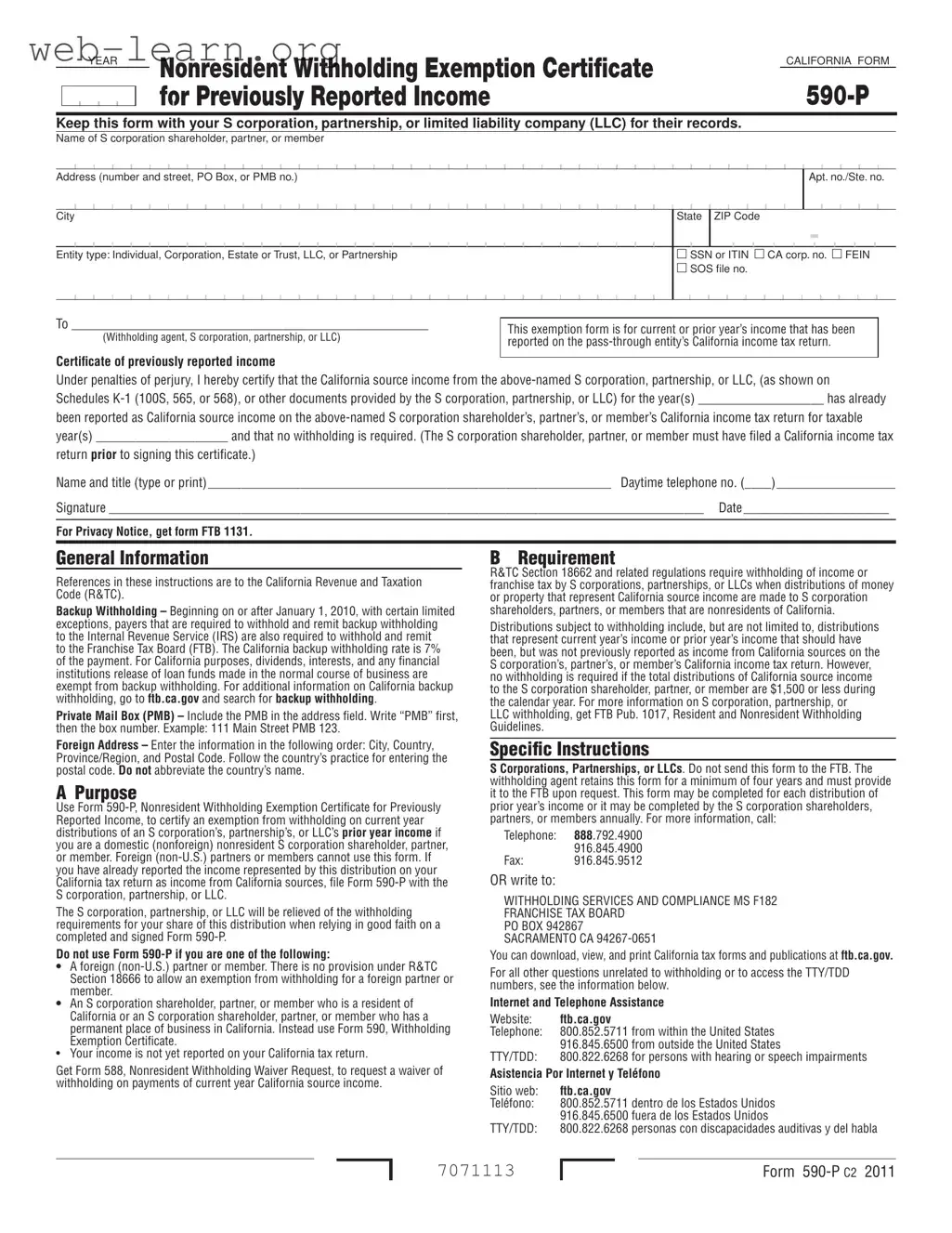
Homepage Blank California 590 P Form
Outline

The California Form 590 P, known as the Nonresident Withholding Exemption Certificate for Previously Reported Income, plays a crucial role for nonresident shareholders, partners, or members of S corporations, partnerships, and limited liability companies (LLCs). This form certifies that certain income has already been reported on a California tax return, thus exempting the individual from additional withholding on current distributions of that income. To utilize this form, one must ensure they are a domestic nonresident and that the income in question has been duly reported in prior tax filings. It's important to note that foreign partners or members are not eligible to use this form. The 590 P form must be kept on file by the entity for at least four years, providing a safeguard against unnecessary withholding. By accurately completing and submitting this form, nonresidents can avoid the burden of withholding taxes on distributions that represent income already accounted for in their tax returns. Understanding the nuances of this form is essential for compliance and financial planning, making it imperative for affected individuals to stay informed and act promptly.

Sample - California 590 P Form

Form 590-P C2 2011
7071113
Keep this form with your S corporation, partnership, or limited liability company (LLC) for their records.
Name of S corporation shareholder, partner, or member
Address (number and street, PO Box, or PMB no.) Apt. no./Ste. no.
City State ZIP Code
Entity type: Individual, Corporation, Estate or Trust, LLC, or Partnership m SSN or ITIN m
CA corp. no. m
FEIN
m฀SOS file no.
To ______________________________________________________
(Withholding agent, S corporation, partnership, or LLC)
Certificate of previously reported income
Under penalties of perjury, I hereby certify that the California source income from the above-named S corporation, partnership, or LLC, (as shown on
Schedules K-1 (100S, 565, or 568), or other documents provided by the S corporation, partnership, or LLC) for the year(s) ___________________ has already
been reported as California source income on the above-named S corporation shareholder’s, partner’s, or member’s California income tax return for taxable
year(s) ____________________ and that no withholding is required. (The S corporation shareholder, partner, or member must have filed a California income tax
return prior
to signing this certificate.)
Name and title (type or print) _____________________________________________________________ Daytime telephone no. (____) __________________
Signature __________________________________________________________________________________________ Date ______________________
For Privacy Notice, get form FTB 1131.
Nonresident Withholding Exemption Certificate
for Previously Reported Income
CALIFORNIA FORM
590-P
General Information
References in these instructions are to the California Revenue and Taxation
Code (R&TC).
Backup Withholding – Beginning on or after January 1, 2010, with certain limited
exceptions, payers that are required to withhold and remit backup withholding
to the Internal Revenue Service (IRS) are also required to withhold and remit
to the Franchise Tax Board (FTB). The California backup withholding rate is 7%
of the payment. For California purposes, dividends, interests, and any financial
institutions release of loan funds made in the normal course of business are
exempt from backup withholding. For additional information on California backup
withholding, go to ftb.ca.gov and search for backup withholding.
Private Mail Box (PMB) – Include the PMB in the address field. Write “PMB” first,
then the box number. Example: 111 Main Street PMB 123.
Foreign Address – Enter the information in the following order: City, Country,
Province/Region, and Postal Code. Follow the country’s practice for entering the
postal code. Do not abbreviate the country’s name.
A Purpose
Use Form 590-P, Nonresident Withholding Exemption Certificate for Previously
Reported Income, to certify an exemption from withholding on current year
distributions of an S corporation’s, partnership’s, or LLC’s prior year income if
you are a domestic (nonforeign) nonresident S corporation shareholder, partner,
or member. Foreign (non-U.S.) partners or members cannot use this form. If
you have already reported the income represented by this distribution on your
California tax return as income from California sources, file Form 590-P with the
S corporation, partnership, or LLC.
The S corporation, partnership, or LLC will be relieved of the withholding
requirements for your share of this distribution when relying in good faith on a
completed and signed Form 590-P.
Do not use Form 590-P if you are one of the following:
A foreign (non-U.S.) partner or member. There is no provision under R&TC
Section 18666 to allow an exemption from withholding for a foreign partner or
member.
An S corporation shareholder, partner, or member who is a resident of
California or an S corporation shareholder, partner, or member who has a
permanent place of business in California. Instead use Form 590, Withholding
Exemption Certificate.
Your income is not yet reported on your California tax return.
Get Form 588, Nonresident Withholding Waiver Request, to request a waiver of
withholding on payments of current year California source income.
B Requirement
R&TC Section 18662 and related regulations require withholding of income or
franchise tax by S corporations, partnerships, or LLCs when distributions of money
or property that represent California source income are made to S corporation
shareholders, partners, or members that are nonresidents of California.
Distributions subject to withholding include, but are not limited to, distributions
that represent current year’s income or prior year’s income that should have
been, but was not previously reported as income from California sources on the
S corporation’s, partner’s, or member’s California income tax return. However,
no withholding is required if the total distributions of California source income
to the S corporation shareholder, partner, or member are $1,500 or less during
the calendar year. For more information on S corporation, partnership, or
LLC withholding, get FTB Pub. 1017, Resident and Nonresident Withholding
Guidelines.
Specific Instructions
S Corporations, Partnerships, or LLCs. Do not send this form to the FTB. The
withholding agent retains this form for a minimum of four years and must provide
it to the FTB upon request. This form may be completed for each distribution of
prior year’s income or it may be completed by the S corporation shareholders,
partners, or members annually. For more information, call:
Telephone: 888.792.4900
916.845.4900
Fax: 916.845.9512
OR write to:
WITHHOLDING SERVICES AND COMPLIANCE MS F182
FRANCHISE TAX BOARD
PO BOX 942867
SACRAMENTO CA 94267-0651
You can download, view, and print California tax forms and publications at ftb.ca.gov.
For all other questions unrelated to withholding or to access the TTY/TDD
numbers, see the information below.
Internet and Telephone Assistance
Website: ftb.ca.gov
Telephone: 800.852.5711 from within the United States
916.845.6500 from outside the United States
TTY/TDD: 800.822.6268 for persons with hearing or speech impairments
Asistencia Por Internet y Teléfono
Sitio web: ftb.ca.gov
Teléfono: 800.852.5711 dentro de los Estados Unidos
916.845.6500 fuera de los Estados Unidos
TTY/TDD: 800.822.6268 personas con discapacidades auditivas y del habla
This exemption form is for current or prior year’s income that has been
reported on the pass-through entity’s California income tax return.
YEAR
-

Form Information

Fact Name Details
Purpose Form 590-P certifies an exemption from withholding on current year distributions of prior year income for nonresident S corporation shareholders, partners, or members.
Eligibility This form is only for domestic nonresident individuals. Foreign partners or members cannot use Form 590-P.
Governing Law The form is governed by California Revenue and Taxation Code Section 18662.
Withholding Requirements No withholding is required if total distributions are $1,500 or less during the calendar year.
Retention Period The withholding agent must retain Form 590-P for a minimum of four years and provide it to the Franchise Tax Board upon request.

Detailed Guide for Filling Out California 590 P

Completing the California 590 P form is essential for nonresident S corporation shareholders, partners, or members who wish to certify an exemption from withholding on distributions of previously reported income. Follow the steps below to ensure that the form is filled out correctly.

  1. Gather necessary information, including your name, address, and entity type (individual, corporation, estate or trust, LLC, or partnership).
  2. Locate your Social Security Number (SSN) or Individual Taxpayer Identification Number (ITIN), California corporation number, Federal Employer Identification Number (FEIN), or Secretary of State (SOS) file number.
  3. Identify the withholding agent, S corporation, partnership, or LLC to whom the form is being submitted.
  4. In the section labeled "Certificate of previously reported income," enter the year(s) for which income has been reported.
  5. Fill in the taxable year(s) during which the income was reported on your California income tax return.
  6. Type or print your name and title in the designated area.
  7. Provide your daytime telephone number for any necessary follow-up.
  8. Sign and date the form, confirming that the information provided is accurate and complete.

Once completed, keep the form with your S corporation, partnership, or LLC for their records. This document will help ensure that the withholding requirements are met appropriately.

Obtain Answers on California 590 P

  1. What is the purpose of California Form 590-P?

    California Form 590-P, also known as the Nonresident Withholding Exemption Certificate for Previously Reported Income, is used to certify that certain income has already been reported on a California tax return. This form is specifically for nonresident shareholders, partners, or members of S corporations, partnerships, or LLCs. When this form is completed and submitted, it allows these entities to avoid withholding taxes on distributions that represent income already reported in prior years.

  2. Who should use Form 590-P?

    This form is intended for domestic (nonforeign) nonresident individuals who are shareholders, partners, or members of an S corporation, partnership, or LLC. If you have reported income from these entities on your California tax return, you can use Form 590-P to claim an exemption from withholding on current year distributions of that previously reported income. However, foreign partners or members cannot use this form.

  3. What are the requirements for using Form 590-P?

    To use Form 590-P, the following conditions must be met:

    • You must be a nonresident shareholder, partner, or member of an S corporation, partnership, or LLC.
    • The income you are claiming an exemption for must have already been reported on your California tax return.
    • You must have filed a California income tax return prior to signing the certificate.

    If you are a California resident or have a permanent place of business in California, you should use Form 590 instead.

  4. What happens if my total distributions are $1,500 or less?

    If your total distributions of California source income from the S corporation, partnership, or LLC are $1,500 or less during the calendar year, no withholding is required. This means that you do not need to submit Form 590-P for those distributions, as they fall below the threshold that triggers withholding requirements.

  5. How long should the withholding agent keep Form 590-P?

    The withholding agent, which can be the S corporation, partnership, or LLC, must retain Form 590-P for a minimum of four years. This form may need to be provided to the Franchise Tax Board (FTB) upon request. It’s important for the withholding agent to keep accurate records, as this helps ensure compliance with tax regulations.

  6. Where can I find more information about withholding requirements?

    For additional information regarding withholding requirements for S corporations, partnerships, or LLCs, you can refer to FTB Publication 1017, which outlines guidelines for both resident and nonresident withholding. For further assistance, you can visit the FTB website at ftb.ca.gov or contact them directly at their provided phone numbers.

Common mistakes

Filling out the California 590 P form can be straightforward, but many people make common mistakes that can lead to complications. One frequent error is failing to provide accurate personal information. Ensure that your name, address, and taxpayer identification number (SSN or ITIN) are correct. A simple typo can cause delays or issues with processing your form.

Another mistake is not including the correct entity type. The form asks for your entity type—whether you are an individual, corporation, LLC, or partnership. Omitting this detail can lead to confusion and may result in your form being rejected.

Many individuals forget to indicate the correct withholding agent. This is the S corporation, partnership, or LLC that you are associated with. Make sure to fill in this section completely. If you leave it blank, it may be unclear who the form pertains to, leading to potential problems.

People often overlook the requirement to report previously reported income. The form is designed for income that has already been declared on your California tax return. If you haven’t reported the income yet, you should not use this form. Instead, consider filing Form 588 for a waiver.

Another common oversight is not signing the form. Your signature is crucial as it certifies that the information you provided is true. Without it, the form is incomplete and cannot be processed.

Additionally, some individuals neglect to include a daytime telephone number. This can be a barrier if the withholding agent needs to reach you for clarification or additional information. Including a contact number can expedite the process.

People also sometimes forget to keep a copy of the completed form for their records. It’s important to maintain a personal copy in case any questions arise later regarding your withholding exemption.

Another mistake involves misunderstanding the income threshold. If your total distributions of California source income are $1,500 or less during the calendar year, you may not need to fill out this form. Be sure to check your totals to see if this applies to you.

Lastly, many individuals fail to read the instructions thoroughly. The California 590 P form has specific guidelines that need to be followed. Taking the time to read the instructions can help prevent these common mistakes and ensure that your form is filled out correctly.

Documents used along the form

When dealing with the California 590 P form, several other documents may come into play. Each serves a specific purpose in the process of managing nonresident withholding exemptions. Understanding these documents can help ensure compliance and smooth transactions.

  • Form 590: This is the Withholding Exemption Certificate for California residents. If you are a California resident or have a permanent business in the state, you will need this form instead of the 590 P to claim an exemption from withholding.
  • Form 588: This is the Nonresident Withholding Waiver Request. If you have not yet reported your income on your California tax return, this form allows you to request a waiver of withholding on payments of current year California source income.
  • Schedules K-1: These schedules are issued by S corporations, partnerships, or LLCs to report income, deductions, and credits. They provide the necessary details about the income that has already been reported, which is crucial for completing the 590 P form.
  • FTB Publication 1017: This publication outlines the guidelines for resident and nonresident withholding. It provides additional context and rules regarding withholding requirements for S corporations, partnerships, or LLCs.

Having these forms and documents ready can make the process much easier. They help clarify your tax situation and ensure that you meet all necessary requirements. Always keep them organized and accessible to avoid any last-minute issues.

Similar forms

  • Form 590: This is the general withholding exemption certificate for California residents. Like Form 590-P, it certifies that the income has been reported on the California tax return, thus exempting the taxpayer from withholding. However, Form 590 is specifically for California residents, while Form 590-P is for nonresidents.
  • Form 588: This document serves as a request for a waiver of withholding on current year California source income. Similar to Form 590-P, it addresses withholding issues but is intended for cases where the income has not yet been reported on the tax return.
  • Schedule K-1: This form provides detailed information about income, deductions, and credits from partnerships or S corporations. Both Schedule K-1 and Form 590-P relate to the reporting of income, but Schedule K-1 is used to report income to the IRS, while Form 590-P certifies the exemption from withholding.
  • Form W-9: This form is used by U.S. persons to provide their taxpayer identification number (TIN) to entities that will pay them income. Like Form 590-P, it is related to tax reporting and withholding, but Form W-9 is not specifically for California nor does it certify an exemption from withholding.
  • Form 1040: The U.S. Individual Income Tax Return, Form 1040, is where individuals report their annual income. While Form 590-P certifies that income has been reported, Form 1040 is the actual return where that income is reported to the IRS.
  • Form 1065: This is the U.S. Return of Partnership Income. Similar to Form 590-P, it deals with income reporting for partnerships. However, Form 1065 is filed by the partnership itself, while Form 590-P is used by individual partners to claim an exemption from withholding.

Dos and Don'ts

When filling out the California 590 P form, there are important guidelines to follow. Here’s a list of things you should and shouldn’t do:

  • Do ensure that you have reported the income on your California tax return before signing the form.
  • Do include your Private Mail Box (PMB) number correctly by writing "PMB" first, followed by the box number.
  • Do verify that the entity type you select accurately reflects your status (individual, corporation, etc.).
  • Do keep the completed form with your S corporation, partnership, or LLC for their records.
  • Don't use this form if you are a foreign partner or member; it is not applicable to you.
  • Don't submit the form to the Franchise Tax Board (FTB); the withholding agent retains it for a minimum of four years.

Misconceptions

Here are ten common misconceptions about the California 590 P form, along with explanations to clarify each point:

  • Only California residents can use the form. This is incorrect. The form is specifically for nonresident S corporation shareholders, partners, or members who have already reported their income on their California tax return.
  • The form must be submitted to the Franchise Tax Board (FTB). In fact, this form is not sent to the FTB. Instead, it should be kept by the S corporation, partnership, or LLC for their records.
  • All distributions require withholding. Not true. If the total distributions of California source income are $1,500 or less during the calendar year, no withholding is required.
  • Foreign partners can use this form. This is a misconception. Foreign (non-U.S.) partners or members are not eligible to use Form 590 P.
  • The form is only for current year income. This is misleading. The form can also be used for prior year income that has already been reported on the pass-through entity’s California income tax return.
  • Filing the form guarantees no withholding. While the form certifies an exemption, it only relieves withholding if the S corporation, partnership, or LLC relies in good faith on the completed form.
  • All types of entities can use this form. This is not accurate. The form is specifically designed for nonresident shareholders, partners, or members of S corporations, partnerships, or LLCs.
  • The form can be used by any taxpayer. This is incorrect. Only those who have reported California source income on their tax return are eligible to use this form.
  • Once filed, the form does not need to be retained. This is a misconception. The withholding agent must retain the form for a minimum of four years and provide it to the FTB upon request.
  • Form 590 P is the only form needed for nonresident withholding. This is misleading. If the income has not yet been reported on the California tax return, Form 588 should be used to request a waiver of withholding.

Key takeaways

When filling out and using the California 590 P form, it is essential to understand its purpose and requirements. Here are key takeaways to guide you through the process:

  • Purpose of the Form: The California 590 P form is used to certify an exemption from withholding on distributions of prior year income from an S corporation, partnership, or LLC for nonresident shareholders, partners, or members.
  • Eligibility: Only domestic nonresident individuals can use this form. Foreign partners or members are not eligible.
  • Income Reporting: You must have already reported the income on your California tax return to qualify for the exemption. Ensure that this income is documented correctly.
  • Withholding Requirements: If the total distributions of California source income are $1,500 or less during the calendar year, no withholding is required.
  • Retention of the Form: The S corporation, partnership, or LLC must keep the completed form for at least four years. It should be provided to the Franchise Tax Board (FTB) upon request.
  • Signature and Certification: The form must be signed by the S corporation shareholder, partner, or member. This signature certifies that the information provided is accurate under penalties of perjury.
  • Contact Information: For any questions regarding the form or withholding requirements, you can reach the FTB by phone or visit their website for more resources.

Understanding these key points will help ensure that you fill out the California 590 P form accurately and comply with the necessary tax regulations. Take your time to review the requirements and seek assistance if needed.