Homepage Blank California 5870A Form
Outline

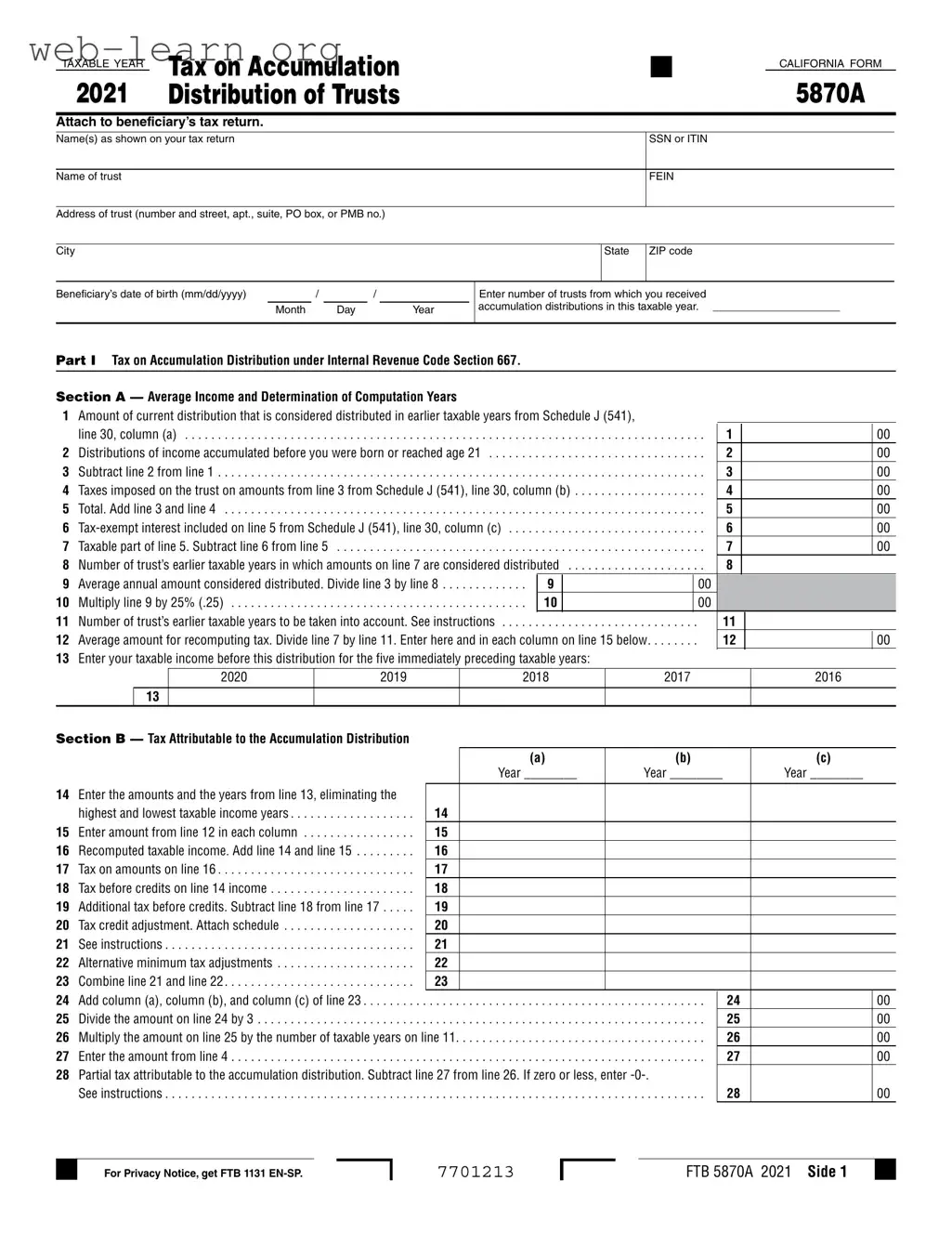
The California 5870A form plays a crucial role in the tax reporting process for beneficiaries of trusts. Designed for the 2020 tax year, this form is primarily used to report the tax on accumulation distributions from trusts, ensuring that beneficiaries accurately account for their received distributions. It requires specific information, including the name of the trust, its federal employer identification number (FEIN), and the beneficiary’s details, such as their Social Security Number (SSN) or Individual Taxpayer Identification Number (ITIN). The form is divided into several sections, each focusing on different aspects of the trust distributions. Part I addresses the tax on accumulation distributions under Internal Revenue Code Section 667, guiding beneficiaries through calculations related to prior taxable years and average annual amounts. Part II focuses on distributions of previously untaxed trust income, while Part III pertains to the Mental Health Services Tax. Beneficiaries must attach this form to their tax returns, making it essential for accurate tax reporting and compliance.
Sample - California 5870A Form

FTB 5870A 2021 Side 17701213
TAXABLE YEAR
2021
Tax on Accumulation
Distribution of Trusts
CALIFORNIA FORM
5870A
Attach to beneficiary’s tax return.
Beneficiary’s date of birth (mm/dd/yyyy) / / Enter number of trusts from which you received
accumulation distributions in this taxable year. _____________________
Month Day Year
Part I Tax on Accumulation Distribution under Internal Revenue Code Section 667.
Section A Average Income and Determination of Computation Years
Section B — Tax Attributable to the Accumulation Distribution
1 Amount of current distribution that is considered distributed in earlier taxable years from Schedule J (541),
line 30, column (a) ............................................................................... 1 00
2 Distributions of income accumulated before you were born or reached age 21 ................................. 2 00
3 Subtract line 2 from line 1 .......................................................................... 3 00
4 Taxes imposed on the trust on amounts from line 3 from Schedule J (541), line 30, column (b) .................... 4 00
5 Total. Add line 3 and line 4 ......................................................................... 5 00
6 Tax-exempt interest included on line 5 from Schedule J (541), line 30, column (c) .............................. 6 00
7 Taxable part of line 5. Subtract line 6 from line 5 ........................................................ 7 00
8 Number of trust’s earlier taxable years in which amounts on line 7 are considered distributed ..................... 8
9 Average annual amount considered distributed. Divide line 3 by line 8 ............. 9 00
10 Multiply line 9 by 25% (.25) ............................................. 10 00
11 Number of trust’s earlier taxable years to be taken into account. See instructions .............................. 11
12 Average amount for recomputing tax. Divide line 7 by line 11. Enter here and in each column on line 15 below........
12 00
13
Enter your taxable income before this distribution for the five immediately preceding taxable years:
2020 2019 2018 2017 2016
13
14 Enter the amounts and the years from line 13, eliminating the
highest and lowest taxable income years ................... 14
15 Enter amount from line 12 in each column ................. 15
16 Recomputed taxable income. Add line 14 and line 15 ......... 16
17 Tax on amounts on line 16 .............................. 17
18 Tax before credits on line 14 income ...................... 18
19 Additional tax before credits. Subtract line 18 from line 17 ..... 19
20 Tax credit adjustment. Attach schedule .................... 20
21 See instructions ...................................... 21
22 Alternative minimum tax adjustments ..................... 22
23 Combine line 21 and line 22............................. 23
24 Add column (a), column (b), and column (c) of line 23 .................................................... 24 00
25 Divide the amount on line 24 by 3 .................................................................... 25 00
26 Multiply the amount on line 25 by the number of taxable years on line 11...................................... 26 00
27 Enter the amount from line 4 ........................................................................ 27 00
28 Partial tax attributable to the accumulation distribution. Subtract line 27 from line 26. If zero or less, enter -0-.
See instructions
.................................................................................. 28
00
(a)
Year ________
(b)
Year ________
(c)
Year ________
For Privacy Notice, get FTB 1131 EN-SP.
Name(s) as shown on your tax return SSN or ITIN
Name of trust FEIN
Address of trust (number and street, apt., suite, PO box, or PMB no.)
City State ZIP code
Side 2 FTB 5870A 2021 7702213
Part II Tax on Distributions of Previously Untaxed Trust Income under Revenue and Taxation Code Section 17745 (b) and (d):
# If the income was accumulated over a period of five taxable years or more, complete Section A.
# If the income was accumulated over a period of less than five taxable years, complete Section B.
Section A See instructions.
Section B See instructions.
(a)
2020
(b)
2019
(c)
2018
(d)
2017
(e)
2016
1 Income accumulated less than five taxable years............................................................. 1 00
2 Averaging factor:
a Enter the number of years the trust accumulated the amount on line 1 .......... 2a
b Distribution year .................................................... 2b 1
3 Add line 2a and line 2b................................................................................. 3
4 Divide line 1 by line 3. Enter here and on Schedule CA (540), Part I, Section B, line 8z, column C,
or Schedule CA (540NR), Part II, Section B, line 8z, column C. .................................................. 4 00
5
Were you a resident or part-year resident? Check “Yes” or “No” for each year.
5
Yes Yes Yes Yes
(Answer “No” for nonresident years.)
No
No No No
6 Enter your taxable income before this distribution for the number of
preceding years entered on line 2a. See instructions ................. 6
7 Enter the amount from line 4 in col. (a) through col. (d). See instructions .. 7
8 Recomputed taxable income. Add line 6 and line 7
.................. 8
9 Tax on amounts on line 8 ...................................... 9
10 Tax before credits on line 6 income .............................. 10
11 Additional tax before credits. Subtract line 10 from line 9 ............. 11
12 Tax credit adjustment. Attach schedule ........................... 12
13 Subtract line 12 from line 11. See instructions ..................... 13
14 Alternative minimum tax adjustments ............................ 14
15 Add line 13 and line 14........................................ 15
16 Add line 15, column (a) through column (d) for all taxable years that you checked “Yes” on line 5. Enter here and on
Form 540, line 34; Form 540NR, line 41; or Form 541, line 21b. See instructions................................... 16 00
(a)
2020
(b)
2019
(c)
2018
(d)
2017
1 Income accumulated over five taxable years or more ......................................................... 1 00
2 Divide line 1 by six. Enter here and on Schedules CA (540), Part I, Section B, line 8z, column C,
or CA (540NR), Part II, Section B, line 8z, column C........................................................... 2 00
3
Were you a resident or part-year resident? Check “Yes” or “No” for each year 3 Yes Yes Yes Yes Yes
(Answer “No” for nonresident years.
)
No
No No No No
4 Enter your taxable income before this distribution for the five immediately
preceding years. See instructions. ............................... 4
5 Enter the amount from line 2 in col. (a) through col. (e) if the distribution
is ordinary income. For a capital gain distribution, see instructions. ..... 5
6 Recomputed taxable income. Add line 4 and line 5 .................. 6
7 Tax on amounts on line 6 ...................................... 7
8 Tax before credits on line 4 income .............................. 8
9 Additional tax before credits. Subtract line 8 from line 7 .............. 9
10 Tax credit adjustment. Attach schedule ........................... 10
11 Subtract line 10 from line 9. See instructions. ...................... 11
12 Alternative minimum tax adjustments ............................ 12
13 Add line 11 and line 12........................................ 13
14 Add line 13, column (a) through column (e) for all taxable years that you checked “Yes” on line 3. Enter here and on
Form 540, line 34; Form 540NR, line 41; or Form 541, line 21b. See instructions.................................... 14 00
FTB 5870A 2021 Side 37703213
List the tax year where you selected “Yes” to Part II, Section A, line 3.
1 Enter the recomputed taxable income from Part II, Section A, line 6 ..... 1
2 Subtract 1,000,000 from line 1. If zero or less, enter -0- .............. 2
3 Multiply line 2 by 1% ......................................... 3
4 Mental Health Services Tax paid on taxable income before distribution ... 4
5 Subtract line 4 from line 3 ..................................... 5
6 Add line 5, columns (a) through (e). Enter here and on Form 540, line 62; Form 540NR, line 72; or
Form 541, line 27. See instructions ....................................................................... 6 00
List the tax year where you selected “Yes” to Part II, Section B, line 5.
1 Enter the recomputed taxable income from Part II, Section B, line 8 .................. 1
2 Subtract 1,000,000 from line 1. If zero or less enter -0- ........................... 2
3 Multiply line 2 by 1% ...................................................... 3
4 Mental Health Services Tax paid on taxable income before distribution ................ 4
5 Subtract line 4 from line 3 .................................................. 5
6 Add line 5, columns (a) through (d). Enter here and on Form 540, line 62; Form 540NR, line 72; or
Form 541, line 27. See instructions ....................................................................... 6 00
Part III Mental Health Services Tax under Revenue and Taxation Code Section 17043:
# If the income was accumulated over a period of five taxable years or more, complete Section A.
# If the income was accumulated over a period of less than five taxable years, complete Section B.
Section A See instructions.
(a)
Year _____
(b)
Year _____
(c)
Year _____
(d)
Year _____
(e)
Year _____
Section B See instructions.
(a)
Year _____
(b)
Year _____
(c)
Year _____
(d)
Year _____

Form Information

Fact Name Description
Purpose The California Form 5870A is used to report taxes on accumulation distributions from trusts to beneficiaries.
Tax Year This form is specifically for the taxable year 2020, as indicated at the top of the form.
Governing Law The form operates under the Internal Revenue Code Section 667 and the California Revenue and Taxation Code Section 17745.
Filing Requirement Beneficiaries must attach Form 5870A to their individual tax returns when reporting accumulation distributions received from trusts.

Detailed Guide for Filling Out California 5870A

Filling out the California 5870A form is an important step in reporting trust distributions. This form must be attached to the beneficiary's tax return and requires specific information about the trust and the distributions received. Following these steps will help ensure that the form is completed accurately.

  1. Begin by entering the taxable year at the top of the form.
  2. Fill in the tax on accumulation section, including the name(s) as shown on the tax return, Social Security Number (SSN) or Individual Taxpayer Identification Number (ITIN), and the name of the trust.
  3. Provide the trust's Federal Employer Identification Number (FEIN), address, city, state, and ZIP code.
  4. Enter the beneficiary’s date of birth in the specified format (mm/dd/yyyy).
  5. Indicate the number of trusts from which you received accumulation distributions in the current taxable year.

Next, complete Part I by calculating the average income and determining the computation years. Start with the current distribution amount from Schedule J, then follow through with the calculations outlined in the form. Move on to Section B to calculate the tax attributable to the accumulation distribution. Make sure to fill out the necessary income details for the previous five taxable years.

  1. In Section A, record the amount of current distribution considered distributed in earlier taxable years.
  2. List any distributions of income accumulated before you were born or reached age 21.
  3. Perform the necessary calculations to determine the total and the taxable part of the amounts.
  4. Complete the tax attributable section by entering the recomputed taxable income and tax amounts for the applicable years.
  5. For Part II, indicate whether the income was accumulated over five taxable years or less, and complete the corresponding section.
  6. Finally, if applicable, complete Part III regarding the Mental Health Services Tax.

After filling out all sections, review the form for accuracy. Make sure to attach it to the beneficiary's tax return before submission. This will ensure compliance with California tax regulations.

Obtain Answers on California 5870A

  1. What is the California 5870A form?

    The California 5870A form is used to report tax on accumulation distributions from trusts. If you are a beneficiary who has received distributions from a trust, you will need to attach this form to your tax return. It helps determine the tax liability on amounts that have been accumulated in the trust and distributed to you.

  2. Who needs to file the 5870A form?

    If you are a beneficiary of a trust and received accumulation distributions during the taxable year, you must file the 5870A form. This applies regardless of whether the distributions were made before or after you were born or reached the age of 21.

  3. What information do I need to complete the form?

    You will need several pieces of information to fill out the California 5870A form:

    • Your name and Social Security Number (SSN) or Individual Taxpayer Identification Number (ITIN).
    • The name and address of the trust.
    • Your date of birth.
    • Details about the distributions you received, including the amounts and the years they were distributed.
  4. How do I calculate the tax on accumulation distributions?

    The tax calculation involves several steps. You will need to determine the average income from previous taxable years, subtract any tax-exempt interest, and then apply the appropriate tax rates. Each section of the form guides you through the calculations, ensuring you account for all relevant factors.

  5. Are there any penalties for not filing the 5870A form?

    Failing to file the 5870A form when required can lead to penalties and interest on any unpaid taxes. It's essential to file accurately and on time to avoid complications with the California Franchise Tax Board.

  6. Where can I get help with the California 5870A form?

    If you have questions or need assistance, you can refer to the instructions provided with the form. Additionally, consulting a tax professional can help clarify any uncertainties and ensure that you complete the form correctly.

Common mistakes

Filling out the California 5870A form can be challenging. Many individuals make common mistakes that can lead to issues with their tax returns. One frequent error is not providing the correct Social Security Number (SSN) or Individual Taxpayer Identification Number (ITIN). This information is crucial for identifying the beneficiary and ensuring accurate processing. Missing or incorrect SSNs or ITINs can delay the tax return and create complications.

Another mistake is failing to include the trust's Federal Employer Identification Number (FEIN). This number is essential for tax purposes and helps the state track the trust's income and distributions. Omitting the FEIN can lead to confusion and potential penalties.

Some individuals also overlook the importance of accurately reporting the beneficiary's date of birth. This date can affect tax calculations, especially in relation to distributions received before the beneficiary turned 21. Providing an incorrect date can lead to miscalculations in the tax owed.

Additionally, many people forget to enter the number of trusts from which they received accumulation distributions. This number is necessary for determining the tax liability accurately. Without this information, the form may be deemed incomplete, leading to further inquiries from tax authorities.

In Section A, errors often occur when calculating the average income and determining the computation years. For instance, miscalculating the amounts from Schedule J can result in incorrect tax calculations. It's vital to ensure that each line is filled out correctly, as even small errors can compound into larger issues.

Another common oversight is failing to eliminate the highest and lowest taxable income years when reporting income from previous years. This step is crucial for an accurate tax computation. Neglecting this requirement can lead to an inflated tax amount.

People sometimes also forget to attach required schedules, such as the tax credit adjustment schedule. Missing attachments can result in delays or rejections of the tax return, causing unnecessary stress for the taxpayer.

Lastly, individuals often misinterpret the instructions regarding the alternative minimum tax adjustments. This can lead to incorrect calculations and potential penalties. Understanding these adjustments is essential for compliance and accurate reporting.

By being aware of these common mistakes, individuals can approach the California 5870A form with greater confidence and accuracy. Careful attention to detail can help ensure a smoother tax filing process.

Documents used along the form

The California 5870A form is a critical document for beneficiaries of trusts, particularly when dealing with accumulation distributions. However, several other forms and documents often accompany it, providing essential information for tax purposes. Below is a list of these related forms, each serving a specific role in the overall process.

  • California Form 541: This is the California Fiduciary Income Tax Return. Trusts must file this form to report income, deductions, and tax liability. It provides the foundation for calculating the tax owed by the trust itself, which can affect the distributions to beneficiaries.
  • Schedule J (Form 541): This schedule is used to report the income distributions to beneficiaries and the corresponding tax calculations. It helps determine how much of the trust’s income has been distributed and what tax implications arise from those distributions.
  • California Form 540: The California Resident Income Tax Return is necessary for individual beneficiaries. They use this form to report their personal income, including any distributions received from trusts, ensuring that all income is accounted for in their tax filings.
  • California Schedule CA (540): This schedule is used to adjust federal adjusted gross income to California income. Beneficiaries must complete this form to ensure compliance with California tax regulations, particularly when reporting trust distributions.
  • FTB 1131: This Privacy Notice is important for beneficiaries to understand how their personal information is used and protected during the tax filing process. It reassures individuals that their data will be handled responsibly.

Understanding these forms and their interconnections can greatly simplify the process of filing taxes related to trust distributions. Each document plays a vital role in ensuring compliance and accuracy, ultimately benefiting the beneficiaries involved.

Similar forms

  • California Form 541: This form is used for fiduciary income tax returns. Like Form 5870A, it deals with income distributions from trusts and estates, requiring detailed reporting of income and distributions.
  • California Form 540: This is the individual income tax return for California residents. Similar to Form 5870A, it includes sections for reporting taxable income and tax calculations, but it is for individual taxpayers rather than trusts.
  • California Form 540NR: This form is for non-residents or part-year residents of California. It shares similarities with Form 5870A in that it requires the reporting of income and tax calculations, focusing on distributions received by non-residents.
  • IRS Form 1041: This is the U.S. Income Tax Return for Estates and Trusts. It parallels Form 5870A in addressing the taxation of trust income and distributions, requiring a breakdown of income and deductions.
  • IRS Form 1040: This form is used by individual taxpayers to report their income. While it is not specifically for trusts, it includes sections that may involve distributions from trusts, similar to the reporting done on Form 5870A.
  • IRS Form 3520: This form is for reporting transactions with foreign trusts and receipt of certain foreign gifts. It shares a focus on distributions and income but is specific to foreign trusts, unlike Form 5870A.
  • IRS Form 706: This is the U.S. Estate (and Generation-Skipping Transfer) Tax Return. It relates to the taxation of estates and may involve similar reporting of trust distributions in the context of estate tax calculations.
  • California Form 592: This form is used for reporting California source income paid to non-residents. It is similar to Form 5870A in that it involves the reporting of distributions, particularly for beneficiaries who are not residents of California.

Dos and Don'ts

When filling out the California 5870A form, it’s essential to be thorough and accurate. Here’s a helpful list of dos and don’ts to guide you through the process.

  • Do read the instructions carefully before starting the form.
  • Do ensure that all names, Social Security Numbers (SSNs), and addresses are correct.
  • Do double-check your calculations, especially for taxable income and distributions.
  • Do include all required documentation when submitting the form.
  • Do keep a copy of the completed form for your records.
  • Don't leave any sections blank; fill in all applicable fields.
  • Don't use outdated forms; always use the latest version available.
  • Don't forget to sign and date the form before submission.
  • Don't rush through the process; take your time to avoid mistakes.
  • Don't hesitate to seek assistance if you have questions about the form.

Misconceptions

  • Misconception 1: The California 5870A form is only for trusts established in California.
  • This form applies to all trusts that have accumulated income, regardless of where they were established. If the trust has beneficiaries in California, the form must be completed and submitted as part of their tax returns.

  • Misconception 2: Only professional tax preparers can fill out the California 5870A form correctly.
  • While tax professionals can provide valuable assistance, individuals can also complete the form. Clear instructions accompany the form, making it accessible for those willing to invest time in understanding the requirements.

  • Misconception 3: The California 5870A form is irrelevant if the trust has not made distributions.
  • Even if no distributions have been made, the form may still be necessary. It addresses accumulated income, which can impact tax obligations. Beneficiaries should be aware of any accumulation, as it may affect their tax situation.

  • Misconception 4: Completing the California 5870A form guarantees a tax refund.
  • Filing this form does not guarantee a refund. It is designed to calculate tax liabilities on accumulated income. The actual tax outcome will depend on various factors, including the overall income and deductions of the beneficiaries.

Key takeaways

  • The California 5870A form is used to report accumulation distributions from trusts. It must be attached to the beneficiary's tax return.

  • When filling out the form, ensure that you provide accurate information regarding the trust, including its name, address, and federal employer identification number (FEIN).

  • It is important to note the taxable year for which you are filing, as well as the beneficiary's date of birth, which may impact tax calculations.

  • Sections A and B of the form require different calculations based on the accumulation period of the income. Be sure to follow the instructions closely to determine which section applies to your situation.

  • Finally, review the completed form for accuracy before submission. Mistakes can lead to delays or issues with tax processing.