Homepage Blank California 587 Form
Outline

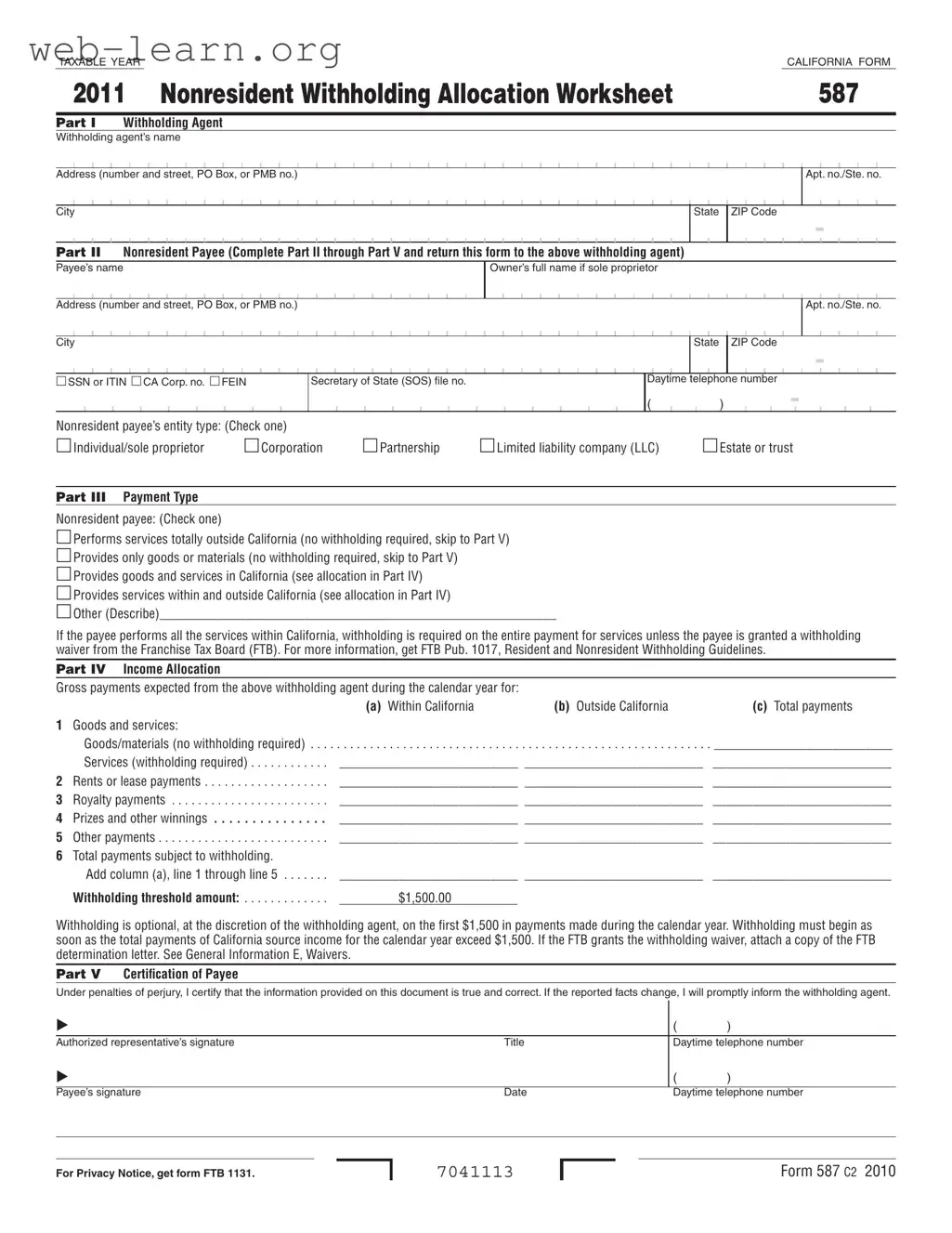
Understanding the California Form 587, also known as the Nonresident Withholding Allocation Worksheet, is essential for anyone involved in payments to nonresidents for services performed within the state. This form plays a crucial role in determining how much tax needs to be withheld from such payments. When a nonresident payee, whether an individual or a business entity, earns income from California sources, the withholding agent must use this form to assess the appropriate withholding amount. The form is divided into several parts, beginning with the details of the withholding agent and the nonresident payee, including their names and addresses. It also categorizes the type of payment being made, whether for services, goods, or other income types. Importantly, the form outlines specific guidelines regarding when withholding is required, with a threshold of $1,500 before mandatory withholding kicks in. Moreover, it includes sections for income allocation, allowing payees to specify the amounts earned both within and outside California. By completing and returning this form, nonresidents can ensure compliance with California tax laws while withholding agents can fulfill their obligations effectively. Keeping accurate records of this form is vital, as it must be retained for a minimum of four years and provided to the Franchise Tax Board upon request.


Sample - California 587 Form

Form 587 C2 2010
Withholding agent’s name
Address (number and street, PO Box, or PMB no.) Apt. no./Ste. no.
City State ZIP Code
Part II Nonresident Payee (Complete Part II through Part V and return this form to the above withholding agent)
Payee’s name Owner’s full name if sole proprietor
Address (number and street, PO Box, or PMB no.) Apt. no./Ste. no.
City State ZIP Code
Part IV Income Allocation
Gross payments expected from the above withholding agent during the calendar year for:
(a) Within California (b) Outside California (c) Total payments
1 Goods and services:
Goods/materials (no withholding required) . . . . . . . . . . . . . . . . . . . . . . . . . . . . . . . . . . . . . . . . . . . . . . . . . . . . . . . . . . . . .
___________________________
Services (withholding required) . . . . . . . . . . . . ___________________________ ___________________________ ___________________________
2 Rents or lease payments . . . . . . . . . . . . . . . . . . . ___________________________ ___________________________ ___________________________
3 Royalty payments . . . . . . . . . . . . . . . . . . . . . . . . ___________________________ ___________________________ ___________________________
4 Prizes and other winnings . . . . . . . . . . . . . . . ___________________________ ___________________________ ___________________________
5 Other payments . . . . . . . . . . . . . . . . . . . . . . . . . . ___________________________ ___________________________ ___________________________
6 Total payments subject to withholding.
Add column (a), line 1 through line 5 . . . . . . . ___________________________ ___________________________ ___________________________
Withholding threshold amount: . . . . . . . . . . . . . $1,500.00
Withholding is optional, at the discretion of the withholding agent, on the first $1,500 in payments made during the calendar year. Withholding must begin as
soon as the total payments of California source income for the calendar year exceed $1,500. If the FTB grants the withholding waiver, attach a copy of the FTB
determination letter. See General Information E, Waivers.
Part V Certification of Payee
Under penalties of perjury, I certify that the information provided on this document is true and correct. If the reported facts change, I will promptly inform the withholding agent.
฀( )
Authorized representative’s signature Title Daytime telephone number
฀( )
Payee’s signature Date Daytime telephone number
Nonresident Withholding Allocation Worksheet
CALIFORNIA FORM
587
7041113For Privacy Notice, get form FTB 1131.
Part I Withholding Agent
฀SSN or ITIN ฀CA Corp. no. ฀FEIN
Secretary of State (SOS) file no.
Daytime telephone number
( )
Nonresident payee’s entity type: (Check one)
Individual/sole proprietor Corporation Partnership Limited liability company (LLC) Estate or trust
Part III Payment Type
Nonresident payee: (Check one)
Performs services totally outside California (no withholding required, skip to Part V)
Provides only goods or materials (no withholding required, skip to Part V)
Provides goods and services in California (see allocation in Part IV)
Provides services within and outside California (see allocation in Part IV)
Other (Describe)____________________________________________________________
If the payee performs all the services within California, withholding is required on the entire payment for services unless the payee is granted a withholding
waiver from the Franchise Tax Board (FTB). For more information, get FTB Pub. 1017, Resident and Nonresident Withholding Guidelines.
TAXABLE YEAR
2011
-
-
-
Instructions for Form 587
Nonresident Withholding Allocation Worksheet
References in these instructions are to the California Revenue and Taxation Code (R&TC).
General Information
Beginning January 1, 2008, domestic
nonresidents may use Form 589,
Nonresident Reduced Withholding
Request, to request the reduction in
the standard seven percent withholding
amount that is applicable to California
source payments made to nonresidents.
Backup Withholding – Beginning on or
after January 1, 2010, with certain limited
exceptions, payers that are required to
withhold and remit backup withholding
to the Internal Revenue Service (IRS)
are also required to withhold and remit
to the Franchise Tax Board (FTB). The
California backup withholding rate is 7%
of the payment. For California purposes,
dividends, interests, and any financial
institutions, release of loan funds made in
the normal course of business are exempt
from backup withholding.
If a payee has backup withholding, the
payee must contact the FTB to provide
a valid Taxpayer Identification Number
(ITIN) before filing a tax return. The
following are acceptable TINs: social
security number (SSN); individual
taxpayer identification number (ITIN);
federal employer identification number
(FEIN); California corporation number
(CA Corp No.); or California Secretary of
State (SOS) file number. Failure to provide
a valid TIN will result in the denial of
the backup withholding credit. For more
information, go to ftb.ca.gov and search
for backup withholding.
Private Mail Box (PMB) – Include the
PMB in the address field. Write “PMB”
first, then the box number. Example: 111
Main Street PMB 123.
Foreign Address – Enter the information
in the following order: City, Country,
Province/Region, and Postal Code.
Follow the country’s practice for entering
the postal code. Do not abbreviate the
country’s name.
A Purpose
Use Form 587, Nonresident Withholding
Allocation Worksheet, to determine
the amount of withholding required on
payments to nonresidents.
The payee completes, signs, and
returns Form 587 to the withholding
agent. The withholding agent relies on
the certification made by the payee to
determine the amount of withholding
required, provided the completed and
signed Form 587 is accepted in good faith.
Retain the completed Form 587 for your
records for a minimum of four years and
provide it to the FTB upon request.
Do not use Form 587 if any of the
following applies:
Payment to a nonresident is only for
the purchase of goods.
You sold California real estate. Use
Form 593-C, Real Estate Withholding
Certificate.
The payee is a resident of California
or is a non-grantor trust that has at
least one California resident trustee.
Use Form 590, Withholding Exemption
Certificate.
The payee is a corporation, partnership,
or limited liability company (LLC) that
has a permanent place of business in
California or is qualified to do business
in California. Foreign corporations
must be qualified to transact intrastate
business. Use Form 590.
The payment is to an estate and the
decedent was a California resident. Use
Form 590.
B Requirement
California Revenue and Taxation Code
(R&TC) Section 18662 and the related
regulations require withholding of income
or franchise tax on certain payments made
to nonresidents of California for personal
services performed in California and for
rents on property located in California and
royalties with activities in California. The
withholding rate is seven percent (.07)
unless the FTB grants a waiver. See
General Information E, Waivers.
C When to File This Form
The withholding agent requests that the
payee completes, signs, and returns
Form 587 when a contract is entered into
or before payment is made to the payee.
The withholding agent retains Form 587
for a minimum of four years and must
provide it to the FTB upon request.
Form 587 remains valid for the duration
of the contract (or term of payments),
provided there is no material change in
the facts. By signing Form 587, the payee
agrees to promptly notify the withholding
agent of any changes in the facts.
D Withholding Requirements
Payments made to nonresident payees
(including individuals, corporations,
partnerships, LLCs, estates, and trusts)
are subject to withholding. However, no
withholding is required if total payments
of California source income to the payee
during the calendar year are $1,500 or less.
If the California resident, qualified
corporation, LLC, or partnership is acting
as an agent for the nonresident payee, the
payment is subject to withholding if the
nonresident payee does not meet any of
the exceptions on Form 590.
Payments subject to withholding include
the following:
Payments for services performed in
California by nonresidents.
Payments made in connection with a
California performance.
Rent paid to nonresidents if the rent is
paid in the course of the withholding
agent’s business.
Royalties paid to nonresidents from
business activities in California.
Payments of prizes for contests
entered in California.
Distributions of California source
income to nonresident beneficiaries
from an estate or trust.
Other payments of California source
income made to nonresidents.
Payments not subject to withholding
include payments:
To a resident of California or to a
corporation with a permanent place of
business in California.
To a corporation qualified to do
business in California.
To a partnership or LLC that has
a permanent place of business in
California.
For sale of goods.
For income from intangible personal
property, such as interest and
dividends, unless the property has
acquired a business situs in California.
For services performed outside of
California.
To a payee that is a tax-exempt
organization under either California or
federal law, use Form 590.
Form 587 Instructions 2010 Page 1
Representing wages paid to employees.
Wage withholding is administered
by the California Employment
Development Department (EDD). For
more information, contact your local
EDD office.
To a payee that is a government entity.
To reimburse a payee for expenses
relating to services performed in
California if the reimbursement is
separately accounted for and not
subject to federal Form 1099 reporting.
Corporate payees, for purposes of this
exception, are treated as individual
persons.
E Waivers
A nonresident payee may request that
withholding be waived. To apply for
a withholding waiver, use Form 588,
Nonresident Withholding Waiver Request.
If the FTB has granted a waiver, you must
attach a copy of FTB’s determination letter
to Form 587.
F Requirement to File a
California Tax Return
A payee’s exemption certification on
Form 587, Form 590, or a determination
letter from the FTB waiving withholding
does not eliminate the requirement to
file a California tax return and pay the
tax due. For return filing requirements,
see the instructions for Long or Short
Form 540NR, California Nonresident or
Part-Year Resident Income Tax Return;
Form 541, California Fiduciary Income Tax
Return; Form 100, California Corporation
Franchise or Income Tax Return; or
Form 100S, California S Corporation
Franchise or Income Tax Return.
Specific Instructions
Part I – Withholding Agent
The withholding agent must complete
Part I before giving Form 587 to the
payee.
Part II – Nonresident Payee
The payee must complete all information in
Part II including the social security number,
individual taxpayer identification number,
California corporation number, FEIN, or
SOS file number, and entity type.
Part III – Payment Type
The nonresident payee must check the
box that identifies the type of payment
being received.
Page 2 Form 587 Instructions 2010
No withholding is required when payees
are residents or have a permanent place of
business in California.
Part IV – Income Allocation
Use Part IV to identify payments that are
subject to withholding. Only payments
sourced within California are subject
to withholding. Services performed in
California are sourced in California. In the
case of payments for services performed
when part of the services are performed
outside California, enter the amount paid
for performing services within California
in column (a). Enter the amount paid
for performing services while outside
California in column (b). Enter the total
amount paid for services in column (c).
If the payee’s trade, business, or
profession carried on in California is
an integral part of a unitary business
carried on within and outside California,
the amounts included on line 1 through
line 5 should be computed by applying
the payee’s California apportionment
percentage (determined in accordance
with the provisions of the Uniform
Division of Income for Tax Purposes
Act) to the payment amounts. For more
information on apportionment, get
California Schedule R, Apportionment and
Allocation of Income.
Withholding agent. Withholding is
optional, at your discretion, on the first
$1,500 in payments made during the
calendar year. Withholding must begin as
soon as the total payments of California
source income for the calendar year
exceed $1,500. If circumstances change
during the year (such as the total amount
of payments), which would change the
amount on line 6, the payee must submit
a new Form 587 to the withholding agent
reflecting those changes. The withholding
agent should evaluate the need for a new
Form 587 when a change in facts occurs.
Part V – Certification of Payee
The payee and/or the authorized
representative must complete, sign, date,
and return this form to the withholding
agent.
Authorized representatives include
those persons the payee authorized to
act on their behalf through a power of
attorney, third party designee, or other
individual taxpayers authorized to view
their confidential tax data via a waiver or
release.
Additional Information
For additional information or to speak to
a representative regarding this form, call
the Withholding Services and Compliance
automated telephone service at:
888.792.4900, or
916.845.4900
FAX 916.845.9512
OR write to:
WITHHOLDING SERVICES AND
COMPLIANCE MS F182
FRANCHISE TAX BOARD
PO BOX 942867
SACRAMENTO CA 94267-0651
You can download, view, and print
California tax forms and publications at
ftb.ca.gov.
OR write to:
TAX FORMS REQUEST UNIT MS F284
FRANCHISE TAX BOARD
PO BOX 307
RANCHO CORDOVA CA 95741-0307
For all other questions unrelated to
withholding or to access the TTY/TDD
numbers, see the information below.
Internet and Telephone Assistance
Website: ftb.ca.gov
Telephone: 800.852.5711 from within the
United States
916.845.6500 from outside
the United States
TTY/TDD: 800.822.6268 for persons
with hearing or speech
impairments
Asistencia Por Internet y Teléfono
Sitio web: ftb.ca.gov
Teléfono: 800.852.5711 dentro de los
Estados Unidos
916.845.6500 fuera de los
Estados Unidos
TTY/TDD: 800.822.6268 personas con
discapacidades auditivas y del
habla
By Automated Phone Service: Use this
service to check the status of your refund,
order California forms, obtain payment
and balance due information, and hear
recorded answers to general questions.
This service is available 24 hours a day,
7 days a week, in English and Spanish.
Telephone: 800.338.0505 from within the
United States
916.845.6600 from outside
the United States
Follow the recorded instructions. Have
paper and pencil available to take notes.

Form Information

Fact Name Details
Purpose Form 587 is used to determine the withholding amount required on payments made to nonresidents for services performed in California.
Governing Law The form is governed by the California Revenue and Taxation Code (R&TC) Section 18662.
Withholding Rate The standard withholding rate is 7% on payments made to nonresidents for California source income.
Threshold for Withholding No withholding is required if total payments to the nonresident are $1,500 or less during the calendar year.
Filing Requirement The withholding agent must request Form 587 to be completed and returned before payment is made to the nonresident payee.
Certification The payee must certify that the information provided on Form 587 is true and correct, signing under penalties of perjury.
Waivers A nonresident payee can request a waiver for withholding using Form 588, and must attach the waiver letter if granted.
Retention Period The withholding agent must retain Form 587 for a minimum of four years and provide it to the Franchise Tax Board upon request.

Detailed Guide for Filling Out California 587

Completing the California Form 587 is a straightforward process. This form is essential for nonresidents to report their withholding allocations correctly. After filling it out, return it to the withholding agent, who will use the information to determine the appropriate withholding amounts.

  1. Gather Necessary Information: Collect all required details, including the withholding agent’s name and address, as well as your own personal information.
  2. Complete Part I: Fill in the withholding agent's name, address, and other relevant details.
  3. Move to Part II: Enter your name and address. If you are a sole proprietor, include the owner's full name. Provide your Tax Identification Number (SSN, ITIN, CA Corp No., FEIN, or SOS file number).
  4. Select Entity Type: Check the box that corresponds to your entity type: Individual, Corporation, Partnership, LLC, or Estate/Trust.
  5. Fill Out Part III: Indicate the type of payment you are receiving by checking the appropriate box. This will determine if withholding is required.
  6. Complete Part IV: Report the gross payments expected from the withholding agent. Break down the amounts into payments made within California and outside California.
  7. Calculate Total Payments: Add the amounts in column (a) for payments subject to withholding. Ensure the total is accurate.
  8. Sign and Date Part V: Certify that the information provided is true and correct. Both the payee and any authorized representative must sign.
  9. Return the Form: Submit the completed Form 587 to the withholding agent. Keep a copy for your records.

Obtain Answers on California 587

  1. What is the purpose of California Form 587?

    California Form 587, known as the Nonresident Withholding Allocation Worksheet, is designed to determine the amount of withholding required on payments made to nonresidents. It is crucial for ensuring compliance with California tax regulations regarding income earned by nonresidents for services performed or other income sourced within the state.

  2. Who needs to complete Form 587?

    The form must be completed by the nonresident payee receiving payments from a withholding agent. This includes individuals, corporations, partnerships, limited liability companies (LLCs), estates, and trusts that are not residents of California. The withholding agent must also fill out Part I of the form before providing it to the payee.

  3. When should Form 587 be filed?

    Form 587 should be completed and submitted by the payee to the withholding agent at the time a contract is established or before any payment is made. The withholding agent is required to retain this form for a minimum of four years and must provide it to the Franchise Tax Board (FTB) upon request.

  4. What types of payments are subject to withholding?

    Payments made to nonresidents for services performed in California, rents for property located in California, royalties, and certain other payments are subject to withholding. However, if the total payments to the nonresident during the calendar year do not exceed $1,500, withholding is not required.

  5. How does a nonresident request a withholding waiver?

    A nonresident payee can request a waiver from withholding by submitting Form 588, the Nonresident Withholding Waiver Request. If granted, a copy of the FTB's determination letter must be attached to Form 587 when submitted to the withholding agent.

  6. What happens if the payee's information changes?

    Should there be any changes in the information provided on Form 587, the payee is obligated to promptly notify the withholding agent. This ensures that the withholding agent has the most accurate and up-to-date information for tax compliance.

  7. What should a payee do if they do not provide a valid Taxpayer Identification Number (TIN)?

    If a payee fails to provide a valid TIN, they may be denied the backup withholding credit. It is essential for the payee to contact the FTB to provide a valid TIN before filing a tax return to avoid complications.

Common mistakes

Filling out the California Form 587 can be straightforward, but several common mistakes can lead to delays or complications. One frequent error is failing to provide all required information in Part II. This section requires detailed information about the nonresident payee, including their full name and taxpayer identification number. Omitting any of this information can result in processing delays.

Another common mistake is not checking the correct box in Part III regarding the type of payment. The payee must accurately indicate whether they perform services entirely outside California or provide goods and services within the state. Misclassification can lead to incorrect withholding calculations.

In Part IV, some individuals forget to allocate income properly. It is essential to distinguish between payments made for services rendered within California and those made for services outside the state. This allocation affects the withholding amount. Failure to provide accurate figures can lead to over- or under-withholding.

Additionally, many payees overlook the withholding threshold amount of $1,500. If total payments exceed this amount, withholding is mandatory. Not being aware of this requirement can lead to unexpected tax liabilities.

Another mistake occurs when individuals neglect to sign the certification in Part V. Both the payee and any authorized representative must sign and date the form. Without signatures, the form is incomplete and cannot be processed.

Some people also fail to update the withholding agent if their circumstances change after submitting the form. If there are any changes in the facts reported, the payee is obligated to inform the withholding agent promptly. Ignoring this responsibility can create issues down the line.

Lastly, many individuals do not keep a copy of the completed Form 587 for their records. It is important to retain this document for at least four years, as it may be needed for future reference or in case of an audit.

By being aware of these common mistakes, payees can fill out the California Form 587 more accurately and avoid potential complications. Attention to detail is key in ensuring compliance with state tax requirements.

Documents used along the form

The California Form 587, known as the Nonresident Withholding Allocation Worksheet, is essential for determining withholding requirements on payments made to nonresidents. In conjunction with this form, several other documents are commonly utilized to ensure compliance with California tax regulations. Below is a list of documents that often accompany Form 587, each serving a specific purpose in the withholding process.

  • Form 588: This is the Nonresident Withholding Waiver Request form. Nonresidents can use it to request a reduction or waiver of the standard withholding amount, which is typically seven percent of California source payments.
  • Form 590: Known as the Withholding Exemption Certificate, this form is used by payees to certify that they are exempt from withholding due to their residency status or business qualifications in California.
  • Form 593-C: This Real Estate Withholding Certificate is required when a nonresident seller sells California real estate. It helps determine the withholding amount on the sale proceeds.
  • Form 540NR: The California Nonresident or Part-Year Resident Income Tax Return is filed by nonresidents to report their California-source income and calculate any taxes owed.
  • Form 541: This form is the California Fiduciary Income Tax Return, used by estates and trusts to report income and calculate taxes owed in California.
  • Form 100: This is the California Corporation Franchise or Income Tax Return, which corporations must file to report income and pay taxes due in California.
  • Form 100S: The California S Corporation Franchise or Income Tax Return is similar to Form 100 but specifically for S Corporations, allowing them to report income and taxes owed.
  • Form FTB 1131: This Privacy Notice outlines how the Franchise Tax Board collects, uses, and protects personal information, providing transparency to payees regarding their data.
  • FTB Publication 1017: This publication provides guidelines for resident and nonresident withholding, offering detailed information on the withholding process and requirements.
  • Backup Withholding Documentation: If applicable, documentation related to backup withholding may be required to ensure compliance with IRS regulations regarding withholding on certain payments.

Each of these forms and documents plays a vital role in the withholding process for nonresidents in California. Understanding their purposes can help ensure compliance with state tax laws and avoid potential penalties. Proper documentation is crucial for both withholding agents and payees to navigate the complexities of California's tax regulations effectively.

Similar forms

  • Form 590 - Withholding Exemption Certificate: This form is used by payees to claim exemption from withholding on payments received. Similar to Form 587, it helps determine when withholding is not necessary, particularly for residents or entities with a permanent business presence in California.
  • Form 588 - Nonresident Withholding Waiver Request: Payees use this form to request a waiver of withholding. Like Form 587, it addresses withholding requirements but focuses on reducing or eliminating withholding for specific situations, providing flexibility for nonresidents.
  • Form 593-C - Real Estate Withholding Certificate: This document is specifically for withholding on real estate transactions. It shares similarities with Form 587 in that both involve withholding calculations, but Form 593-C is tailored to real estate sales rather than general payments for services.
  • Form 541 - California Fiduciary Income Tax Return: This form is for estates and trusts to report income. Like Form 587, it deals with income allocation and tax responsibilities, but it specifically addresses fiduciary entities rather than nonresident payees.
  • Form 100 - California Corporation Franchise or Income Tax Return: Corporations use this form to report their income. While Form 587 focuses on withholding for nonresidents, Form 100 is about corporate income tax obligations, reflecting different aspects of California tax law.
  • Form 100S - California S Corporation Franchise or Income Tax Return: This form is designed for S corporations to report income and pay taxes. Similar to Form 587, it involves tax reporting, but it pertains specifically to S corporations, highlighting the diversity in tax forms based on entity type.

Dos and Don'ts

When filling out the California 587 form, there are several key do's and don'ts to keep in mind. Here’s a helpful list:

  • Do provide accurate information for all required fields.
  • Do include your Social Security Number (SSN) or Individual Taxpayer Identification Number (ITIN).
  • Do check the correct box for your entity type.
  • Do ensure that your signature is included on the form.
  • Do keep a copy of the completed form for your records.
  • Don't leave any mandatory fields blank.
  • Don't forget to update the form if your information changes.
  • Don't use the form if you’re a California resident or have a permanent place of business in California.
  • Don't submit the form without verifying all calculations are correct.

Misconceptions

Understanding the California Form 587 can be challenging due to various misconceptions. Here are eight common misunderstandings about this form, along with clarifications:

  • Misconception 1: Only individuals need to fill out Form 587.
  • In reality, Form 587 is required for various entity types, including corporations, partnerships, and limited liability companies (LLCs), not just individuals.

  • Misconception 2: Withholding is always mandatory for nonresident payments.
  • Withholding is only required when total payments exceed $1,500 during the calendar year. Payments below this threshold do not require withholding.

  • Misconception 3: All payments to nonresidents are subject to withholding.
  • This is incorrect. Payments for goods or services performed entirely outside California do not require withholding.

  • Misconception 4: The withholding agent has no responsibilities regarding Form 587.
  • The withholding agent must complete Part I of the form and ensure that it is filled out correctly before returning it to the payee.

  • Misconception 5: A payee can ignore changes in their tax status after submitting Form 587.
  • Payees must inform the withholding agent of any changes to the information provided on Form 587 promptly.

  • Misconception 6: Form 587 is only for California residents.
  • Form 587 is specifically designed for nonresidents receiving payments for services performed in California.

  • Misconception 7: A waiver from withholding can be obtained informally.
  • To request a waiver, payees must complete Form 588 and submit it to the Franchise Tax Board (FTB). A formal process is necessary.

  • Misconception 8: Completing Form 587 eliminates the need to file a California tax return.
  • Even if withholding is waived or the payee is exempt, they are still required to file a California tax return and pay any taxes owed.

Key takeaways

When dealing with the California Form 587, Nonresident Withholding Allocation Worksheet, it's essential to understand its purpose and requirements. Here are five key takeaways:

  • Purpose of the Form: Form 587 is used to determine the amount of withholding required on payments made to nonresidents for services performed in California.
  • Who Completes the Form: The payee, which can be an individual or an entity, must fill out and sign the form before returning it to the withholding agent.
  • Withholding Threshold: Withholding is not required if total payments to the nonresident are $1,500 or less during the calendar year. However, once payments exceed this amount, withholding must begin.
  • Types of Payments: The form allows the payee to indicate the type of payment they are receiving, such as services or goods. It's important to check the correct box to avoid unnecessary withholding.
  • Retention of Records: The withholding agent must keep the completed Form 587 for at least four years. This form may be requested by the Franchise Tax Board (FTB) for verification purposes.

Understanding these key points can help ensure compliance and avoid potential issues related to nonresident withholding in California.