Homepage Blank California 5805 Form
Outline

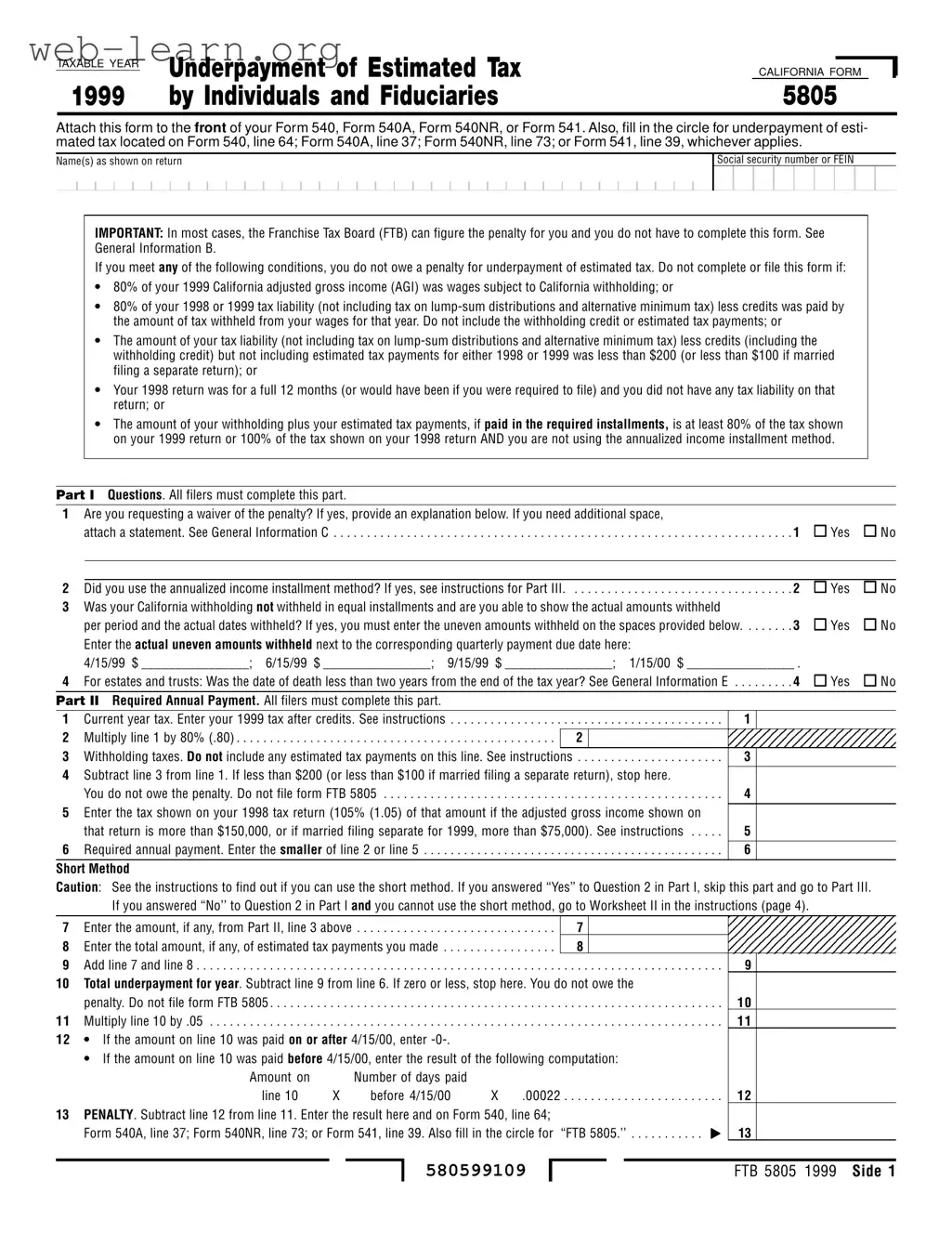
The California Form 5805 is an essential document for individuals and fiduciaries who may face penalties for underpaying their estimated taxes. This form is specifically designed to help taxpayers determine whether they owe a penalty and, if so, to calculate the amount due. When filing your California income tax return, you must attach Form 5805 to the front of your Form 540, Form 540A, Form 540NR, or Form 541. It is important to note that in many cases, the Franchise Tax Board (FTB) will automatically calculate any penalties, so completing this form may not be necessary for everyone. However, there are specific conditions under which you must fill it out, such as if your withholding was not done in equal installments or if you are requesting a waiver of the penalty. The form includes sections that require you to provide your personal information, answer key questions about your tax situation, and calculate your required annual payment based on your tax liability. By understanding the major components of Form 5805, taxpayers can navigate their obligations more effectively and ensure compliance with California tax regulations.


Sample - California 5805 Form

1234567890123456789012
1
23456789012345678901
2
1
23456789012345678901
2
1
23456789012345678901
2
1234567890123456789012
1234567890123456789012
1
23456789012345678901
2
1234567890123456789012
Underpayment of Estimated Tax
by Individuals and Fiduciaries
CALIFORNIA FORM
5805
TAXABLE YEAR
1999
Attach this form to the front of your Form 540, Form 540A, Form 540NR, or Form 541. Also, fill in the circle for underpayment of esti-
mated tax located on Form 540, line 64; Form 540A, line 37; Form 540NR, line 73; or Form 541, line 39, whichever applies.
580599109
FTB 5805 1999 Side 1
Name(s) as shown on return
Social security number or FEIN
Part I Questions. All filers must complete this part.
1 Are you requesting a waiver of the penalty? If yes, provide an explanation below. If you need additional space,
attach a statement. See General Information C . . . . . . . . . . . . . . . . . . . . . . . . . . . . . . . . . . . . . . . . . . . . . . . . . . . . . . . . . . . . . . . . . . . . .1
Yes
No
2 Did you use the annualized income installment method? If yes, see instructions for Part III. . . . . . . . . . . . . . . . . . . . . . . . . . . . . . . . . .2
Yes
No
3 Was your California withholding not withheld in equal installments and are you able to show the actual amounts withheld
per period and the actual dates withheld? If yes, you must enter the uneven amounts withheld on the spaces provided below. . . . . . . . 3
Yes
No
Enter the actual uneven amounts withheld next to the corresponding quarterly payment due date here:
4/15/99 $ ________________; 6/15/99 $ ________________; 9/15/99 $ ________________; 1/15/00 $ ________________ .
4 For estates and trusts: Was the date of death less than two years from the end of the tax year? See General Information E . . . . . . . . .4
Yes
No
Part II Required Annual Payment. All filers must complete this part.
1 Current year tax. Enter your 1999 tax after credits. See instructions . . . . . . . . . . . . . . . . . . . . . . . . . . . . . . . . . . . . . . . . . 1
2 Multiply line 1 by 80% (.80) . . . . . . . . . . . . . . . . . . . . . . . . . . . . . . . . . . . . . . . . . . . . . . . . 2
3 Withholding taxes. Do not include any estimated tax payments on this line. See instructions . . . . . . . . . . . . . . . . . . . . . . 3
4 Subtract line 3 from line 1. If less than $200 (or less than $100 if married filing a separate return), stop here.
You do not owe the penalty. Do not file form FTB 5805 . . . . . . . . . . . . . . . . . . . . . . . . . . . . . . . . . . . . . . . . . . . . . . . . . . . 4
5 Enter the tax shown on your 1998 tax return (105% (1.05) of that amount if the adjusted gross income shown on
that return is more than $150,000, or if married filing separate for 1999, more than $75,000). See instructions . . . . . 5
6 Required annual payment. Enter the smaller of line 2 or line 5 . . . . . . . . . . . . . . . . . . . . . . . . . . . . . . . . . . . . . . . . . . . . . 6
Short Method
Caution: See the instructions to find out if you can use the short method. If you answered “Yes’’ to Question 2 in Part I, skip this part and go to Part III.
If you answered “No’’ to Question 2 in Part I and you cannot use the short method, go to Worksheet II in the instructions (page 4).
7 Enter the amount, if any, from Part II, line 3 above . . . . . . . . . . . . . . . . . . . . . . . . . . . . . . 7
8 Enter the total amount, if any, of estimated tax payments you made . . . . . . . . . . . . . . . . . 8
9 Add line 7 and line 8 . . . . . . . . . . . . . . . . . . . . . . . . . . . . . . . . . . . . . . . . . . . . . . . . . . . . . . . . . . . . . . . . . . . . . . . . . . . . . . . 9
10 Total underpayment for year. Subtract line 9 from line 6. If zero or less, stop here. You do not owe the
penalty. Do not file form FTB 5805 . . . . . . . . . . . . . . . . . . . . . . . . . . . . . . . . . . . . . . . . . . . . . . . . . . . . . . . . . . . . . . . . . . . . 10
11 Multiply line 10 by .05 . . . . . . . . . . . . . . . . . . . . . . . . . . . . . . . . . . . . . . . . . . . . . . . . . . . . . . . . . . . . . . . . . . . . . . . . . . . . . 11
12 If the amount on line 10 was paid on or after 4/15/00, enter -0-.
If the amount on line 10 was paid before 4/15/00, enter the result of the following computation:
Amount on Number of days paid
line 10 X before 4/15/00 X .00022 . . . . . . . . . . . . . . . . . . . . . . . . 12
13 PENALTY. Subtract line 12 from line 11. Enter the result here and on Form 540, line 64;
Form 540A, line 37; Form 540NR, line 73; or Form 541, line 39. Also fill in the circle for “FTB 5805.’’ . . . . . . . . . . .
13
IMPORTANT: In most cases, the Franchise Tax Board (FTB) can figure the penalty for you and you do not have to complete this form. See
General Information B.
If you meet any of the following conditions, you do not owe a penalty for underpayment of estimated tax. Do not complete or file this form if:
80% of your 1999 California adjusted gross income (AGI) was wages subject to California withholding; or
80% of your 1998 or 1999 tax liability (not including tax on lump-sum distributions and alternative minimum tax) less credits was paid by
the amount of tax withheld from your wages for that year. Do not include the withholding credit or estimated tax payments; or
The amount of your tax liability (not including tax on lump-sum distributions and alternative minimum tax) less credits (including the
withholding credit) but not including estimated tax payments for either 1998 or 1999 was less than $200 (or less than $100 if married
filing a separate return); or
Your 1998 return was for a full 12 months (or would have been if you were required to file) and you did not have any tax liability on that
return; or
The amount of your withholding plus your estimated tax payments, if paid in the required installments, is at least 80% of the tax shown
on your 1999 return or 100% of the tax shown on your 1998 return AND you are not using the annualized income installment method.
12345678901
1
234567890
1
1
234567890
1
1
234567890
1
1
234567890
1
1
234567890
1
1
234567890
1
1
234567890
1
1
234567890
1
12345678901
12345678901
1
234567890
1
12345678901
Part III Annualized Income Installment Method Schedule.
Use this schedule ONLY IF you earned taxable income at an UNEVEN RATE during 1999 (See Example A). If you earned your income at approximately
the same rate each month (See Example B), then you should not complete this schedule. If you choose to figure the penalty, see the instructions for
Worksheet II — Regular Method to Figure Your Underpayment and Penalty, on page 3 of the instructions.
Example A: If you were a commissioned salesperson who earned no income during the first three months of the year, earned most of your income during the
following six months, and earned very little during the last three months, you should complete this schedule. You may be able to benefit by using the
annualized income installment method. The required installment of estimated tax figured using the annualized method may be less than your required
installment figured using the equal installment method.
Example B: If you worked all year and earned a monthly salary that did not change much during the year, you should not complete this schedule.
Note: To complete this schedule correctly, you must first complete Side 1, Part II,
line 1 through line 6.
Estates and trusts, do not use the period ending dates shown to the right. (a) (b) (c) (d)
Instead, use the following: 2/28/99, 4/30/99, 7/31/99, and 11/30/99. Fiscal-year 1/1/99 to 1/1/99 to 1/1/99 to 1/1/99 to
filers must adjust dates accordingly. 3/31/99 5/31/99 8/31/99 12/31/99
1 Enter your adjusted gross income (AGI) for each period. Form 540NR filers,
see instructions. Estates or trusts, enter the amount from Form 541, line 20
attributable to each period. See instructions . . . . . . . . . . . . . . . . . . . . . . . . . . . . . 1
2 Annualization amounts. Estates or trusts, see instructions . . . . . . . . . . . . . . . . . . . 2 4 2.4 1.5 1
3 Annualized income. Multiply line 1 by line 2 . . . . . . . . . . . . . . . . . . . . . . . . . . . . . . 3
4 Enter your itemized deductions for the period shown in each column. If you
do not itemize deductions, enter -0- here and on line 6. Estates or trusts,
enter -0- here, skip to line 9, and enter the amount from line 3 on line 9 . . . . . . 4
5 Annualization amounts . . . . . . . . . . . . . . . . . . . . . . . . . . . . . . . . . . . . . . . . . . . . . . 5 4 2.4 1.5 1
6 Annualized itemized deductions. Multiply line 4 by line 5. See instructions . . . . . . 6
7 Enter your standard deduction from your 1999 Form 540 or Form 540NR,
line 18; or Form 540A, line 15. Enter the total standard deduction amount
in each column . . . . . . . . . . . . . . . . . . . . . . . . . . . . . . . . . . . . . . . . . . . . . . . . . . . . 7
8 Enter line 6 or line 7, whichever is larger . . . . . . . . . . . . . . . . . . . . . . . . . . . . . . . 8
9 Subtract line 8 from line 3 . . . . . . . . . . . . . . . . . . . . . . . . . . . . . . . . . . . . . . . . . . . 9
10 Figure the tax on the amount in each column of line 9 using the tax table or
the tax rate schedule in the instructions for Form 540, Form 540NR, or Form 541.
Also, include any tax from form FTB 3803. Estates or trusts, see instructions . . . 10
11 Enter the total amount of exemption credits from your 1999 Form 540, line 21;
Form 540A, line 18; Form 540NR, line 23; or Form 541, line 22. Enter the total
exemption credit amount in each column. See instructions . . . . . . . . . . . . . . . . . 11
12 Subtract line 11 from line 10. Form 540NR filers, complete Worksheet I in the
instructions . . . . . . . . . . . . . . . . . . . . . . . . . . . . . . . . . . . . . . . . . . . . . . . . . . . . . . . 12
13 Enter the total credit amount from your 1999 Form 540, line 33 or Form 541,
line 23. Form 540NR filers, see instructions. Enter the total amount of credits
in each column . . . . . . . . . . . . . . . . . . . . . . . . . . . . . . . . . . . . . . . . . . . . . . . . . . . . 13
14 Subtract line 13 from line 12. If zero or less, enter -0- . . . . . . . . . . . . . . . . . . . . . 14
15 Applicable percentage . . . . . . . . . . . . . . . . . . . . . . . . . . . . . . . . . . . . . . . . . . . . . . . 15 20% 40% 60% 80%
16 Multiply line 14 by line 15 . . . . . . . . . . . . . . . . . . . . . . . . . . . . . . . . . . . . . . . . . . . . 16
COMPLETE LINE 17 THROUGH LINE 23 OF EACH COLUMN BEFORE YOU TO GO TO
THE NEXT COLUMN.
17 Enter the combined amounts shown on line 23 from all preceding columns . . . . 17
18 Subtract line 17 from line 16. If zero or less, enter -0- . . . . . . . . . . . . . . . . . . . . . 18
19 In each column, enter 1/4 of the amount on form FTB 5805, Part II, line 6 . . . . . 19
20 Enter the amount from line 22 from the preceding column . . . . . . . . . . . . . . . . . 20
21 Add line 19 and line 20 . . . . . . . . . . . . . . . . . . . . . . . . . . . . . . . . . . . . . . . . . . . . . . 21
22 If line 21 is more than line 18, subtract line 18 from line 21. Otherwise, enter -0- 22
23 Enter line 18 or line 21, whichever is less. Transfer these amounts to
Worksheet II — Regular Method to Figure Your Underpayment and
Penalty, line 1 . . . . . . . . . . . . . . . . . . . . . . . . . . . . . . . . . . . . . . . . . . . . . . . . . . . .
23
Note: If you use the annualized income installment method for one payment due date, you must use it for all payment due dates.
This schedule automatically selects the smaller of your annualized income installment or your regular installment.
Side 2 FTB 5805 1999
580599209
FTB 5805 Instructions 1999 Page 1
Instructions for Form FTB 5805
Underpayment of Estimated Tax by Individuals and Fiduciaries
General Information
A Purpose
Use form FTB 5805 to see if you owe a penalty for
underpaying your estimated tax and, if you do, to
figure the amount of the penalty.
B Who Must File
Generally, you do not have to complete this form.
The Franchise Tax Board (FTB) can figure the
amount of any penalty for you and send you a bill
after you have filed your return. If the FTB figures
your penalty and sends you a bill, you must pay
the penalty within 15 days of the billing to avoid
additional interest charges.
Important: If you answered “Yes” to any of the
questions in Part I (estates and trusts, see
General Information E), you must complete this
form and attach it to the front of your return.
C Waiver of the Penalty
You may request a waiver of the penalty if:
You underpaid an estimated tax installment
due to a casualty, disaster, or other unusual
circumstance and it would be inequitable to
impose the penalty; or
You retired after age 62 or became disabled in
1998 or 1999 and your underpayment was
due to reasonable cause.
To request a waiver:
Check “Yes” on form FTB 5805, Part I,
Question 1, and in the space provided, explain
why you are requesting a waiver of the
estimate penalty. If you need additional space,
attach a statement;
Complete form FTB 5805 through Part II,
line 12 (Worksheet II, line 15 if you use the
regular method) without regard to the waiver.
Write the amount you want waived in
parenthesis on the dotted line next to Part II,
line 13 (Worksheet II, line 16 if you use the
regular method). Subtract this amount from
the total penalty you figured without regard to
the waiver, and enter the result on Part II,
line 13 (Worksheet II, line 16 if you use the
regular method);
Fill in the circle on Form 540, line 64;
Form 540NR, line 73; or Form 541, line 39;
and
Attach form FTB 5805 to the front of your
return on top of any check, money order,
Form W-2, Form 1099, or other special
documentation.
D Annualized Income
Installment Method
If your income varied during the year and you use
the annualized income installment method to
determine your estimate payment requirements,
you must complete form FTB 5805, including
Side 2. Attach it to the front of your return on
top of any check, money order, Form W-2,
Form 1099, or other special documentation. Also
fill in the circle on your return for underpayment
of estimated tax.
E Estates and Trusts
Estates and trusts are required to make quarterly
estimated tax payments. Estates and grantor
trusts, which receive the residue of the
decedent’s estate, are required to make estimated
income tax payments for any year ending two or
more years after the date of the decedent’s death.
If you answered “Yes” to Question 4, complete
Part I only and attach form FTB 5805 to the
front of your return.
Note: Exempt trusts should use form FTB 5806,
Underpayment of Estimated Tax by Corporations.
F Nonresidents and New
Residents
The penalty for the underpayment of estimated tax
applies to nonresidents and new residents. See
the conditions listed in the box labeled “Impor-
tant” on Side 1 of form FTB 5805.
G Farmers and Fishermen
You are considered a farmer or fisherman if at
least two-thirds (2/3) of your annual gross
income for 1998 or 1999 is from farming or
fishing. Farmers and fishermen are required to
make one estimate payment. For calendar year
taxpayers, the due date is January 15, 2000. If
you file Form 540 or Form 541 and pay the entire
tax due by March 1, 2000, you do not owe a
penalty for underpaying estimated tax. Otherwise,
use form FTB 5805F, Underpayment of Estimated
Tax by Farmers and Fishermen, to figure your
penalty.
H Due Dates for Estimated
Tax Installments
If you are a calendar year taxpayer, the estimated
tax installment due dates for 1999 were:
First quarter April 15, 1999
Second quarter June 15, 1999
Third quarter September 15, 1999
Fourth quarter January 15, 2000
Fiscal-year filers must pay estimated tax
installments on the 15th day of the 4th, 6th, and
9th months of their fiscal year, and the 1st month
of the following fiscal year.
The penalty is figured separately for each due
date. Therefore, you may owe a penalty for an
earlier installment due date, even if you pay
enough tax later to make up the underpayment.
If a due date falls on a Saturday, Sunday, or legal
holiday, use the next business day.
I Filing an Early Return in
Place of the 4th Installment
If you file your 1999 tax return by February 1,
2000, and pay the entire balance due, you do not
have to make your last estimate payment. Fiscal-
year filers must file their return and pay their tax
before the first day of the 2nd month after the end
of their taxable year.
J Amended Return
If you file an amended return:
On or before the due date of your original
return, use the tax, credit and other amounts
shown on your amended return to figure your
penalty for underpayment of estimated tax.
After the due date of the original return, you
must use the amounts shown on the original
return to figure the penalty.
K Penalty Rates
The rates used to determine the amount of your
penalty are established at various dates through-
out the year. If an installment of estimated tax for
any quarter remained unpaid or underpaid for
more than one rate period, the penalty for that
underpayment will be figured using more than one
rate when applicable.
The following rates apply to the 1999 computation
period:
8% 4-15-99 through 6-30-99
7% 7-1-99 through 12-31-99
8% 1-1-00 through 6-30-00
Fiscal-year filers: the rates for the periods
7/1/00 through 12/31/00 and 1/1/01 through
3/15/01 will be determined by the FTB in
March 2000 and September 2000, respectively.
Call the FTB’s automated toll-free phone service to
get updated penalty rates. Call the number below,
select personal income tax information, follow the
recorded instructions, and enter code number 403
when instructed.
The automated toll-free phone service is available
in English and Spanish to callers with touch-tone
telephones 24 hours a day, seven days a week.
From within the
United States, call . . . . . . . . . . . (800) 338-0505
From outside the United States,
call (not toll free) . . . . . . . . . . . . (916) 845-6600
Specific Line Instructions
Part II — Computing the
Required Annual Payment
Use this part to figure the amount of estimated
tax that you were required to pay.
Certain high-income taxpayers are required to use
105% (instead of 100%) of the tax shown on
their previous year’s return in the computation of
the required annual payment. See the instructions
for line 5.
Line 1 – Enter your tax liability (excluding any tax
on lump-sum distributions) from your 1999
Form 540, line 34; Form 540A, line 23;
Form 540NR, line 43; or Form 541, line 25.
Line 3 – Enter the amounts from your 1999
Form 540, line 38 and line 41; Form 540A, line 24
and line 27; Form 540NR, line 47 and line 50; or
Form 541, line 28.
Line 5 – Enter your tax liability (excluding any tax
on lump-sum distributions) from your 1998
Form 540, line 34; Form 540A, line 23;
Form 540NR, line 43; or Form 541, line 25.
Page 2 FTB 5805 Instructions 1999
If the adjusted gross income shown on your 1998
California tax return is more than $150,000, or
more than $75,000 if married filing separate, then
enter 105% (1.05) of the tax liability from your
1998 return on line 5.
Short Method
You may use the short method only if you are a
calendar year taxpayer and:
1. You made no estimated tax payments or your
only payments were California income tax
withheld; or
2. You paid estimated tax in four equal amounts
on the due dates.
Note: If any payment was made earlier than the
due date, you may use the short method, but
using it may cause you to pay a larger penalty
than using the regular method. If the payment
was only a few days early, the difference is likely
to be small.
You may not use the short method if either of the
following apply:
1. You made any estimated tax payment late; or
2. You answered “Yes” to Part I, Question 3.
If you can use the short method, complete Part II,
line 1 through line 10 to figure your total
underpayment for the year, and line 11 through
line 13 to figure the penalty.
Part III – Annualized Income
Installment Method
If your income varied during the year, you may be
able to lower or eliminate the amount of one or
more required installments by using the
annualized income installment method. Use
Part III to figure the required installment amount
to enter on Worksheet II – Regular Method to
Figure Your Underpayment and Penalty, line 1
(page 4).
Complete line 1 through line 16 to figure your
current year tax, per quarter, based on your
income as you earned it. Then, complete line 17
through line 23 to figure your required installment
for each quarter. (The total of all amounts entered
on line 23 should equal the amount from Part II,
line 6.)
If you use the annualized income installment
method for any payment due date, you must use
it for all payment due dates. To figure the amount
of each required installment, Part III automatically
selects the smaller of the annualized income
installment or the regular installment (increased
by the amount saved by using the annualized
income installment method in figuring earlier
installments).
Note: If you are filing Form 540NR, see
Form 540NR Instructions for Part III at the end of
this section.
Line 1 – For the period, figure your total income
minus your adjustments to income for the period.
Include your share of partnership or S corpora-
tion income or loss items for the period.
Line 2 – Form 541 filers. Do not use amounts
shown in column (a) through column (d).
Instead, use 6, 3, 1.71429, and 1.09091,
respectively, as the annualization amounts.
Line 6 – Multiply line 4 by line 5 and enter the
result on line 6. Your annualized itemized
deductions are limited if, in any quarter, line 3 is
greater than:
$239,628 (married filing joint or qualifying
widow(er)); or
$119,813 (single or married filing separate);
or
$179,720 (head of household).
Use the following worksheet to figure the amount
to enter on line 6 for each period line 3 reaches
the above amounts.
1 Enter the amount from
Part III, line 4 . . . . . . . . . . . . . . . 1_______
2 Using California amounts, add
the amounts on federal
Schedule A, line 4, line 13 and
line 19 plus any gambling
losses included on line 27 . . . . . . 2_______
3 Subtract line 2 from line 1 . . . . . 3_______
4 Enter the number from
Part III, line 5 . . . . . . . . . . . . . . . 4_______
5 Multiply the amount on line 1
by line 4 . . . . . . . . . . . . . . . . . . . 5_______
Note: If the amount on line 3
is zero, stop here and enter the
amount from line 5 on Part III,
line 6.
6 Multiply the amount on line 3
by the number on line 4 . . . . . . . 6_______
7 Multiply the amount on
line 6 by 80% (.80) . . . . . . . . . . . 7_______
8 Enter the amount from
Part III, line 3 . . . . . . . . . . . . . . . 8_______
9 Enter the amount shown
above for your filing status . . . . . 9_______
10 Subtract line 9 from line 8 . . . . . 10_______
11 Multiply the amount on
line 10 by 6% (.06) . . . . . . . . . . . 11_______
12 Enter the smaller of line 7 or
line 11 . . . . . . . . . . . . . . . . . . . . . 12_______
13 Subtract line 12 from line 5.
Enter the result here and on
Part III, line 6 . . . . . . . . . . . . . . . 13_______
Line 10 – Form 541 filers. Figure the tax on the
amount in each column of line 9 using the tax
table or tax rate schedule in your tax booklet.
Also, include any tax from:
FTB 5870A, Tax on Accumulation Distribution
of Trusts; or
IRC Section 453A tax.
Line 11 – If your exemption credits were limited
by adjusted gross income (AGI), it may be to your
advantage to make a separate computation for
each period. If you choose, you may complete the
exemption credit worksheet in your tax booklet for
each period.
Line 13 – Enter the special credits you are entitled
to because of events that occurred during the
months shown in the column headings.
Credit Limitation – If your special credits were
limited by tentative minimum tax (TMT), it may be
to your advantage to make a separate computation
for each period. If you choose, you may complete
a separate Schedule P (540 or 541) for each
period.
Form 540NR Instructions for Part III
Use these instructions only if you are filing
Form 540NR.
Line 1 – Enter your total adjusted gross income
(AGI) for each period. Your total AGI is your AGI
for the period from all sources.
Line 12 – As a nonresident or part-year resident,
you must figure your tax based on your total
income. You then must determine your California
tax liability by multiplying the tax by the ratio of
California AGI to total AGI. To do this, complete
Worksheet I below.
California AGI is all of the income you earned
while you were a California resident plus any
income received from sources within California
while you were a nonresident, less applicable
income adjustments. For more information, see
the instructions for Schedule CA (540NR),
California Adjustments – Nonresident or Part-Year
Residents, column E.
Line 13 – Refigure Form 540NR, line 31 through
line 42 prorating the credits on line 31 through
line 36 using the ratio from Line D of Worksheet I
below.
Worksheet I – Prorated Tax for Form 540NR Filers 1/1/99 to 1/1/99 to 1/1/99 to 1/1/99 to
3/31/99 5/31/99 8/31/99 12/31/99
A California AGI . . . . . . . . . . . . . . . . . . . . . . . . . . . . . . . . . . . . . . . . . _____________ _____________ _____________ _____________
B Annualization amounts . . . . . . . . . . . . . . . . . . . . . . . . . . . . . . . . . ______
4______ _____2.4_____ _____1.5_____ ______1______
C Multiply line A by line B . . . . . . . . . . . . . . . . . . . . . . . . . . . . . . . . _____________ _____________ _____________ _____________
D Ratio. Divide line C by Part III, line 3 . . . . . . . . . . . . . . . . . . . . . . _____________ _____________ _____________ _____________
E Subtract Part III, line 11 from Part III, line 10 . . . . . . . . . . . . . . . _____________ _____________ _____________ _____________
F Multiply line D by line E. Enter the result here and on Part III,
line 12 . . . . . . . . . . . . . . . . . . . . . . . . . . . . . . . . . . . . . . . . . . . . . . _____________ _____________ _____________ _____________
FTB 5805 Instructions 1999 Page 3
12345678
1
234567
8
1
234567
8
12345678
1234567890123456
1
23456789012345
6
1
23456789012345
6
1234567890123456
Instructions for Worksheet II –
Regular Method to Figure Your
Underpayment and Penalty
Part I — Figure Your Underpayment
Line 1 – Enter in column (a) through
column (d) the amount of your required
installment. For most taxpayers, this is the
amount shown on form FTB 5805, Side 1,
Part II, line 6 divided by 4. If you use the
annualized income installment method, enter
the amount from form FTB 5805, Side 2,
Part III, line 23.
Line 2 – Enter the estimate payments made
by the date at the top of each column.
Include in column (a) any overpayment of
tax from your 1998 return that you elected
to apply to the 1999 estimated tax.
Divide by 4 the amount you entered on form
FTB 5805, Part II, line 3, and enter the result
in each column, unless you can show it was
withheld otherwise.
Note: If your California withholding was not
withheld in equal installments, and you are
able to show the actual amounts withheld per
period and the dates withheld, you must
answer “Yes” to Part I, Question 3 and enter
the uneven amounts withheld on the lines
provided on Part I, Question 3.
If you file your return and pay the tax due by
February 1, 2000, enter the amount of tax
paid with your return in column (d). In this
case, you will not owe a penalty for the
estimate payment due by January 15, 2000.
Line 8 – If line 8 is zero for all payment
periods, you do not owe a penalty. But if you
checked “Yes” for any question on form
FTB 5805, Side 1, Part I, you must file form
FTB 5805 with your return.
Part II — Figure the Penalty
Figure the penalty by applying the appropri-
ate rate against each underpayment shown
on line 8. The penalty is figured for the
number of days that the underpayment
remained unpaid.
The rates are established at various times
throughout the year. If an underpayment
remained unpaid for more than one rate
period, the penalty on that underpayment will
be figured using more than one rate period.
Use line 10, line 12, and line 14 to figure the
number of days the underpayment remained
unpaid. Use line 11, line 13, and line 15 to
figure the actual penalty amount by applying
the rate against the underpayment for the
number of days it remained unpaid.
Maximum days in a rate period per quarter:
Installment
Days in Rate
Period 1 Period 2 Period 3
1 76 184 106
2 15 184 106
3 107 106
491
Payment Application. Your payments are
applied to any underpayment balance on an
earlier installment. It does not matter if you
designate a payment for a later period.
Example: You had an underpayment for the
April 15th installment of $500. The June
15th installment required a payment of
$1,200. On June 10th, you sent in a
payment of $1,200 to cover the June 15th
installment. However, $500 of this payment
is considered to be for the April 15th
installment. The penalty for the April 15th
installment is figured to June 10th. The
amount of the payment to be applied to the
June 15th installment is $700.
Subsequent Payments. For purposes of
computing the penalty, it may be helpful to
make a list of any payments that you made
after the timely payments entered in Part I,
line 2. If you made no other payments, follow
the line-by-line instructions for Part II.
If you made subsequent payments, you may
need to make additional computations for the
applicable column on the worksheet. However,
if the payment reduced the underpayment to
zero, there are no further computations to
make for that column. In that case, you count
the number of days from the installment due
date to the date paid.
If a subsequent payment does not reduce the
underpayment to zero, you will need to make
an additional computation in the column.
First, count the number of days from the
due date to the date paid and use the
underpayment amount from Worksheet II,
line 8.
Second, count the number of days from
the payment date to the end of the rate
period, and subtract the amount of the
subsequent payment from the underpay-
ment amount from Worksheet II, line 8.
Then apply the rate for the applicable
period.
Page 4 FTB 5805 Instructions 1999
1234
1
23
4
1234
1234
1
23
4
1234
1234
1
23
4
1234
1234
1
23
4
1
23
4
1
23
4
1
23
4
1
23
4
1
23
4
1
23
4
1234
12345678901
1
234567890
1
1
234567890
1
1
234567890
1
1
234567890
1
1
234567890
1
1
234567890
1
1
234567890
1
1
234567890
1
1
234567890
1
1
234567890
1
1
234567890
1
1
234567890
1
1
234567890
1
1
234567890
1
1
234567890
1
12345678901
1234567890123456789012
1
23456789012345678901
2
1
23456789012345678901
2
1
23456789012345678901
2
1
23456789012345678901
2
1
23456789012345678901
2
1
23456789012345678901
2
1
23456789012345678901
2
1
23456789012345678901
2
1
23456789012345678901
2
1
23456789012345678901
2
1
23456789012345678901
2
1
23456789012345678901
2
1
23456789012345678901
2
1
23456789012345678901
2
1
23456789012345678901
2
1234567890123456789012
12345678901
1
234567890
1
1
234567890
1
1
234567890
1
12345678901
12345678901
1
234567890
1
1
234567890
1
1
234567890
1
12345678901
12345678901
1
234567890
1
1
234567890
1
1
234567890
1
1
234567890
1
1
234567890
1
1
234567890
1
1
234567890
1
1
234567890
1
1
234567890
1
1
234567890
1
1
234567890
1
1
234567890
1
1
234567890
1
12345678901
Worksheet II Regular Method to Figure Your Underpayment and Penalty.
Payment Due Dates
Part I Figure Your Underpayment (a) (b) (c) (d)
4/15/99 6/15/99 9/15/99 1/15/00
1 Required Installments. See instructions . . . . . . . . . . . . . . . . . . . . . . . . . . . . . 1
2 Estimated tax paid and tax withheld. See instructions. For column (a) only,
also enter the amount from line 2 on line 6. (If line 2 is equal to or more than
line 1 for all payment periods, stop here; you do not owe the penalty. Do not
file form FTB 5805 unless you answered “Yes’’ to a question in Part I) . . . . . 2
3 Enter amount, if any, from line 9 of previous column . . . . . . . . . . . . . . . . . . . 3
COMPLETE LINE 3 THROUGH LINE 9 OF ONE COLUMN BEFORE GOING TO THE
NEXT COLUMN.
4 Add line 2 and line 3 . . . . . . . . . . . . . . . . . . . . . . . . . . . . . . . . . . . . . . . . . . . . . . . 4
5 Add amounts on line 7 and line 8 of the previous column . . . . . . . . . . . . . . . . . . 5
6 Subtract line 5 from line 4. If zero or less, enter -0-. For column (a) only,
enter the amount from line 2 . . . . . . . . . . . . . . . . . . . . . . . . . . . . . . . . . . . . . . . . 6
7 If the amount on line 6 is zero, subtract line 4 from line 5.
Otherwise, enter -0- . . . . . . . . . . . . . . . . . . . . . . . . . . . . . . . . . . . . . . . . . . . . . . . 7
8 Underpayment. If line 1 is equal to or more than line 6, subtract line 6 from
line 1. Then go to line 3 of next column. Otherwise, go to line 9 . . . . . . . . . . . 8
9 Overpayment. If line 6 is more than line 1, subtract line 1 from line 6.
Then go to line 3 of next column . . . . . . . . . . . . . . . . . . . . . . . . . . . . . . . . . . . . . 9
Part II Figure the Penalty. Complete line 10 through line 15 of one column before going to the next column.
Rate Period 1: 4/15/99 6/15/99
April 15, 1999 — June 30, 1999
Days: Days:
10 Number of days FROM the date shown above line 10 TO the date the
amount on line 8 was paid or 6/30/99, whichever is earlier . . . . . . . . . . . . . . . . 10
11 Underpayment Number of
on line 8 X
days on line 10 X .08
(see instructions) 365 11 $$
Rate Period 2: 6/30/99 6/30/99 9/15/99
July 1, 1999 — December 31, 1999
Days: Days: Days:
12 Number of days FROM the date shown above line 12 TO the date the
amount on line 8 was paid or 12/31/99, whichever is earlier . . . . . . . . . . . . . . . 12
13 Underpayment Number of
on line 8 X
days on line 12 X .07
(see instructions) 365 13 $$$
Rate Period 3: 12/31/99 12/31/99 12/31/99 1/15/00
January 1, 2000 — April 15, 2000
Days: Days: Days: Days:
14 Number of days FROM the date shown above line 14 TO the date the
amount on line 8 was paid or 4/15/00, whichever is earlier . . . . . . . . . . . . . . . . 14
15 Underpayment Number of
on line 8 X
days on line 14 X .08
(see instructions) 366 15 $$$$
16 PENALTY. Add all amounts on line 11, line 13, and line 15 in all columns. Enter the total here, on Form FTB 5805, Side 1,
Part II, line 13, and on Form 540, line 64; Form 540A, line 37; Form 540NR, line 73; or Form 541, line 39.
Also fill in the circle on that line . . . . . . . . . . . . . . . . . . . . . . . . . . . . . . . . . . . . . . . . . . . . . . . . . . . . . . . . . . . . . . . . . . . . . 16 $

Form Information

Fact Name Description
Purpose The California Form 5805 is used to determine if an individual or fiduciary owes a penalty for underpaying estimated taxes for the tax year 1999.
Filing Requirement This form must be attached to the front of Form 540, Form 540A, Form 540NR, or Form 541 if the filer meets certain conditions that may result in a penalty.
Conditions for No Penalty No penalty is owed if specific criteria are met, such as having 80% of income from wages subject to withholding or if the tax liability is below $200.
Waiver of Penalty Filers can request a waiver of the penalty for reasons such as retirement after age 62 or underpayment due to a disaster. This request must be documented on the form.
Governing Law The form is governed by California Revenue and Taxation Code Section 19132, which outlines penalties for underpayment of estimated tax.

Detailed Guide for Filling Out California 5805

Completing the California Form 5805 requires careful attention to detail. This form is essential for determining any penalties related to underpayment of estimated taxes. Follow the steps outlined below to ensure accuracy in filling out the form.

  1. Gather Necessary Information: Collect your tax documents, including your previous year’s tax return and any relevant income statements.
  2. Identify Tax Year: Write the tax year at the top of the form, indicating the year for which you are filing.
  3. Complete Personal Information: Fill in your name(s) as they appear on your tax return and your Social Security number or FEIN.
  4. Check the Waiver Request: In Part I, question 1, indicate whether you are requesting a waiver of the penalty. Provide an explanation if you answer "Yes."
  5. Annualized Income Method: If applicable, answer question 2 regarding the annualized income installment method.
  6. Uneven Withholding: For question 3, indicate if your California withholding was not withheld in equal installments. If so, enter the actual amounts withheld next to the corresponding quarterly payment due dates.
  7. Complete Required Annual Payment: In Part II, calculate your current year tax after credits. Multiply this amount by 80% and fill in the result.
  8. Calculate Withholding Taxes: Enter the total withholding taxes from your tax return, excluding any estimated tax payments.
  9. Determine Underpayment: Subtract the withholding taxes from your current year tax. If this amount is less than $200 (or $100 if married filing separately), you do not owe a penalty.
  10. Fill in Previous Year’s Tax: Enter the tax shown on your previous year’s return, adjusting for high-income thresholds if necessary.
  11. Calculate Required Annual Payment: Enter the smaller amount between the results from the previous calculations.
  12. Complete Penalty Calculation: If applicable, complete the penalty calculation section, determining the amount owed based on your underpayment.
  13. Annualized Income Installment Method: If your income varied, complete Part III to determine the required installment amounts based on your income as it was earned.
  14. Review the Form: Carefully review all entries for accuracy and completeness.
  15. Attach to Your Tax Return: Attach the completed Form 5805 to the front of your Form 540, Form 540A, Form 540NR, or Form 541.

After completing these steps, ensure that you file your tax return by the due date to avoid additional penalties. Keep a copy of the completed form for your records.

Obtain Answers on California 5805

  1. What is the purpose of the California Form 5805?

    The California Form 5805 is used to determine if you owe a penalty for underpaying your estimated tax. If you do owe a penalty, this form helps calculate the amount. It is important to attach this form to the front of your tax return, such as Form 540, Form 540A, Form 540NR, or Form 541.

  2. Who needs to file Form 5805?

    Most taxpayers do not need to complete this form, as the Franchise Tax Board (FTB) can calculate any penalties for you. However, if you meet specific conditions, such as having uneven withholding or being an estate or trust, you must complete and file this form.

  3. What conditions exempt me from the penalty?

    You may not owe a penalty if:

    • 80% of your California adjusted gross income was from wages subject to withholding.
    • 80% of your tax liability for 1998 or 1999 was covered by withholding from your wages.
    • Your tax liability, after credits, was less than $200 (or $100 if married filing separately).
    • Your 1998 return had no tax liability.
    • Your total withholding and estimated payments met specific thresholds.
  4. How do I request a waiver for the penalty?

    If you believe you qualify for a waiver, check "Yes" on Part I of Form 5805 and provide an explanation. You may attach a statement if you need more space. Complete the form through Part II, and indicate the amount you wish to waive.

  5. What if I have uneven withholding?

    If your California withholding was not withheld in equal installments, you must indicate the actual amounts withheld and their corresponding dates on Part I, Question 3 of the form. This information is crucial for accurately calculating your penalty.

  6. What is the annualized income installment method?

    This method is beneficial if your income varied throughout the year. It allows you to calculate your required estimated tax payments based on your actual income as it was earned. If you choose this method, you must complete Part III of Form 5805.

  7. What are the due dates for estimated tax payments?

    If you are a calendar year taxpayer, the due dates for 1999 estimated tax installments were:

    • First quarter: April 15, 1999
    • Second quarter: June 15, 1999
    • Third quarter: September 15, 1999
    • Fourth quarter: January 15, 2000
  8. How is the penalty calculated?

    The penalty is calculated based on the amount of underpayment and the number of days it remained unpaid. Different rates apply depending on the time period during which the underpayment occurred. The FTB provides the applicable rates for each period.

  9. What should I do if I file an amended return?

    If you file an amended return, you must use the amounts from your original return to calculate the penalty if the amended return is filed after the original due date. If filed on or before the due date, you can use the amended amounts.

Common mistakes

Completing the California Form 5805 can be a daunting task, and many individuals make common mistakes that can lead to penalties or complications. One frequent error is failing to determine whether the form is actually necessary. In many cases, the Franchise Tax Board (FTB) can calculate the penalty for underpayment on behalf of the taxpayer. If certain conditions are met, individuals may not owe a penalty and should not complete the form. Always check the criteria outlined in the instructions to see if you qualify for exemption.

Another common mistake involves incorrect calculations on the form itself. Taxpayers often miscalculate their required annual payment by not accurately entering their tax liability or withholding amounts. For example, if you do not properly account for all tax credits or fail to include the correct amounts from your previous year’s return, your figures will be off. Double-check all calculations to ensure accuracy, as even small errors can lead to significant penalties.

Many individuals also neglect to complete all necessary parts of the form. Part I requires specific questions to be answered, and skipping any of these can result in an incomplete submission. For instance, if you answer "Yes" to requesting a waiver of the penalty, you must provide an explanation. Failing to do so may lead the FTB to reject your request, resulting in an automatic penalty.

Additionally, taxpayers often forget to attach the completed Form 5805 to the front of their tax return. This is a crucial step that should not be overlooked. Without the proper attachment, the FTB may not consider your submission valid, and you could face penalties for underpayment. Always ensure that your form is securely attached to your main return before filing.

Finally, many individuals overlook the importance of timely filing. If you file your return late, even if you have completed the form correctly, you may still incur penalties. It is essential to be aware of filing deadlines and to submit your tax return, along with Form 5805 if applicable, on time to avoid unnecessary charges. By being diligent and thorough in your preparation, you can navigate this process more smoothly and reduce the risk of penalties.

Documents used along the form

The California Form 5805 is an important document used to determine if individuals and fiduciaries owe a penalty for underpaying estimated taxes. Alongside this form, several other documents are often required to ensure accurate tax reporting and compliance. Below is a list of related forms and documents that may be used in conjunction with the California 5805.

  • Form 540: This is the California Resident Income Tax Return. It is used by residents to report their income, calculate their tax liability, and claim any credits or deductions.
  • Form 540A: This is a simplified version of Form 540. It is designed for taxpayers with simpler tax situations, allowing them to report income and claim deductions without the complexity of the full Form 540.
  • Form 540NR: This form is for non-residents and part-year residents of California. It helps these individuals report their income earned in California and calculate their tax liability accordingly.
  • Form 541: This is the California Fiduciary Income Tax Return. It is used by estates and trusts to report income, deductions, and taxes owed on behalf of the beneficiaries.
  • Form W-2: Employers provide this form to report wages paid to employees and the taxes withheld. It is crucial for individuals when filing their income tax returns.
  • Form 1099: This form is used to report various types of income other than wages, salaries, and tips. It is essential for independent contractors and other non-employee income earners.
  • Form FTB 5806: This form is specifically for exempt trusts to report underpayment of estimated taxes. It is used when the FTB 5805 is not applicable.
  • Worksheet II: This is a supporting document used to calculate the underpayment and penalty. It provides detailed steps for determining the required annual payment and any penalties owed.

Using these forms correctly is crucial for compliance with California tax laws. Ensure that all necessary documents are completed accurately and submitted on time to avoid penalties and interest charges. Staying informed and organized will help streamline the tax filing process.

Similar forms

  • Form 540: This is the California Resident Income Tax Return. Like Form 5805, it is used by individuals to report income and calculate tax liability. Both forms are part of the overall process of filing state taxes in California.
  • Form 540A: This is a simplified version of Form 540 for individuals with less complex tax situations. Similar to Form 5805, it requires the same tax liability information and is used to determine if a penalty for underpayment applies.
  • Form 540NR: This is for non-residents and part-year residents. It parallels Form 5805 in that it addresses tax liabilities and potential penalties for underpayment of estimated tax for those who do not meet residency requirements.
  • Form 541: This form is used for fiduciaries, such as estates and trusts. Like Form 5805, it addresses estimated tax payments and the penalties associated with underpayment, ensuring compliance for different types of taxpayers.
  • Form FTB 5806: This form is specifically for exempt trusts. It is similar to Form 5805 in that it also addresses underpayment of estimated tax but is tailored for a different taxpayer demographic.
  • Form FTB 5805F: This form is designed for farmers and fishermen. It shares the purpose of determining underpayment penalties similar to Form 5805, but it accounts for the unique income situations of these professions.
  • Form 8879: This is the IRS e-file Signature Authorization. While it serves a different function, both forms are part of the tax filing process and require accurate reporting of income and tax liabilities.
  • Form 1040: This is the standard individual income tax return used at the federal level. Like Form 5805, it involves reporting income and calculating tax owed, though it is not specific to California.
  • Form 1099: This form reports various types of income other than wages. While it serves a different purpose, it relates to income reporting, which is essential for completing forms like 5805.
  • Form 4868: This is the application for an automatic extension of time to file a U.S. individual income tax return. Like Form 5805, it is part of the overall tax compliance process, although it focuses on extensions rather than penalties.

Dos and Don'ts

When filling out the California 5805 form, follow these guidelines to ensure accuracy and compliance.

  • Do attach the form to the front of your Form 540, 540A, 540NR, or 541.
  • Do check the appropriate box for underpayment of estimated tax on your main tax form.
  • Do provide accurate personal information, including your name(s) and Social Security number or FEIN.
  • Do read the instructions carefully, especially the sections about who must file.
  • Do complete all required parts of the form, especially Part I and Part II.
  • Don't fill out the form if you qualify for an exemption from the penalty.
  • Don't forget to keep copies of all documents submitted for your records.
  • Don't leave any required fields blank; provide all necessary information.
  • Don't submit the form late; adhere to the filing deadlines to avoid penalties.

Misconceptions

Misconceptions about the California 5805 form can lead to confusion regarding tax obligations. Below are nine common misconceptions along with clarifications.

  • Everyone must file the 5805 form. Many individuals believe that all taxpayers are required to complete this form. In reality, the Franchise Tax Board (FTB) can often calculate the penalty for underpayment on behalf of the taxpayer, meaning that many do not need to file this form.
  • Filing the 5805 guarantees a penalty waiver. Some taxpayers assume that submitting the form will automatically exempt them from penalties. However, waivers are granted only under specific circumstances, such as unusual circumstances or retirement after age 62.
  • The 5805 form applies only to individuals. A common misunderstanding is that this form is exclusively for individual taxpayers. In fact, fiduciaries, such as estates and trusts, are also required to use this form under certain conditions.
  • All underpayments incur penalties. Many individuals think that any underpayment of estimated taxes will lead to penalties. However, if certain criteria are met, such as having a tax liability below a specified threshold, no penalties will apply.
  • Using the annualized income installment method is mandatory. Some taxpayers believe they must use this method if their income fluctuates. In reality, this method is optional and should only be used if it benefits the taxpayer.
  • Paying taxes late always results in penalties. While late payments can incur penalties, there are provisions that allow taxpayers to avoid penalties if they file their returns early and pay the full balance due.
  • All tax credits can be applied to the 5805 form. Taxpayers often think that any credit can reduce their tax liability on this form. However, only specific credits can be considered, and others may not apply.
  • Filing an amended return affects the 5805 form automatically. Some individuals believe that filing an amended return will automatically adjust their obligations on the 5805 form. Instead, the amounts on the original return must be used for penalty calculations if the amended return is filed after the original due date.
  • Once filed, the 5805 form cannot be changed. Many taxpayers think that after submitting the form, they cannot make any modifications. In fact, if errors are identified, taxpayers can amend their submissions as needed.

Understanding these misconceptions can help taxpayers navigate their responsibilities more effectively and avoid unnecessary penalties.

Key takeaways

  • The California Form 5805 is used to determine if you owe a penalty for underpaying estimated taxes.

  • Attach this form to the front of your tax return, such as Form 540, 540A, 540NR, or 541.

  • Before filling out the form, check if the Franchise Tax Board (FTB) can calculate the penalty for you. In many cases, they will do so automatically.

  • You do not need to file the form if certain conditions are met, such as having 80% of your income from wages subject to California withholding.

  • All filers must complete Part I of the form, which includes questions about your tax situation.

  • If you request a waiver for the penalty, provide a clear explanation on the form.

  • Part II requires you to calculate your required annual payment based on your current year tax and withholding.

  • If your income fluctuated throughout the year, consider using the annualized income installment method detailed in Part III.

  • Make sure to fill in the appropriate circles on your main tax form to indicate you are submitting Form 5805.