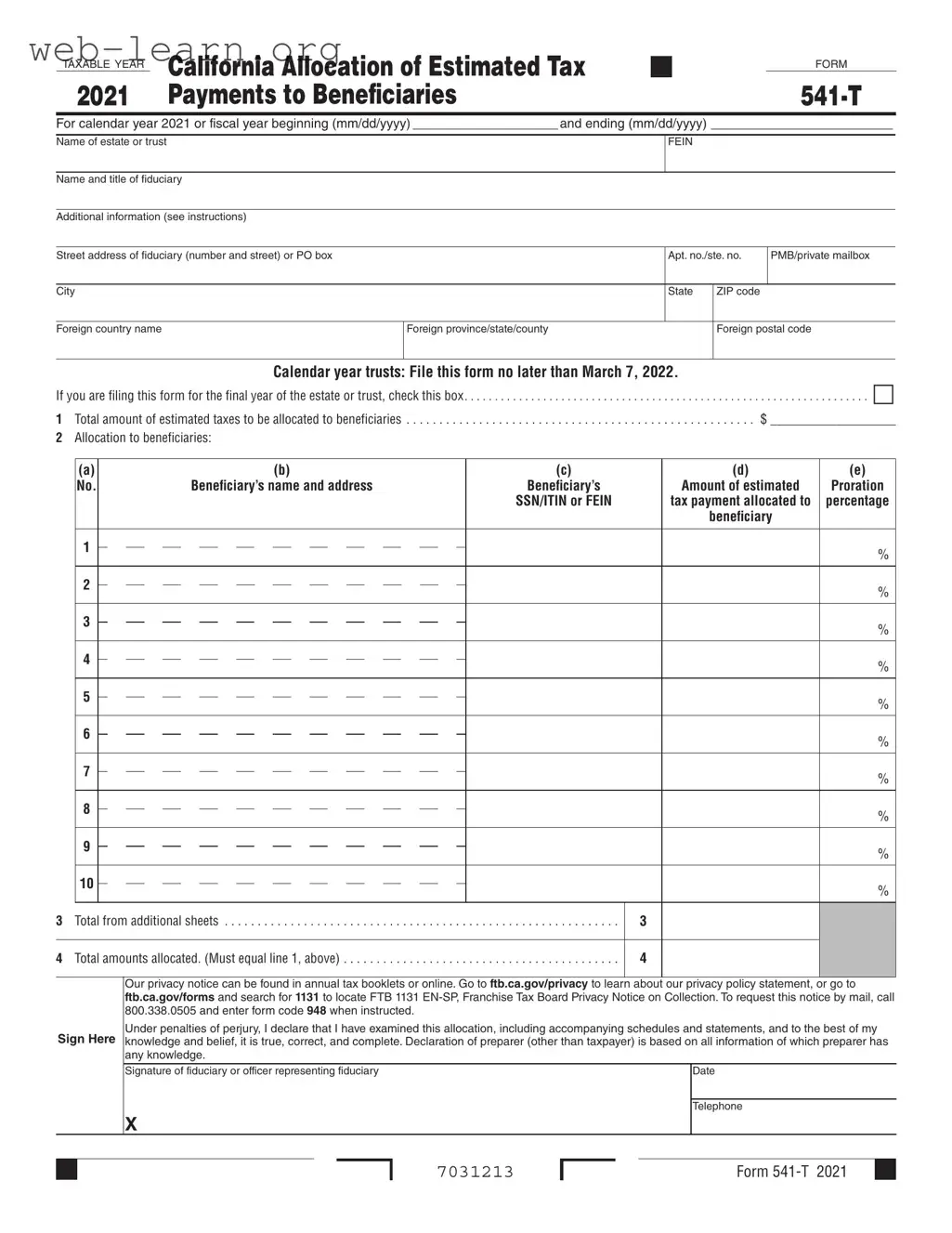
Homepage Blank California 541 T Form
Outline

The California 541 T form plays a crucial role in the financial management of estates and trusts, particularly when it comes to the allocation of estimated tax payments to beneficiaries. Designed for use in the tax year 2002, this form allows fiduciaries to elect to treat a portion of the estate or trust’s estimated tax payments as if they were made directly by the beneficiaries. This election, once made, cannot be revoked. Completing the form involves providing essential details such as the name and address of the fiduciary, the federal employer identification number (FEIN), and the total amount of estimated taxes to be allocated. Additionally, fiduciaries must list each beneficiary's name, identifying number, allocated tax payment, and the proration percentage. It is important to file the 541 T form separately from the California Fiduciary Income Tax Return (Form 541) and to do so within a specific timeframe to ensure the election is valid. This form is not only a tool for compliance but also a means to optimize tax benefits for beneficiaries, making it an essential document in estate and trust administration.
Sample - California 541 T Form

Form 541-T 2021
____________________
I
I
_________________________
TAXABLE YEAR
2021
California Allocation of Estimated Tax
Payments to Beneciaries
FORM
541-T
For calendar year 2021 or fiscal year beginning (mm/dd/yyyy) and ending (mm/dd/yyyy)
Name of estate or trust FEIN
Name and title of fiduciary
Additional information (see instructions)
Street address of fiduciary (number and street) or PO box Apt. no./ste. no. PMB/private mailbox
City State ZIP code
Foreign country name Foreign province/state/county Foreign postal code
Calendar year trusts: File this form no later than March 7, 2022.
If you are filing this form for the final year of the estate or trust, check this box ...................................................................
1 Total amount of estimated taxes to be allocated to beneficiaries $
2 Allocation to beneficiaries:
(a)
No.
(b)
Beneciary’s name and address
(c)
Beneciary’s
SSN/ITIN or FEIN
(d)
Amount of estimated
tax payment allocated to
beneciary
(e)
Proration
percentage
1
%
2
%
3
%
4
%
5
%
6
%
7
%
8
%
9
%
10
%
3 Total from additional sheets ...........................................................
3
4 Total amounts allocated. (Must equal line 1, above)
4
Sign Here
Our privacy notice can be found in annual tax booklets or online. Go to ftb.ca.gov/privacy to learn about our privacy policy statement, or go to
ftb.ca.gov/forms and search for 1131 to locate FTB 1131 EN-SP, Franchise Tax Board Privacy Notice on Collection. To request this notice by mail, call
800.338.0505 and enter form code 948 when instructed.
Under penalties of perjury, I declare that I have examined this allocation, including accompanying schedules and statements, and to the best of my
knowledge and belief, it is true, correct, and complete. Declaration of preparer (other than taxpayer) is based on all information of which preparer has
any knowledge.
Signature of fiduciary or officer representing fiduciary
X
Date
Telephone
7031213
..................................................... ___________________
.
......................................... .

Form Information

Fact Name Details
Taxable Year This form is for the taxable year 2002, applicable to calendar and fiscal years starting in 2002.
Governing Laws The form is governed by Revenue and Taxation Code Section 17731 and Internal Revenue Code Section 643(g)(1)(B).
Purpose Form 541-T allows a trust or estate to allocate estimated tax payments to beneficiaries.
Election Irrevocability Once the election to allocate estimated tax payments is made, it cannot be revoked.
Filing Instructions File Form 541-T separately from Form 541, the California Fiduciary Income Tax Return.
Filing Deadline The form must be filed by the 65th day after the tax year ends. For calendar year 2002, the deadline is March 6, 2003.
Mailing Address Send Form 541-T to the Franchise Tax Board at PO Box 942840, Sacramento, CA 94240-0002.
Beneficiary Information List beneficiaries with their names, addresses, and either SSN or FEIN on the form.
Proration Calculation Calculate the proration percentage for each beneficiary based on their allocated amount.
Additional Beneficiaries If there are more than ten beneficiaries, list additional ones on a separate sheet following the same format.

Detailed Guide for Filling Out California 541 T

Completing the California 541 T form requires careful attention to detail. This form is essential for allocating estimated tax payments to beneficiaries of a trust or decedent's estate. Follow the steps below to ensure accurate completion.

  1. Fill in the Taxable Year: At the top of the form, indicate the taxable year for which you are filing, either for the calendar year 2002 or for a fiscal year beginning in 2002.
  2. Provide Estate or Trust Information: Enter the name of the estate or trust, the fiduciary's name and title, and the fiduciary's Federal Employer Identification Number (FEIN).
  3. Address of the Fiduciary: Fill in the fiduciary's complete address, including street number, suite number, PMB number, city, state, and ZIP code.
  4. Final Year Checkbox: If this is the final year for the estate or trust, check the appropriate box.
  5. Line 1 - Total Estimated Taxes: Enter the total amount of estimated taxes to be allocated to beneficiaries.
  6. Line 2 - Allocation to Beneficiaries: List each beneficiary's name and address, SSN or FEIN, the amount of estimated tax payment allocated, and the proration percentage. Ensure that the total of all allocations equals the amount on line 1.
  7. Line 3 - Additional Beneficiaries: If there are more than 10 beneficiaries, list them on an attached sheet, following the same format as line 2. Enter the total from the attached sheets on line 3.
  8. Line 4 - Total Amounts Allocated: Confirm that this total matches the amount on line 1.
  9. Declaration: Sign and date the form, certifying that the information provided is accurate and complete.

Once you have completed the form, mail it to the Franchise Tax Board at the specified address. Ensure you file it separately from Form 541. The deadline for filing is crucial, so be mindful of the 65-day requirement following the close of the tax year.

Obtain Answers on California 541 T

  1. What is the purpose of Form 541-T?

    Form 541-T is used by a trust or a decedent’s estate to allocate estimated tax payments made on behalf of beneficiaries. This form allows the fiduciary to elect to treat part of the estimated tax payments as made by the beneficiaries. Once this election is made, it cannot be revoked.

  2. When should I file Form 541-T?

    The form must be filed by the 65th day after the close of the tax year. For trusts operating on a calendar year, this means the form is due on or before March 6 of the following year. If the due date falls on a weekend or holiday, you should file on the next business day.

  3. How do I file Form 541-T?

    Form 541-T should be filed separately from Form 541, the California Fiduciary Income Tax Return. Make sure not to attach Form 541-T to Form 541. The completed form must be mailed to the Franchise Tax Board at the specified address.

  4. Where do I send Form 541-T?

    Mail the completed Form 541-T to:

    • FRANCHISE TAX BOARD
    • PO BOX 942840
    • SACRAMENTO, CA 94240-0002
  5. What information is required on the form?

    You will need to provide the name of the estate or trust, the fiduciary’s name and title, and the fiduciary's address. Additionally, you must list each beneficiary’s name, address, and either their Social Security Number (SSN) or Federal Employer Identification Number (FEIN). The amount of estimated tax payments allocated to each beneficiary and the proration percentage must also be included.

  6. What if I have more than 10 beneficiaries?

    If you need to allocate estimated tax payments to more than 10 beneficiaries, you can list the additional beneficiaries on an attached sheet. This sheet should follow the same format as the one provided on Form 541-T. Make sure to include the fiduciary name and FEIN on the attached sheet.

  7. Is there a penalty for not providing accurate information?

    Yes, failing to provide accurate information such as valid SSNs or FEINs can lead to processing delays and may result in penalties imposed on the beneficiaries. It is crucial to ensure that all information is correct and complete to avoid any issues.

Common mistakes

Filling out the California 541 T form can be straightforward, but many people make common mistakes that can lead to issues down the line. One frequent error is not providing complete information about the fiduciary. The fiduciary’s name, title, and address must be accurate. Omitting details or providing incorrect information can delay processing and lead to complications.

Another mistake involves the allocation of estimated tax payments. Line 1 requires the total amount of estimated taxes to be allocated to beneficiaries. Some individuals forget to include all relevant payments or miscalculate the total, which can result in discrepancies later. It is crucial to double-check the figures before submitting the form.

Beneficiary information is also often mishandled. On line 2, column (b), the names and addresses of beneficiaries must be clearly listed. Failing to group individual beneficiaries with their social security numbers (SSNs) and other entities with their federal employer identification numbers (FEINs) can cause processing delays. Missing or incorrect SSNs or FEINs can lead to penalties for beneficiaries.

Moreover, people sometimes neglect to complete column (d), where the amount of estimated tax payment allocated to each beneficiary is entered. This amount must match the total on line 1. If these amounts do not align, it can raise red flags during review.

Another common oversight is the proration percentage in column (e). This percentage should reflect the allocation of the estimated tax payment to each beneficiary. A miscalculation here can lead to incorrect tax liabilities for beneficiaries, creating further complications.

Some individuals also forget to sign the form. The declaration at the bottom of the form requires a signature from the fiduciary or an officer representing the fiduciary. Not signing can result in the form being rejected or delayed.

Additionally, failing to file the form on time is a significant mistake. The form must be submitted by the 65th day after the close of the tax year. If the deadline falls on a weekend or holiday, it is important to file on the next business day. Missing this deadline can jeopardize the election for estimated tax payments.

Lastly, people often confuse the filing requirements. Form 541-T must be filed separately from Form 541. Attaching the two can lead to processing errors. Understanding the proper submission process is essential for ensuring compliance and avoiding unnecessary complications.

Documents used along the form

The California 541 T form is a crucial document for estates and trusts to allocate estimated tax payments to beneficiaries. However, it is often accompanied by several other forms and documents that help ensure compliance with tax regulations and facilitate proper reporting. Below are some of the key forms that may be used in conjunction with the California 541 T form.

  • Form 541: This is the California Fiduciary Income Tax Return. It reports the income, deductions, and credits of the estate or trust. The 541 T form is filed separately from this form, but it is essential for determining how estimated tax payments are distributed to beneficiaries.
  • Schedule K-1 (541): This schedule is used to report each beneficiary's share of income, deductions, and credits from the estate or trust. The amounts allocated on the 541 T form must be reflected on this schedule to ensure beneficiaries can accurately report their income on their personal tax returns.
  • Form FTB 1131: This form provides a Privacy Act Notice. While it is not filed with the 541 T, it is important for understanding how personal information is handled during the filing process. Beneficiaries should be aware of their privacy rights when dealing with tax documents.
  • Form 1041: This is the U.S. Income Tax Return for Estates and Trusts. While it is a federal form, it is essential for reporting income and deductions at the federal level. It complements the California forms by ensuring that both state and federal tax obligations are met.
  • Form 8862: This form is used to claim the Earned Income Credit after a disallowance. If a beneficiary is eligible for this credit, they may need to file this form along with their personal tax return, especially if they receive income from the estate or trust.
  • Form 1099: Various 1099 forms may be issued to beneficiaries for reporting income received from the estate or trust. These forms help beneficiaries accurately report their income on their tax returns and ensure compliance with IRS regulations.

Understanding these accompanying forms can help streamline the tax filing process for estates and trusts. Each document plays a specific role in ensuring that beneficiaries receive their rightful allocations while adhering to tax laws. If you have any questions about these forms or need assistance, it is advisable to consult with a tax professional or legal expert familiar with estate and trust taxation.

Similar forms

The California 541 T form serves a specific purpose in the context of estate and trust taxation. Several other documents share similarities with this form, particularly in terms of their function and the information they require. Below is a list of eight documents that are comparable to the California 541 T form:

  • Form 541: This is the California Fiduciary Income Tax Return. Like the 541 T, it is used by estates and trusts to report income, deductions, and tax liabilities. Both forms are essential for the fiduciary to fulfill tax obligations.
  • Form 1041: This is the U.S. Income Tax Return for Estates and Trusts. Similar to Form 541, it allows fiduciaries to report income and deductions at the federal level. Both forms require detailed information about beneficiaries and their respective shares.
  • Schedule K-1 (541): This schedule is part of Form 541 and provides beneficiaries with information about their share of income, deductions, and credits. The allocation of estimated tax payments on Form 541 T is reflected in this schedule, highlighting the connection between the two documents.
  • Form 706: This is the United States Estate (and Generation-Skipping Transfer) Tax Return. While it focuses on estate tax, it also requires information about the beneficiaries and the distribution of assets, similar to the beneficiary allocations in Form 541 T.
  • Form 990-PF: This is the Return of Private Foundation. It requires private foundations to report their financial activities, including distributions to beneficiaries. Like the 541 T, it involves the allocation of funds to specific parties.
  • Form 990: This is the Return of Organization Exempt from Income Tax. Nonprofits must report their financial activities, including distributions. The emphasis on beneficiary reporting aligns with the purpose of the 541 T form.
  • Form 1099: Various types of 1099 forms report income received by individuals from different sources. While not specific to estates or trusts, they share the commonality of documenting income allocations to individuals.
  • Form 1040: This is the U.S. Individual Income Tax Return. Beneficiaries of estates or trusts often report income received on this form. The connection lies in how beneficiaries report their share of income from the estate or trust, similar to the allocations made on the 541 T.

Dos and Don'ts

When filling out the California 541 T form, it is crucial to approach the task with care and attention to detail. Here are some essential do's and don'ts to keep in mind:

  • Do ensure that all beneficiary information is accurate, including names, addresses, and identifying numbers.
  • Do file Form 541-T separately from Form 541, as combining them can lead to complications.
  • Do double-check the total amount of estimated taxes allocated to beneficiaries to confirm it matches the amount on line 1.
  • Do submit the form by the 65th day after the close of the tax year to ensure validity.
  • Don't forget to provide a valid Social Security Number (SSN) or Federal Employer Identification Number (FEIN) for each beneficiary, as this may cause processing delays.
  • Don't attach Form 541-T to Form 541; they must be filed separately.
  • Don't leave any fields blank. Every section of the form should be completed accurately.
  • Don't overlook the importance of signing the form. A missing signature can invalidate the submission.

By following these guidelines, you can help ensure that the process of filling out the California 541 T form goes smoothly and efficiently.

Misconceptions

Understanding the California 541 T form is crucial for fiduciaries managing estates and trusts. However, several misconceptions can lead to confusion. Here are ten common misunderstandings about this form:

  1. Only estates can use Form 541 T. This form is applicable to both trusts and decedent’s estates, allowing for the allocation of estimated tax payments to beneficiaries.
  2. Form 541 T must be filed with Form 541. In fact, these forms should be filed separately. Form 541 T is not to be attached to Form 541.
  3. The election made with Form 541 T can be revoked. Once the election is made, it is irrevocable. Fiduciaries should consider this carefully before filing.
  4. All beneficiaries must receive an equal allocation. The allocation can vary among beneficiaries based on the proration percentage calculated by the fiduciary.
  5. Form 541 T can be filed at any time during the year. It must be filed by the 65th day after the close of the tax year. Missing this deadline can invalidate the election.
  6. Fiduciaries do not need to provide SSNs for beneficiaries. It is essential to include the Social Security Number (SSN) or Federal Employer Identification Number (FEIN) for each beneficiary to avoid processing delays and potential penalties.
  7. Form 541 T is only for the final year of an estate or trust. While it can be used in the final year, it is also applicable in other years when allocating estimated tax payments.
  8. Only individual beneficiaries can be listed. Both individual beneficiaries and entities can be included, but their identifying numbers must be provided accordingly.
  9. The total estimated tax payments do not need to match the allocations. The total amount allocated to beneficiaries must equal the total amount of estimated taxes listed on line 1 of the form.
  10. Filing Form 541 T is optional. For fiduciaries who wish to allocate estimated tax payments to beneficiaries, filing this form is necessary to make the election.

Addressing these misconceptions can help fiduciaries navigate the complexities of tax obligations more effectively.

Key takeaways

Filling out the California 541 T form can seem daunting, but understanding its key components can make the process smoother. Here are some essential takeaways to keep in mind:

  • Purpose of the Form: The California 541 T form allows a trust or decedent’s estate to allocate estimated tax payments to beneficiaries. This election is irrevocable once made.
  • Filing Instructions: It’s crucial to file Form 541-T separately from Form 541, the California Fiduciary Income Tax Return. Do not attach them together.
  • Timely Submission: To be valid, the form must be filed by the 65th day after the close of the tax year. If the deadline falls on a weekend or holiday, submit it on the next business day.
  • Beneficiary Information: When listing beneficiaries, ensure that you include their names, addresses, and identifying numbers (SSN or FEIN). This information is vital to avoid processing delays and potential penalties.
  • Allocation Amount: Clearly indicate the total estimated tax payments to be allocated to beneficiaries on line 1. This amount should be included in the trust's income distribution deductions.
  • Additional Beneficiaries: If there are more than ten beneficiaries, list them on an attached sheet, following the same format as the main form. Don’t forget to include the fiduciary's name and FEIN on this sheet.

By keeping these points in mind, you can navigate the process of completing the California 541 T form with greater confidence and accuracy.