Homepage Blank California 541 A Form
Outline

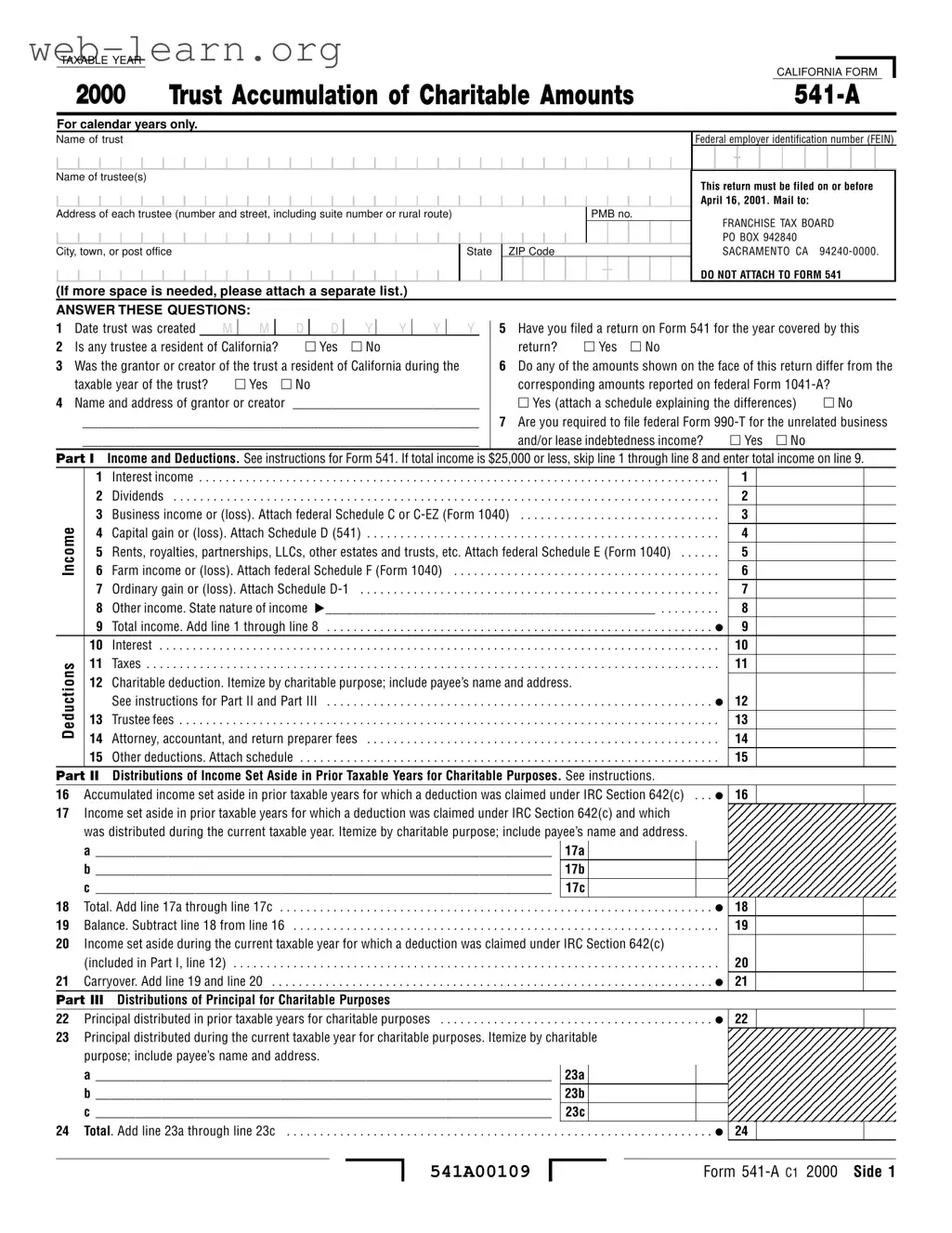
The California 541 A form is a tax document used by trustees to report charitable amounts accumulated in a trust. This form is specifically designed for trusts that claim deductions for charitable contributions under federal tax law. It requires the name of the trust, the federal employer identification number, and details about the trustee or trustees. The form includes sections for reporting income and deductions, as well as distributions made for charitable purposes. It also asks important questions about the trust's creation date, residency of trustees, and whether any discrepancies exist between the amounts reported on this form and federal forms. The 541 A form must be filed by April 16 of the following year, and it is essential for trustees to provide accurate information to comply with California tax regulations. Additional instructions guide trustees on how to detail distributions and reconcile any differences in financial records.

Sample - California 541 A Form

Form 541-A C1 2000 Side 1
Part I Income and Deductions. See instructions for Form 541. If total income is $25,000 or less, skip line 1 through line 8 and enter total income on line 9.
1 Interest income . . . . . . . . . . . . . . . . . . . . . . . . . . . . . . . . . . . . . . . . . . . . . . . . . . . . . . . . . . . . . . . . . . . . . . . . . . . . . . 1
2 Dividends . . . . . . . . . . . . . . . . . . . . . . . . . . . . . . . . . . . . . . . . . . . . . . . . . . . . . . . . . . . . . . . . . . . . . . . . . . . . . . . . . . 2
3 Business income or (loss). Attach federal Schedule C or C-EZ (Form 1040) . . . . . . . . . . . . . . . . . . . . . . . . . . . . . . 3
4 Capital gain or (loss). Attach Schedule D (541) . . . . . . . . . . . . . . . . . . . . . . . . . . . . . . . . . . . . . . . . . . . . . . . . . . . . . 4
5 Rents, royalties, partnerships, LLCs, other estates and trusts, etc. Attach federal Schedule E (Form 1040) . . . . . . 5
6 Farm income or (loss). Attach federal Schedule F (Form 1040) . . . . . . . . . . . . . . . . . . . . . . . . . . . . . . . . . . . . . . . . 6
7 Ordinary gain or (loss). Attach Schedule D-1 . . . . . . . . . . . . . . . . . . . . . . . . . . . . . . . . . . . . . . . . . . . . . . . . . . . . . . 7
8 Other income. State nature of income _________________________________________________ . . . . . . . . . 8
9 Total income. Add line 1 through line 8 . . . . . . . . . . . . . . . . . . . . . . . . . . . . . . . . . . . . . . . . . . . . . . . . . . . . . . . . . .
9
10 Interest . . . . . . . . . . . . . . . . . . . . . . . . . . . . . . . . . . . . . . . . . . . . . . . . . . . . . . . . . . . . . . . . . . . . . . . . . . . . . . . . . . . . 10
11 Taxes . . . . . . . . . . . . . . . . . . . . . . . . . . . . . . . . . . . . . . . . . . . . . . . . . . . . . . . . . . . . . . . . . . . . . . . . . . . . . . . . . . . . . . 11
12 Charitable deduction. Itemize by charitable purpose; include payee’s name and address.
See instructions for Part II and Part III . . . . . . . . . . . . . . . . . . . . . . . . . . . . . . . . . . . . . . . . . . . . . . . . . . . . . . . . . .
12
13 Trustee fees . . . . . . . . . . . . . . . . . . . . . . . . . . . . . . . . . . . . . . . . . . . . . . . . . . . . . . . . . . . . . . . . . . . . . . . . . . . . . . . . . 13
14 Attorney, accountant, and return preparer fees . . . . . . . . . . . . . . . . . . . . . . . . . . . . . . . . . . . . . . . . . . . . . . . . . . . . . 14
15 Other deductions. Attach schedule . . . . . . . . . . . . . . . . . . . . . . . . . . . . . . . . . . . . . . . . . . . . . . . . . . . . . . . . . . . . . . . 15
Part II Distributions of Income Set Aside in Prior Taxable Years for Charitable Purposes. See instructions.
16 Accumulated income set aside in prior taxable years for which a deduction was claimed under IRC Section 642(c) . . .
16
17 Income set aside in prior taxable years for which a deduction was claimed under IRC Section 642(c) and which
was distributed during the current taxable year. Itemize by charitable purpose; include payee’s name and address.
a _____________________________________________________________________ 17a
b _____________________________________________________________________ 17b
c _____________________________________________________________________ 17c
18 Total. Add line 17a through line 17c . . . . . . . . . . . . . . . . . . . . . . . . . . . . . . . . . . . . . . . . . . . . . . . . . . . . . . . . . . . . . . . . .
18
19 Balance. Subtract line 18 from line 16 . . . . . . . . . . . . . . . . . . . . . . . . . . . . . . . . . . . . . . . . . . . . . . . . . . . . . . . . . . . . . . . . 19
20 Income set aside during the current taxable year for which a deduction was claimed under IRC Section 642(c)
(included in Part I, line 12) . . . . . . . . . . . . . . . . . . . . . . . . . . . . . . . . . . . . . . . . . . . . . . . . . . . . . . . . . . . . . . . . . . . . . . . . . 20
21 Carryover. Add line 19 and line 20 . . . . . . . . . . . . . . . . . . . . . . . . . . . . . . . . . . . . . . . . . . . . . . . . . . . . . . . . . . . . . . . . . .
21
Part III Distributions of Principal for Charitable Purposes
22 Principal distributed in prior taxable years for charitable purposes . . . . . . . . . . . . . . . . . . . . . . . . . . . . . . . . . . . . . . . . . 22
23 Principal distributed during the current taxable year for charitable purposes. Itemize by charitable
purpose; include payee’s name and address.
a _____________________________________________________________________ 23a
b _____________________________________________________________________ 23b
c _____________________________________________________________________ 23c
24 Total. Add line 23a through line 23c . . . . . . . . . . . . . . . . . . . . . . . . . . . . . . . . . . . . . . . . . . . . . . . . . . . . . . . . . . . . . . . .
24
Name of trust Federal employer identification number (FEIN)
Name of trustee(s)
Address of each trustee (number and street, including suite number or rural route) PMB no.
City, town, or post office State ZIP Code
1234567890123456789012
1
23456789012345678901
2
1
23456789012345678901
2
1
23456789012345678901
2
1
23456789012345678901
2
1
23456789012345678901
2
1
23456789012345678901
2
1
23456789012345678901
2
1
23456789012345678901
2
1
23456789012345678901
2
1
23456789012345678901
2
1
23456789012345678901
2
1234567890123456789012
1234567890123456789012
1
23456789012345678901
2
1
23456789012345678901
2
1
23456789012345678901
2
1
23456789012345678901
2
1
23456789012345678901
2
1
23456789012345678901
2
1
23456789012345678901
2
1
23456789012345678901
2
1
23456789012345678901
2
1
23456789012345678901
2
1
23456789012345678901
2
1234567890123456789012
Trust Accumulation of Charitable Amounts
TAXABLE YEAR
2000
For calendar years only.
541A00109
CALIFORNIA FORM
541-A
-
(If more space is needed, please attach a separate list.)
ANSWER THESE QUESTIONS:
1 Date trust was created
MMDDYYYY
2 Is any trustee a resident of California? Yes No
3 Was the grantor or creator of the trust a resident of California during the
taxable year of the trust? Yes No
4 Name and address of grantor or creator ____________________________
____________________________________________________________
____________________________________________________________
5 Have you filed a return on Form 541 for the year covered by this
return? Yes No
6 Do any of the amounts shown on the face of this return differ from the
corresponding amounts reported on federal Form 1041-A?
Yes (attach a schedule explaining the differences) No
7 Are you required to file federal Form 990-T for the unrelated business
and/or lease indebtedness income? Yes No
This return must be filed on or before
April 16, 2001. Mail to:
FRANCHISE TAX BOARD
PO BOX 942840
SACRAMENTO CA 94240-0000.
DO NOT ATTACH TO FORM 541
IncomeDeductions
Side 2 Form 541-A C1 2000
12345
1
234
5
12345
12345
1
234
5
12345
12345
1
234
5
12345
12345
1
234
5
12345
123456789012345678901234567890121234567
1
2345678901234567890123456789012123456
7
1
2345678901234567890123456789012123456
7
123456789012345678901234567890121234567
123456789012345678901234567890121234567
1
2345678901234567890123456789012123456
7
123456789012345678901234567890121234567
123456789012345678901234567890121234567
1
2345678901234567890123456789012123456
7
123456789012345678901234567890121234567
123456789012345678901234567890121234567
1
2345678901234567890123456789012123456
7
123456789012345678901234567890121234567
Part IV Balance Sheet. If line 9 is $25,000 or less, complete only line 38, line 42, and line 45. If books of account do not agree, please reconcile all differences.
Assets (a) Beginning-of-Year Book Value (b) End-of-Year Book Value
25 Cash — non-interest bearing . . . . . . . . . . . . . . . . . . . . . . . . . . . . . . . . . . . . . . . . . . . . . . . . . . 25
26 Savings and temporary cash investments . . . . . . . . . . . . . . . . . . . . . . . . . . . . . . . . . . . . . . . . . 26
27 a Accounts receivable . . . . . . . . . . . . . . . . . . . . . . . . . . . . . . . . . 27a
b Less: allowance for doubtful accounts . . . . . . . . . . . . . . . . . . 27b
28 a Notes and loans receivable . . . . . . . . . . . . . . . . . . . . . . . . . . . 28a
b Less: allowance for doubtful accounts . . . . . . . . . . . . . . . . . . 28b
29 Inventories for sale or use . . . . . . . . . . . . . . . . . . . . . . . . . . . . . . . . . . . . . . . . . . . . . . . . . . . . 29
30 Prepaid expenses and deferred charges . . . . . . . . . . . . . . . . . . . . . . . . . . . . . . . . . . . . . . . . . . 30
31 Investments — U.S. and state government obligations. Attach schedule . . . . . . . . . . . . . . . . . 31
32 Investments — corporate stock. Attach schedule . . . . . . . . . . . . . . . . . . . . . . . . . . . . . . . . . . . 32
33 Investments — corporate bonds. Attach schedule . . . . . . . . . . . . . . . . . . . . . . . . . . . . . . . . . . 33
34 a Investments — land, buildings, and equipment: basis . . . . . 34a
b Less: accumulated depreciation . . . . . . . . . . . . . . . . . . . . . . . 34b
35 Investments — other. Attach schedule . . . . . . . . . . . . . . . . . . . . . . . . . . . . . . . . . . . . . . . . . . . 35
36 a Land, buildings, and equipment (trade or business): basis . . 36a
b Less: accumulated depreciation . . . . . . . . . . . . . . . . . . . . . . . 36b
37 Other assets. Describe. _____________________________________________________ 37
38 Total assets. Add line 25 through line 37 . . . . . . . . . . . . . . . . . . . . . . . . . . . . . . . . . . . . . . . . 38
Liabilities
39 Accounts payable and accrued expenses . . . . . . . . . . . . . . . . . . . . . . . . . . . . . . . . . . . . . . . . . . 39
40 Mortgages and other notes payable. Attach schedule . . . . . . . . . . . . . . . . . . . . . . . . . . . . . . . . 40
41 Other liabilities. Describe. ___________________________________________________ 41
42 Total liabilities. Add line 39 through line 41 . . . . . . . . . . . . . . . . . . . . . . . . . . . . . . . . . . . . . . 42
Net Assets
43 Trust principal or corpus . . . . . . . . . . . . . . . . . . . . . . . . . . . . . . . . . . . . . . . . . . . . . . . . . . . . . . 43
44 Undistributed income and profits . . . . . . . . . . . . . . . . . . . . . . . . . . . . . . . . . . . . . . . . . . . . . . . 44
45 Total net assets. Add line 43 and line 44 . . . . . . . . . . . . . . . . . . . . . . . . . . . . . . . . . . . . . . . . . 45
46 Total liabilities and net assets. Add line 42 and line 45 . . . . . . . . . . . . . . . . . . . . . . . . . . . . . 46
Date
Preparer’s
Check if self-
signature employed
___________________________________________________________
Signature of trustee or officer representing trustee
Please
Sign
Here
Paid
Preparer’s
Use Only
Under penalties of perjury, I declare that I have examined this return, including accompanying schedules and statements, and to the best of my knowledge and belief, it is
true, correct, and complete. Declaration of preparer (other than taxpayer) is based on all information of which preparer has any knowledge.
Paid preparer’s SSN/PTIN
Firms name (or yours, if
self-employed) and address
-
Trustee’s SSN/FEIN
FEIN
Date
For Privacy Act Notice, get form FTB 1131.541A00209
General Information
In general, California tax law conforms to the
Internal Revenue Code (IRC) as of
January 1, 1998. However, there are
continuing differences between California
and federal tax law. California has not
conformed to most of the changes made to
the IRC by the federal Internal Revenue
Service Restructuring and Reform Act of
1998 (Public Law 105-206) and has not
conformed to any of the changes made by
the Tax and Trade Relief Extension Act of
1998 (Public Law 105-277), the
Miscellaneous Trade and Technical
Corrections Act of 1999 (Public
Law 106-36), and the Ticket to Work and
Work Incentives Improvement Act of 1999
(Public Law 106-170).
A Purpose
Use Form 541-A to report the charitable
information required by Revenue and
Taxation Code (R&TC) Section 18635.
BB
BB
B Who Must File
A trustee must file a calendar year
Form 541-A for a trust that claims a
charitable or other deduction under IRC
Section 642(c) or for a charitable or split-
interest trust. However, Form 541-A is not
required for any taxable year if the trustee is
required by the terms of the governing
instrument and applicable local law to
distribute currently all of the income of the
trust for such year.
A charitable trust is a trust which:
Is not exempt from taxation under R&TC
Section 23701d; and
Has all the unexpired interests devoted to
charitable purposes described in IRC
Section 170(c); and
Had a charitable contribution deduction
allowed for all the unexpired interests
under the R&TC.
A split-interest trust is a trust which:
Is not exempt from taxation under
R&TC Section 23701d; and
Has some of the unexpired interests
devoted to one or more charitable
purposes described in IRC Section 170(c);
and
Has amounts in trust for which a chari-
table contributions deduction was allowed
under the R&TC. Pooled income funds
(IRC Section 642(c)(5)), charitable
remainder annuity trusts (IRC
Section 664(d)(1)), and remainder
unitrusts (IRC Section 664(d)(2)), are
considered split-interest trusts for which
the trustee must file Form 541-A for the
taxable year.
Simple trusts which received a letter from
the Franchise Tax Board (FTB) granting
exemption from tax under R&TC
Section 23701d are considered to be
corporations for tax purposes. They may be
required to file Form 199, California Exempt
Organization Annual Information Return. See
the instructions for that form.
Nonexempt charitable trusts, described in
IRC Section 4947(a)(1), must file Form 199.
Private Mailbox (PMB) No.
If you lease a mailbox from a private
business rather than a PO box from the
United States Postal Service, enter your
PMB number in the field labeled “PMB no.”
CC
CC
C When to File
File Form 541-A on or before April 16, 2001.
However, if you need additional time to file,
California grants an automatic six-month
extension. A request form is not required to
obtain this extension.
DD
DD
D Where to File
Mail Form 541-A to:
FRANCHISE TAX BOARD
PO BOX 942840
SACRAMENTO CA 94240-0000
Specific Instructions
Part II and Part IIIPart II and Part III
Part II and Part III
Describe in detail on an attached statement
the purpose for which charitable disburse-
ments were made from income set aside in
prior taxable years and amounts which were
paid out of principal for charitable purposes.
Examples of appropriate descriptions are:
payments for nursing service, laboratory
construction, fellowships, or assistance to
indigent families (not simply charitable,
educational, religious, or scientific).
Part IVPart IV
Part IVPart IV
Part IV
If the balance sheet does not agree with the
books of account, all differences must be
reconciled in an attached statement.
Form 541-A Instructions 2000
Instructions for FTB Form 541-A
Trust Accumulation of Charitable Amounts

Form Information

Fact Name Details
Form Purpose The California Form 541-A is used to report the accumulation of charitable amounts by a trust for a calendar year.
Governing Law This form is governed by the California Revenue and Taxation Code, specifically Section 18635.
Filing Deadline Form 541-A must be filed on or before April 16, 2001. Extensions are available without a request form.
Who Must File Trustees of charitable or split-interest trusts that claim deductions under IRC Section 642(c) must file this form.
Residency Requirement If any trustee is a resident of California, they must complete the form, indicating the residency status.
Income Threshold If total income is $25,000 or less, the trustee can skip several lines and directly report total income on line 9.
Mailing Address Completed forms should be mailed to the Franchise Tax Board at PO Box 942840, Sacramento, CA 94240-0000.

Detailed Guide for Filling Out California 541 A

Filling out the California 541 A form can seem daunting, but with a clear understanding of the steps involved, it becomes manageable. This form is specifically designed for trusts that accumulate charitable amounts, and it requires precise information to ensure compliance with California tax regulations. Below are the steps to guide you through the process of completing this form.

  1. Gather Necessary Information: Collect all relevant information about the trust, including its name, federal employer identification number (FEIN), and the names and addresses of all trustees.
  2. Provide Trust Details: At the top of the form, fill in the name of the trust and its FEIN. List the names and addresses of each trustee in the designated fields.
  3. Trust Creation Date: Enter the date the trust was created in the format MM/DD/YYYY.
  4. Trustee Residency: Indicate whether any trustee is a resident of California by marking "Yes" or "No."
  5. Grantor Information: Provide the name and address of the grantor or creator of the trust.
  6. Previous Returns: Answer whether you have filed a return on Form 541 for the year covered by this return.
  7. Income and Deductions: In Part I, report all sources of income, such as interest, dividends, and business income. If total income is $25,000 or less, skip lines 1 through 8 and enter the total on line 9.
  8. Deductions: Fill in the deductions for taxes, charitable contributions, trustee fees, and any other applicable deductions in the provided sections.
  9. Distributions of Income: Complete Part II by detailing any accumulated income set aside in prior years for charitable purposes and any distributions made during the current taxable year.
  10. Principal Distributions: In Part III, provide information about any principal distributed for charitable purposes, itemizing by charitable purpose.
  11. Balance Sheet: Complete Part IV with a balance sheet that includes assets and liabilities. Ensure that all figures are accurate and reconciled.
  12. Declaration: Finally, sign and date the form. If someone else prepared the form, they must also sign and provide their information.

Once completed, mail the form to the Franchise Tax Board at the address provided. Make sure to keep a copy for your records. If you need more time, remember that California grants an automatic six-month extension without needing to file a request form. This can provide peace of mind as you finalize your submission.

Obtain Answers on California 541 A

  1. What is the purpose of California Form 541-A?

    California Form 541-A is used to report the charitable information required by the Revenue and Taxation Code Section 18635. This form is specifically for trusts that claim a charitable deduction under IRC Section 642(c) or for charitable and split-interest trusts. The form helps ensure compliance with California tax law regarding charitable distributions.

  2. Who is required to file Form 541-A?

    A trustee must file Form 541-A for a trust that claims a charitable deduction under IRC Section 642(c) or for a charitable or split-interest trust. However, if the governing instrument requires the trustee to distribute all income for the taxable year, then filing is not necessary. This applies to charitable trusts that are not exempt from taxation under R&TC Section 23701d.

  3. When is Form 541-A due?

    Form 541-A must be filed on or before April 16, 2001. If more time is needed, California allows for an automatic six-month extension without the need for a request form. It’s important to ensure timely filing to avoid potential penalties.

  4. Where should I mail Form 541-A?

    Mail Form 541-A to the Franchise Tax Board at the following address:

    FRANCHISE TAX BOARD
    PO BOX 942840
    SACRAMENTO CA 94240-0000

  5. What information is required about the trust on Form 541-A?

    The form requires several key pieces of information, including:

    • Name of the trust
    • Federal employer identification number (FEIN)
    • Name and address of the trustee(s)
    • Date the trust was created
    • Residency status of the grantor and trustees
  6. What if my trust has a taxable year different from the calendar year?

    If the trust’s taxable year differs from the calendar year, you must indicate this on the form. Any discrepancies between the amounts reported on Form 541-A and the corresponding federal Form 1041-A must be explained in an attached schedule.

  7. How do I report income and deductions on Form 541-A?

    Income and deductions are reported in Part I of the form. If the total income is $25,000 or less, you can skip lines 1 through 8 and simply enter the total income on line 9. Various types of income, such as interest, dividends, and business income, need to be itemized accordingly.

  8. What kind of charitable distributions need to be reported?

    In Parts II and III, you must report distributions of income set aside in prior taxable years for charitable purposes, as well as distributions of principal for charitable purposes. It’s essential to provide detailed descriptions of these distributions, including the purpose and the recipient’s information.

  9. What should I do if my balance sheet does not agree with my books of account?

    If there are discrepancies between the balance sheet and the books of account, you must reconcile these differences in an attached statement. This ensures transparency and accuracy in your reporting.

  10. What penalties might I face for failing to file Form 541-A on time?

    Failure to file Form 541-A by the due date may result in penalties. These can include late filing fees and interest on any taxes owed. To avoid such consequences, it’s crucial to adhere to the filing deadlines and requirements outlined by the Franchise Tax Board.

Common mistakes

Filling out the California Form 541-A can be a complex task, and many individuals make common mistakes that can lead to confusion or delays. One frequent error is failing to provide complete and accurate trustee information. The form requires the name, address, and federal employer identification number (FEIN) of each trustee. Incomplete information can result in processing delays or even rejection of the form.

Another mistake involves misunderstanding the filing requirements. Some trustees may overlook the necessity of filing if the trust is required to distribute all income for the year. If this requirement is not met, the trustee must file Form 541-A. Ignoring this crucial detail can lead to penalties or issues with the Franchise Tax Board.

Many individuals also neglect to check the residency status of the trustee and grantor. The form asks whether any trustee is a resident of California and whether the grantor was a resident during the taxable year. Incorrectly answering these questions can lead to misclassification of the trust, impacting tax obligations.

Moreover, mistakes often occur in reporting income and deductions. Some trustees may skip lines or miscalculate totals, particularly when the total income is $25,000 or less. This oversight can lead to inaccurate reporting, which may trigger audits or additional scrutiny from tax authorities.

Another common error is failing to reconcile discrepancies between California and federal tax law. California has not conformed to many changes made to the Internal Revenue Code, and trustees must be aware of these differences. Not addressing these discrepancies can lead to incorrect filings and potential penalties.

Trustees sometimes overlook the importance of itemizing charitable deductions. The form requires detailed information about charitable contributions, including the payee’s name and address. Failing to provide this information can result in disallowance of the deduction, affecting the trust's overall tax liability.

Lastly, many trustees forget to sign and date the form. The declaration of perjury at the bottom of the form emphasizes the importance of accuracy and honesty in reporting. A missing signature can lead to the form being considered incomplete, resulting in further delays and complications.

Documents used along the form

The California Form 541-A is used for reporting the accumulation of charitable amounts by a trust. When filing this form, there are several other documents that may be required or helpful to include. Below is a list of these forms and documents, along with brief descriptions of each.

  • California Form 541: This is the main income tax return form for fiduciaries in California. It reports income, deductions, and tax credits for estates and trusts.
  • Federal Form 1041: The U.S. Income Tax Return for Estates and Trusts. This form is used to report income, deductions, gains, losses, etc., of the estate or trust.
  • Federal Form 990-T: This form is filed to report unrelated business income tax (UBIT) if the trust has income from a business activity that is not related to its exempt purpose.
  • Schedule D (541): This schedule is used to report capital gains and losses for California trusts and estates. It helps calculate the tax on these gains.
  • Schedule E (Form 1040): This form reports income or loss from rental real estate, royalties, partnerships, S corporations, trusts, etc. It is important for trusts with rental income.
  • Schedule C or C-EZ: Used to report income or loss from a business operated by the trust. This includes details of the business's expenses and income.
  • California Form 199: This is the California Exempt Organization Annual Information Return. It is required for certain non-profit organizations and may apply to charitable trusts.
  • Charitable Contribution Schedule: This document itemizes charitable contributions made by the trust, including details of the payee and purpose of the contributions.
  • Balance Sheet: A financial statement that summarizes the trust's assets, liabilities, and net assets. It is necessary for providing a complete picture of the trust's financial status.
  • Trust Agreement: This legal document outlines the terms of the trust, including the responsibilities of the trustee and the beneficiaries. It may be needed to clarify the trust's purpose and operations.

These forms and documents collectively help ensure compliance with both California and federal tax laws. They provide necessary details about the trust's income, deductions, and charitable activities. Properly preparing and submitting these documents can help facilitate a smoother filing process and avoid potential issues with tax authorities.

Similar forms

The California Form 541-A is primarily used for reporting the accumulation of charitable amounts by trusts. It has similarities with several other tax-related documents, each serving specific purposes. Below is a list of documents that share characteristics with Form 541-A:

  • Form 1041: This is the U.S. Income Tax Return for Estates and Trusts. Like Form 541-A, it is used to report income, deductions, and distributions of a trust, but it applies at the federal level rather than state-specific regulations.
  • Form 990: This is the Return of Organization Exempt from Income Tax. Similar to Form 541-A, it is used by charitable organizations to report financial information, including income and expenses, though it is geared towards non-profits rather than trusts specifically.
  • Form 990-T: This form is used to report unrelated business income tax. It shares the commonality of dealing with income reporting, specifically for tax-exempt organizations, akin to the charitable reporting in Form 541-A.
  • Form 199: This is the California Exempt Organization Annual Information Return. Like Form 541-A, it is used for reporting by charitable organizations in California, ensuring compliance with state tax laws.
  • Form 990-PF: This form is the Return of Private Foundation. It is similar in that it requires reporting on charitable distributions and financial activities, focusing specifically on private foundations.
  • Schedule A (Form 990): This schedule is used to provide additional information on public charities. It parallels Form 541-A in that it focuses on the charitable activities and financial distributions of organizations.

Dos and Don'ts

When filling out the California 541 A form, it’s important to follow certain guidelines to ensure accuracy and compliance. Here’s a list of things you should and shouldn’t do:

  • Do double-check all information for accuracy before submitting.
  • Don’t leave any required fields blank. Fill in all necessary details.
  • Do use clear and legible handwriting or type your responses.
  • Don’t attach any documents unless specifically instructed to do so.
  • Do file your form by the deadline, which is April 16, 2001.
  • Don’t forget to sign and date the form before sending it in.
  • Do provide a detailed explanation for any discrepancies between your state and federal filings.
  • Don’t assume that previous years’ information is still accurate. Update as necessary.
  • Do keep a copy of your completed form for your records.
  • Don’t hesitate to seek help if you’re unsure about how to fill out any part of the form.

Misconceptions

Misconception 1: The California 541 A form is only for large trusts.

This form is required for any trust claiming a charitable deduction, regardless of its size. Even smaller trusts must file if they meet certain criteria.

Misconception 2: You can file the 541 A form at any time during the year.

The form must be filed by April 16 of the following year. Timely filing is crucial to avoid penalties.

Misconception 3: You don't need to file if the trust is exempt from taxes.

Even if a trust is exempt, it may still need to file if it claims deductions under IRC Section 642(c).

Misconception 4: The 541 A form is the same as the federal Form 1041-A.

While they share similarities, there are significant differences due to California's tax laws. It's important to understand both forms separately.

Misconception 5: All trustees must be California residents to file the 541 A form.

Only if any trustee is a California resident does it affect the filing requirements. Non-resident trustees can still file the form.

Misconception 6: You can skip filing if the trust has no income.

If the trust is claiming charitable deductions, it still needs to file, even if it reports no income.

Misconception 7: Filing the 541 A form is optional if the trust distributes all income.

Trusts that distribute all income might not need to file, but they must confirm this based on the governing instrument and local laws.

Misconception 8: The 541 A form is only for charitable trusts.

While primarily for charitable trusts, split-interest trusts also need to file this form if they claim deductions.

Key takeaways

  • The California Form 541-A is specifically for reporting charitable amounts accumulated by trusts during the taxable year.
  • This form must be filed for calendar years only and is due by April 16 of the following year.
  • Trustees must provide detailed information about the trust, including the name, federal employer identification number, and address of each trustee.
  • If the trust's total income is $25,000 or less, only the total income needs to be reported on line 9, skipping lines 1 through 8.
  • Trustees should answer specific questions regarding residency and prior filings, which are critical for determining tax obligations.
  • It's essential to attach any required schedules if there are discrepancies between amounts reported on Form 541-A and federal Form 1041-A.
  • Part II requires detailing distributions of income set aside in prior years for charitable purposes, including the payee's name and address.
  • Part III focuses on distributions of principal for charitable purposes, and again, itemization is required.
  • The balance sheet in Part IV must reconcile any differences between the reported figures and the trust's books of account.
  • Trustees should ensure that all necessary documentation is complete and accurate to avoid penalties or delays in processing.