Homepage Blank California 513 026 Form
Outline

The California 513 026 form is an essential document for businesses looking to register organic input materials with the state. This form, officially known as the Fertilizing Materials Registration Application, is managed by the Department of Food and Agriculture. It is crucial for applicants to determine whether they already hold a fertilizing materials license, as this influences the submission process. The form requires detailed information about the applicant, including their business name, contact information, and the specific type of organic input material being registered. Applicants must check all applicable categories, such as soil amendments or specialty fertilizers. To complete the application, thorough documentation is necessary. This includes a complete formula of the product, a description of the manufacturing process, and intended uses. It is also important to provide labeling information, as this helps ensure compliance with state regulations. The registration fee is set at $500 per product, and applicants should be aware that incomplete submissions may lead to processing delays. Additionally, the registration expires on December 31 of odd-numbered years, necessitating timely renewals to maintain compliance.


Sample - California 513 026 Form

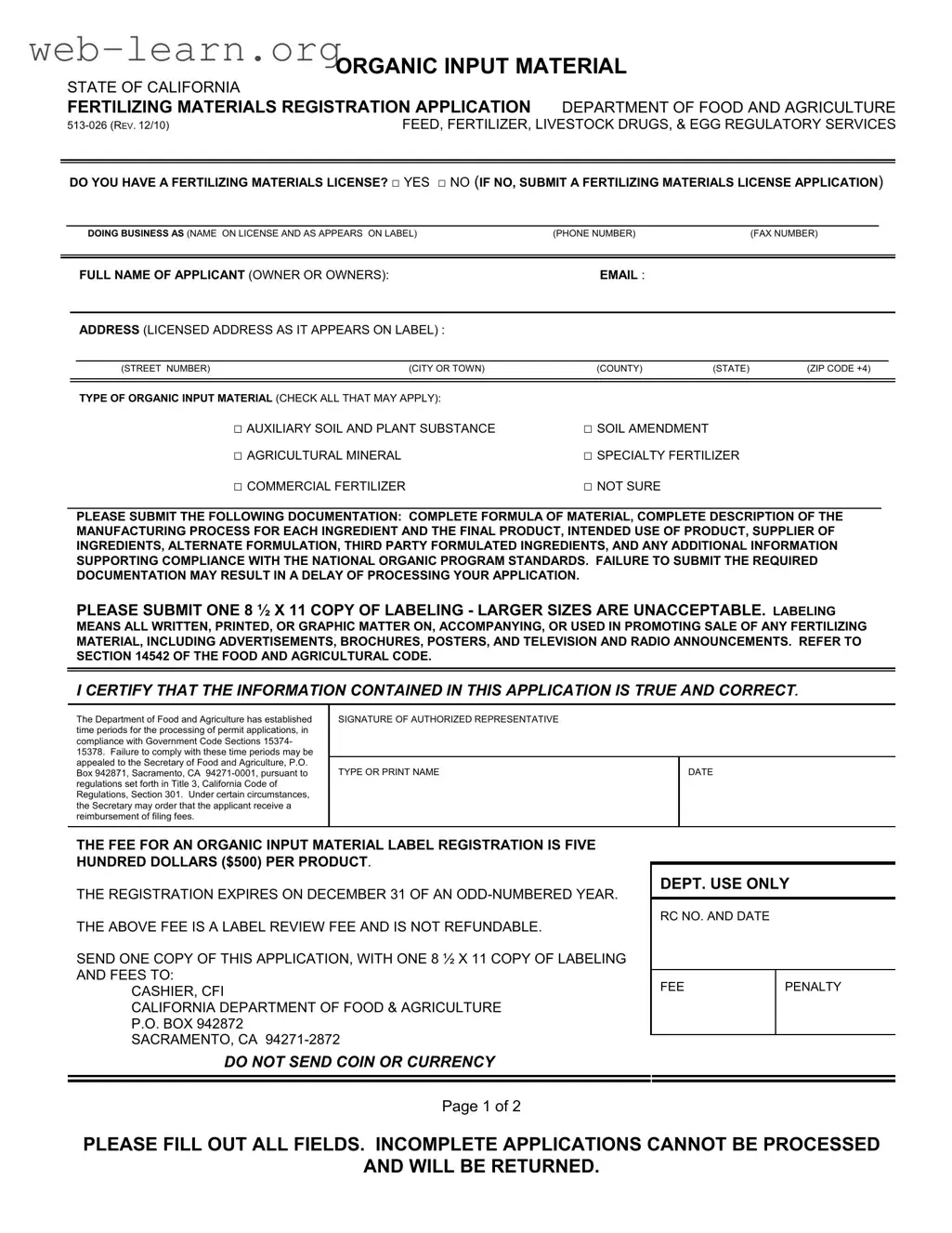
ORGANIC INPUT MATERIAL
STATE OF CALIFORNIA
FERTILIZING MATERIALS REGISTRATION APPLICATION DEPARTMENT OF FOOD AND AGRICULTURE
513-026 (REV. 12/10) FEED, FERTILIZER, LIVESTOCK DRUGS, & EGG REGULATORY SERVICES
Page 1 of 2
PLEASE FILL OUT ALL FIELDS. INCOMPLETE APPLICATIONS CANNOT BE PROCESSED
AND WILL BE RETURNED.
DO YOU HA
VE A FERTILIZING MATERIALS LICENSE?
YES NO (IF NO, SUBMIT A FERTILIZING MATERIALS LICENSE APPLICATION)
DOING BUSINESS AS (NAME ON LICENSE AND AS APPEARS ON LABEL) (PHONE NUMBER) (FAX NUMBER)
FULL NAME OF APPLICANT (OWNER OR OWNERS): EMAIL :
ADDRESS (LICENSED ADDRESS AS IT APPEARS ON LABEL) :
(STREET NUMBER) (CITY OR TOWN) (COUNTY) (STATE) (ZIP CODE +4)
TYPE OF ORGANIC INPUT MATERIAL (CHECK ALL THAT MAY APPLY):
AUXILIARY SOIL AND PLANT SUBSTANCE
AGRICULTURAL MINERAL
COMMERCIAL FERTILIZER
SOIL AMENDMENT
SPECIALTY FERTILIZER
NOT SURE
PLEASE SUBMIT THE FOLLOWING DOCUMENTATION: COMPLETE FORMULA OF MATERIAL, COMPLETE DESCRIPTION OF THE
MANUFACTURING PROCESS FOR EACH INGREDIENT AND THE FINAL PRODUCT, INTENDED USE OF PRODUCT, SUPPLIER OF
INGREDIENTS, ALTERNATE FORMULATION, THIRD PARTY FORMULATED INGREDIENTS, AND ANY ADDITIONAL INFORMATION
SUPPORTING COMPLIANCE WITH THE NATIONAL ORGANIC PROGRAM STANDARDS. FAILURE TO SUBMIT THE REQUIRED
DOCUMENTATION MAY RESULT IN A DELAY OF PROCESSING YOUR APPLICATION.
PLEASE SUBMIT ONE 8 ½ X 11 COPY OF LABELING - LARGER SIZES ARE UNACCEPTABLE. LABELING
MEANS ALL WRITTEN, PRINTED, OR GRAPHIC MATTER ON, ACCOMPANYING, OR USED IN PROMOTING SALE OF ANY FERTILIZING
MATERIAL, INCLUDING ADVERTISEMENTS, BROCHURES, POSTERS, AND TELEVISION AND RADIO ANNOUNCEMENTS. REFER TO
SECTION 14542 OF THE FOOD AND AGRICULTURAL CODE.
I CERTIFY THAT THE INFORMATION CONTAINED IN THIS APPLICATION IS TRUE AND CORRECT.
SIGNATURE OF AUTHORIZED REPRESENTATIVE
The Department of Food and Agriculture has established
time periods for the processing of permit applications, in
compliance with Government Code Sections 15374-
15378. Failure to comply with these time periods may be
appealed to the Secretary of Food and Agriculture, P.O.
Box 942871, Sacramento, CA 94271-0001, pursuant to
regulations set forth in Title 3, California Code of
Regulations, Section 301. Under certain circumstances,
the Secretary may order that the applicant receive a
reimbursement of filing fees.
TYPE OR PRINT NAME
DATE
DEPT. USE ONLY
RC NO. AND DATE
FEE
PENALTY
THE FEE FOR AN ORGANIC INPUT MATERIAL LABEL REGISTRATION IS FIVE
HUNDRED DOLLARS ($500) PER PRODUCT.
THE REGISTRATION EXPIRES ON DECEMBER 31 OF AN ODD-NUMBERED YEAR.
THE ABOVE FEE IS A LABEL REVIEW FEE AND IS NOT REFUNDABLE.
SEND ONE COPY OF THIS APPLICATION, WITH ONE 8 ½ X 11 COPY OF LABELING
AND FEES TO:
CASHIER, CFI
CALIFORNIA DEPARTMENT OF FOOD & AGRICULTURE
P.O. BOX 942872
SACRAMENTO, CA 94271-2872
DO NOT SEND COIN OR CURRENCY
PRODUCT NAME
WETTING AGENT
APPROVAL DATE / PRODUCT
TYPE (OFFICE USE ONLY):
Confidential? YES
NO
PAM SF ASPS PSA CF
BAM
BSA COMPOST
Confidential? YES
NO
PAM SF ASPS PSA CF
BAM BSA COMPOST
Confidential? YES
NO
PAM SF ASPS PSA CF
BAM BSA COMPOST
Confidential? YES
NO
PAM SF ASPS PSA CF
BAM BSA COMPOST
Confidential? YES
NO
PAM SF ASPS PSA CF
BAM BSA COMPOST
Confidential? YES
NO
PAM SF ASPS PSA CF
BAM BSA COMPOST
Confidential? YES
NO
PAM SF ASPS PSA CF
BAM BSA COMPOST
Confidential? YES
NO
PAM SF ASPS PSA CF
BAM BSA COMPOST
Confidential? YES
NO
PAM SF ASPS PSA CF
BAM BSA COMPOST
Confidential? YES
NO
PAM SF ASPS PSA CF
BAM BSA COMPOST
Page 2 of 2
PLEASE FILL OUT ALL FIELDS. INCOMPLETE APPLICATIONS CANNOT BE PROCESSED
AND WILL BE RETURNED.

Form Information

Fact Name Details
Form Purpose The California 513 026 form is used to apply for registration of organic input materials under the Fertilizing Materials Registration Program.
Governing Law This form is governed by Section 14542 of the Food and Agricultural Code of California.
Application Fee The registration fee for an organic input material label is $500 per product, which is non-refundable.
Expiration Registrations expire on December 31 of odd-numbered years, requiring renewal for continued compliance.
Required Documentation Applicants must submit a complete formula, manufacturing process, intended use, and labeling information for the product.
Processing Time The Department of Food and Agriculture has set time periods for processing applications, as per Government Code Sections 15374-15378.

Detailed Guide for Filling Out California 513 026

After completing the California 513 026 form, you will need to submit it along with the required documentation and fees to the appropriate department. Ensure that all information is accurate and that you include any necessary attachments to avoid delays in processing.

  1. Indicate if you have a fertilizing materials license by checking the appropriate box (YES or NO).
  2. Fill in the "Doing Business As" name, which should match the name on your license and label.
  3. Provide your phone number and fax number.
  4. Enter the full name of the applicant (owner or owners).
  5. Include your email address.
  6. Complete the licensed address fields, including street number, city or town, county, state, and ZIP code.
  7. Select the type(s) of organic input material that apply by checking the corresponding boxes.
  8. Gather and prepare the required documentation, including the complete formula of the material, a description of the manufacturing process, intended use, supplier information, alternate formulations, and any additional compliance information.
  9. Prepare one 8 ½ x 11 copy of your labeling. Ensure that it is not larger than this size.
  10. Sign the application, certifying that the information provided is true and correct.
  11. Print your name and date next to your signature.
  12. Include the registration fee of $500 per product with your application.
  13. Send the completed application, labeling copy, and payment to the specified address: Cashier, CFI California Department of Food & Agriculture, P.O. Box 942872, Sacramento, CA 94271-2872.

Obtain Answers on California 513 026

  1. What is the purpose of the California 513 026 form?

    The California 513 026 form is used for the registration of organic input materials. This application is essential for businesses that wish to sell or distribute organic fertilizers and soil amendments within California. By completing this form, applicants provide necessary details about their products, including their ingredients and manufacturing processes, ensuring compliance with state regulations and the National Organic Program standards.

  2. What documentation is required when submitting the application?

    When submitting the California 513 026 form, it is crucial to include comprehensive documentation. This includes:

    • A complete formula of the material
    • A detailed description of the manufacturing process for each ingredient and the final product
    • The intended use of the product
    • Information about the supplier of ingredients
    • Any alternate formulations
    • Details about third-party formulated ingredients
    • Additional information that supports compliance with the National Organic Program standards

    Failure to provide this documentation may lead to delays in processing the application.

  3. What is the fee associated with the registration of organic input materials?

    The fee for registering an organic input material label is $500 per product. It is important to note that this fee is non-refundable and is specifically for the label review process. Additionally, the registration will expire on December 31 of every odd-numbered year, requiring timely renewal to maintain compliance.

  4. What happens if the application is incomplete?

    In the event that an application is incomplete, it cannot be processed and will be returned to the applicant. To avoid this, it is essential to fill out all fields of the California 513 026 form thoroughly. Taking the time to ensure that all required information is provided will help facilitate a smoother application process.

Common mistakes

When filling out the California 513 026 form, one common mistake is failing to provide complete information in all required fields. Each section of the form must be filled out thoroughly, including the applicant's name, contact details, and the type of organic input material. Incomplete applications cannot be processed and will be returned, which can lead to unnecessary delays. Attention to detail is crucial in ensuring that every box is checked and every line is filled.

Another frequent error involves misunderstanding the documentation requirements. The form specifies that applicants must submit a complete formula of the material, a description of the manufacturing process, and additional information supporting compliance with the National Organic Program Standards. Omitting any of these documents can result in processing delays. Applicants should ensure they have all necessary documentation prepared and included with their application.

Additionally, many individuals overlook the importance of the labeling requirements. The form states that only one 8 ½ x 11 copy of labeling is acceptable. Larger sizes will not be accepted. This oversight can cause significant setbacks, as the application will be deemed incomplete without the proper labeling format. Ensuring that the labeling adheres to the specified size and includes all required information is essential for a smooth application process.

Lastly, applicants often neglect to double-check their application before submission. A simple error in the signature or date can lead to complications. The certification statement at the end of the form requires the applicant to affirm that the information is true and correct. Therefore, it is vital to verify that all details are accurate and complete before sending the application. Taking the time to review the entire form can prevent unnecessary issues and expedite the approval process.

Documents used along the form

The California 513 026 form is used for the registration of organic input materials within the state. This application is crucial for businesses that wish to market their organic fertilizers and related products. Along with this form, several other documents are often required to ensure compliance with state regulations. Below is a list of these documents, each with a brief description.

  • Fertilizing Materials License Application: This document is necessary for applicants who do not already hold a fertilizing materials license. It initiates the licensing process required to legally distribute fertilizing materials in California.
  • Labeling Documentation: A copy of the product label is required, which must be submitted in an 8 ½ x 11 format. This label includes all written and graphic information related to the product, essential for consumer transparency and compliance.
  • Complete Formula of Material: A detailed breakdown of the ingredients used in the organic input material must be provided. This information helps in assessing the product’s compliance with organic standards.
  • Manufacturing Process Description: Applicants must describe the manufacturing process for each ingredient and the final product. This helps regulators understand how the product is made and ensure it meets safety standards.
  • Intended Use Statement: A declaration of the intended use of the product is required. This statement clarifies how the product is meant to be applied in agricultural practices.
  • Supplier Information: Details regarding the suppliers of the ingredients must be included. This information is necessary for traceability and accountability in the supply chain.
  • Alternate Formulation Documentation: If applicable, any alternative formulations of the product should be documented. This is important for products that may have variations in their composition.
  • Third-Party Formulated Ingredients Information: If any ingredients are formulated by a third party, their details must be provided. This ensures all components of the product are accounted for and compliant.
  • Compliance Support Documentation: Any additional information that supports compliance with the National Organic Program standards should be submitted. This may include test results or certifications.

Collectively, these documents support the application process for the California 513 026 form and help ensure that organic input materials meet the necessary regulatory standards. Proper documentation is essential for a smooth application process and to maintain compliance with state laws.

Similar forms

The California 513 026 form is used for registering organic input materials. Several other documents serve similar purposes in the realm of agricultural and fertilizing materials. Below is a list of eight documents that share similarities with the California 513 026 form:

  • Fertilizing Materials License Application: This document is required for individuals or businesses seeking a license to distribute fertilizing materials, similar to how the 513 026 form registers organic inputs.
  • Organic Fertilizer Registration Application: Like the 513 026 form, this application focuses on the registration of fertilizers that meet organic standards, ensuring compliance with state regulations.
  • Pesticide Registration Application: This document is used to register pesticide products, requiring detailed information about ingredients and intended use, much like the requirements for organic input materials.
  • Soil Amendment Registration Application: This form is specifically for soil amendments, requiring similar documentation about the product's formulation and intended use as the 513 026 form.
  • Commercial Fertilizer Registration Application: Similar to the 513 026 form, this application focuses on the registration of commercial fertilizers, detailing their composition and labeling.
  • Labeling Compliance Form: This document ensures that product labels comply with state regulations, paralleling the labeling requirements outlined in the 513 026 form.
  • Specialty Fertilizer Registration Application: This form is used for registering specialty fertilizers and requires similar supporting documentation about the product's formulation and intended use.
  • Organic Input Material Compliance Report: This report is necessary for verifying compliance with organic standards, similar to the compliance documentation required with the 513 026 form.

Dos and Don'ts

When filling out the California 513 026 form, it is important to follow specific guidelines to ensure a smooth application process. Below is a list of things you should and shouldn't do.

  • Do fill out all required fields completely to avoid delays.
  • Do provide a complete formula of the material you are registering.
  • Do submit one 8 ½ x 11 copy of the labeling as specified.
  • Do include a description of the manufacturing process for each ingredient.
  • Do ensure that the information provided is accurate and truthful.
  • Don't send coin or currency with your application.
  • Don't submit incomplete applications, as they will be returned.

Adhering to these guidelines will help facilitate the processing of your application and prevent unnecessary complications.

Misconceptions

Misconceptions about the California 513 026 form can lead to confusion during the registration process. Here are eight common misunderstandings:

  • Only large companies need to register. Many believe that only large agricultural businesses require this registration. In reality, any entity producing organic input materials must complete the form, regardless of size.
  • The application is optional. Some people think that submitting the form is optional if they are selling organic products. However, registration is mandatory to comply with state regulations.
  • All organic products are automatically approved. There is a misconception that any product labeled as organic will be approved without scrutiny. The California Department of Food and Agriculture reviews each application to ensure compliance with standards.
  • Documentation is not necessary. Some applicants believe they can submit the form without additional documents. In fact, detailed documentation about the product and its ingredients is required for processing.
  • The registration fee is refundable. Many assume that if their application is denied, they can get their registration fee back. This fee is non-refundable, regardless of the outcome.
  • Labeling requirements are flexible. There is a belief that labeling can be any size or format. However, only an 8 ½ x 11 copy is acceptable, and larger sizes will not be processed.
  • Processing times are always quick. Some expect their applications to be processed immediately. The Department has set time periods for processing, and delays can occur, which may require follow-up.
  • Confidentiality is guaranteed. While applicants can mark their information as confidential, it is important to understand that not all information may be protected from public disclosure.

Understanding these misconceptions can help ensure a smoother application process for organic input material registration in California.

Key takeaways

Here are the key takeaways for filling out and using the California 513 026 form:

  • Complete All Fields: Ensure every section of the form is filled out. Incomplete applications will be returned.
  • Documentation Required: Submit a complete formula of the material and a detailed description of the manufacturing process for each ingredient.
  • Labeling Copy: Provide one 8 ½ x 11 copy of the labeling. Larger sizes will not be accepted.
  • Application Fee: The fee for registration is $500 per product. This fee is non-refundable.
  • Registration Expiry: Registration expires on December 31 of odd-numbered years. Keep track of this date.
  • Submission Address: Send the application and payment to the California Department of Food & Agriculture, P.O. Box 942872, Sacramento, CA 94271-2872.
  • Certification: The applicant must certify that the information provided is true and correct by signing the form.
  • Processing Time: Be aware of the established processing time for applications. Delays can be appealed to the Secretary of Food and Agriculture.