Homepage Blank California 461 Form
Outline

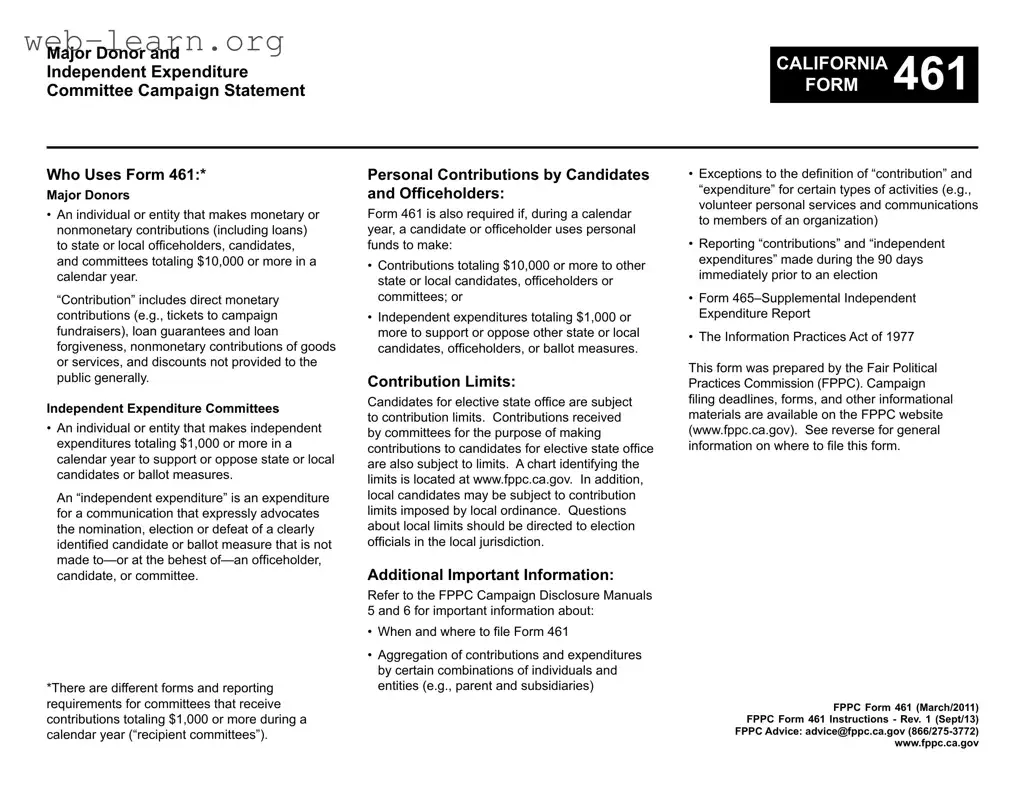
The California 461 form serves as a crucial tool for transparency in political contributions and independent expenditures within the state. Designed for use by major donors and independent expenditure committees, this form captures essential financial information that helps maintain the integrity of the electoral process. Major donors, defined as individuals or entities contributing $10,000 or more in a calendar year, must report their contributions, which can include monetary gifts, loans, and nonmonetary donations such as goods or services. Similarly, independent expenditure committees, which spend $1,000 or more to advocate for or against candidates or ballot measures, are required to file this form. Candidates and officeholders also need to disclose personal contributions or expenditures exceeding specified thresholds. Understanding the contribution limits is vital, as candidates for state office face specific restrictions, and local ordinances may impose additional rules. The form not only facilitates compliance with campaign finance laws but also promotes accountability by requiring detailed reporting of financial activities related to political campaigns.


Sample - California 461 Form

Major Donor and
Independent Expenditure
Committee Campaign Statement
461
CALIFORNIA
FORM
Who Uses Form 461:*
Major Donors
 










Independent Expenditure Committees
 









Personal Contributions by Candidates




 


 


Contribution Limits:










Additional Important Information:


 
 


 



 


 

 














Instructions for
Major Donor and
Independent Expenditure
Committee Campaign Statement
CALIFORNIA
FORM
461
Where to File:
State Elections and Committees Active in
More Than One County: If more than 50% of
your contributions or independent expenditures
were made to support or oppose state candidates,
measures and committees, or to support or oppose
local candidates and measures being voted on in
more than one county. File in the following place:
Secretary of State (original and one copy)
Political Reform Division
1500 11th Street, Room 495
Sacramento, CA 95814
Phone (916) 653-6224
Fax (916) 653-5045
www.sos.ca.gov
County Elections: If you are not a state
committee and more than 50% of your
contributions or independent expenditures were
made to support or oppose candidates and
measures being voted on in a single county, fi le
with the election offi cial in that county (original and
one copy).
This fi ling requirement also applies to contributions
or independent expenditures made to support or
oppose candidates and measures on the ballot in
more than one jurisdiction located within a single
county.
City Elections: If you are not a state committee
and more than 50% of your contributions or
independent expenditures were made to support
or oppose candidates and measures being voted
on in a single city, fi le with the city clerk in that city
(original and one copy).
Electronic Filing:
Major donor and independent expenditure
committees that are required to fi le reports with the
Secretary of State must fi le Form 461 electronically
if they make contributions or independent
expenditures totaling $25,000 or more in a
calendar year. Paper reports are also required.
Some local jurisdictions also require reports to be
electronically fi led.
FPPC Form 461 (March/2011)
FPPC Toll-Free Helpline: 866/ASK-FPPC (866/275-3772)
461
CALIFORNIA
FORM
Date Stamp
Type or print in ink.
Major Donor and
Independent Expenditure Committee
Campaign Statement
(Government Code sections 84200-84216.5)
For Offi cial Use Only
Date of election if applicable:
(Month, Day, Year)
1. Name and Address of Filer
STATE ZIP CODE
AREA CODE/DAYTIME PHONE
BUSINESS INTERESTS
from
MAJOR DONOR AND INDEPENDENT EXPENDITURE
COMMITTEE STATEMENT
3. Summary
SEE INSTRUCTIONS ON REVERSE
Statement covers period
through
Page
of
RESIDENTIAL OR MAILING ADDRESS (NO. AND STREET)
CITY
RESPONSIBLE OFFICER
(If fi ler is other than an individual)
2. Nature and Interests of Filer (Complete each applicable section.)
ADDRESS OF EMPLOYER/BUSINESS
NAME OF EMPLOYER/BUSINESS
Executed on
DATE
4. Verifi cation
I have used all reasonable diligence in preparing this statement. I have
reviewed the statement and to the best of my knowledge the information
contained herein is true and complete. I certify under penalty of perjury under
the laws of the State of California that the foregoing is true and correct.
1. Expenditures and contributions
(including loans) of $100 or more
made this period. (Part 5.)................................................ $
2. Unitemized expenditures and
contributions (including loans) under
$100 made this period...................................................... $
3. Total expenditures and contributions
made this period. (Add Lines 1 + 2.) ................SUBTOTAL $
4. Total expenditures and contributions
made from prior statement. (Enter
amount from Line 5 of last statement
led. If this is the fi rst statement for
the calendar year, enter zero.) ......................................... $
5. Total expenditures and contributions
(including loans) made since
January 1 of the current calendar year.
(Add Lines 3 + 4.) ................................................... TOTAL $
(Amounts may be rounded to whole dollars.)
NAME OF FILER
A FILER WHO IS AN INDIVIDUAL MUST LIST THE NAME, ADDRESS, AND BUSINESS INTERESTS
OF EMPLOYER OR, IF SELF-EMPLOYED, THE NAME, ADDRESS, AND NATURE OF THE BUSINESS
A FILER THAT IS A BUSINESS ENTITY MUST DESCRIBE THE BUSINESS ACTIVITY IN WHICH IT IS
ENGAGED
A FILER THAT IS AN ASSOCIATION MUST PROVIDE A SPECIFIC DESCRIPTION OF ITS INTERESTS
A FILER THAT IS NOT AN INDIVIDUAL, BUSINESS ENTITY, OR ASSOCIATION MUST DESCRIBE THE
COMMON ECONOMIC INTEREST OF THE GROUP OR ENTITY
By
SIGNATURE OF INDIVIDUAL DONOR OR
RESPONSIBLE OFFICER, IF OTHER THAN AN INDIVIDUAL
Amendment (Explain):
FPPC Form 461 (March/2011)
FPPC Toll-Free Helpline: 866/ASK-FPPC (866/275-3772)
Instructions for
Major Donor and
Independent Expenditure
Committee Campaign Statement
CALIFORNIA
FORM
461
For defi nitions and detailed information
about completing Form 461, refer to the FPPC
Campaign Disclosure Manuals 5 and 6.
Period Covered by a Statement:
The “period covered” by a campaign statement
begins the day after the closing date of the last
campaign statement you fi led. For example, if the
closing date of the last statement was June 30,
the beginning date of the next statement will be
July 1.
If this is the fi rst campaign statement for the
calendar year, begin with January 1.
The closing date of the statement depends on the
type of statement you are fi ling.
Date of Election:
Enter the date of the election if you are fi ling
Form 461 as a city or a county major donor or
independent expenditure committee and the city
or county’s election will be held this year.
1. Name and Address of Filer:
Enter the legal name of the individual or entity
ling the statement. If the fi ler is commonly known
to the public by another name, that name may
be used. When a person directs and controls
the making of contributions and independent
expenditures by a related entity (e.g., a parent
and subsidiaries or a majority shareholder of a
corporation) that must be aggregated and reported
on Form 461, list as the “Name of Filer” the name
of the individual or entity that directs and controls
the making of the contributions and independent
expenditures. In addition, you must:
Indicate that the campaign statement includes
the contributions and independent expenditures
of other entities. For example, “ABC
Corporation, including aggregated contributions/
independent expenditures.”
Identify any entities added to this report that
were not included in a prior report fi led for the
current calendar year, as well as any entities
included in a prior report for the current calendar
year that are no longer required to aggregate
under the name of fi ler.
Identify both names if the “Name of Filer” listed
on a previous report fi led for the current calendar
year is different than the name identifi ed on
this report. For example, “John Lewis, formerly
identifi ed as Lewis Construction.”
Enter the name of the responsible offi cer of an
entity or organization fi ling the statement.
2. Nature and Interests of Filer:
When more than one person or entity is listed
under “Name of Filer,” identify the nature and
interests of each. (Use appropriately labeled
continuation sheets if necessary.)
FPPC Form 461 (March/2011)
FPPC Toll-Free Helpline: 866/ASK-FPPC (866/275-3772)
3. Summary:
Summary totals are calculated from the
information itemized in Part 5 of the Form 461 and
unitemized payments of less than $100. If this is
the fi rst report being led for a calendar year, enter
a zero on line 4 of the summary.
4. Verifi cation:
A responsible offi cer of an entity or an entity fi ling
jointly with any number of affi liates must sign
the Form 461. An attorney or a certifi ed public
accountant may sign on behalf of the entity or
entities. A statement fi led by an individual must be
signed by the individual.
Amendments:
To amend previously fi led Form 461, check the
“Amendment” box, enter the period covered by the
statement you are amending, and complete Part
1. Disclose the amended information, including
Part 3, if applicable, and complete the Verifi cation.
SEE INSTRUCTIONS ON REVERSE
NAME OF FILER
Major Donor and
Independent Expenditure Committee
Campaign Statement
Page of
CANDIDATE AND OFFICE,
MEASURE AND JURISDICTION,
OR COMMITTEE
Type or print in ink.
Amounts may be rounded
to whole dollars.
CALIFORNIA
FORM
Statement covers period
from
through
MAJOR DONOR AND INDEPENDENT EXPENDITURE
COMMITTEE STATEMENT
NAME, STREET ADDRESS, CITY, STATE AND ZIP CODE
OF PAYEE
(IF COMMITTEE, ALSO ENTER I.D. NUMBER)
DATE
TYPE OF PAYMENT
Monetary
Contribution
Loan
Non-Monetary
Contribution
Independent
Expenditure
CUMULATIVE AMOUNT
RELATED TO THIS
CANDIDATE, MEASURE,
OR COMMITTEE
AMOUNT THIS
PERIOD
Support
Oppose
DESCRIPTION OF
PAYMENT
(IF OTHER THAN MONETARY
CONTRIBUTION OR LOAN)
Support
Oppose
461
5. Contributions (Including Loans, Forgiveness of Loans, and Loan Guarantees) and Expenditures Made
(If more space is needed, use additional copies of this page for continuation sheets.)
Support
Oppose
Support
Oppose
SUBTOTAL $
Monetary
Contribution
Loan
Non-Monetary
Contribution
Independent
Expenditure
Monetary
Contribution
Loan
Non-Monetary
Contribution
Independent
Expenditure
Monetary
Contribution
Loan
Non-Monetary
Contribution
Independent
Expenditure
FPPC Form 461 (March/2011)
FPPC Toll-Free Helpline: 866/ASK-FPPC (866/275-3772)
Instructions for
Major Donor and
Independent Expenditure Committee
Campaign Statement
CALIFORNIA
FORM
461
5. Contributions and Expenditures:
When itemizing contributions and expenditures
made by more than one entity (e.g., a parent and
subsidiaries), note which entity made each payment.
Date of Contribution
A monetary contribution is made on the date it is
mailed, delivered, or otherwise transmitted to the
candidate or committee. A nonmonetary contribution
is made on the earlier of the following: 1) the date
you made an expenditure for goods or services at
the behest of the candidate or committee; or 2) the
date the candidate or committee or an agent of the
candidate or committee obtained possession or
control of the goods or services.
Name and Address of Payee
If a total of $100 or more is contributed or expended
during a calendar year to support or oppose a
single candidate, committee or measure, disclose
the name and address of the payee. If the payee is
a committee, also disclose the identifi cation number
assigned to that committee by the Secretary of
State. If no ID number has been assigned to a
committee, provide the name and address of that
committee’s treasurer.
Contributions and expenditures of less than $100
to support or oppose a single candidate, committee
or measure during a calendar year are totaled and
reported as a lump sum on Line 2 of the Summary.
Candidate, Measure or Committee
Identify the candidate, measure or committee
supported or opposed by the contribution or
expenditure. Disclose the name of the candidate
and the offi ce sought or held; the name of the
ballot measure and its jurisdiction; or the name of
the committee if a nonmonetary contribution was
made to a general purpose committee. Check the
appropriate box to indicate whether the payment
was made to support or oppose the candidate or
measure listed.
Amount/Cumulative Amount
Disclose the amount of the contribution or
expenditure made this period.
If a single payment supports or opposes more than
one candidate or measure, provide the name and
address of the vendor. Enter the amount paid to
the vendor in the “Description of Payment” column.
Identify each candidate or measure, and enter the
amount of the contribution or expenditure attributable
to each in the “Amount this Period” column.
For each contribution, also disclose the cumulative
amount contributed to the candidate (including all
of the candidate’s controlled election committees)
or to the committee (in the case of a ballot measure
or other type of committee) since January 1 of
the current calendar year. For each independent
expenditure, disclose the cumulative amount of
independent expenditures made since January 1 of
the current calendar year related to the candidate
or ballot measure supported or opposed by the
expenditure.
Reporting Loans:
Check the “loan” box under “Type of Payment”
if you make, forgive, or guarantee a loan. You
need not report loan repayments received. If you
make and forgive a loan during the same calendar
year, report the amount of the forgiveness under
“Description of Payment.” The same is true if you
guarantee a loan and you make payments to the
lender during the same calendar year.
Loans to state candidates are subject to
contribution limits. If the candidate repays all or a
portion of a loan, the lender may make additional
contributions subject to the applicable contribution
limit.
Non-Monetary Contributions:
Report the fair market value of non-monetary
contributions. The fair market value is the amount
it would cost to purchase the goods or services
on the open market, which may be more than the
amount it cost to provide them. For example, the
fair market value of donated catering services
would normally be higher than the actual cost to the
caterer.
Reporting Subvendors:
If an agent (including an independent contractor)
makes payments on your behalf (“subvendor
payments”), disclose those payments in addition
to the payments made to the agent. For example,
you pay a public relations fi rm, which pays for an
advertisement supporting a ballot measure. In
addition to disclosing the payment(s) made to the
public relations fi rm, itemize payments of $500 or
more made by the fi rm related to the advertisement.
Do not include payments that are not for the
purpose of making contributions or independent
expenditures (e.g., for overhead or operating
expenses).
Report the name and address of the agent followed
by the name and address of each subvendor.
Disclose amounts paid to the agent and subvendor
in the “Description of Payment” column.
FPPC Form 461 (March/2011)
FPPC Toll-Free Helpline: 866/ASK-FPPC (866/275-3772)

Form Information

Fact Name Details
Purpose of Form 461 This form is used by major donors and independent expenditure committees to report contributions and expenditures made in support of or opposition to state and local candidates and measures.
Who Must File Individuals or entities that contribute $10,000 or more, or spend $1,000 or more on independent expenditures in a calendar year are required to file Form 461.
Contribution Definition A contribution includes monetary donations, loans, nonmonetary contributions, and discounts not available to the general public.
Filing Locations Form 461 must be filed with the Secretary of State or local election officials, depending on where contributions were made.
Electronic Filing Requirement Committees that make contributions or expenditures totaling $25,000 or more must file Form 461 electronically, in addition to paper reports.
Contribution Limits There are specific limits on contributions to candidates for state office, and local candidates may have additional limits set by local ordinances.
Governing Law Form 461 is governed by the California Government Code sections 84200-84216.5, which detail campaign finance regulations.

Detailed Guide for Filling Out California 461

Filling out the California Form 461 requires careful attention to detail. This form is used by major donors and independent expenditure committees to report contributions and expenditures. After completing the form, it will need to be filed with the appropriate election office.

  1. Obtain a copy of the California Form 461. Ensure you have the most recent version.
  2. Fill in the period covered by the statement at the top of the form. Indicate the start and end dates.
  3. Enter the name and address of the filer in the designated section. This includes the legal name and, if applicable, any commonly known names.
  4. Provide the nature and interests of the filer. If the filer is an individual, list their employer and business interests. If a business entity, describe the business activity.
  5. In the summary section, complete the following:
    • Line 1: Total expenditures and contributions of $100 or more made during the reporting period.
    • Line 2: Total unitemized expenditures and contributions under $100 made during the reporting period.
    • Line 3: Add Lines 1 and 2 for total expenditures and contributions made during this period.
    • Line 4: Enter total expenditures and contributions from the previous statement. If this is the first statement of the year, enter zero.
    • Line 5: Add Lines 3 and 4 for the cumulative total since January 1 of the current year.
  6. Complete the verification section. The responsible officer must sign and date the form. If filed by an individual, they must sign it themselves.
  7. If this form is an amendment to a previously filed statement, check the amendment box and provide the relevant details.
  8. File the completed form with the appropriate election office. Ensure you keep a copy for your records.

Obtain Answers on California 461

  1. What is the purpose of the California Form 461?

    The California Form 461 is designed for Major Donors and Independent Expenditure Committees to report their contributions and expenditures related to state and local candidates, officeholders, and ballot measures. It ensures transparency in campaign financing by requiring detailed disclosures of monetary and nonmonetary contributions that meet or exceed specified thresholds.

  2. Who is required to file Form 461?

    Individuals or entities that make significant contributions—$10,000 or more in a calendar year—are required to file this form. This includes Major Donors and Independent Expenditure Committees. Additionally, candidates or officeholders using personal funds for contributions or independent expenditures that meet these thresholds must also file Form 461.

  3. What types of contributions are reported on Form 461?

    Form 461 requires the reporting of various types of contributions, including:

    • Direct monetary contributions, such as cash donations or ticket purchases for fundraising events.
    • Loans, including guarantees and forgiveness of loans.
    • Nonmonetary contributions, which can involve goods or services provided at no charge.
    • Discounts not available to the public.
  4. Where should Form 461 be filed?

    The filing location for Form 461 depends on the scope of contributions or expenditures:

    • If more than 50% of contributions support candidates or measures across multiple counties, file with the Secretary of State.
    • If contributions are primarily within a single county, submit the form to the local county election official.
    • For contributions focused in a single city, the form should be filed with the city clerk.
  5. Are there contribution limits associated with Form 461?

    Yes, there are contribution limits for candidates seeking elective state office. These limits apply to both individual contributions and those made by committees. Local candidates may also face additional restrictions based on local ordinances. For detailed limits, refer to the Fair Political Practices Commission (FPPC) website.

  6. What is the process for amending Form 461?

    If changes need to be made to a previously filed Form 461, an amendment can be submitted. To do so, check the "Amendment" box on the form, specify the period being amended, and provide the updated information in the appropriate sections. Ensure that the verification section is completed as well.

  7. What resources are available for assistance with Form 461?

    The FPPC provides various resources, including Campaign Disclosure Manuals, that offer detailed guidance on completing Form 461. Additionally, for direct inquiries, individuals can reach out to the FPPC's toll-free helpline or email for advice.

Common mistakes

Filling out the California Form 461 can be a straightforward process, but many individuals make critical mistakes that can lead to compliance issues. One common error is failing to provide complete and accurate information in the "Name and Address of Filer" section. This is essential for identifying who is responsible for the contributions and expenditures. If the name is incorrect or incomplete, it could result in delays or rejections of the filing.

Another frequent mistake involves the failure to report all contributions and expenditures accurately. Many filers underestimate the amounts or omit certain contributions altogether. It is crucial to ensure that all monetary and non-monetary contributions are included, as the total needs to reflect the actual financial activity during the reporting period. Inaccurate reporting can lead to penalties and a loss of credibility.

Additionally, some individuals neglect to check the "Amendment" box when they are updating previously filed information. If changes are necessary, failing to indicate that the form is an amendment can create confusion and may not fulfill legal obligations. Always ensure that any updates are clearly marked and that the correct period covered is indicated.

Improper categorization of contributions is another significant mistake. Filers often mislabel contributions as loans or vice versa. Understanding the definitions provided by the Fair Political Practices Commission (FPPC) is essential to avoid misreporting. Misclassification can lead to serious compliance issues and potential legal ramifications.

Some individuals also overlook the verification section. It is critical that the responsible officer or individual signs the form. A missing signature can render the entire filing invalid. This step is often rushed or forgotten, but it is non-negotiable for compliance.

Lastly, many filers fail to be aware of the specific filing requirements based on their contributions or expenditures. For instance, if contributions exceed $25,000, electronic filing is mandatory. Ignoring this requirement can result in additional penalties. Understanding and adhering to these specific guidelines is crucial for a successful filing.

Documents used along the form

The California Form 461 is essential for major donors and independent expenditure committees to report their contributions and expenditures. Along with this form, several other documents are often required to ensure compliance with campaign finance regulations. Below is a list of these forms and documents, each serving a specific purpose in the reporting process.

  • Form 465 - Supplemental Independent Expenditure Report: This form is used to provide additional details about independent expenditures made to support or oppose candidates or measures. It helps ensure transparency in campaign financing.
  • Form 497 - 24-Hour Contribution Report: This report must be filed when a contribution of $1,000 or more is received within 90 days of an election. It allows for timely disclosure of significant contributions to maintain transparency.
  • Form 700 - Statement of Economic Interests: Individuals in certain positions must disclose their financial interests and potential conflicts of interest. This form helps maintain ethical standards among public officials and candidates.
  • Form 460 - Campaign Statement: This comprehensive form is used by recipient committees to report all contributions received and expenditures made during a specified period. It is crucial for tracking the overall financial activity of a campaign.
  • Form 501 - Candidate Intention Statement: Candidates must file this form before raising or spending any money on their campaign. It officially declares their intention to run for office and sets the stage for subsequent financial reporting.

Understanding these forms and their purposes is vital for anyone involved in campaign finance in California. Proper filing ensures compliance with state laws and promotes transparency in the electoral process.

Similar forms

The California Form 461 is used by major donors and independent expenditure committees to report their contributions and expenditures. Here are ten documents that share similarities with Form 461:

  • Form 460: This form is also used for campaign statements but is specifically for candidate and committee contributions and expenditures. It serves a similar purpose in tracking financial activities in political campaigns.
  • Form 465: This is the Supplemental Independent Expenditure Report. It is used to provide additional details about independent expenditures, similar to how Form 461 details major donor activities.
  • Form 497: This form is for late contribution reports. Like Form 461, it requires timely reporting of financial activities but focuses on contributions made shortly before an election.
  • Form 700: The Statement of Economic Interests is required for public officials and candidates. It shares the goal of transparency in financial dealings, similar to the reporting requirements of Form 461.
  • Form 501: This is the Candidate Intention Statement. It is filed by individuals intending to run for office, similar to how Form 461 is used by those contributing to campaigns.
  • Form 410: This is the Statement of Organization. It is used to register a committee, akin to how Form 461 reports the financial activities of those committees.
  • Form 450: The Campaign Statement for smaller contributions and expenditures is similar to Form 461 but is designed for those who do not meet the thresholds for major donor reporting.
  • Form 451: This is the Independent Expenditure Committee Campaign Statement. It focuses specifically on independent expenditures, paralleling the focus of Form 461 on major donors and their expenditures.
  • Form 462: This form is used for reporting contributions made by political parties. It shares similarities in tracking contributions but is specific to party activities.
  • Form 463: This is the Campaign Statement for Political Committees. It is used to report contributions and expenditures, similar to the purpose of Form 461 for major donors and independent expenditure committees.

Dos and Don'ts

When filling out the California Form 461, there are important guidelines to follow. Here is a list of things you should and shouldn't do:

  • Do provide accurate and complete information about contributions and expenditures.
  • Do include the name of the responsible officer if filing on behalf of an entity.
  • Do ensure that all amounts are rounded to whole dollars as required.
  • Do file the form electronically if required and if contributions exceed $25,000 in a calendar year.
  • Do check the deadlines for filing to avoid penalties.
  • Don't leave any sections blank; provide information for all applicable parts.
  • Don't forget to sign the form; an unsigned form may be rejected.
  • Don't submit inaccurate figures; this can lead to legal issues.
  • Don't ignore local contribution limits; verify them with local election officials.
  • Don't file without reviewing the instructions thoroughly to ensure compliance.

Misconceptions

Understanding the California Form 461 can be tricky, and there are several misconceptions that can lead to confusion. Here’s a breakdown of seven common misunderstandings:

  • Only large organizations need to file Form 461. Many individuals and small entities who contribute significant amounts also need to file. If you contribute $10,000 or more in a calendar year, you are required to submit this form.
  • Form 461 is only for political campaigns. While it is primarily used for campaign contributions, it also applies to independent expenditures, which can include spending to support or oppose ballot measures.
  • Filing Form 461 is optional. This form is mandatory for major donors and independent expenditure committees that meet the contribution thresholds. Failing to file can result in penalties.
  • All contributions are treated the same. Not all contributions are equal. The form distinguishes between monetary and non-monetary contributions, and different rules apply to each type.
  • You can file Form 461 anytime. There are specific deadlines for filing this form, especially around election periods. It’s crucial to be aware of these deadlines to avoid late penalties.
  • Only contributions to candidates require reporting. Contributions made to support or oppose ballot measures also need to be reported on Form 461, not just those made to candidates.
  • Local regulations don’t matter. Local jurisdictions may impose additional rules or limits on contributions. Always check with local election officials to ensure compliance.

By clearing up these misconceptions, individuals and organizations can better navigate the requirements of Form 461 and ensure they remain compliant with California's campaign finance laws.

Key takeaways

The California Form 461 is essential for individuals and entities involved in political contributions and independent expenditures. Here are some key takeaways regarding its use:

  • Who Must Use Form 461: Major donors and independent expenditure committees are required to file this form if their contributions or expenditures meet specific thresholds.
  • Contribution Thresholds: Major donors must report if they contribute $10,000 or more in a calendar year. Independent expenditure committees must report expenditures of $1,000 or more.
  • Personal Contributions: Candidates and officeholders must also file Form 461 if they use personal funds to contribute $10,000 or more or make independent expenditures of $1,000 or more.
  • Filing Locations: Depending on the nature of the contributions or expenditures, filings can be made with the Secretary of State, county election officials, or city clerks.
  • Electronic Filing Requirement: Committees making contributions or expenditures totaling $25,000 or more in a calendar year must file Form 461 electronically.
  • Understanding the Reporting Period: The reporting period starts the day after the closing date of the last filed statement. If it’s the first statement of the year, begin with January 1.
  • Verification of Information: A responsible officer must sign the form, certifying that all information is accurate and complete.
  • Amendments: If changes are needed, the form can be amended by checking the “Amendment” box and providing updated information.
  • Additional Resources: For detailed guidance, refer to the FPPC Campaign Disclosure Manuals and the FPPC website for deadlines and other information.

Understanding these key points can help ensure compliance with California's political contribution and expenditure laws. Proper filing is crucial for maintaining transparency and accountability in the political process.