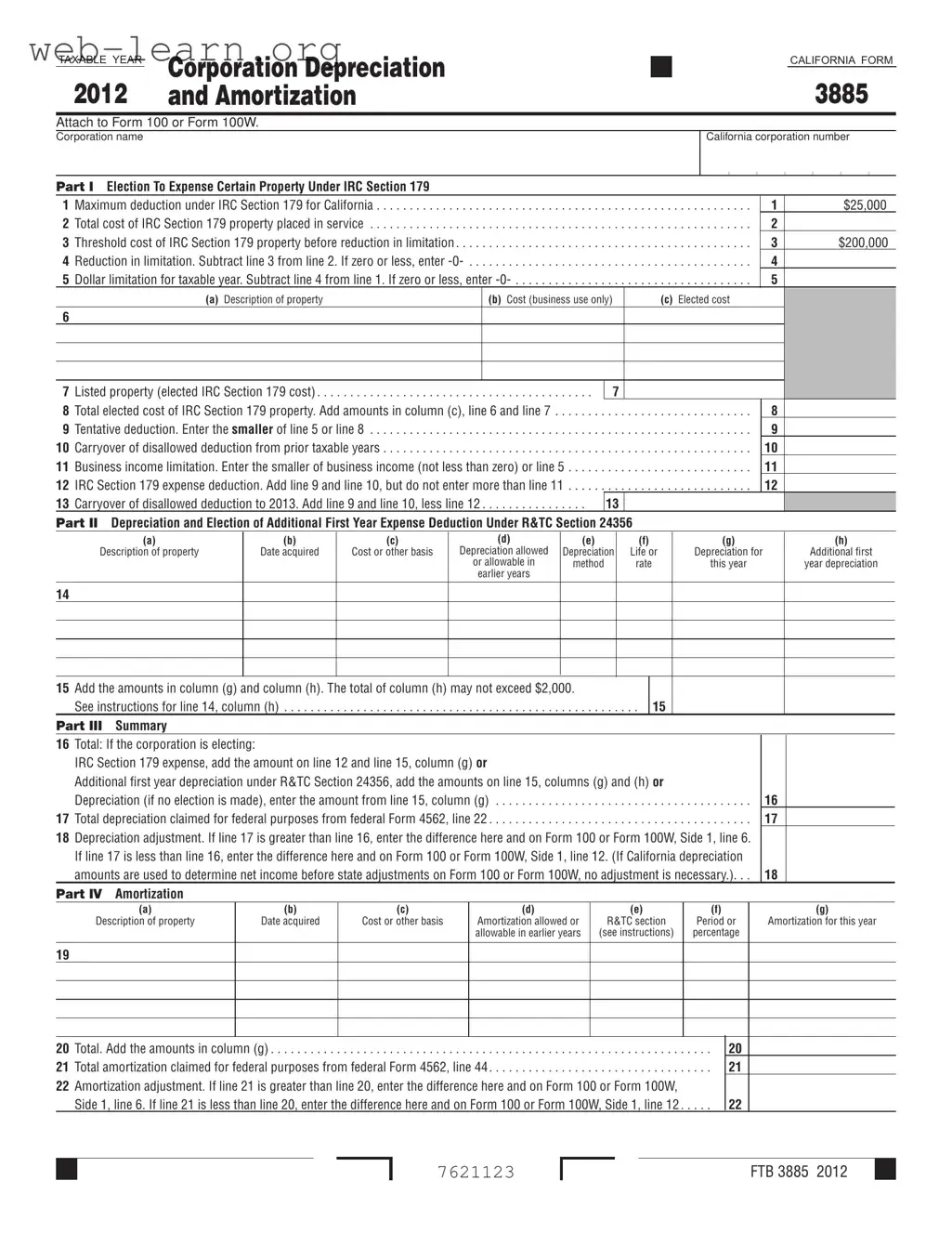
Homepage Blank California 3885 Form
Outline

The California Form 3885 is a crucial document for corporations, partnerships, and limited liability companies (LLCs) classified as corporations, as it facilitates the calculation of depreciation and amortization deductions. This form is essential for reporting on the election to expense certain property under IRC Section 179, which allows a corporation to deduct a portion of the cost of qualifying property in the year it is placed in service. The maximum deduction under this section for California is set at $25,000, with specific thresholds and limitations based on the total cost of the property. Additionally, Form 3885 includes sections for detailing depreciation methods, such as straight-line and declining balance, and allows for the election of additional first-year expense deductions. It also addresses amortization for intangible assets over a fixed period, typically 15 years, aligning with California’s Revenue and Taxation Code. Understanding the nuances of this form is vital for accurate tax reporting and compliance, particularly given the differences between California and federal tax laws.

Sample - California 3885 Form

FTB 3885 2012
14
15 Add the amounts in column (g) and column (h). The total of column (h) may not exceed $2,000.
See instructions for line 14, column (h)
...................................................... 15
Part III Summary
16 Total: If the corporation is electing:
IRC Section 179 expense, add the amount on line 12 and line 15, column (g) or
Additional first year depreciation under R&TC Section 24356, add the amounts on line 15, columns (g) and (h) or
Depreciation (if no election is made), enter the amount from line 15, column (g)
....................................... 16
17 Total depreciation claimed for federal purposes from federal Form 4562, line 22 ........................................ 17
18 Depreciation adjustment. If line 17 is greater than line 16, enter the difference here and on Form 100 or Form 100W, Side 1, line 6.
If line 17 is less than line 16, enter the difference here and on Form 100 or Form 100W, Side 1, line 12. (If California depreciation
amounts are used to determine net income before state adjustments on Form 100 or Form 100W, no adjustment is necessary.)
... 18
Part IV Amortization
Corporation Depreciation
and Amortization
TAXABLE YEAR
2012
Attach to Form 100 or Form 100W.
CALIFORNIA FORM
3885
Corporation name California corporation number
7621123
Part I Election To Expense Certain Property Under IRC Section 179
1 Maximum deduction under IRC Section 179 for California ......................................................... 1 $25,000
2 Total cost of IRC Section 179 property placed in service .......................................................... 2
3 Threshold cost of IRC Section 179 property before reduction in limitation............................................. 3 $200,000
4 Reduction in limitation. Subtract line 3 from line 2. If zero or less, enter -0- ........................................... 4
5 Dollar limitation for taxable year. Subtract line 4 from line 1. If zero or less, enter -0- .................................... 5
(a) Description of property (b) Cost (business use only) (c) Elected cost
6
7 Listed property (elected IRC Section 179 cost).......................................... 7
8 Total elected cost of IRC Section 179 property. Add amounts in column (c), line 6 and line 7 .............................. 8
9 Tentative deduction. Enter the smaller of line 5 or line 8 .......................................................... 9
10 Carryover of disallowed deduction from prior taxable years . . . . . . . . . . . . . . . . . . . . . . . . . . . . . . . . . . . . . . . . . . . . . . . . . . . . . . . . 10
11 Business income limitation. Enter the smaller of business income (not less than zero) or line 5 ............................ 11
12 IRC Section 179 expense deduction. Add line 9 and line 10, but do not enter more than line 11 ............................ 12
13 Carryover of disallowed deduction to 2013. Add line 9 and line 10, less line 12 ................ 13
Part II Depreciation and Election of Additional First Year Expense Deduction Under R&TC Section 24356
(a)
Description of property
(b)
Date acquired
(c)
Cost or other basis
(d)
Depreciation allowed
or allowable in
earlier years
(e)
Depreciation
method
(f)
Life or
rate
(g)
Depreciation for
this year
(h)
Additional first
year depreciation
(a)
Description of property
(b)
Date acquired
(c)
Cost or other basis
(d)
Amortization allowed or
allowable in earlier years
(e)
R&TC section
(see instructions)
(f)
Period or
percentage
(g)
Amortization for this year
19
20 Total. Add the amounts in column (g) ................................................................... 20
21 Total amortization claimed for federal purposes from federal Form 4562, line 44.................................. 21
22 Amortization adjustment. If line 21 is greater than line 20, enter the difference here and on Form 100 or Form 100W,
Side 1, line 6. If line 21 is less than line 20, enter the difference here and on Form 100 or Form 100W, Side 1, line 12
..... 22
FTB 3885 Instructions 2012 Page 1
2012 Instructions for Form FTB 3885
Corporation Depreciation and Amortization
References in these instructions are to the Internal Revenue Code (IRC) as of January 1, 2009, and to the California Revenue and Taxation Code (R&TC).
General Information
In general, for taxable years beginning on or after
January 1, 2010, California law conforms to the
Internal Revenue Code (IRC) as of January 1, 2009.
However, there are continuing differences between
California and federal law. When California conforms
to federal tax law changes, we do not always adopt
all of the changes made at the federal level. For
more information, go to ftb.ca.gov and search for
conformity. Additional information can be found
in FTB Pub. 1001, Supplemental Guidelines to
California Adjustments, the instructions for California
Schedule CA (540 or 540NR), and the Business
Entity tax booklets.
The instructions provided with California tax forms
are a summary of California tax law and are only
intended to aid taxpayers in preparing their state
income tax returns. We include information that is
most useful to the greatest number of taxpayers
in the limited space available. It is not possible to
include all requirements of the California Revenue
and Taxation Code (R&TC) in the tax booklets.
Taxpayers should not consider the tax booklets as
authoritative law.
A Purpose
Use form FTB 3885, Corporation Depreciation and
Amortization, to calculate California depreciation and
amortization deduction for corporations, including
partnerships and limited liability companies (LLCs)
classified as corporations.
S corporations must use Schedule B (100S),
S Corporation Depreciation and Amortization.
Depreciation is the annual deduction allowed to
recover the cost or other basis of business or income
producing property with a determinable useful life of
more than one year. Generally, depreciation is used
in connection with tangible property.
Amortization is an amount deducted to recover the
cost of certain capital expenses over a fixed period.
Generally amortization is used for intangible assets.
For amortizing the cost of certified pollution control
facilities, use form FTB 3580, Application and
Election to Amortize Certified Pollution Control
Facility.
B Federal/State Differences
Differences between federal and California laws affect
the calculation of depreciation and amortization. The
following lists are not intended to be all-inclusive of
the federal and state conformities and differences.
For more information, refer to the R&TC.
California law conforms to federal law for the
following:
The sport utility vehicles (SUVs) and minivans
built on a truck chassis are included in the
definition of trucks and vans when applying the
6,000 pound gross weight limit. See federal Rev.
Proc. 2003-75 for more information.
The additional first-year depreciation, or the
election to expense the cost of the property as
provided in IRC Section 179, with modification.
The federal Class Life Asset Depreciation Range
(ADR) System provisions, which specifies a
useful life for various types of property. However,
California law does not allow the corporation to
choose a depreciation period that varies from the
specified asset guideline system.
California law does not conform to federal law for
the following:
The enhanced IRC Section 179 expensing election
for assets placed in service in 2010 through 2012
taxable year.
The first-year depreciation deduction allowed
for new luxury autos or certain passenger
automobiles acquired and placed in service in
2010 through 2012.
The IRC Section 613A(d)(4) relating to the
exclusion of certain refiners. See R&TC
Section 24831.3 for more information.
The IRC Section 168(k) relating to the 50% bonus
depreciation deduction for assets acquired in tax
years 2008 through 2012 and placed in service
before 2013 (or before 2014 for certain qualifying
property). For property acquired and placed in
service after September 8, 2010, and before 2012
(before 2013 in the case of certain qualifying
property), the bonus depreciation deduction is
100%.
The additional first-year depreciation of certain
qualified property placed in service after
October 3, 2008, and the election to claim
additional research and minimum tax credits in
lieu of claiming the bonus depreciation.
The accelerated recovery period for depreciation
of smart meters and smart grid systems.
The ten-year useful life for grapevines planted as
replacements for vines subject to Phylloxera or
Pierce’s disease. California law allows a useful life
of five years.
The federal special class life for gas station
convenience stores and similar structures.
The depreciation under Modified Accelerated Cost
Recovery System (MACRS) for corporations,
except to the extent such depreciation is passed
through from a partnership or LLC classified as a
partnership.
C Depreciation Calculation
Methods
Depreciation methods are defined in R&TC
Sections 24349 through 24354. Depreciation
calculation methods, described in R&TC
Section 24349, are as follows:
Straight-Line. The straight-line method divides the
cost or other basis of property, less its estimated
salvage value, into equal amounts over the estimated
useful life of the property. An asset may not be
depreciated below a reasonable salvage value.
Declining Balance. Under this method, depreciation
is greatest in the first year and smaller in each
succeeding year. The property must have a useful
life of at least three years. Salvage value is not taken
into account in determining the basis of the property,
but the property may not be depreciated below a
reasonable salvage value.
The amount of depreciation for each year is
subtracted from the basis of the property and a
uniform rate of up to 200% of the straight-line rate is
applied to the remaining balance.
For example, the annual depreciation allowances for
property with an original basis of $100,000 are:
Year
Remaining
basis
Declining
balance
rate
Depreciation
allowance
First
...... $100,000 20% $20,000
Second
... 80,000 20% 16,000
Third ..... 64,000 20% 12,800
Fourth .... 51,200 20% 10,240
Sum-of-the-Years-Digits Method. This method may
be used whenever the declining balance method is
allowed. The depreciation deduction is figured by
subtracting the salvage value from the cost of the
property and multiplying the result by a fraction.
The numerator of the fraction is the number of years
remaining in the useful life of the property. Therefore,
the numerator changes each year as the life of the
property decreases. The denominator of the fraction
is the sum of the digits representing the years of
useful life. The denominator remains constant every
year.
Other Consistent Methods. Other depreciation
methods may be used as long as the total
accumulated depreciation at the end of any taxable
year during the first 2/3 of the useful life of the
property is not more than the amount that would
have resulted from using the declining balance
method.
D Period of Depreciation
Under Cal. Code Regs., tit. 18, section 24349(l),
California conforms to the federal useful lives of
property.
Use the following information as a guide to
determine reasonable periods of useful life for
purposes of calculating depreciation. Actual facts and
circumstances will determine useful life. However,
the figures listed below represent the normal periods
of useful life for the types of property listed as shown
in IRS Rev. Proc. 87-56.
Office furniture, fixtures, machines,
and equipment
......................10 yrs.
This category includes furniture and fixtures (that
are not structural components of a building) and
machines and equipment used in the preparation
of paper or data.
Examples include: desks; files; safes; typewriters,
accounting, calculating, and data processing
machines; communications equipment; and
duplicating and copying equipment.
Computers and peripheral
equipment (printers, etc.)
...............6 yrs.
Transportation equipment and
automobiles (including taxis)
............3 yrs.
General-purpose trucks:
Light (unloaded weight less than
13,000 lbs.)
.........................4 yrs.
Heavy (unloaded weight 13,000 lbs.
or more)
............................6 yrs.
Buildings
This category includes the structural shell of a
building and all of its integral parts that service
normal heating, plumbing, air conditioning,
fire prevention and power requirements, and
equipment such as elevators and escalators.
Type of building:
Apartments
.........................40 yrs.
Dwellings (including rental residences)
...45 yrs.
Office buildings
......................45 yrs.
Warehouses
........................60 yrs.
E Depreciation Methods to Use
Corporations may use the straight-line method
for any depreciable property. Before using other
methods, consider the kind of property, its useful
life, whether it is new or used, and the date it was
acquired. Use the following chart as a general guide
to determine which method to use:
Property description
Maximum
depreciation method
Real estate acquired 12/31/70 or earlier
New (useful life 3 yrs. or more) .....200% Declining balance
Used (useful life 3 yrs. or more) .....150% Declining balance
Real estate acquired 1/1/71 or later
Residential rental:
New..........................200% Declining balance
Used (useful life 20 yrs. or more) ...125% Declining balance
Used (useful life less than 20 yrs.) ..Straight-line
Page 2 FTB 3885 Instructions 2012
Commercial and industrial:
New (useful life 3 yrs. or more) ....150% Declining balance
Used .........................Straight-line
Personal property
New (useful life 3 yrs. or more) .....200% Declining balance
Used (useful life 3 yrs. or more) .....150% Declining balance
See “Other Consistent Methods” information on
page 1.
The Class Life ADR System of depreciation may
be used for designated classes of assets placed in
service after 1970.
The Guideline Class Life System of depreciation
may be used for certain classes of assets placed in
service before 1971.
F Election To Expense
Certain Property Under IRC
Section 179
For taxable years beginning on or after
January 1, 2005, corporations may elect IRC
Section 179 to expense part or all of the cost of
depreciable tangible property used in the trade
or business and certain other property described
in federal Publication 946, How to Depreciate
Property. To elect IRC Section 179, the corporation
must have purchased property, as defined in the
IRC Section 179(d)(2), and placed it in service
during the taxable year. If the corporation elects
this deduction, the corporation must reduce the
California depreciable basis by the IRC Section 179
expense. See the instructions for federal Form 4562,
Depreciation and Amortization, for more information.
California does not allow IRC Section 179 expense
election for off-the-shelf computer software.
California conforms to the federal changes made to
the deduction of business start-up and organizational
costs paid or incurred on or after January 1,
2005. Exceptions: California does not conform to
the federal increase in the deduction for start-up
expenses in 2010 taxable year.
Limitations. Federal limitation amounts are different
than California limitation amounts. For California
purposes, the maximum IRC Section 179 expense
deduction allowed is $25,000. This amount is
reduced if the cost of all IRC Section 179 property
placed in service during the taxable year is more
than $200,000. The total IRC Section 179 expense
deduction cannot exceed the corporation’s business
income.
G Amortization
California conforms to the IRC Section 197
amortization of intangibles for taxable years
beginning on or after January 1, 1994. Generally,
assets that meet the definition under IRC Section 197
are amortized on a straight-line basis over 15 years.
There may be differences in the federal and California
amounts for intangible assets acquired in taxable
years beginning prior to January 1, 1994. See R&TC
Section 24355.5 for more information.
Amortization of the following assets is governed by
California law:
Bond premiums R&TC 24360 – 24363.5
Research expenditures R&TC 24365
Reforestation expenses R&TC 24372.5
Organizational expenditures R&TC 24407 – 24409
Start-up expenses R&TC 24414
Other intangible assets may be amortized if it is
approved with reasonable accuracy that the asset
has an ascertainable value that diminishes over time
and has a limited useful life.
Specific Line Instructions
For properties placed in service during the taxable
year, the corporation may complete Part I if the
corporation elects to expense qualified property
under IRC Section 179, or Part II if the corporation
elects additional first year expense deduction for
qualified property under R&TC Section 24356. The
corporation may only elect IRC Section 179 or the
additional first year expense deduction for the same
taxable year. The election must be made on a timely
filed tax return (including extension). The election
may not be revoked except with the Franchise Tax
Board‘s consent.
Part II is also used to calculate depreciation for
property (with or without the above elections).
Part I Election To Expense Certain Property
Under IRC Section 179
Complete Part I if the corporation elects IRC
Section 179 expense. Include all assets qualifying
for the deduction since the limit applies to all
qualifying assets as a group rather than to each asset
individually. The total IRC Section 179 expense for
property, which the election may be made, is figured
on line 5. The amount of IRC Section 179 expense
deductions for the taxable year cannot exceed the
corporation’s business income on line 11. See
the instructions for federal Form 4562 for more
information.
Line 2
Enter the cost of all IRC Section 179 qualified
property placed in service during the taxable year
including the cost of any listed property. See General
Information F, Election To Expense Certain Property
Under IRC Section 179, for information regarding
qualified property. See line 7 instructions for
information regarding listed property.
Line 5
If line 5 is zero, the corporation cannot elect to
expense any IRC Section 179 property. Skip line 6
through line 11, enter zero on line 12.
Line 6
Do not include any listed property on line 6. Enter
the elected IRC Section 179 cost of listed property
on line 7.
Column (a) – Description of property. Enter a brief
description of the property the corporation elects to
expense.
Column (b) – Cost (business use only). Enter the
cost of the property. If the corporation acquired
the property through a trade-in, do not include any
carryover basis of the property traded in. Include
only the excess of the cost of the property over the
value of the property traded in.
Column (c) – Elected cost. Enter the amount the
corporation elects to expense. The corporation does
not have to expense the entire cost of the property.
The corporation can depreciate the amount it does
not expense.
Line 7
Use a format similar to federal Form 4562, Part V,
line 26 to determine the elected IRC Section 179 cost
of listed property. Listed property generally includes
the following:
Passenger automobiles weighing 6,000 pounds or
less.
Any other property used for transportation if the
nature of the property lends itself to personal use,
such as motorcycles, pick-up trucks, SUVs, etc.
Any property used for entertainment or
recreational purposes (such as photographic,
phonographic, communication, and video
recording equipment).
Cellular telephones (and other similar
telecommunications equipment). Note: California
does not conform to the federal exclusion of these
items from being treated as listed property for
taxable years beginning on or after January 1,
2010.
Computers or peripheral equipment.
Exception. Listed property generally does not
include:
Photographic, phonographic, communication,
or video equipment used exclusively in the
corporation’s trade or business.
Any computer or peripheral equipment used
exclusively at a regular business.
An ambulance, hearse, or vehicle used for
transporting persons or property for hire.
Listed property used 50% or less in business activity
does not qualify for the IRC Section 179 expense
deduction. For more information regarding listed
property, see the instructions for federal Form 4562.
Line 11
The total cost the corporation can deduct is limited to
the corporation’s business income. For the purpose
of IRC Section 179 election, business income is the
net income derived from the corporation’s active
trade or business, Form 100 or Form 100W, line 18,
before the IRC Section 179 expense deduction
(excluding items not derived from a trade or
business actively conducted by the corporation).
Part II Depreciation and Election of
Additional First Year Expense
Deduction Under R&TC
Section 24356
Line 14
Corporations may enter each asset separately or
group assets into depreciation accounts. Figure the
depreciation separately for each asset or group of
assets. The basis for depreciation is the cost or other
basis reduced by a reasonable salvage value (except
when using the declining balance method), additional
first-year depreciation (if applicable), and tax credits
claimed on depreciable property (where specified).
This may cause the California basis to be different
from the federal basis.
If the Guideline Class Life System or Class Life ADR
System is used, enter the total amount from the
corporation’s schedule showing the computation on
form FTB 3885, column (g), and identify as such.
Line 14, Column (h), Additional first-year
depreciation.
Corporations may elect to deduct up to 20% of the
cost of “qualifying property” in the year acquired
in addition to the regular depreciation deduction.
The maximum additional first-year depreciation
deduction is $2,000. Corporations must reduce the
basis used for regular depreciation by the amount of
additional first-year depreciation claimed.
“Qualifying property” is tangible personal property
used in business and having a useful life of at
least six years. Land, buildings, and structural
components do not qualify. Property converted from
personal use, acquired by gift, inheritance, or from
related parties also does not qualify.
See R&TC Section 24356 and the applicable
regulations for more information.
An election may be made to expense up to
40% of the cost of property described in
R&TC Sections 24356.6, 24356.7, and 24356.8.
For more information, get form FTB 3809, Targeted
Tax Area Deduction and Credit Summary; form
FTB 3805Z, Enterprise Zone Deduction and Credit
Summary; or form FTB 3807, Local Agency Military
Base Recovery Area Deduction and Credit Summary.
Part IV Amortization
Line 19, Column (e) – R&TC section.
Enter the correct R&TC section for the type
of amortization. See General Information G,
Amortization, for a list of the R&TC sections.

Form Information

Fact Name Fact Description
Form Purpose The California Form 3885 is used to calculate depreciation and amortization deductions for corporations.
Governing Laws This form is governed by the California Revenue and Taxation Code (R&TC) and the Internal Revenue Code (IRC).
Section 179 Deduction The maximum deduction allowed under IRC Section 179 for California is $25,000.
Threshold Cost The threshold cost of IRC Section 179 property before reduction is $200,000.
Listed Property Listed property includes passenger automobiles and other assets used for transportation that can also be used personally.
Depreciation Methods California allows various depreciation methods, including straight-line and declining balance methods.
Amortization Period Intangible assets under R&TC Section 197 are amortized on a straight-line basis over 15 years.
Federal/State Differences California law has specific differences from federal law regarding depreciation and amortization calculations.

Detailed Guide for Filling Out California 3885

Filling out the California 3885 form involves several steps to accurately report depreciation and amortization for your corporation. After completing the form, you will attach it to Form 100 or Form 100W as part of your tax filing. Ensure that all information is accurate to avoid any issues with your submission.

  1. Obtain the Form: Download the California 3885 form from the California Franchise Tax Board website or acquire a physical copy.
  2. Fill in Corporation Information: Enter your corporation's name and California corporation number at the top of the form.
  3. Part I - Election to Expense: If you choose to expense certain property under IRC Section 179, complete this section. Start with line 1, entering the maximum deduction allowed.
  4. Line 2: Enter the total cost of IRC Section 179 property placed in service during the taxable year.
  5. Line 3: Enter the threshold cost before any reduction in limitation.
  6. Line 4: Calculate the reduction in limitation by subtracting line 3 from line 2. If the result is zero or less, enter -0-.
  7. Line 5: Determine the dollar limitation for the taxable year by subtracting line 4 from line 1. If zero or less, enter -0-.
  8. Lines 6-12: Fill in the necessary details for property descriptions, costs, and elected costs. Follow the instructions for listed property on line 7.
  9. Part II - Depreciation: Begin this section by entering details about each property, including acquisition date and cost. Complete columns for depreciation allowed and method used.
  10. Line 15: Add the amounts in column (g) and column (h) for total depreciation.
  11. Part III - Summary: Enter totals from previous sections as instructed, including depreciation claimed for federal purposes.
  12. Part IV - Amortization: Fill in details for any amortization claimed, including description, date acquired, and amortization allowed.
  13. Review: Double-check all entries for accuracy before submitting the form.
  14. Submit: Attach the completed form to Form 100 or Form 100W and file it with the California Franchise Tax Board.

Obtain Answers on California 3885

  1. What is California Form 3885?

    California Form 3885 is used by corporations to calculate depreciation and amortization deductions. This includes partnerships and limited liability companies (LLCs) classified as corporations. S corporations, however, must use Schedule B (100S) for these calculations. The form helps businesses recover costs associated with their property over time, providing significant tax benefits.

  2. Who needs to file Form 3885?

    Any corporation, including partnerships and LLCs treated as corporations, that has depreciable or amortizable property must file Form 3885. If you are an S corporation, you will need to complete Schedule B instead. It's essential to file this form if your business has purchased property that qualifies for depreciation or amortization deductions.

  3. What types of property can be included on Form 3885?

    Form 3885 covers both tangible and intangible assets. Tangible assets include office furniture, machinery, and vehicles, while intangible assets may include organizational expenditures and certain types of intellectual property. The form allows businesses to recover costs for property with a determinable useful life of more than one year.

  4. What is the maximum deduction allowed under IRC Section 179 for California?

    The maximum deduction allowed under IRC Section 179 for California is $25,000. However, this amount is subject to reduction if the total cost of IRC Section 179 property placed in service during the taxable year exceeds $200,000. Therefore, businesses must carefully track their property costs to determine their eligibility for this deduction.

  5. What is the difference between depreciation and amortization?

    Depreciation applies to tangible assets, allowing businesses to recover the cost of property like machinery and vehicles over time. Amortization, on the other hand, pertains to intangible assets, such as patents or trademarks, and spreads the cost over a fixed period. Understanding these distinctions is crucial for accurately completing Form 3885.

  6. How do I determine the depreciation method to use?

    Corporations can choose from several depreciation methods, including straight-line, declining balance, and sum-of-the-years-digits. The choice depends on the type of property, its useful life, and whether it is new or used. It's vital to consider these factors to maximize deductions and comply with tax regulations.

  7. Can I elect to expense certain property under IRC Section 179?

    Yes, corporations can elect to expense certain property under IRC Section 179, provided the property is placed in service during the taxable year. However, the total deduction cannot exceed the corporation’s business income. This election must be made on a timely filed tax return and cannot be revoked without consent from the Franchise Tax Board.

  8. What happens if I do not file Form 3885?

    If you fail to file Form 3885 when required, you may miss out on valuable tax deductions. This could lead to a higher tax liability than necessary. Additionally, not filing could result in penalties or interest charges from the California Franchise Tax Board. Therefore, it is critical to file accurately and on time.

  9. Where can I find more information about Form 3885?

    For more detailed information, you can visit the California Franchise Tax Board's website. There, you will find resources, instructions, and guidelines related to Form 3885. It’s essential to stay informed about any updates or changes to tax laws that could affect your filings.

Common mistakes

Filling out the California Form 3885 can be a complex task, and mistakes can lead to delays or inaccuracies in tax filings. One common mistake is failing to provide the correct corporation name and number at the top of the form. This information is essential for identifying the business and ensuring that the form is processed correctly. Omitting or misspelling this information can cause significant issues.

Another frequent error occurs in Part I, where taxpayers often miscalculate the maximum deduction under IRC Section 179. It is crucial to remember that the maximum deduction allowed for California is $25,000. If a corporation places more than $200,000 of Section 179 property in service, the deduction may be reduced, and some individuals overlook this threshold, leading to incorrect entries.

Inaccuracies in reporting the total cost of IRC Section 179 property placed in service can also create problems. Taxpayers sometimes forget to include all qualifying assets, which can result in a lower deduction than entitled. Each asset must be accounted for to ensure compliance with tax regulations.

Another mistake involves the elected cost of listed property. Taxpayers may include listed property in the wrong section or fail to apply the correct limits. Listed property, such as passenger vehicles under 6,000 pounds, has specific rules that must be followed. Ignoring these rules can lead to disallowed deductions.

Many individuals also fail to properly calculate the business income limitation. This figure determines the maximum deduction a corporation can claim under Section 179. If the business income is less than the allowable deduction, the corporation cannot claim the full amount, which can be overlooked during the filling process.

In Part II, errors often arise in reporting the depreciation method. Taxpayers sometimes select the wrong method for their assets, such as using the straight-line method when a declining balance method would be more appropriate. Understanding the asset's classification and useful life is essential for accurate reporting.

Another common mistake is failing to include the additional first-year depreciation for qualifying property. This deduction can significantly reduce taxable income, but it must be calculated correctly. Taxpayers may neglect to apply this deduction or miscalculate the amount, leading to missed savings.

In Part IV, taxpayers often misidentify the correct R&TC section for amortization. Each type of amortization has specific regulations, and entering the wrong section can result in incorrect calculations and potential penalties. It is vital to refer to the instructions carefully to ensure compliance.

Finally, many individuals overlook the importance of keeping accurate records of all property placed in service. Documentation is crucial for substantiating claims made on the form. Failing to maintain proper records can lead to challenges during audits or reviews by tax authorities.

In summary, careful attention to detail is required when completing the California Form 3885. By avoiding these common mistakes, taxpayers can ensure a smoother filing process and potentially maximize their deductions.

Documents used along the form

The California Form 3885 is essential for corporations to calculate their depreciation and amortization deductions. However, several other forms and documents are often used alongside it to ensure compliance with state tax regulations. Here’s a list of these related documents, each serving a unique purpose in the tax preparation process.

  • Form 100: This is the California Corporation Franchise or Income Tax Return. Corporations use it to report income, deductions, and credits, and to calculate the tax owed to the state.
  • Form 100W: This form is similar to Form 100 but is specifically for corporations that are classified as "water's edge." It focuses on income derived from California sources.
  • Form 4562: The federal Depreciation and Amortization form. Corporations use this to report depreciation and amortization expenses for federal tax purposes, which can differ from California calculations.
  • Schedule B (100S): This form is used by S corporations to report their depreciation and amortization. It ensures that S corporations comply with specific tax requirements.
  • Form FTB 3580: This form is for the application and election to amortize certified pollution control facilities. It allows corporations to recover costs related to these facilities over time.
  • Form FTB 3805Z: This is used for Enterprise Zone Deduction and Credit Summary. Corporations in designated areas can take advantage of tax incentives through this form.
  • Form FTB 3809: This form is related to the Targeted Tax Area Deduction and Credit Summary, providing tax benefits to businesses in specific areas to encourage economic growth.
  • Form FTB 3807: This form is used for the Local Agency Military Base Recovery Area Deduction and Credit Summary, aimed at businesses operating near military bases.

Using these forms in conjunction with the California Form 3885 helps corporations navigate the complexities of tax regulations while maximizing their deductions. Understanding the purpose of each document ensures accurate reporting and compliance with state tax laws.

Similar forms

  • IRS Form 4562: This form is used to claim depreciation and amortization for federal tax purposes. Like California Form 3885, it allows businesses to report depreciation on property and claim expensing deductions under IRC Section 179.
  • California Form 100: This is the California Corporation Franchise or Income Tax Return. Form 3885 is attached to Form 100 to report depreciation and amortization deductions, similar to how Form 4562 is used for federal returns.
  • California Form 100W: This form is for corporations that are considered as pass-through entities. Similar to Form 100, Form 3885 is used to report depreciation and amortization deductions for these entities.
  • IRS Form 8829: This form is used by self-employed individuals to claim expenses for business use of their home. It shares similarities with Form 3885 in that both deal with deductions related to property used for business purposes.
  • IRS Form 8594: This form is used for asset acquisitions. It is similar to Form 3885 in that both involve the reporting of property and its corresponding tax treatment during business transactions.
  • California Form 3580: This form is specifically for the amortization of certified pollution control facilities. It parallels Form 3885 as both deal with amortization and specific property types under California tax law.
  • IRS Form 4797: This form is used to report the sale of business property. It is similar to Form 3885 in that both forms involve property transactions and their tax implications.
  • California Schedule B (100S): This schedule is used by S Corporations to report depreciation and amortization. Like Form 3885, it is focused on the proper reporting of these deductions for specific types of corporations.

Dos and Don'ts

When filling out the California 3885 form, it is essential to follow specific guidelines to ensure accuracy and compliance. Here are eight things to consider:

  • Do double-check the corporation's name and number for accuracy.
  • Do include all qualifying property placed in service during the taxable year.
  • Do ensure that the total IRC Section 179 expense does not exceed the corporation’s business income.
  • Do provide a brief description of each property in the appropriate section.
  • Don't forget to include any listed property on the correct lines as specified.
  • Don't enter costs for properties not used primarily for business on the form.
  • Don't overlook the differences between California and federal tax laws regarding depreciation methods.
  • Don't attempt to revoke any elections made without consent from the Franchise Tax Board.

Misconceptions

  • Misconception 1: The California 3885 form is only for large corporations.
  • This form is applicable to all corporations, including small businesses and limited liability companies (LLCs) that are classified as corporations.

  • Misconception 2: Completing the form is optional for corporations.
  • Corporations must complete this form if they want to claim depreciation and amortization deductions on their California tax returns.

  • Misconception 3: The maximum deduction under IRC Section 179 is the same in California as it is federally.
  • In California, the maximum deduction is limited to $25,000, which differs from federal limits.

  • Misconception 4: All types of property qualify for the IRC Section 179 deduction.
  • Not all property qualifies; off-the-shelf computer software and certain vehicles do not meet the criteria.

  • Misconception 5: The form is only for depreciation calculations.
  • In addition to depreciation, the form is also used to calculate amortization for intangible assets.

  • Misconception 6: Corporations can elect to expense under IRC Section 179 and take additional first-year depreciation in the same year.
  • Corporations must choose one or the other for the same taxable year; they cannot elect both.

  • Misconception 7: California law completely conforms to federal law regarding depreciation.
  • There are significant differences between California and federal laws that affect how depreciation is calculated.

  • Misconception 8: Depreciation methods are the same for all types of property.
  • Different methods apply based on the type of property, such as straight-line or declining balance methods.

  • Misconception 9: Once a corporation makes an election, it cannot be changed.
  • The election can be revoked, but only with consent from the Franchise Tax Board.

  • Misconception 10: The form is straightforward and does not require detailed information.
  • Filling out the form accurately requires attention to detail, including specific descriptions and costs for each asset.

Key takeaways

  • The California 3885 form is used by corporations to calculate depreciation and amortization deductions.

  • Corporations, partnerships, and LLCs classified as corporations can utilize this form, while S corporations must use Schedule B (100S).

  • IRC Section 179 allows corporations to expense certain property, with a maximum deduction of $25,000 for California.

  • The total cost of IRC Section 179 property placed in service must be reported, as it affects the deduction limit.

  • California has specific differences from federal law regarding depreciation and amortization, which must be understood to ensure compliance.

  • Corporations must make their election for IRC Section 179 on a timely filed tax return, and this election cannot be revoked without consent from the Franchise Tax Board.

  • Listed property, such as passenger automobiles and certain entertainment equipment, has specific rules under IRC Section 179.

  • For depreciation, corporations can choose from various methods, including straight-line and declining balance, depending on the asset type and useful life.

  • Amortization for intangible assets typically follows a straight-line basis over 15 years, but there are exceptions based on asset type.

  • It is crucial for corporations to maintain accurate records of property costs and depreciation calculations to support their deductions on tax returns.