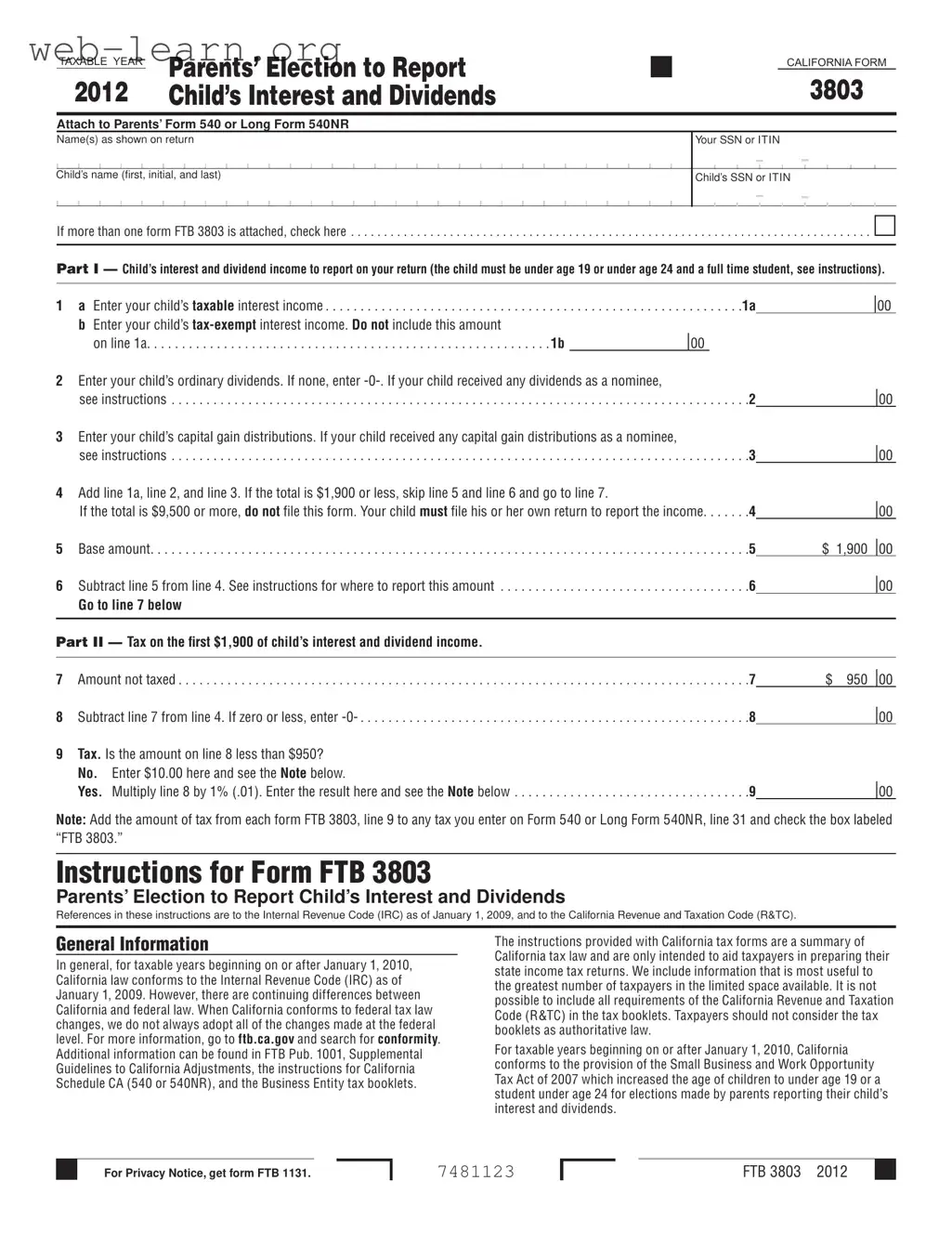
Homepage Blank California 3803 Form
Outline

The California Form 3803, also known as the Parents’ Election to Report Child’s Interest and Dividends, plays a crucial role for families managing their children's income tax responsibilities. This form allows parents to report their child's interest and dividend income on their own tax returns, simplifying the filing process for children under 19 or under 24 if they are full-time students. By completing this form, parents can elect to include their child's income, which must not exceed $9,500, thereby relieving the child from the obligation to file a separate return. The form requires parents to provide essential details, including the child's name and Social Security Number (SSN) or Individual Taxpayer Identification Number (ITIN), as well as the total amount of the child's taxable interest and dividends. Notably, if the child's total income is $1,900 or less, no tax is owed on that amount, making this form particularly beneficial for families with modest income. The tax implications are straightforward, as the form guides parents through calculating any additional tax owed based on the child's income. Understanding the nuances of this form can help families make informed decisions about their tax filings and optimize their financial responsibilities.


Sample - California 3803 Form

FTB 3803 2012
For Privacy Notice, get form FTB 1131.
7481123
1 a Enter your child’s taxable interest income ............................................................1a
|
00
b Enter your child’s tax-exempt interest income. Do not include this amount
on line 1a
..........................................................1b
|
00
2 Enter your child’s ordinary dividends. If none, enter -0-. If your child received any dividends as a nominee,
see instructions
...................................................................................2
|
00
3 Enter your child’s capital gain distributions. If your child received any capital gain distributions as a nominee,
see instructions
...................................................................................3
|
00
4 Add line 1a, line 2, and line 3. If the total is $1,900 or less, skip line 5 and line 6 and go to line 7.
If the total is $9,500 or more, do not
file this form. Your child must file his or her own return to report the income.......4
|
00
5 Base amount......................................................................................5 $ 1,900
|
00
6 Subtract line 5 from line 4. See instructions for where to report this amount ....................................6
|
00
Go to line 7 below
Part II — Tax on the first $1,900 of child’s interest and dividend income.
7 Amount not taxed ..................................................................................7 $ 950
|
00
8 Subtract line 7 from line 4. If zero or less, enter -0- ........................................................8
|
00
9 Tax. Is the amount on line 8 less than $950?
No. Enter $10.00 here and see the Note below.
Yes. Multiply line 8 by 1% (.01). Enter the result here and see the Note below ..................................9
|
00
Note: Add the amount of tax from each form FTB 3803, line 9 to any tax you enter on Form 5 40 or Long Form 5 40N R, line 31 and check the box labeled
“FTB 3803.”
Part I —
Child’s interest and dividend income to report on your return (the child must be under age 19 or under age 24 and a full time student, see instructions).
Parents’ Election to Report
Child’s Interest and Dividends
TAXABLE YEAR
2012
Attach to Parents’ Form 5 40 or Long Form 5 40 N R
CALIFORNIA FORM
3803
If more than one form FTB 3803 is attached, check here ...............................................................................
Your SSN or I T I N
Name(s) as shown on return
Child’s SSN or I
T I N
-
-
Child’s name (first, initial, and last)
-
-
Instructions for Form FTB 3803
Parents’ Election to Report Child’s Interest and Dividends
References in these instructions are to the Internal Revenue Code (IRC) as of January 1, 2009, and to the California Revenue and Taxation Code (R&TC).
The instructions provided with California tax forms are a summary of
California tax law and are only intended to aid taxpayers in preparing their
state income tax returns. We include information that is most useful to
the greatest number of taxpayers in the limited space available. It is not
possible to include all requirements of the California Revenue and Taxation
Code (R&TC) in the tax booklets. Taxpayers should not consider the tax
booklets as authoritative law.
For taxable years beginning on or after January 1, 2010, California
conforms to the provision of the Small Business and Work Opportunity
Tax Act of 2007 which increased the age of children to under age 19 or a
student under age 24 for elections made by parents reporting their child’s
interest and dividends.
General Information
In general, for taxable years beginning on or after January 1, 2010,
California law conforms to the Internal Revenue Code (IRC) as of
January 1, 2009. However, there are continuing differences between
California and federal law. When California conforms to federal tax law
changes, we do not always adopt all of the changes made at the federal
level. For more information, go to ftb.ca.gov and search for conformity.
Additional information can be found in FTB Pub. 1001, Supplemental
Guidelines to California Adjustments, the instructions for California
Schedule CA (540 or 540NR), and the Business Entity tax booklets.
Page 2 FTB 3803 2012
Registered Domestic Partners (R D P)
For purposes of California income tax, references to a spouse, husband,
or wife also refer to a California R D P, unless otherwise specied.
When we use the initials R D P they refer to both a California registered
domestic “partner” and a California registered domestic “partnership,”
as applicable. For more information on R D Ps, get FTB Pub. 7 37, Tax
Information for Registered Domestic Partners.
A Purpose
Parents may elect to report their child’s income on their California income
tax return by completing form FTB 3803, Parents’ Election to Report Child’s
Interest and Dividends. If you make this election, the child will not have to
file a return. You may report your child’s income on your California income
tax return even if you do not do so on your federal income tax return. You
may make this election if your child meets all of the following conditions:
Was under age 19 or a student under age 24 at the end of 2012. A child
born on January 1, 1994, is considered to be age 19 at the end of 2012.
A child born on January 1, 1989, is considered to be age 24 at the end of
2012.
Is required to file a 2012 income tax return.
Had income only from interest and dividends.
Had gross income for 2012 that was less than $9,500.
Made no estimated tax payments for 2012.
Did not have any overpayment of tax shown on his or her 2011 return
applied to the 2012 estimated taxes.
Had no state income tax withheld from his or her income (backup
withholding).
As a parent, you must also qualify as explained in Section B.
B Parents Who Qualify to Make the Election
You qualify to make this election if you file Form 5 40, California Resident
Income Tax Return, or Long Form 5 40N R, California Nonresident or Part-
Year Resident Income Tax Return, and if any of the following applies to you:
You and the child’s other parent were married to each other or in a
registered domestic partnership and you file a joint return for 2012.
You and the child’s other parent were married to each other or in a
registered domestic partnership but you file separate returns for 2012
AND you had the higher taxable income. If you do not know if you had
the higher taxable income, get federal Publication 9 29, Tax Rules for
Children and Dependents.
You were unmarried, treated as unmarried for state income tax purposes,
or separated from the child’s other parent by a divorce, separate
maintenance decree, or termination of a domestic partnership and you had
custody of your child for most of the year (you were the custodial parent).
If you were the custodial parent and you remarried or entered into another
registered domestic partnership, you may make the election on a joint
return with your new spouse/R D P (your child’s stepparent). But if you and
your new spouse/R D P do not file a joint return, you qualify to make the
election only if you had higher taxable income than your new spouse/R D P.
If you and the child’s other parent were not married or in a registered
domestic partnership but you lived together during the year with the child,
you qualify to make the election only if you are the parent with the higher
taxable income.
If you elect to report your child’s income on your return, you may not
reduce that income by any deductions that your child would be entitled to
claim on his or her own return, such as the penalty on early withdrawal
of child’s savings or any itemized deductions. For more information, get
the instructions for federal Form 8814, Parents’ Election to Report Child’s
Interest and Dividends.
C How to Make the Election
To make the election, complete and attach form FTB 3803 to your
Form 5 40 or Long Form 5 40N R and file your return by the due date
(including extensions).
File a separate form FTB 3803 for each child whose income you choose to
report.
Specific Line Instructions
Use Part I to figure the amount of the child’s income to report on your return.
Use Part II to figure any additional tax that must be added to your tax.
Name and Social Security Number (S S N) or Individual Taxpayer
Identification Number (I T I N). Enter your name as shown on your tax
return. If filing a joint return, include your spouse’s/R D P’s name but enter
the SSN or I T I N of the person whose name is shown first on the return.
For more information about interest, dividends, and capital gain
distributions taxable by California, get the instructions for Schedule C A
(5 40), California Adjustments — Residents, or Schedule C A (5 40N R),
California Adjustments — Nonresidents or Part-Year Residents.
Part I Child’s Interest and Dividend Income to
Report on Your Return
Line 1a
Enter all
interest income taxable by California and received by your child
in 2012. If, as a nominee, your child received interest that actually belongs
to another person, write the amount and the initials “N D” (for “nominee
distribution”) on the dotted line to the left of line 1a. Do not include amounts
received by your child as a nominee in the total entered on line 1a.
If your child received Form 10 99-I N T, Interest Income, showing California
tax-exempt interest or Form 10 99-O I D, Original Issue Discount, get the
instructions for federal Form 8814.
Line 1b
If your child received any interest income exempt from California tax, such
as interest on United States savings bonds or California municipal bonds,
enter the total tax-exempt interest on line 1b. Also include any exempt-
interest dividends your child received as a shareholder in a mutual fund
or other regulated investment company. Do not include this interest on
line 1a. Get the instructions for Schedule CA (5 40 or 5 40N R), line 8, for
more information.
Line 2
Enter ordinary dividends received by your child in 2012. Ordinary
dividends should be shown on Form 10 99-D I V, Dividends and
Distributions, box 1. Also, include ordinary dividends your child received
through a partnership, an S corporation, an estate, or trust.
If your child received, as a nominee, ordinary dividends that actually
belong to another person, enter the amount and the initials “N D” on the
dotted line to the left of line 2. Do not include amounts received as a
nominee in the total for line 2.
Line 3
Enter the capital gain distributions taxable by California and received by your
child in 2012. Capital gain distributions should be shown on Form 10 99-D I V,
box 2a. Also, see the instructions for line 6. If your child received, as a
nominee, capital gain distributions that actually belong to another person,
enter the amount and the initials “N D” on the dotted line to the left of line 3.
Do not include amounts received as a nominee in the total for line 3.
Line 6
If the total amount on line 6 of all form(s) FTB 3803 is less than the total
amount on line 6 of all your federal Form(s) 88 14, enter the difference on
Schedule CA (5 40 or 5 40N R), line 21f, column B and write “FTB 3803” on
line 21f.
If the total amount on line 6 of all form(s) FTB 3803 is more than the total
amount on line 6 of all your federal Form(s) 8814, enter the difference on
Schedule CA (5 40 or 5 40N R), line 21f, column C and write “FTB 3803” on
line 21f.
If you did not file federal Form 8814, enter the amount from form
FTB 3803, line 6, on Schedule CA (540 or 540NR), line 21f, column C and
write “FTB 3803” on line 21f.
If your child received capital gain distributions (shown on Form 10 99-D I V,
box 2a and box 2b) and you have other gains or losses to report on your
Schedule D, California Capital Gain or Loss Adjustment, you must report
part or all of your child’s capital gain distributions on your Schedule D
instead of on form FTB 3803, line 6. Get federal Publication 9 29 for more
information on how to figure the amount to report on your Schedule D.
Part II Tax on the First $1,900 of Child’s Interest
and Dividend Income
Line 9
Add the amount of tax from each form FTB 3803, line 9 to any tax you
enter on Form 5 40 or Long Form 5 40N R, line 31 and check the box labeled
FTB 3803.”

Form Information

Fact Name Details
Purpose of Form The California Form 3803 allows parents to report their child's interest and dividend income on their own tax returns, preventing the child from needing to file separately.
Eligibility Criteria To use this form, the child must be under age 19 or under age 24 if a full-time student, and their income must come solely from interest and dividends with a total gross income below $9,500.
Governing Laws This form is governed by the California Revenue and Taxation Code (R&TC) and conforms to the Internal Revenue Code (IRC) as of January 1, 2009.
Filing Requirements Form 3803 must be attached to either Form 540 or Long Form 540NR when filed, and a separate form is required for each child whose income is being reported.

Detailed Guide for Filling Out California 3803

Filling out the California 3803 form involves several steps to ensure accurate reporting of your child's interest and dividends on your tax return. Follow these instructions carefully to complete the form correctly.

  1. Gather necessary information: Collect your child's name, Social Security Number (SSN) or Individual Taxpayer Identification Number (ITIN), and your own SSN or ITIN.
  2. Complete the top section: Enter your name(s) as shown on your tax return, followed by your child's name and their SSN or ITIN.
  3. If applicable, check the box if you are attaching more than one FTB 3803 form.
  4. Move to Part I: Enter your child's taxable interest income on line 1a. If your child has tax-exempt interest income, enter that amount on line 1b.
  5. On line 2, input your child's ordinary dividends. If your child received dividends as a nominee, refer to the instructions for guidance.
  6. For line 3, enter your child's capital gain distributions, again noting any nominee distributions as instructed.
  7. Add the amounts from lines 1a, 2, and 3 together. Enter the total on line 4. If this total is $1,900 or less, skip to line 7. If it's $9,500 or more, your child must file their own return.
  8. If applicable, enter the base amount on line 5. Subtract line 5 from line 4 and enter the result on line 6.
  9. Proceed to Part II: Enter the amount not taxed on line 7. Subtract line 7 from line 4 and enter that result on line 8.
  10. For line 9, determine the tax based on the amount on line 8. If it’s less than $950, multiply by 1% and enter the result. If it’s $950 or more, enter $10.
  11. Finally, ensure all entries are correct and attach the completed form FTB 3803 to your Form 540 or Long Form 540NR when filing your tax return.

Obtain Answers on California 3803

  1. What is California Form 3803?

    California Form 3803, also known as the Parents' Election to Report Child's Interest and Dividends, allows parents to report their child's interest and dividend income on their own tax return. This form is useful for parents who wish to avoid having their child file a separate tax return if the child's income falls below certain thresholds.

  2. Who qualifies to use Form 3803?

    To use Form 3803, the child must be under age 19, or under age 24 if a full-time student. The child must also have income solely from interest and dividends, with gross income below $9,500. Additionally, the parents must meet specific criteria regarding their filing status and income level.

  3. How do I complete Form 3803?

    To complete Form 3803, you need to provide your name, your child's name, and their Social Security Number (SSN) or Individual Taxpayer Identification Number (ITIN). You will enter the child's taxable interest income, tax-exempt interest income, ordinary dividends, and capital gain distributions. The form will guide you through calculating the total income and any tax owed.

  4. What happens if my child's total income is $1,900 or less?

    If the total income reported on Form 3803 is $1,900 or less, you can skip certain lines related to additional tax calculations. This simplifies the process, as you will not owe any tax on that income. However, if the total is $9,500 or more, the child must file their own tax return.

  5. Can I use Form 3803 if I filed a federal return differently?

    Yes, you can elect to report your child's income on your California return even if you did not do so on your federal return. California allows this election as long as you meet the qualifications outlined in the form's instructions.

  6. What if I have more than one child?

    If you have more than one child whose income you wish to report, you must complete a separate Form 3803 for each child. Attach each form to your Form 540 or Long Form 540NR when you file your tax return.

  7. How do I file Form 3803?

    To file Form 3803, complete the form and attach it to your Form 540 or Long Form 540NR. Ensure that you file your return by the due date, including any extensions. Be sure to check the box labeled “FTB 3803” on your tax return to indicate that you are reporting your child's income.

Common mistakes

When filling out the California 3803 form, many individuals make common mistakes that can lead to complications in their tax filings. One frequent error is failing to accurately report the child’s Social Security Number (SSN) or Individual Taxpayer Identification Number (ITIN). The form requires this information to be correct and consistent with the child’s tax records. Omitting or misentering this number can delay processing and cause issues with the IRS.

Another mistake is not understanding the eligibility criteria for reporting the child’s income. Parents must ensure that the child is under age 19 or a full-time student under age 24. If the child does not meet these criteria, the election to report the child's income cannot be made. This oversight can result in the need for the child to file their own tax return, which may incur additional taxes or penalties.

Many people also overlook the requirement to separate taxable and tax-exempt income. Line 1a of the form specifically asks for taxable interest income, while line 1b is for tax-exempt interest. Confusing these lines can lead to incorrect calculations and potential issues with tax liability. It is crucial to read the instructions carefully to ensure that each type of income is reported accurately.

In addition, some filers fail to check the box indicating that more than one form FTB 3803 is attached if applicable. This can create confusion for tax authorities and may lead to delays in processing the tax return. Properly indicating the number of forms attached helps ensure that all relevant information is considered during processing.

Lastly, individuals often neglect to follow the specific instructions for calculating the tax on the child’s income. The form includes distinct lines for different calculations, and miscalculating these figures can result in incorrect tax amounts being reported. It is essential to carefully follow the steps outlined in the instructions to avoid errors that could affect the overall tax return.

Documents used along the form

The California Form 3803 is essential for parents electing to report their child's interest and dividends on their tax returns. Several other forms and documents are often used in conjunction with this form. Below is a list of these documents, each serving a specific purpose in the tax filing process.

  • Form 540: This is the California Resident Income Tax Return. Parents use it to report their income and claim deductions and credits. It is the primary form for California residents.
  • Form 540NR: The California Nonresident or Part-Year Resident Income Tax Return. This form is for individuals who do not qualify as full-year residents of California but have income from California sources.
  • Form 8814: Parents’ Election to Report Child’s Interest and Dividends (Federal). This federal form allows parents to report their child's income on their tax return, similar to the California 3803.
  • Form 1099-INT: This form reports interest income earned by the child. It is crucial for accurately reporting the child's taxable interest on Form 3803.
  • Form 1099-DIV: This form is used to report dividends received by the child. It helps parents determine the amount of ordinary dividends to report on Form 3803.
  • Schedule CA (540): California Adjustments. This schedule is used to report adjustments to income and deductions, which may be necessary when filing Form 540.
  • Schedule CA (540NR): Similar to Schedule CA (540), this form is for nonresidents or part-year residents to report adjustments to income and deductions.
  • FTB Publication 1001: Supplemental Guidelines to California Adjustments. This publication provides additional information on adjustments that may affect the tax return.
  • FTB Publication 737: Tax Information for Registered Domestic Partners. This publication offers guidance for registered domestic partners regarding tax obligations in California.

Utilizing these forms and publications can streamline the tax filing process and ensure compliance with California tax laws. It is essential to gather all necessary documents before filing to avoid delays and potential issues with the tax authorities.

Similar forms

The California Form 3803, which allows parents to report their child's interest and dividends on their tax returns, shares similarities with several other tax documents. Here’s a breakdown of eight forms that are akin to the California 3803 form, along with a brief explanation of how they are similar:

  • Form 8814 - This federal form allows parents to report their child's interest and dividends on their tax return. Like the 3803, it provides a method for parents to include their child's income without requiring the child to file a separate return.
  • Form 1040 - The standard individual income tax return used in the U.S. Both the 1040 and 3803 are used to report income, but the 3803 specifically pertains to a child's income that parents elect to report.
  • Form 540 - This is the California Resident Income Tax Return. Similar to the 3803, it is used by California residents to report income, including any child income reported on the 3803.
  • Form 540NR - The California Nonresident or Part-Year Resident Income Tax Return. Like the 3803, it accommodates specific situations for individuals who may not be full-time residents, including reporting child income.
  • Schedule CA (540) - This form is used to make adjustments to income reported on the California tax return. The 3803's income can affect calculations on Schedule CA, showing how both forms interact within the tax filing process.
  • Form 1099-INT - This form reports interest income. The 3803 requires information from 1099-INT to determine the child's taxable interest income, making them closely related in terms of reporting income.
  • Form 1099-DIV - This document reports dividends and distributions. Similar to the 3803, it provides essential information needed to calculate the child's dividend income for tax purposes.
  • Form 8960 - This is the Net Investment Income Tax form. While it serves a different purpose, it also deals with investment income, similar to how the 3803 focuses on interest and dividends from investments held by a child.

Dos and Don'ts

When filling out the California 3803 form, it is essential to be thorough and accurate. Here are some guidelines to follow, as well as common pitfalls to avoid.

  • Do ensure that you qualify to report your child's income by meeting the necessary criteria outlined in the form instructions.
  • Do use the correct year for the tax return. Ensure you are filling out the form for the correct taxable year.
  • Do accurately report all income by including all taxable interest, ordinary dividends, and capital gain distributions received by your child.
  • Do check for nominee distributions and mark them appropriately with “ND” to avoid reporting errors.
  • Do file the form on time by attaching it to your Form 540 or Long Form 540NR before the due date.
  • Don't leave any fields blank unless instructed to do so. Every section must be completed as required.
  • Don't forget to include your child’s SSN or ITIN as well as your own. This information is crucial for processing.
  • Don't mix up tax-exempt and taxable income. Report tax-exempt interest separately and do not include it in the taxable income total.
  • Don't assume you can claim deductions that your child would be entitled to if they filed their own return. This can lead to inaccuracies.

By adhering to these guidelines, parents can ensure that they accurately report their child's interest and dividend income, simplifying the tax filing process for both themselves and their child.

Misconceptions

Understanding the California Form 3803 can be challenging, and there are several misconceptions that can lead to confusion. Here are five common misunderstandings about this form:

  • Misconception 1: Only children under 18 can have their income reported by parents.
  • In fact, parents can report their child's income if the child is under age 19 or under age 24 and a full-time student. This flexibility allows more families to take advantage of the form.

  • Misconception 2: The form is only for children with a specific type of income.
  • Some believe that the form is limited to interest income. However, it applies to both interest and dividends, including capital gain distributions. Parents can report a variety of income types using this form.

  • Misconception 3: If a child earns more than $1,900, parents cannot use the form.
  • While it is true that if the child's total income exceeds $9,500, they must file their own return, parents can still use Form 3803 if the income is $1,900 or less. This threshold is crucial for determining eligibility.

  • Misconception 4: Parents must report the child's income on both state and federal returns.
  • Parents may choose to report their child's income on their California state tax return without having to do the same on their federal return. This option provides flexibility based on individual tax situations.

  • Misconception 5: Filing Form 3803 means parents can claim deductions related to the child's income.
  • It is a common belief that parents can reduce the reported income by claiming deductions. However, any deductions that the child would have claimed on their own return cannot be used when filing Form 3803.

Key takeaways

  • The California 3803 form allows parents to report their child's interest and dividend income on their tax return.

  • This election is available for children under age 19 or under age 24 if they are full-time students.

  • To qualify, the child must have income solely from interest and dividends, and their gross income must be less than $9,500.

  • Parents must file either Form 540 or Long Form 540NR to use this election.

  • Each child requires a separate California 3803 form if parents choose to report multiple children’s income.

  • Part I of the form is used to calculate the child’s total interest and dividend income.

  • Part II determines any additional tax owed on the first $1,900 of the child’s income.

  • It is important to file the form by the due date of the tax return, including any extensions.