Homepage Blank California 3540 Form
Outline

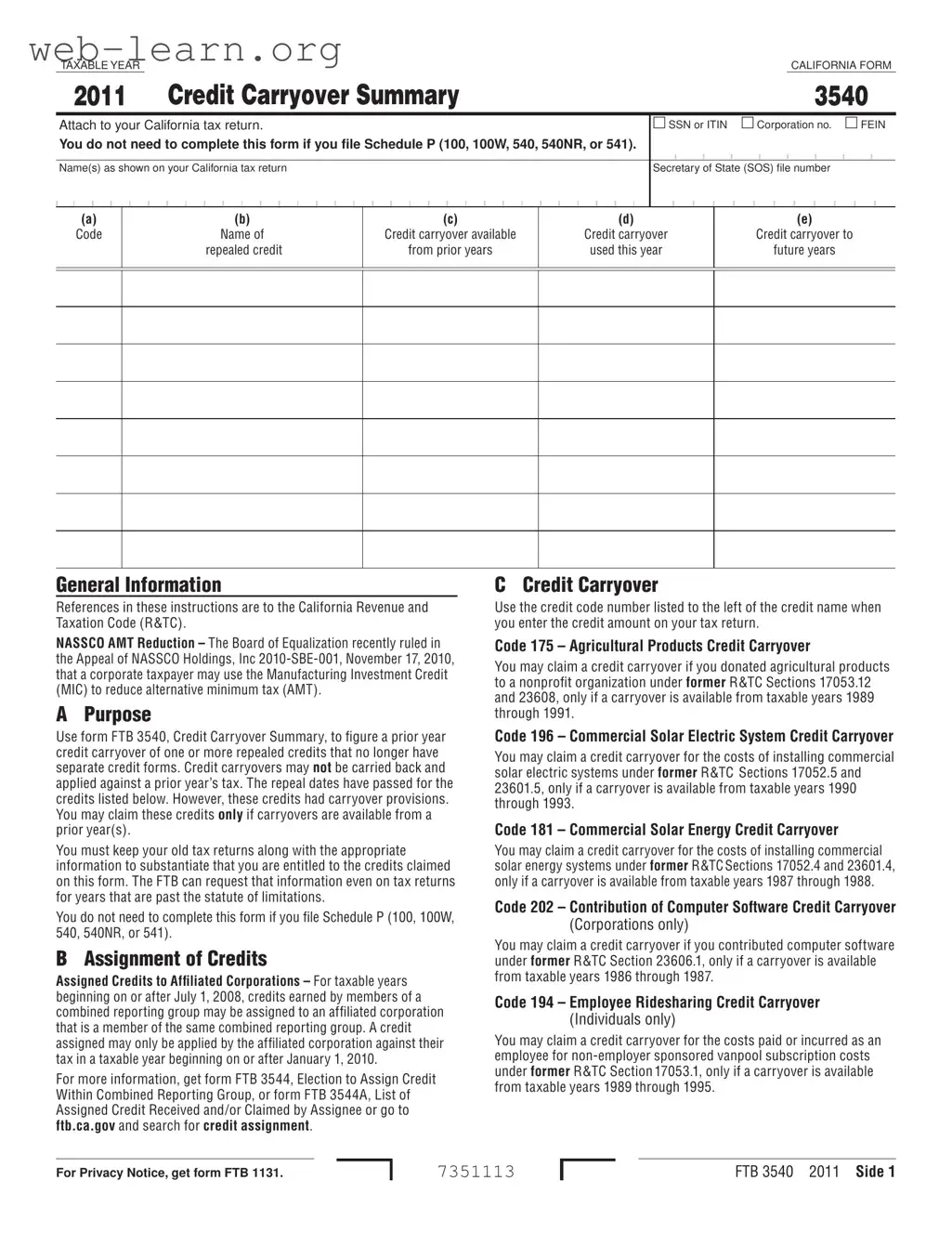
The California Form 3540, known as the Credit Carryover Summary, plays an important role for taxpayers who have credits from previous years that can still be utilized. This form is necessary for those who want to calculate and report any carryover of repealed tax credits that no longer have separate forms. Taxpayers must attach this form to their California tax return if they have available credit carryovers from prior years. The form requires specific information, including the taxpayer's identification number, the name of the credit, and the amounts available for carryover, used, and to be carried over to future years. Notably, the form is not required if taxpayers file certain schedules, such as Schedule P. Various types of credits are listed, including those related to energy conservation, ridesharing programs, and agricultural donations, each with its own set of limitations and eligibility criteria. Understanding how to properly complete this form is crucial for maximizing potential tax benefits while ensuring compliance with California tax regulations.

Sample - California 3540 Form

FTB 3540 2011 Side 1For Privacy Notice, get form FTB 1131. 7351113
General Information
References in these instructions are to the California Revenue and
Taxation Code (R&TC).
NASSCO AMT Reduction – The Board of Equalization recently ruled in
the Appeal of NASSCO Holdings, Inc 2010-SBE-001, November 17, 2010,
that a corporate taxpayer may use the Manufacturing Investment Credit
(MIC) to reduce alternative minimum tax (AMT).
A Purpose
Use form FTB 3540, Credit Carryover Summary, to figure a prior year
credit carryover of one or more repealed credits that no longer have
separate credit forms. Credit carryovers may not be carried back and
applied against a prior year’s tax. The repeal dates have passed for the
credits listed below. However, these credits had carryover provisions.
You may claim these credits only if carryovers are available from a
prior year(s).
You must keep your old tax returns along with the appropriate
information to substantiate that you are entitled to the credits claimed
on this form. The FTB can request that information even on tax returns
for years that are past the statute of limitations.
You do not need to complete this form if you file Schedule P (100, 100W,
540, 540NR, or 541).
B Assignment of Credits
Assigned Credits to Affiliated Corporations – For taxable years
beginning on or after July 1, 2008, credits earned by members of a
combined reporting group may be assigned to an affiliated corporation
that is a member of the same combined reporting group. A credit
assigned may only be applied by the affiliated corporation against their
tax in a taxable year beginning on or after January 1, 2010.
For more information, get form FTB 3544, Election to Assign Credit
Within Combined Reporting Group, or form FTB 3544A, List of
Assigned Credit Received and/or Claimed by Assignee or go to
ftb.ca.gov and search for credit assignment.
C Credit Carryover
Use the credit code number listed to the left of the credit name when
you enter the credit amount on your tax return.
Code 175 – Agricultural Products Credit Carryover
You may claim a credit carryover if you donated agricultural products
to a nonprofit organization under former R&TC Sections 17053.12
and 23608, only if a carryover is available from taxable years 1989
through 1991.
Code 196 – Commercial Solar Electric System Credit Carryover
You may claim a credit carryover for the costs of installing commercial
solar electric systems under former
R&TC Sections 17052.5 and
23601.5, only if a carryover is available from taxable years 1990
through 1993.
Code 181 – Commercial Solar Energy Credit Carryover
You may claim a credit carryover for the costs of installing commercial
solar energy systems under former
R&TC Sections 17052.4 and 23601.4,
only if a carryover is available from taxable years 1987 through 1988.
Code 202 – Contribution of Computer Software Credit Carryover
(Corporations only)
You may claim a credit carryover if you contributed computer software
under former R&TC Section 23606.1, only if a carryover is available
from taxable years 1986 through 1987.
Code 194 – Employee Ridesharing Credit Carryover
(Individuals only)
You may claim a credit carryover for the costs paid or incurred as an
employee for non-employer sponsored vanpool subscription costs
under former
R&TC Section 17053.1, only if a carryover is available
from taxable years 1989 through 1995.
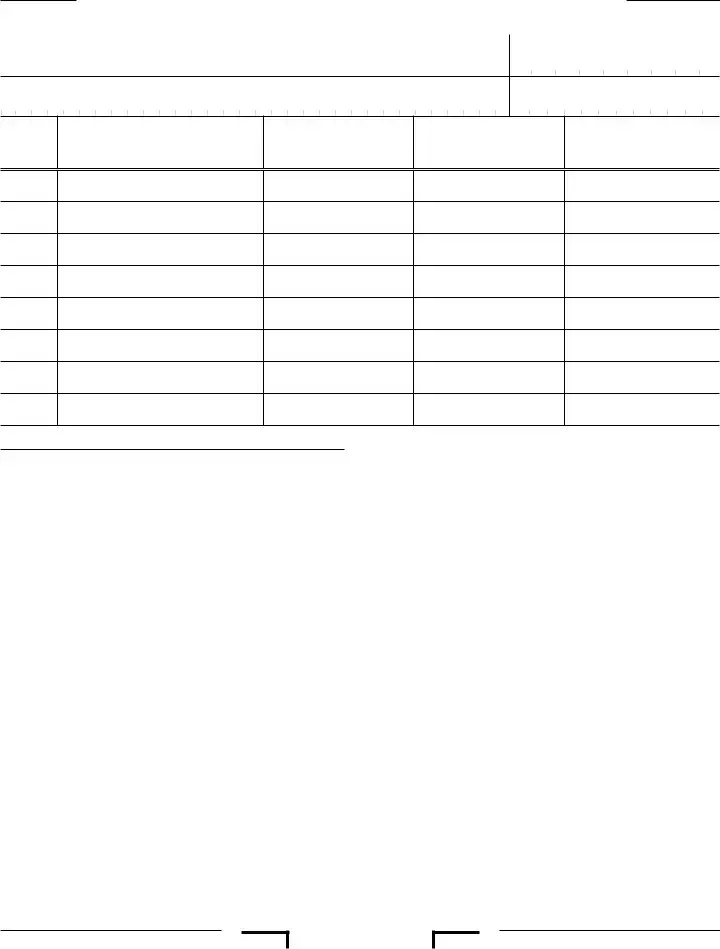
Credit Carryover Summary
TAXABLE YEAR
2011
CALIFORNIA FORM
3540
Attach to your California tax return.
You do not need to complete this form if you file Schedule P (100, 100W, 540, 540NR, or 541).
SSN or ITIN Corporation no. FEIN
Name(s) as shown on your California tax return Secretary of State (SOS) file number
(a)
Code
(b)
Name of
repealed credit
(c)
Credit carryover available
from prior years
(d)
Credit carryover
used this year
(e)
Credit carryover to
future years
Side 2 FTB 3540 Instructions 2011
Code 191 – Employer Ridesharing Credit Carryover (Large)
You may claim a credit carryover for the cost of sponsoring a ridesharing
program for your employees or for operating a private, third-party
ridesharing program under former R&TC Sections 17053 and 23605,
only if a carryover is available from taxable years 1989 through 1995.
Use Code 191 if, in the year(s) in which the credit was generated, your
available credit was computed using the Large Employer Program
because you were an employer with 200 or more employees.
Code 192 – Employer Ridesharing Credit Carryover (Small)
You may claim a credit carryover for the cost of sponsoring a
ridesharing program for your employees or for operating a private,
third-party ridesharing program under former R&TC Sections 17053
and 23605, only if a carryover is available from taxable years 1989
through 1995.
Use Code 192 if, in the year(s) in which the credit was generated, your
available credit was computed using the Small Employer Program
because you were an employer with fewer than 200 employees.
Code 193 – Employer Ridesharing Credit Carryover
(Transit Passes)
You may claim a credit carryover for the costs paid or incurred for
providing subsidized public transit passes to your employees under
former R&TC Sections 17053 and 23605, only if a carryover is
available from taxable years 1989 through 1995.
Code 182 – Energy Conservation Credit Carryover
You may claim a credit carryover for the costs of installing energy
conservation measures under former
R&TC Sections 17052.4,
17052.8, and 23601.5, only if a carryover is available from taxable
years 1981 through 1986.
Code 207 – Farmworker Housing Credit Carryover – Construction
You may claim a credit carryover for the eligible costs to construct
or rehabilitate qualified farmworker housing under former R&TC
Sections 17053.14 and 23608.2 only if a carryover is available from
taxable years 1997 through 2008.
Code 215 – Joint Strike Fighter Credit Carryover — Wages
You may claim a credit carryover for the percentage of qualified
wages paid or incurred for qualified employees under former R&TC
Sections 17053.36 and 23636, only if the carryover is available from
taxable years 2001 through 2005.
Limitation: The credit may be carried forward for up to eight years
from the year in which the credit was incurred, or until exhausted,
whichever occurs first.
Code 216 – Joint Strike Fighter Credit Carryover — Property Costs
You may claim a credit carryover for the qualified cost to manufacture
qualied property placed in service in California under former
R&TC Sections 17053.37 and 23637, only if the carryover is available
from taxable years 2001 through 2005.
Limitation: The credit may be carried forward for up to eight years
from the year in which the credit was incurred, or until exhausted,
whichever occurs first.
Code 159 – Los Angeles Revitalization Zone (LARZ) Hiring
Credit Carryover & Sales or Use Tax Credit
Carryover
You may claim a credit carryover for the following:
Qualified wages paid to qualified employees under former
R&TC Sections 17053.10, 17053.17, 23623.5, and 23625, only if a
carryover is available from taxable years 1992 through 1997.
Sales or use tax paid or incurred on qualified property under former
R&TC Sections 17052.15 and 23612.6, only if a carryover is available
from taxable years 1992 through 1997.
The amount of credit carryover you may claim for the LARZ hiring
credit and LARZ sales or use tax credit is limited by the amount of
tax on business income attributable to the former LARZ. Get form
FTB 3806, Los Angeles Revitalization Zone Business Booklet, to
determine the amount of credit carryover you may claim.
Code 160 – Low-Emission Vehicles Credit Carryover
You may claim a credit carryover for the amount that was authorized
by the CA Energy Commission under former R&TC Sections 17052.11
and 23603, only if a carryover is available from taxable years 1991
through 1995.
Code 199 – Manufacturers’ Investment Credit (MIC)
You may claim a credit carryover for the qualified costs paid or incurred
for acquiring, constructing, or reconstructing qualied properties under
Cal. Code Regs., tit. 18, sections 17053.49-0 through 17053.49-11 and
sections 23649-0 through 23649-11, only if a carryover is available
from taxable years 1994 through 2003.
Limitation: The credit may generally be carried over for a maximum
of eight years. However, if the qualied taxpayer met the definition of a
small business as of the last day of the taxable year in the year the credit
was allowed, then the credit may be carried over for ten years.
Even though the cost to construct or acquire the property may have
been paid or incurred during 2003 or prior years, if the property was
not placed in service before January 1, 2004, none of those costs are
qualied costs for the credit.
Code 185 – Orphan Drug Credit Carryover
You may claim a credit carryover for expenses related to qualied
clinical testing under former
R&TC Sections 17057 and 23609.5, only
if a carryover is available from taxable years 1987 through 1992.
Code 184 – Political Contributions Credit Carryover
(Individuals only)
You may claim a credit carryover for political contributions you made
prior to January 1, 1992, under former R&TC Section 17053.14, only if
a carryover is available from taxable years 1987 through 1991.
The political contribution credit was the smaller of one of the following:
25% (.25) of the amount contributed.
$50 ($25 for married filing separately and single).
Code 174 – Recycling Equipment Credit Carryover
You may claim a credit carryover for the purchase of qualified
recycling equipment, which was certified by the California Integrated
Waste Management Board, under former
R&TC Sections 17052.14
and 23612.5, only if a carryover is available from taxable years 1989
through 1993.
Code 186 – Residential Rental and Farm Sales Credit
Carryover (Individuals Only)
You may claim a credit carryover if you had a gain from the
sale of residential rental or farm property under former R&TC
Section 17061.5, only if a carryover is available from taxable years
1987 through 1991.
Code 206 – Rice Straw Credit Carryover
You may claim a credit carryover for the purchase of rice straw grown
in California under former R&TC Sections 17052.10 and 23610, only if
a carryover is available from taxable years 1997 through 2007.
Limitation: The credit may be carried forward for up to ten years
from the year in which the credit was incurred, or until exhausted,
whichever occurs first.
FTB 3540 Instructions 2011 Page 3
Code 171 – Ridesharing Credit Carryover (Pre-1989)
You may claim a credit carryover for the cost of sponsoring a
ridesharing program for your employees, or for operating a private,
third-party ridesharing program under former R&TC Sections 17053,
and 23605, only if a carryover is available from taxable years 1981
through 1986.
Use Code 171 only for employer ridesharing credit carryovers from
pre-1989 taxable years. If you are claiming a credit carryover from
the employer ridesharing vehicle credit available in taxable years 1989
through 1995, see codes 191 through 193 to determine which code to
use.
Code 200 – Salmon and Steelhead Trout Habitat Restoration
You may claim a credit carryover for the cost associated with salmon
and steelhead trout habitat restoration and improvement projects
under former R&TC Sections 17053.66 and 23666, only if a carryover
is available from taxable years 1995 through 1999.
The credit amount is the lesser of 10% of qualified costs, or other
amounts determined by the California Department of Fish and Game.
Code 180 – Solar Energy Credit Carryover
You may claim a credit carryover for the costs of installing solar
energy systems under former
R&TC Sections 17052.5 and 23601, only
if a carryover is available from taxable years 1985 through 1988.
Code 179 – Solar Pump Credit Carryover
You may claim a credit carryover for the cost of installing a solar pump
system under former R&TC Sections 17052.1, 17052.4, 17052.8,
and 23607, only if a carryover is available from taxable years 1981
through 1983.
Code 217 – Solar or Wind Energy System Credit Carryover
You may claim a credit carryover for the purchase and installation
costs of a solar energy or wind energy system installed on California
property under former R&TC Sections 17053.84 and 23684, from
taxable years 2001 through 2005.
Limitation: The credit may be carried forward for up to eight years
from the year in which the credit was incurred, or until exhausted,
whichever occurs first.
Code 201 – Technological Property Contribution Credit
Carryover (Corporations only)
You may claim a credit carryover if you contributed technological
property under former R&TC Section 23606, only if a carryover is
available from taxable years 1983 through 1984.
Code 178 – Water Conservation Credit Carryover
(Individuals, Estates, and Trusts only)
You may claim a credit carryover for the costs of installing water
conservation measures under former
R&TC Section 17052.8, only if a
carryover is available from taxable years 1980 through 1982.
Code 161 – Young Infant Credit Carryover (Individuals Only)
You may claim a credit carryover for a dependent under 13 months
of age under former R&TC Section 17052.20, only if a carryover is
available from taxable years 1991 through 1993.
D Limitations
In general, a credit carryover cannot reduce the minimum franchise
tax (corporations and S corporations) and the annual tax (limited
partnerships, limited liability companies (LLCs) classied as
partnerships, limited liability partnerships), the alternative minimum
tax (corporations, exempt organizations, individuals, and fiduciaries),
the built-in gains tax (S corporations), or the excess net passive
income tax (S corporations).
Alternative Minimum Tax (AMT) may be reduced by the following
credit carryovers: solar energy credit, commercial solar energy credit
and the manufacturing investment credit (MIC). However, the MIC
carryover may only reduce the alternative minimum tax (AMT) for
corporations. Get Schedule P (100, 100W, 540, 540NR, or 541).
If the available credit carryover for the current taxable year exceeds
the current year tax, any unused amount may be carried over to
succeeding years unless the credit carryover period has expired. Apply
the carryover to the earliest taxable year(s) possible.
In no event can a credit carryover be carried back and applied against
a prior year’s tax.
Single Member LLCs (SMLLC)
If a taxpayer owns an interest in a disregarded business entity [a
single member limited liability company (SMLLC) not recognized
by California, and for tax purposes treated as a sole proprietorship
owned by an individual or a branch owned by a corporation], the credit
amount received from the disregarded entity that can be utilized is
limited to the difference between the taxpayer’s regular tax figured
with the income of the disregarded entity, and the taxpayer’s regular
tax figured without the income of the disregarded entity.
An SMLLC may be disregarded as an entity separate from its owner,
and is subject to statutory provisions that recognize otherwise
disregarded entities for certain tax purposes. Get Form 568, Limited
Liability Company Income Tax Booklet.
If the disregarded entity reports a loss, the taxpayer may not claim the
credit this year, but can carry over the credit amount received from the
disregarded entity.
Specific Column Instructions
Column (a) – Enter the code number from the instructions for the
carryover credit(s) you are eligible to claim.
Column (b) – Enter the name of repealed credit from the instructions for
the carryover credit(s) you are eligible to claim.
Column (c) Enter the amount of credit carryover available from prior
years. This amount is on the prior year credit form or statement that you
attached to your previous year’s tax return. This amount may also be
on the prior year Schedule P (100, 100W, 540, 540NR, or 541), under
Credit Carryover, column (d).
Column (d) – Enter the amount of credit carryover claimed on your
current year tax return. The credit carryover amount you can claim on
your tax return may be limited by tentative minimum tax or your tax
liability. Refer to the credit instructions in your tax booklet to determine
the amount of credit carryover you can claim and for information on
claiming the credit carryover on your tax return. Also see General
Information D, Limitations.
Column (e) – Subtract the amount in column (d) from the amount in
column (c). Enter the result in column (e). This is the amount of credit
that can be carried over to future years. To see if the credit is limited, see
General Information D, Limitations.

Form Information

Fact Name Fact Details
Form Purpose The California Form 3540 is used to summarize credit carryovers from prior years for certain repealed tax credits.
Governing Law This form is governed by the California Revenue and Taxation Code (R&TC).
Eligibility Taxpayers must have carryovers available from prior years to claim credits on this form.
Filing Requirement Taxpayers do not need to complete this form if they file Schedule P (100, 100W, 540, 540NR, or 541).
Credit Assignment Credits earned by members of a combined reporting group may be assigned to affiliated corporations starting from taxable years after July 1, 2008.
Credit Limitations Generally, credit carryovers cannot reduce the minimum franchise tax or alternative minimum tax, with specific exceptions for certain credits.

Detailed Guide for Filling Out California 3540

Completing the California 3540 form is an important step for those looking to summarize their credit carryovers. This form must be attached to your California tax return. Ensure you have all necessary information at hand before you begin filling it out. The following steps will guide you through the process.

  1. Begin by identifying the taxable year for which you are filing the form.
  2. In the designated area, enter your Social Security Number (SSN) or Individual Taxpayer Identification Number (ITIN), or the corporation number and Federal Employer Identification Number (FEIN) if applicable.
  3. Provide the name(s) as shown on your California tax return.
  4. Input your Secretary of State (SOS) file number in the appropriate field.
  5. In Column (a), enter the code number corresponding to the credit carryover you are eligible to claim.
  6. In Column (b), write the name of the repealed credit that corresponds with the code number you entered in the previous step.
  7. For Column (c), enter the amount of credit carryover available from prior years. You can find this amount on the prior year’s credit form or statement attached to your previous tax return.
  8. In Column (d), indicate the amount of credit carryover you are claiming on your current year tax return. Make sure this amount is consistent with the limitations outlined in your tax booklet.
  9. Calculate the amount for Column (e) by subtracting the amount in Column (d) from the amount in Column (c). Enter this result in Column (e). This represents the credit that can be carried over to future years.
  10. Review all entries for accuracy before submitting the form with your tax return.

Obtain Answers on California 3540

  1. What is the purpose of the California Form 3540?

    The California Form 3540, also known as the Credit Carryover Summary, is used to report and calculate the carryover of certain tax credits that have been repealed. These credits may no longer have separate forms, but taxpayers can still utilize any remaining credits from prior years. The form helps ensure that eligible taxpayers can claim these credits on their current tax returns, provided they have carryovers available from previous years.

  2. Who needs to complete Form 3540?

    Not every taxpayer needs to fill out Form 3540. If you file Schedule P (100, 100W, 540, 540NR, or 541), you do not need to complete this form. However, if you have carryover credits from prior years that are eligible for use, and you are not filing the aforementioned schedules, then you should complete Form 3540 to claim those credits.

  3. What types of credits can be reported on Form 3540?

    Form 3540 allows taxpayers to report various types of repealed credits, including but not limited to:

    • Agricultural Products Credit Carryover
    • Commercial Solar Electric System Credit Carryover
    • Employer Ridesharing Credit Carryover
    • Low-Emission Vehicles Credit Carryover

    Each credit has specific eligibility requirements and carryover periods, so it is essential to refer to the instructions for the exact details related to each credit.

  4. Are there any limitations on the credits carried over?

    Yes, there are limitations regarding how credits can be applied. Generally, a credit carryover cannot reduce certain taxes, such as the minimum franchise tax or alternative minimum tax (AMT). Additionally, if the available credit carryover exceeds your current tax liability, any unused amount can be carried over to future years, but only until the carryover period expires. It is crucial to apply the carryover to the earliest taxable years possible to maximize its benefits.

Common mistakes

Filling out the California Form 3540 can be a daunting task, and many individuals make critical mistakes that can lead to complications. One common error is failing to provide the correct identification numbers. It is essential to include your Social Security Number (SSN) or Individual Taxpayer Identification Number (ITIN), along with any relevant corporation numbers. Missing this information can delay the processing of your tax return.

Another mistake is neglecting to check the eligibility requirements for the credits being claimed. Each credit has specific rules regarding carryover from prior years. Individuals often assume they qualify without verifying the necessary conditions. This oversight can result in denied credits and potential penalties.

Many filers also struggle with accurately calculating the credit carryover amounts. Column (c) requires the carryover available from prior years, while column (d) is for the amount claimed this year. Miscalculating these figures can lead to incorrect reporting, which may attract scrutiny from tax authorities.

Additionally, failing to maintain proper documentation is a significant pitfall. The Franchise Tax Board (FTB) may request substantiating information even for past tax returns. Without the necessary records, taxpayers may find it challenging to defend their claims.

Some individuals mistakenly believe that they can carry back credits to offset previous years' taxes. This is not allowed. Understanding that credits can only be carried forward is crucial to avoid confusion and ensure compliance.

Using the wrong credit code is another frequent error. Each credit has a specific code that must be entered correctly in column (a). Incorrect coding can lead to delays in processing or even denial of the credit.

Another common issue arises when taxpayers do not apply credits to the earliest taxable years possible. This can limit the benefits of the credit and may result in lost opportunities for tax savings.

Moreover, some filers overlook the limitations imposed on certain credits. For example, credits cannot reduce the minimum franchise tax or alternative minimum tax for corporations. Ignoring these limitations can lead to unexpected tax liabilities.

Finally, failing to review the instructions thoroughly can lead to misunderstandings about the form's requirements. Each section of the form has specific instructions that must be followed closely. Skipping this step can result in incomplete or incorrect submissions.

In summary, taking the time to carefully fill out the California Form 3540 is essential. Avoiding these common mistakes can save taxpayers from complications and ensure they receive the credits they are entitled to.

Documents used along the form

The California Form 3540 is an essential document for taxpayers looking to report credit carryovers from prior years. Along with this form, several other documents may be required or beneficial for a complete and accurate tax filing. Below is a list of forms and documents that are often used in conjunction with the California 3540 form, along with brief descriptions of each.

  • FTB 3544: Election to Assign Credit Within Combined Reporting Group - This form allows taxpayers to assign credits earned by members of a combined reporting group to an affiliated corporation. This is relevant for corporations that wish to optimize their tax liabilities.
  • FTB 3544A: List of Assigned Credit Received and/or Claimed by Assignee - This document must be completed when credits are assigned within a combined reporting group. It details the credits received and claimed by the assignee corporation.
  • Schedule P (100, 100W, 540, 540NR, or 541) - This schedule is used to report various tax credits and deductions. Taxpayers must file this schedule if they are claiming certain credits, and it can affect the completion of Form 3540.
  • FTB 1131: Privacy Notice - This notice provides information regarding the collection and use of taxpayer information. It is essential for understanding how personal data is handled during the tax filing process.
  • FTB 3806: Los Angeles Revitalization Zone Business Booklet - This booklet is necessary for taxpayers claiming credits related to the Los Angeles Revitalization Zone. It provides detailed instructions and guidelines for claiming these specific credits.
  • Form 568: Limited Liability Company Income Tax Booklet - This form is relevant for single-member LLCs, providing guidance on how to report income and claim credits associated with disregarded entities.

It is crucial to gather all relevant forms and documents before filing your taxes. This preparation ensures that you can accurately report any credit carryovers and comply with California tax regulations. If you have any questions or need assistance, consider reaching out to a tax professional for guidance.

Similar forms

  • California Form 540: This form is used by individuals to report their income and calculate their taxes. Similar to the 3540, it allows taxpayers to claim credits and deductions, including carryovers from previous years.
  • California Form 100: Corporations use this form to report income and calculate taxes. Like the 3540, it includes provisions for claiming credits that may have carryover options from prior years.
  • California Form 540NR: Non-residents file this form to report income earned in California. It shares similarities with the 3540 in that it allows for the reporting of tax credits that may be carried over from previous years.
  • California Form 100W: This is for S corporations to report income. It is similar to the 3540 as it also allows for the carryover of tax credits that were earned in prior years.
  • California Schedule P: This schedule is used to calculate the minimum tax for corporations and S corporations. Like the 3540, it can include information about credit carryovers that affect tax calculations.
  • California Form FTB 3544: This form is used to assign credits within a combined reporting group. It relates to the 3540 in that both deal with the management of tax credits and carryovers.
  • California Form FTB 3806: This form is for businesses in the Los Angeles Revitalization Zone. It allows for the claiming of credits, similar to the 3540, which also deals with credit carryovers for various tax credits.

Dos and Don'ts

When filling out the California 3540 form, consider the following guidelines:

  • Provide accurate information for your Social Security Number (SSN) or Individual Taxpayer Identification Number (ITIN).
  • Ensure that you include your corporation number or Federal Employer Identification Number (FEIN) if applicable.
  • Attach the form to your California tax return as required.
  • Verify that you have carryover credits available from prior years before claiming them.
  • Keep copies of your previous tax returns and any supporting documents for your claims.
  • Use the correct credit code numbers as indicated in the instructions.
  • Consult the relevant sections of the California Revenue and Taxation Code for specific credit details.

Additionally, avoid the following mistakes:

  • Do not complete the form if you are filing Schedule P (100, 100W, 540, 540NR, or 541).
  • Avoid entering incorrect credit amounts that exceed your available carryover.
  • Do not forget to subtract the claimed credit amount from your prior year's carryover.
  • Refrain from claiming credits that do not have supporting documentation.
  • Do not ignore the limitations on credits that cannot reduce certain taxes.
  • Do not overlook the need to apply carryovers to the earliest taxable years possible.
  • Avoid assuming that credits can be carried back to prior years; this is not permitted.

Misconceptions

Understanding the California Form 3540 is crucial for taxpayers who want to maximize their tax credits. However, several misconceptions can lead to confusion. Here are seven common misconceptions about the California 3540 form:

  • Form 3540 is only for corporations. Many individuals believe this form is exclusively for corporate entities. In reality, individuals can also use it to claim certain credit carryovers.
  • You can carry back credits to previous years. Some taxpayers think they can apply unused credits to past tax years. This is incorrect; credit carryovers can only be carried forward, not back.
  • You don’t need to keep old tax returns. It’s a common belief that old tax returns can be discarded. However, you must retain them to substantiate your claims for credit carryovers, even for years beyond the statute of limitations.
  • All credits can be claimed regardless of eligibility. Some assume that any available credit can be claimed. In truth, you can only claim credits if you have carryovers available from prior years.
  • Filing Schedule P exempts you from using Form 3540. While it’s true that you do not need to complete Form 3540 if you file Schedule P, some taxpayers mistakenly think this applies to all situations, which is not the case.
  • Credits can reduce the minimum franchise tax. Many believe that credit carryovers can offset the minimum franchise tax. However, this is not allowed; credits generally cannot reduce minimum taxes.
  • All credit carryovers have the same expiration period. There is a misconception that all credits can be carried over for the same duration. In fact, different credits have varying carryover periods and limitations.

Being aware of these misconceptions can help taxpayers navigate the complexities of the California Form 3540 more effectively. Accurate understanding is essential for optimizing tax benefits.

Key takeaways

Here are some important points to remember when filling out and using the California 3540 form:

  • Purpose: The California 3540 form is used to summarize credit carryovers from prior years for certain repealed credits.
  • Eligibility: You do not need to complete this form if you file Schedule P (100, 100W, 540, 540NR, or 541).
  • Keep Records: Retain old tax returns and documentation to support your claims. The FTB may request this information even after the statute of limitations has passed.
  • Credit Codes: Use the specific credit code numbers provided in the form when entering amounts on your tax return.
  • Assignment of Credits: Credits earned by members of a combined reporting group can be assigned to affiliated corporations starting from taxable years after July 1, 2008.
  • Limitation on Carryovers: Credit carryovers cannot reduce certain taxes, including the minimum franchise tax and alternative minimum tax (AMT) for some credits.
  • Carryover Period: Generally, credits can be carried forward for up to eight years, but some may extend up to ten years.
  • Single Member LLCs: If you own an interest in a disregarded entity, the credit amount you can utilize is limited based on your tax calculations.
  • Column Instructions: Follow specific instructions for each column on the form to ensure accurate reporting of credit amounts.