Homepage Blank California 3539 Form
Outline

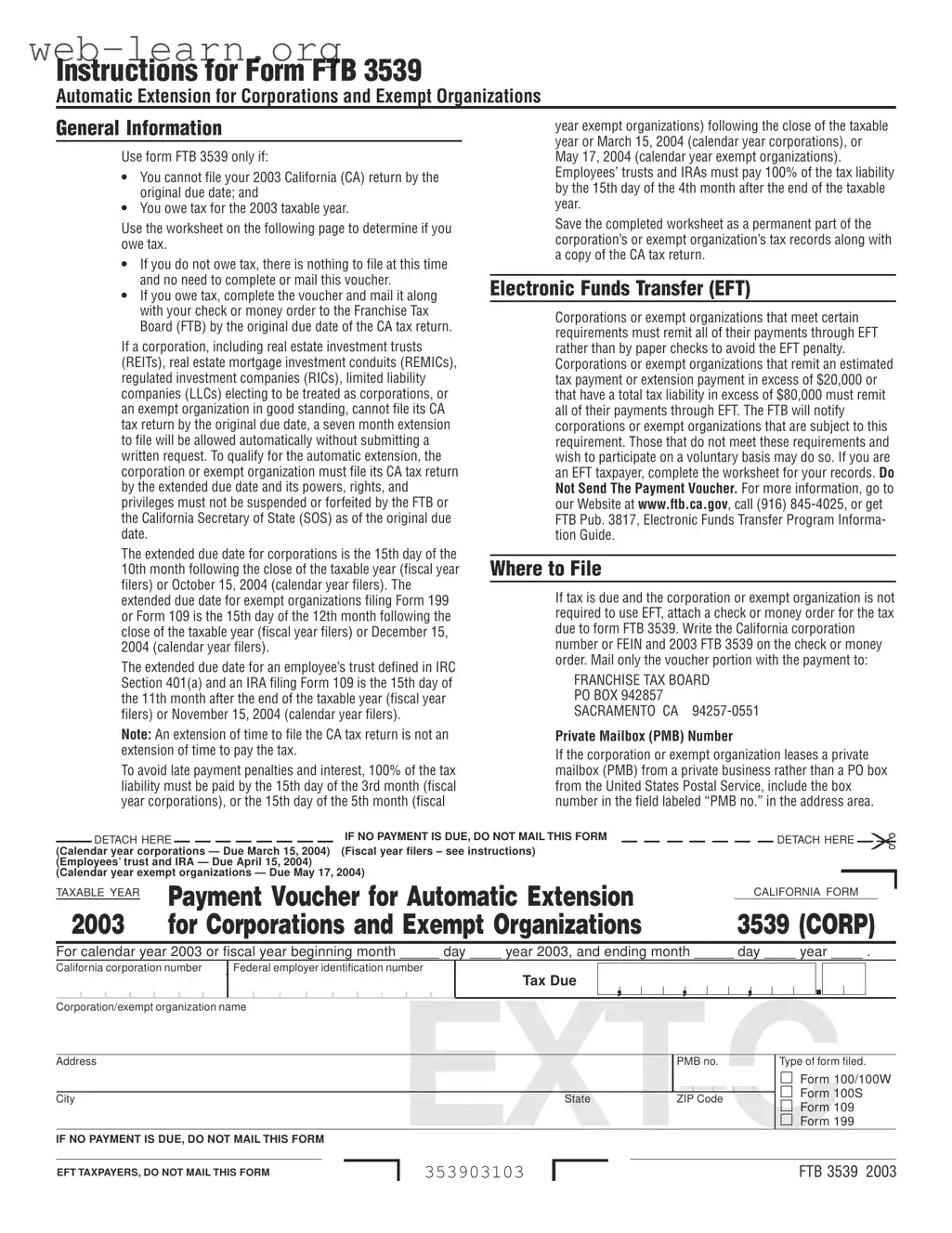
The California Form 3539 serves as a vital tool for corporations and exempt organizations seeking an automatic extension for filing their state tax returns. This form is specifically designed for those who are unable to meet the original filing deadline due to various circumstances. By submitting Form 3539, eligible entities can secure a seven-month extension to file their California tax return, provided they adhere to certain requirements. Notably, this extension does not apply to tax payments, which must still be made by the original due date to avoid penalties and interest. For organizations that owe tax, completing the payment voucher and remitting it along with the appropriate payment is essential. The form also outlines specific guidelines for different types of filers, including corporations, real estate investment trusts, and exempt organizations, each with their own deadlines and tax obligations. Furthermore, the form highlights the necessity for electronic funds transfer for certain entities, ensuring compliance with California’s tax regulations. Understanding these components is crucial for maintaining good standing with the Franchise Tax Board and avoiding potential penalties.

Sample - California 3539 Form

EXT-C
California corporation number Federal employer identification number
Corporation/exempt organization name
Address PMB no. Type of form filed.
City State ZIP Code
353903103
Payment Voucher for Automatic Extension
for Corporations and Exempt Organizations
CALIFORNIA FORM
3539 (CORP)
TAXABLE YEAR
2003
For calendar year 2003 or fiscal year beginning month _____ day ____ year 2003, and ending month _____ day ____ year ____ .
IF NO PAYMENT IS DUE, DO NOT MAIL THIS FORM
FTB 3539 2003
EFT TAXPAYERS, DO NOT MAIL THIS FORM
Instructions for Form FTB 3539
Automatic Extension for Corporations and Exempt Organizations
General Information
Use form FTB 3539 only if:
You cannot file your 2003 California (CA) return by the
original due date; and
You owe tax for the 2003 taxable year.
Use the worksheet on the following page to determine if you
owe tax.
If you do not owe tax, there is nothing to file at this time
and no need to complete or mail this voucher.
If you owe tax, complete the voucher and mail it along
with your check or money order to the Franchise Tax
Board (FTB) by the original due date of the CA tax return.
If a corporation, including real estate investment trusts
(REITs), real estate mortgage investment conduits (REMICs),
regulated investment companies (RICs), limited liability
companies (LLCs) electing to be treated as corporations, or
an exempt organization in good standing, cannot file its CA
tax return by the original due date, a seven month extension
to file will be allowed automatically without submitting a
written request. To qualify for the automatic extension, the
corporation or exempt organization must file its CA tax return
by the extended due date and its powers, rights, and
privileges must not be suspended or forfeited by the FTB or
the California Secretary of State (SOS) as of the original due
date.
The extended due date for corporations is the 15th day of the
10th month following the close of the taxable year (fiscal year
filers) or October 15, 2004 (calendar year filers). The
extended due date for exempt organizations filing Form 199
or Form 109 is the 15th day of the 12th month following the
close of the taxable year (fiscal year filers) or December 15,
2004 (calendar year filers).
The extended due date for an employee’s trust defined in IRC
Section 401(a) and an IRA filing Form 109 is the 15th day of
the 11th month after the end of the taxable year (fiscal year
filers) or November 15, 2004 (calendar year filers).
Note: An extension of time to file the CA tax return is not an
extension of time to pay the tax.
To avoid late payment penalties and interest, 100% of the tax
liability must be paid by the 15th day of the 3rd month (fiscal
year corporations), or the 15th day of the 5th month (fiscal
year exempt organizations) following the close of the taxable
year or March 15, 2004 (calendar year corporations), or
May 17, 2004 (calendar year exempt organizations).
Employees’ trusts and IRAs must pay 100% of the tax liability
by the 15th day of the 4th month after the end of the taxable
year.
Save the completed worksheet as a permanent part of the
corporation’s or exempt organization’s tax records along with
a copy of the CA tax return.
Electronic Funds Transfer (EFT)
Corporations or exempt organizations that meet certain
requirements must remit all of their payments through EFT
rather than by paper checks to avoid the EFT penalty.
Corporations or exempt organizations that remit an estimated
tax payment or extension payment in excess of $20,000 or
that have a total tax liability in excess of $80,000 must remit
all of their payments through EFT. The FTB will notify
corporations or exempt organizations that are subject to this
requirement. Those that do not meet these requirements and
wish to participate on a voluntary basis may do so. If you are
an EFT taxpayer, complete the worksheet for your records. Do
Not Send The Payment Voucher. For more information, go to
our Website at www.ftb.ca.gov, call (916) 845-4025, or get
FTB Pub. 3817, Electronic Funds Transfer Program Informa-
tion Guide.
Where to File
If tax is due and the corporation or exempt organization is not
required to use EFT, attach a check or money order for the tax
due to form FTB 3539. Write the California corporation
number or FEIN and 2003 FTB 3539 on the check or money
order. Mail only the voucher portion with the payment to:
FRANCHISE TAX BOARD
PO BOX 942857
SACRAMENTO CA 94257-0551
Private Mailbox (PMB) Number
If the corporation or exempt organization leases a private
mailbox (PMB) from a private business rather than a PO box
from the United States Postal Service, include the box
number in the field labeled “PMB no.” in the address area.
(Calendar year corporations — Due March 15, 2004) (Fiscal year filers – see instructions)
(Employees’ trust and IRA — Due April 15, 2004)
(Calendar year exempt organizations — Due May 17, 2004)
Tax Due
Form 100/100W
Form 100S
Form 109
Form 199
-
..
..
.
DETACH HERE
IF NO PAYMENT IS DUE, DO NOT MAIL THIS FORM
DETACH HERE
,,,
Page 2 FTB 3539 2003
Penalties and Interest
If the corporation or exempt organization fails to pay its
total tax by the original due date, a late payment penalty
plus interest will be added to the tax due.
If the corporation or exempt organization does not file its
CA tax return by the extended due date, or the
corporation’s powers, rights, and privileges have been
suspended or forfeited by the FTB or the California SOS,
as of the original due date, the automatic extension will
not apply and a delinquency penalty plus interest will be
assessed from the original due date of the CA tax return.
If the corporation or exempt organization is required to
remit all of its payments through EFT and pays by
another method, a 10% non-compliance penalty will be
assessed.
Combined Reports
If members of a combined unitary group have made or
intend to make an election to file a combined unitary
group single return, only the key corporation designated
to file the return should submit form FTB 3539. The key
corporation must include payment of at least the
minimum franchise tax for each corporation of the
combined unitary group that is subject to the franchise
tax in California.
If members of a combined unitary group intend to file
separate returns with the FTB, each member must
submit its own form FTB 3539 if there is an amount
entered on line 3 of the Tax Payment Worksheet.
If any member of a combined unitary group meets the
requirements for mandatory EFT, all members must remit
their payments through EFT, regardless of their filing
election.
How to Complete the Tax Payment Worksheet
Line 1 – Enter the total tentative tax, including the alterna-
tive minimum tax, if applicable, for the taxable year.
If filing Form 100, Form 100W, or Form 100S, and subject
to franchise tax, the tentative tax may not be less than the
minimum franchise tax and Qualified Subchapter S
Subsidiary (QSub) annual tax (S corporations only).
If filing Form 100, Form 100W, or Form 100S, and
subject to income tax, enter the amount of tax. Corpora-
tions subject to the income tax do not pay the minimum
franchise tax.
If a corporation incorporates or qualifies to do business
in California on or after January 1, 2000, the corporation
will compute its tax liability for the first taxable year by
multiplying its state net income by the appropriate tax
rate and will not be subject to the minimum franchise
tax. The corporation will become subject to minimum
franchise tax beginning in its second taxable year.
If filing Form 109, enter the amount of tax. Form 109
filers are not subject to the minimum franchise tax.
Exempt Organizations
Form 100 filers:
The due dates for corporations also apply to the filing of
Form 100, California Corporation Franchise or Income
Tax Return, by political action committees and exempt
homeowners’ associations.
Political action committees and exempt homeowners’
associations that file Form 100 should not enter the
minimum franchise tax on line 1 of the Tax Payment
Worksheet.
Form 199 Filers:
Generally, Form 199, California Exempt Organization
Annual Information Return, requires a $10 filing fee to be
paid with the return on the original or extended due date.
Use form FTB 3539 only if paying the fee early. Enter the
amount of the fee on line 3 of the Tax Payment
Worksheet.
Form 109 Filers:
The due dates for filing Form 109, California Exempt
Organization Business Income Return, depend on the
type of organization filing the return. Employees’ pension
trusts and IRAs (including education IRAs) must file on
or before the 15th day of the 4th month after the close of
their taxable year. All other exempt organizations (except
homeowners’ associations and political organizations)
must file on or before the 15th day of the 5th month after
the close of their taxable year.
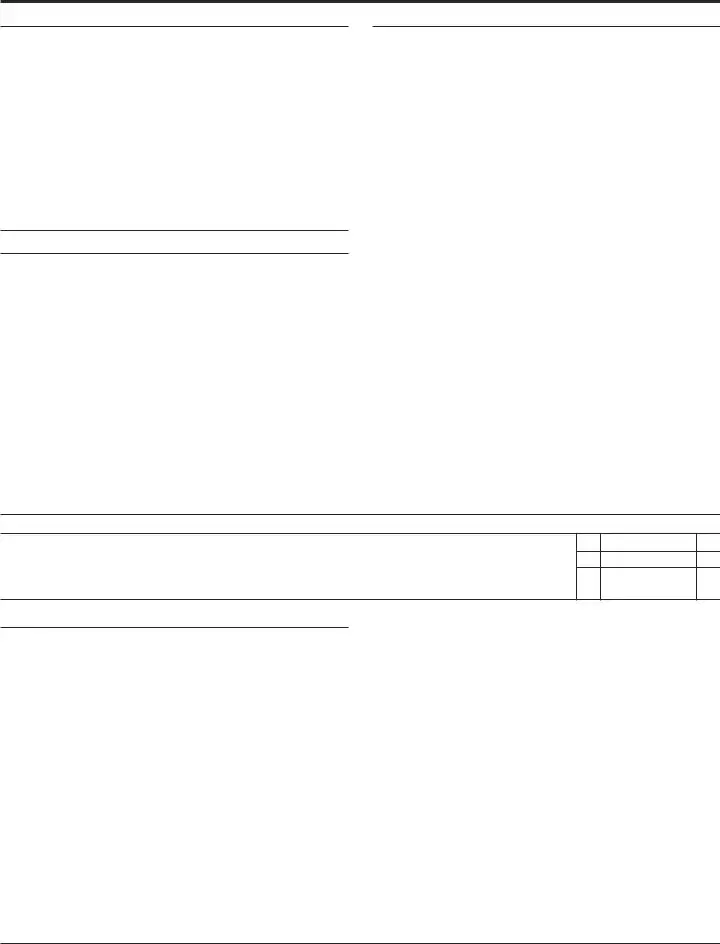
TAX PAYMENT WORKSHEET FOR YOUR RECORDS
1 Total tentative tax. Include alternative minimum tax if applicable. See instructions . . . . . . . . . . . . . . . . . . . . . . . . . . . 1
2 Estimated tax payments including prior year overpayment applied as a credit . . . . . . . . . . . . . . . . . . . . . . . . . . . . . . 2
3 Tax Due. If line 2 is more than line 1, see instructions. If line 1 is more than line 2, subtract line 2 from line 1.
Enter the result here and on form FTB 3539 . . . . . . . . . . . . . . . . . . . . . . . . . . . . . . . . . . . . . . . . . . . . . . . . . . . . . . . . . 3
Line 2 – Enter the estimated tax payments, including prior
year overpayment applied as a credit. S corporations include
any QSub annual tax payments.
Line 3
Tax due. If the amount on line 1 is more than the amount on
line 2, then the corporation’s or exempt organization’s
tentative tax is more than its payments and credits. The
corporation or exempt organization has tax due.
Subtract line 2 from line 1. Enter this amount on line 3 and
on form FTB 3539.
If the amount on line 2 is more than the amount on line 1,
the payments and credits are more than the tentative tax.
The corporation or exempt organization has no tax due. DO
NOT SEND THE PAYMENT VOUCHER. The corporation or
exempt organization will automatically qualify for an
extension if the California tax return is filed by the extended
due date and the corporation and or exempt organization is
in good standing with the FTB and SOS.

Form Information

Fact Name Description
Purpose The California Form FTB 3539 is used to request an automatic extension for filing tax returns for corporations and exempt organizations.
Eligibility Only corporations and exempt organizations that cannot file their tax return by the original due date and owe tax can use this form.
Due Dates For calendar year corporations, the due date is March 15. Exempt organizations have a due date of May 17.
Payment Requirement Tax liabilities must be paid by the original due date to avoid penalties. If no tax is owed, there is no need to file the form.
EFT Requirement Corporations with a tax liability over $80,000 must pay via Electronic Funds Transfer (EFT) to avoid penalties.
Governing Law The use of Form FTB 3539 is governed by California Revenue and Taxation Code sections relevant to corporate tax filings.

Detailed Guide for Filling Out California 3539

Filling out the California 3539 form is a straightforward process that requires careful attention to detail. Once you have completed the form, it will need to be submitted along with your payment if applicable. Be sure to check your entries for accuracy to avoid any potential penalties or issues with your tax return.

  1. Obtain the California 3539 form from the California Franchise Tax Board (FTB) website or other official sources.
  2. At the top of the form, enter the taxable year for which you are filing. This should reflect the year you are reporting taxes for.
  3. Fill in the corporation number and the Federal Employer Identification Number (FEIN) in the designated fields.
  4. Provide the name of your corporation or exempt organization in the appropriate section.
  5. Enter the address of your corporation or exempt organization, including city, state, and ZIP code. If you have a private mailbox (PMB), include that number in the specified field.
  6. Indicate the type of form you are filing by checking the corresponding box (Form 100/100W, Form 100S, Form 109, or Form 199).
  7. Complete the Tax Payment Worksheet included in the form. This involves entering the total tentative tax on line 1, the estimated tax payments on line 2, and calculating the tax due on line 3.
  8. If you owe tax, prepare a check or money order for the amount due. Write your California corporation number or FEIN and "2003 FTB 3539" on the payment.
  9. Detach the payment voucher portion of the form and mail it along with your payment to the address specified: Franchise Tax Board, PO Box 942857, Sacramento, CA 94257-0551.
  10. Keep a copy of the completed form and any payment records for your files.

Obtain Answers on California 3539

  1. What is the purpose of the California 3539 form?

    The California 3539 form is used to request an automatic extension for corporations and exempt organizations that cannot file their California tax return by the original due date. This form allows eligible entities to extend their filing deadline without needing to submit a written request.

  2. Who should use the California 3539 form?

    This form should be used by corporations and exempt organizations that owe taxes for the taxable year and cannot file their tax return by the original due date. If an organization does not owe tax, there is no need to file this form.

  3. When is the California 3539 form due?

    The due date for filing the California 3539 form varies based on the type of entity and its fiscal year. For calendar year corporations, the form is due on March 15, while exempt organizations have a due date of May 17. For fiscal year filers, the extended due date is the 15th day of the 10th month following the close of the taxable year.

  4. What happens if I fail to pay my taxes by the original due date?

    If a corporation or exempt organization fails to pay its total tax by the original due date, a late payment penalty plus interest will be added to the tax due. It's crucial to pay 100% of the tax liability by the specified deadlines to avoid these penalties.

  5. Are there any penalties for not filing the California 3539 form?

    Yes, if the corporation or exempt organization does not file its tax return by the extended due date, or if its powers, rights, and privileges have been suspended or forfeited, a delinquency penalty plus interest will be assessed from the original due date. Additionally, a 10% non-compliance penalty may apply if required payments are not made through Electronic Funds Transfer (EFT).

  6. How do I determine if I owe taxes?

    To determine if you owe taxes, complete the Tax Payment Worksheet included with the California 3539 form. This worksheet will guide you through calculating your total tentative tax and any estimated tax payments you may have made. If your tentative tax exceeds your payments, you have tax due.

  7. What should I include with the California 3539 form if I owe taxes?

    If you owe taxes, complete the form and include a check or money order for the tax due. Ensure that you write your California corporation number or Federal Employer Identification Number (FEIN) on the payment. Only the voucher portion of the form should be mailed with your payment to the Franchise Tax Board (FTB).

  8. What if I am part of a combined unitary group?

    In a combined unitary group, only the designated key corporation should submit the California 3539 form if filing a combined return. This key corporation must include payment for the minimum franchise tax for each corporation in the group that is subject to this tax. If members intend to file separately, each member must submit its own form if there is tax due.

  9. Where can I find more information about the California 3539 form?

    For more information, you can visit the Franchise Tax Board's website at www.ftb.ca.gov or call their customer service at (916) 845-4025. Additionally, you may refer to FTB Pub. 3817, which provides guidance on the Electronic Funds Transfer Program.

Common mistakes

Filling out the California Form FTB 3539 can be a straightforward process, but many individuals make common mistakes that can lead to complications. One frequent error is not filing the form on time. The deadline for submitting the form depends on whether the organization operates on a calendar or fiscal year. Missing this deadline can result in penalties and interest, which can be avoided by being diligent about the due date.

Another mistake is failing to pay the full tax liability by the original due date. Even if an extension is granted for filing the return, it does not extend the time to pay taxes owed. Organizations must ensure that they pay 100% of their tax liability by the required date to avoid late payment penalties. This is a critical point that many overlook, thinking that an extension gives them more time to pay.

Some individuals incorrectly assume that they do not owe tax and thus do not need to file the form. If there is any tax due, the form must be completed and submitted. It’s essential to use the worksheet provided with the form to determine if any tax is owed. Ignoring this step can lead to unnecessary complications down the line.

Another common error is neglecting to include the correct information on the payment voucher. Organizations must ensure that they include their California corporation number or Federal Employer Identification Number (FEIN) on the check or money order. Omitting this information can delay processing and lead to confusion about the payment.

Additionally, some filers do not keep a copy of the completed worksheet and the submitted form for their records. This is important because having these documents can help resolve any future issues with the Franchise Tax Board. Maintaining accurate records is essential for any organization.

Lastly, failing to understand the requirements for Electronic Funds Transfer (EFT) can lead to errors. Corporations that meet certain thresholds must remit all payments through EFT. Those who do not comply may face a non-compliance penalty. It’s crucial to be aware of these requirements and plan accordingly to avoid unnecessary penalties.

Documents used along the form

When dealing with the California 3539 form, several other documents often accompany it to ensure compliance with state tax regulations. Understanding these forms can help streamline the filing process and avoid potential penalties. Below is a list of key documents that may be used alongside the California 3539 form.

  • Form 100: This is the California Corporation Franchise or Income Tax Return. Corporations use it to report their income, calculate their tax liability, and claim any applicable credits. It’s essential for corporations subject to franchise tax.
  • Form 100S: Specifically designed for S corporations, this form allows these entities to report their income and taxes in a way that reflects their pass-through taxation structure. It helps avoid double taxation, as income is passed to shareholders.
  • Form 199: This is the California Exempt Organization Annual Information Return. Exempt organizations use it to report their financial activities and ensure compliance with state regulations. A $10 filing fee is typically required with this form.
  • Form 109: This form is for California Exempt Organization Business Income Return. It’s used by certain exempt organizations, including pension trusts and IRAs, to report business income and calculate taxes owed.
  • Tax Payment Worksheet: This worksheet is part of the FTB 3539 form and helps organizations calculate their tentative tax, estimated payments, and any tax due. Keeping this worksheet is important for record-keeping and ensuring accuracy in tax filings.

By familiarizing yourself with these forms, you can navigate the complexities of California tax regulations more effectively. Each document plays a vital role in ensuring that corporations and exempt organizations meet their filing obligations and avoid unnecessary penalties. Always keep these forms handy during the tax season to ensure a smooth filing process.

Similar forms

The California Form FTB 3539 is an important document for corporations and exempt organizations seeking an automatic extension to file their tax returns. Several other forms share similar functions or requirements. Here’s a list of eight documents that are similar to the California 3539 form, along with a brief explanation of how they are alike:

  • Form 100: This is the California Corporation Franchise or Income Tax Return. Like FTB 3539, it is used by corporations to report income and calculate taxes owed.
  • Form 100W: This form is for corporations that are subject to the California franchise tax. It also requires timely filing and payment, similar to FTB 3539.
  • Form 100S: This is for S corporations in California. It has similar due dates and payment requirements as the FTB 3539, especially concerning extensions.
  • Form 199: This is the California Exempt Organization Annual Information Return. It requires a filing fee and has similar provisions for extensions as FTB 3539.
  • Form 109: Used by exempt organizations to report business income. It has specific due dates and payment requirements that align with the FTB 3539.
  • Form 7004: This is the federal form for automatic extension of time to file certain business income tax returns. It allows for an extension similar to the California 3539.
  • Form 8868: This is the IRS application for extension of time to file an exempt organization return. It functions similarly to the California 3539 by allowing extra time to file.
  • Form 941: The Employer’s Quarterly Federal Tax Return. While it focuses on payroll taxes, it shares the need for timely filing and payment to avoid penalties, just like FTB 3539.

Understanding these forms can help ensure compliance with tax obligations and avoid unnecessary penalties. Always check the specific requirements for each form to ensure proper filing.

Dos and Don'ts

When filling out the California 3539 form, there are specific actions you should take and avoid to ensure a smooth process. Here’s a list of what to do and what not to do:

  • Do complete the form accurately, including all required information.
  • Do file the form by the original due date to qualify for an extension.
  • Do include payment if you owe tax; attach a check or money order.
  • Do keep a copy of the completed form for your records.
  • Do ensure that your organization is in good standing with the FTB and SOS.
  • Don't mail the form if no payment is due; it’s unnecessary.
  • Don't forget to use EFT if required; avoid penalties for non-compliance.

Following these guidelines will help you navigate the California 3539 form more effectively.

Misconceptions

Understanding the California Form 3539 can be challenging, especially with the various rules and requirements involved. Here are some common misconceptions that can lead to confusion:

  • Misconception 1: The form is only for corporations.
  • Many believe that only corporations need to file Form 3539. However, exempt organizations are also required to use this form if they owe taxes.

  • Misconception 2: Filing Form 3539 automatically extends the time to pay taxes.
  • Some assume that filing this form grants an extension for tax payments. In reality, it only extends the time to file the return, not to pay any taxes owed.

  • Misconception 3: You must always pay taxes when filing the form.
  • It's a common belief that taxes must be paid when submitting Form 3539. If you do not owe any taxes, there is no need to file or pay anything at that time.

  • Misconception 4: The form is only for the current tax year.
  • Some think that Form 3539 is only applicable for the current tax year. In fact, it can be used for prior years if certain conditions are met.

  • Misconception 5: You can submit the form anytime.
  • Many people believe that Form 3539 can be filed at any time. However, it must be submitted by the original due date of the tax return to qualify for the extension.

  • Misconception 6: All organizations must file electronically.
  • There is a misconception that all corporations and exempt organizations are required to file electronically. Only those meeting specific criteria must use electronic funds transfer.

  • Misconception 7: The form is unnecessary if you file an extension with the IRS.
  • Some think that filing an extension with the IRS negates the need to file Form 3539. However, California has its own requirements, and filing with the IRS does not automatically extend your California filing deadline.

By clarifying these misconceptions, individuals and organizations can better navigate the complexities of tax filing in California. Understanding the rules surrounding Form 3539 can help ensure compliance and avoid unnecessary penalties.

Key takeaways

Here are some key takeaways about filling out and using the California 3539 form:

  • Purpose: Use the California 3539 form to request an automatic extension for filing your corporation or exempt organization tax return.
  • Eligibility: Complete this form only if you owe tax for the taxable year and cannot file by the original due date.
  • Payment Requirement: If tax is due, you must pay 100% of your tax liability by the original due date to avoid penalties.
  • Extended Due Dates: The extended due date for corporations is the 15th day of the 10th month after the close of the taxable year.
  • Electronic Funds Transfer (EFT): Corporations with certain tax liabilities must make payments via EFT to avoid penalties.
  • Combined Reports: Only the key corporation in a combined unitary group should submit the form, including payment for all members.
  • Exempt Organizations: Different rules apply for Form 100, Form 199, and Form 109 filers regarding due dates and payment requirements.
  • Worksheet Use: Complete the Tax Payment Worksheet to determine the amount of tax due and keep it for your records.
  • Penalties: Failure to pay on time or file by the extended due date may result in late payment penalties and interest.