Homepage Blank California 3523 Form
Outline

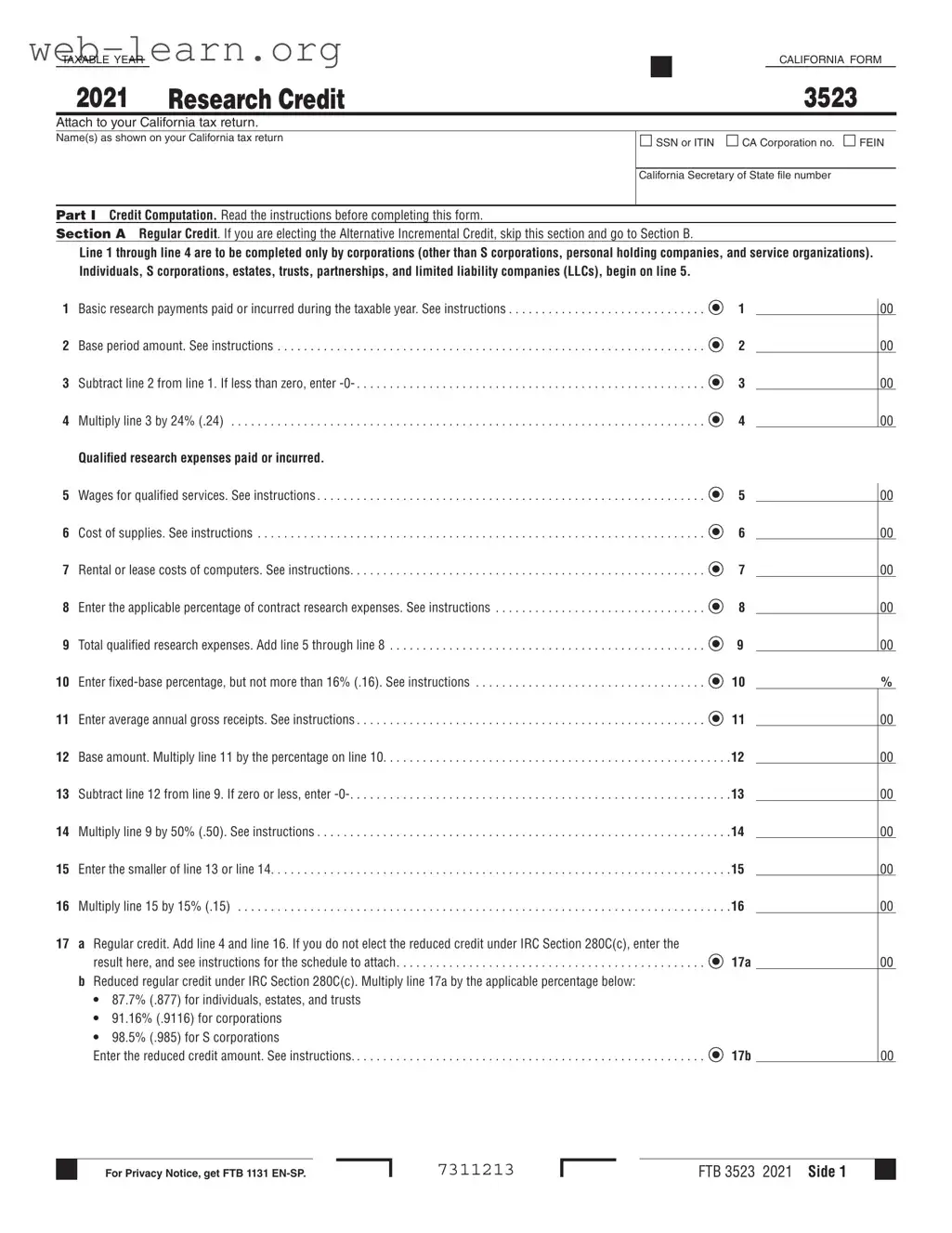
The California Form 3523 is a crucial document for businesses seeking to claim research credits on their state tax returns. This form is specifically designed for the taxable year 2020 and serves as a means for corporations and certain other entities to report their qualified research expenses. It includes two main sections: the Regular Credit and the Alternative Incremental Credit. In the Regular Credit section, businesses calculate their basic research payments and determine their eligible expenses, which can include wages, supplies, and rental costs related to research activities. The Alternative Incremental Credit section provides an alternative pathway for claiming credits, particularly beneficial for those who may not qualify under the regular provisions. Additionally, the form requires entities to provide their identification details, such as Social Security Numbers or Federal Employer Identification Numbers, ensuring proper tracking and compliance. Completing this form accurately can lead to significant tax savings, making it an essential part of the financial planning process for businesses engaged in research and development in California.

Sample - California 3523 Form

TAXABLE YEAR
2021
Research Credit
CALIFORNIA FORM
3523
Attach to your California tax return.
Name(s) as shown on your California tax return
SSN or ITIN CA Corporation no. FEIN
California Secretary of State file number
7311213
FTB 3523 2021 Side 1
Part I Credit Computation. Read the instructions before completing this form.
Section A Regular Credit. If you are electing the Alternative Incremental Credit, skip this section and go to Section B.
Line 1 through line 4 are to be completed only by corporations (other than S corporations, personal holding companies, and service organizations).
Individuals, S corporations, estates, trusts, partnerships, and limited liability companies (LLCs), begin on line 5.
1 Basic research payments paid or incurred during the taxable year. See instructions
.............................. 1 00
2 Base period amount. See instructions .................................................................
2 00
3 Subtract line 2 from line 1. If less than zero, enter 0
- - ..................................................... 3 00
4 Multiply line 3 by 24% (.24) ........................................................................
4 00
Qualied research expenses paid or incurred.
5 Wages for qualified services. See instructions
........................................................... 5 00
6 Cost of supplies. See instructions ....................................................................
6 00
7 Rental or lease costs of computers. See instructions
...................................................... 7 00
8 Enter the applicable percentage of contract research expenses. See instructions ................................
8 00
9 Total qualified research expenses. Add line 5 through line 8 ................................................
9 00
10 Enter fixed-base percentage, but not more than 16% (.16). See instructions ................................... 10 %
11 Enter average annual gross receipts. See instructions
..................................................... 11 00
12 Base amount. Multiply line 11 by the percentage on line 10
..................................................... 12 00
13 Subtract line 12 from line 9. If zero or less, enter 0
- -.......................................................... 13 00
14 Multiply line 9 by 50% (.50). See instructions
............................................................... 14 00
15 Enter the smaller of line 13 or line 14
...................................................................... 15 00
16 Multiply line 15 by 15% (.15) ........................................................................... 16 00
17 a Regular credit. Add line 4 and line 16. If you do not elect the reduced credit under IRC Section 280C(c), enter the
result here, and see instructions for the schedule to attach...............................................
17a 00
b Reduced regular credit under IRC Section 280C(c). Multiply line 17a by the applicable percentage below:
87.7% (.877) for individuals, estates, and trusts
91.16% (.9116) for corporations
98.5% (.985) for S corporations
Enter the reduced credit amount. See instructions.
..................................................... 17b 00
For Privacy Notice, get FTB 1131 EN-SP.
Section B Alternative Incremental Credit. Skip this section if you completed Section A, Regular Credit.
Line 18 through line 21 are to be completed only by corporations (other than S corporations, personal holding companies, and service organizations).
Individuals, S corporations, estates, trusts, partnerships, and LLCs, begin on line 22.
18 Basic research payments paid or incurred during the taxable year. See instructions ..................................18
19 Base period amount. See instructions .....................................................................19
20
Subtract line 19 from line 18. If less than zero, enter -0- .......................................................20
21
Multiply line 20 by 24% (.24) .......................................................................
21
Qualied research expenses paid or incurred.
22 Wages for qualified services. See instructions...........................................................
22
23 Cost of supplies. See instructions .................................................................... 23
24 Rental or lease costs of computers. See instructions...................................................... 24
25 Enter the applicable percentage of contract research expenses. See instructions ................................ 25
26
Total qualified research expenses. Add line 22 through line 25 .............................................. 26
27
Enter average annual gross receipts. See instructions ..................................................... 27
28
Multiply line 27 by 1% (.01).............................................................................28
29
Subtract line 28 from line 26. If zero or less, enter - -
.
-
-
.
-
-
-
-
-
-
0 .........................................................29
30
Multiply line 27 by 1.5% (.015) ................ .........................................................30
31
Subtract line 30 from line 26. If zero or less, enter 0 .........................................................31
32
Subtract line 31 from line 29. If zero or less, enter 0 .........................................................32
33
Multiply line 27 by 2% (.02)................... .........................................................33
34
Subtract line 33 from line 26. If zero or less, enter 0 .........................................................34
35
Subtract line 34 from line 31. If zero or less, enter 0 .........................................................35
36
Multiply line 32 by 1.49% (.0149) ........................................................................36
37
Multiply line 35 by 1.98% (.0198) ........................................................................37
38
Multiply line 34 by 2.48% (.0248) ........................................................................38
39
a
Alternative incremental credit. Add line 21, line 36, line 37, and line 38. If you do not elect the reduced credit
under IRC Section 280C(c), enter the result here, and see instructions for the schedule that must be attached .......
39a
b Reduced alternative incremental credit under IRC Section 280C(c). Multiply line 39a by the applicable percentage below:
00
00
00
00
00
00
00
00
00
00
00
00
00
00
00
00
00
00
00
00
00
00
87.7% (.877) for individuals, estates, and trusts
91.16% (.9116) for corporations
98.5% (.985) for S corporations
Enter the reduced credit amount. See instructions. .....................................................
39b 00
Section C Available Research Credit
40 Pass-through research credit(s) from S corporations, estates, trusts, partnerships, and LLCs. See instructions ........
41 Current year research credit. If you did not elect the reduced credit under IRC Section 280C(c), add line 17a or
line 39a to line 40 and enter the result here. If you elected the reduced credit under IRC Section 280C(c),
add line 17b or line 39b to line 40 and enter the result here ................................................
42
Enter the amount of credit on line 41 that is from passive activities. If none of the amount on line 41 is from
passive activities, enter 0- - .........................................................................
43
Subtract line 42 from line 41 ........................................................................
44
Enter the allowable credit from passive activities. See instructions ...........................................
45 Non-passive activity credit carryover from prior year. (Do not include credits received through assignment.)
See instructions. ..................................................................................
46 Total. Add line 43 through line 45.....................................................................
40 00
41
00
....42
00
....43
00
....44
00
45
00
46
00
Part II
Carryover Computation. Combined Report Filers see instructions for Part III before completing this part.
47
Credit claimed. Enter the amount of the credit claimed on the current year tax return. See instructions.
(Do not include any assigned credit claimed on form FTB 3544, Part B.) ......................................
47
00
48
00
49
00
48 Total credit assigned. Enter the total amount from form FTB 3544, Part A, column (g). If you are not a corporation,
enter -0-. See instructions. .........................................................................
49
Credit carryover available for use or assignment for future years. Subtract lines 47 and 48 from line 46 ..............
Side 2 FTB 3523 2021
7312213
7313213
FTB 3523 2021 Side 3
Part III Credit Allocation and Carryover Per Entity – Only Combined Report Filers
To make an election for assigning credits, you must also complete form FTB 3544, Part A. Otherwise, the assignment indicated here will be invalid.
Credit Generated and Assigned Per Entity
(a)
Corporation
(b)
Corporation no., FEIN, or
SOS no.
(c)
Amount of credit generated
in current year
(d)
Amount of generated credit
carryover from prior years
(e)
Total of generated credit
and credit carryover from
prior years
col. (c) + col. (d)
1
2
3
4
5
6
7
Total
(f)*
*There is a $5,000,000 business credit limitation on the application of tax credits. See instructions.
Amount of credit from col. (e) claimed
in current year return. (Do not include
any assigned credit claimed on
form FTB 3544, Part B.)
(g)
Amount of research credit
assigned and to be reported
on form FTB 3544, Part A
(h)
Generated credit carryover
for future years
col. (e) – [col. (f) + col. (g)]
1
2
3
4
5
6
7
Total

Form Information

Fact Name Detail
Purpose The California 3523 form is used to claim the Research Credit for qualified research expenses on the California tax return.
Eligibility Corporations, individuals, S corporations, estates, trusts, partnerships, and LLCs can complete this form, depending on the section.
Sections The form includes two main sections: Section A for Regular Credit and Section B for Alternative Incremental Credit.
Credit Calculation The credit is calculated based on qualified research expenses, with different methods outlined for corporations and individuals.
Governing Law This form is governed by California Revenue and Taxation Code Section 23609.
Filing Requirement Taxpayers must attach the completed 3523 form to their California tax return when claiming the research credit.

Detailed Guide for Filling Out California 3523

Filling out the California 3523 form involves a series of steps that require accurate information about your research credits. Ensure you have all necessary documents and figures ready before starting the process. Follow the steps below to complete the form correctly.

  1. Begin by entering your name(s) as shown on your California tax return at the top of the form.
  2. Provide your Social Security Number (SSN) or Individual Taxpayer Identification Number (ITIN), California Corporation number, or Federal Employer Identification Number (FEIN) as applicable.
  3. Decide whether you will complete Section A (Regular Credit) or Section B (Alternative Incremental Credit). If you choose Section A, skip to the next step; otherwise, proceed to Section B after completing Section A.
  4. In Section A, fill out lines 1 through 4 if you are a corporation. If you are an individual, S corporation, estate, trust, partnership, or LLC, start at line 5.
  5. For line 1, enter the total basic research payments made during the taxable year.
  6. On line 2, provide the base period amount as instructed.
  7. Complete line 3 by subtracting line 2 from line 1. If the result is negative, enter zero.
  8. Multiply the result from line 3 by 24% and enter this value on line 4.
  9. For lines 5 through 8, enter the qualified research expenses, including wages for qualified services, cost of supplies, rental or lease costs of computers, and applicable contract research expenses.
  10. Add lines 5 through 8 to get the total qualified research expenses and enter this on line 9.
  11. Fill in the fixed-base percentage on line 10, ensuring it does not exceed 16%.
  12. On line 11, enter your average annual gross receipts.
  13. Calculate the base amount by multiplying line 11 by the percentage on line 10 and enter it on line 12.
  14. Subtract line 12 from line 9 for line 13. If the result is zero or negative, enter zero.
  15. Multiply line 9 by 50% and enter this on line 14.
  16. On line 15, enter the smaller of line 13 or line 14.
  17. Multiply line 15 by 15% and enter the result on line 16.
  18. Add line 4 and line 16 for line 17a. If you are not electing the reduced credit under IRC Section 280C(c), proceed as instructed.
  19. For line 17b, if applicable, calculate the reduced regular credit based on your entity type and enter it.
  20. If you are completing Section B instead, follow the same initial steps but begin at line 22 and complete lines 18 through 39b as instructed for Alternative Incremental Credit.
  21. In Section C, enter any pass-through research credits on line 40.
  22. On line 41, add the current year research credit to line 40 and enter the total.
  23. Complete lines 42 through 46 as instructed to finalize your available research credit.
  24. For Part II, enter the credit claimed on line 47 and the total credit assigned on line 48.
  25. Finally, calculate the credit carryover available for future use on line 49.

Once you have filled out the form, review all entries for accuracy. Attach the completed form to your California tax return and ensure you keep copies for your records. If you have any questions or need further assistance, consider consulting a tax professional.

Obtain Answers on California 3523

  1. What is the California 3523 form?

    The California 3523 form is used to claim the Research Credit for the taxable year. This form is specifically designed for businesses engaging in qualified research activities in California. By completing this form, eligible taxpayers can reduce their state tax liability based on their research expenditures.

  2. Who should file the California 3523 form?

    Corporations, individuals, S corporations, estates, trusts, partnerships, and limited liability companies (LLCs) that have incurred qualified research expenses during the taxable year should consider filing this form. However, it’s important to note that certain entities, such as personal holding companies and service organizations, may not be eligible.

  3. What are qualified research expenses?

    Qualified research expenses include costs associated with basic research payments, wages for qualified services, costs of supplies, and rental or lease costs of computers used in research activities. These expenses must be directly related to the research conducted to qualify for the credit.

  4. What is the difference between the Regular Credit and the Alternative Incremental Credit?

    The Regular Credit is calculated based on a percentage of the increase in qualified research expenses compared to a base period amount. In contrast, the Alternative Incremental Credit allows taxpayers to claim a credit based on a percentage of their qualified research expenses without needing to establish a base period. Taxpayers must choose one method to claim their credit and cannot use both.

  5. How do I calculate the Research Credit?

    To calculate the Research Credit, taxpayers must complete the relevant sections of the form based on their chosen credit method. For the Regular Credit, follow the steps outlined in Section A, while for the Alternative Incremental Credit, complete Section B. Each section provides specific lines to fill out based on your qualified research expenses and other relevant financial information.

  6. What is the significance of IRC Section 280C(c)?

    IRC Section 280C(c) allows taxpayers to elect a reduced credit amount if they have received a federal tax deduction for the same research expenses. This section provides a percentage to apply to the calculated credit, which may be beneficial for some taxpayers, depending on their overall tax situation.

  7. Can I carry over unused credits to future years?

    Yes, if you have unused research credits, you can carry them over to future tax years. The California 3523 form includes a section for calculating credit carryovers, allowing you to apply any remaining credits against your tax liability in subsequent years.

  8. What documentation do I need to submit with the California 3523 form?

    When filing the California 3523 form, you must attach it to your California tax return. Additionally, any supporting documentation that verifies your qualified research expenses should be kept on file in case of an audit. While not required to be submitted with the form, having this documentation ready is crucial for substantiating your claim.

  9. Where can I find more information about the California 3523 form?

    For more detailed information, including instructions for completing the form, you can visit the California Franchise Tax Board's official website. They provide resources, guidelines, and contact information for any questions you may have regarding the Research Credit and the California 3523 form.

Common mistakes

Filling out the California 3523 form can be a daunting task, and many individuals make common mistakes that can lead to delays or rejections. One frequent error is not reading the instructions thoroughly before starting. The form contains specific guidelines that are essential for accurate completion. Skipping this step can result in miscalculations or missing information.

Another common mistake is failing to provide the correct identification numbers. Individuals often overlook the need to include their Social Security Number (SSN) or Individual Taxpayer Identification Number (ITIN), while corporations must ensure their California Corporation number or Federal Employer Identification Number (FEIN) is accurate. Missing or incorrect identification can lead to processing issues.

Many people also struggle with the credit computation sections. For example, in Section A, Line 1 through Line 4 should only be filled out by corporations, but individuals and other entities mistakenly complete these lines. Understanding which sections apply to your specific entity type is crucial for correct submission.

Another area where errors occur is in the calculations. When subtracting values or multiplying percentages, simple arithmetic mistakes can lead to incorrect figures. This is particularly important in lines that involve multiplying by percentages, such as Line 4 and Line 16. Taking the time to double-check these calculations can prevent unnecessary complications.

Additionally, individuals often forget to include all relevant qualified research expenses. Lines 5 through 8 require detailed entries for wages, supplies, and other costs. Omitting any of these can result in an inaccurate total on Line 9, affecting the overall credit amount.

Another mistake is not entering the average annual gross receipts correctly. Line 11 requires accurate reporting of gross receipts, which can be tricky. If this figure is incorrect, it can significantly impact the calculations that follow.

People also sometimes neglect to attach the required schedules. If you do not elect the reduced credit under IRC Section 280C(c), specific schedules must accompany the form. Failing to include these can delay processing or lead to disqualification from receiving the credit.

Finally, many individuals overlook the importance of reviewing their completed form before submission. A final check can catch any overlooked mistakes, such as missing signatures or incomplete lines. Taking this extra step can save time and ensure a smoother filing process.

Documents used along the form

The California Form 3523 is essential for claiming research credits on your tax return. However, it is often accompanied by various other forms and documents that help provide additional information or support your claims. Below is a list of these documents, each serving a unique purpose in the process.

  • California Form 540: This is the standard individual income tax return form for California residents. It reports your total income and calculates your tax liability.
  • California Form 100: Corporations use this form to report their income, deductions, and credits. It is essential for corporate entities claiming the research credit.
  • California Form 3544: This form is used to assign research credits to other entities or individuals. It ensures proper tracking of credits that are transferred.
  • California Form 3805Z: This form is for the California Competes Tax Credit, which may be relevant for businesses involved in research and development activities.
  • California Schedule CA (540): This schedule adjusts your federal adjusted gross income to conform to California tax laws. It is necessary for accurate reporting on your California return.
  • California Form 568: Limited liability companies (LLCs) use this form to report income and pay the annual tax. It is crucial for LLCs involved in research activities.
  • California Form 100S: S corporations use this form to report their income, deductions, and credits. It is vital for S corporations claiming research credits.
  • California Form 3885L: This form is used to claim the California Depreciation and Amortization Credit, which may relate to research expenses for certain businesses.
  • California Form FTB 1131: This privacy notice informs taxpayers how their personal information will be used and protected. It is often included with tax filings.

Understanding these additional forms can help ensure a smooth and accurate filing process. Each document plays a critical role in supporting your claims and ensuring compliance with California tax laws. If you have questions about any of these forms, consider seeking assistance to clarify your needs and obligations.

Similar forms

The California Form 3523 is primarily used for claiming the Research Credit for taxable years. Several other documents serve similar purposes in different contexts. Below are four documents that share similarities with the California 3523 form:

  • IRS Form 6765: This form is used to claim the federal Research Credit. Like the California 3523, it requires taxpayers to detail their qualified research expenses and calculate the credit based on specific percentages. Both forms aim to incentivize research and development activities, but the IRS form applies at the federal level.
  • California Form 3805Z: This form is for claiming the California Alternative Energy and Advanced Transportation Financing Authority (CAEATFA) credit. Similar to the 3523, it focuses on encouraging investment in innovative technologies, though it targets a different sector. Both forms require detailed calculations of eligible expenses to determine the credit amount.
  • IRS Form 8826: This form is used to claim the Disabled Access Credit. While it serves a different purpose, both forms require taxpayers to identify eligible expenses and calculate a credit based on those expenses. The focus is on providing financial incentives, whether for research or for improving accessibility.
  • California Form 588: This form is for the Nonresident Withholding Agreement. While its primary focus is on withholding tax for nonresidents, it shares the administrative aspect of documenting financial transactions and claiming credits. Both forms require detailed information about the taxpayer and their financial activities.

Dos and Don'ts

When filling out the California Form 3523, there are several important guidelines to follow. Below is a list of things you should and shouldn't do:

  • Do read the instructions carefully before completing the form to ensure accuracy.
  • Do provide all required information, including your name, SSN or ITIN, and applicable corporation numbers.
  • Do double-check your calculations, especially when determining qualified research expenses.
  • Do attach any necessary schedules or additional documentation as specified in the instructions.
  • Don't skip sections that are applicable to your situation; complete all relevant parts of the form.
  • Don't leave any fields blank; if a question does not apply, indicate it appropriately.
  • Don't use incorrect percentages or amounts when calculating credits; follow the instructions closely.
  • Don't forget to sign and date the form before submitting it with your tax return.

Misconceptions

Here is a list of misconceptions about the California 3523 form, along with clarifications for each:

  • Only corporations can use the California 3523 form. This is incorrect. While corporations primarily complete Section A, individuals, S corporations, estates, trusts, partnerships, and LLCs can start on Section B.
  • The form is only for businesses engaged in research. In reality, the form is designed for various entities that incur qualified research expenses, which may include activities that support research, not just direct research.
  • All expenses can be claimed as qualified research expenses. Not all expenses qualify. Only specific costs, such as wages for qualified services and supplies, can be included, as outlined in the instructions.
  • The California 3523 form is the same as the federal form. This is a misconception. The California 3523 form has unique requirements and calculations that differ from federal forms, such as the IRS Form 6765.
  • Filing the form guarantees a tax credit. Filing does not guarantee a credit. The credit is based on qualifying expenses and must be calculated accurately according to the form's guidelines.
  • The form can be filed anytime during the year. The California 3523 form must be attached to the California tax return for the taxable year in which the research expenses were incurred, adhering to specific deadlines.
  • There is no limit to the amount of credit that can be claimed. There is a $5,000,000 business credit limitation on the application of tax credits, which must be considered when claiming credits.
  • Once the credit is claimed, it cannot be carried over. This is false. Unused credits can be carried over to future years, providing potential tax benefits beyond the current tax year.

Key takeaways

Filling out the California 3523 form can be a crucial step for businesses seeking to claim research credits. Understanding its components is essential for accurate completion and effective use. Here are key takeaways regarding the form:

  • The form is specifically designed for claiming the California Research Credit for the taxable year.
  • It must be attached to your California tax return when submitted.
  • Section A is for the Regular Credit, while Section B pertains to the Alternative Incremental Credit.
  • Only corporations, excluding S corporations, personal holding companies, and service organizations, should complete lines 1 through 4 in Section A.
  • Individuals and other entities begin filling out Section A from line 5 onward.
  • Accurate calculations of qualified research expenses are vital; these include wages, supplies, and rental costs.
  • The form requires an understanding of both the base period amount and the average annual gross receipts.
  • Electing the reduced credit under IRC Section 280C(c) can affect the final credit amount claimed.
  • Careful attention must be paid to the instructions for each line to ensure compliance with California tax regulations.
  • After calculating the credit, the total must be reported accurately on the tax return to avoid potential penalties.