Homepage Blank California 3521 Form
Outline

The California Form 3521 is an essential document for those claiming the Low-Income Housing Credit on their state tax returns. This form must be attached to your California tax return and includes crucial information about your eligibility and the credits available to you. It requires details such as your name, Social Security Number (SSN) or Individual Taxpayer Identification Number (ITIN), and building identification numbers (BINs) for any projects involved. The form breaks down available credits, allowing you to report current year credits, affiliated credits from other entities, and any carryover amounts from previous years. Additionally, if there has been a decrease in the eligible basis of any project, you will need to complete a specific section to recalculate your basis. Understanding how to accurately fill out this form can significantly impact your tax benefits, making it a vital part of the tax filing process for low-income housing projects in California.
Sample - California 3521 Form

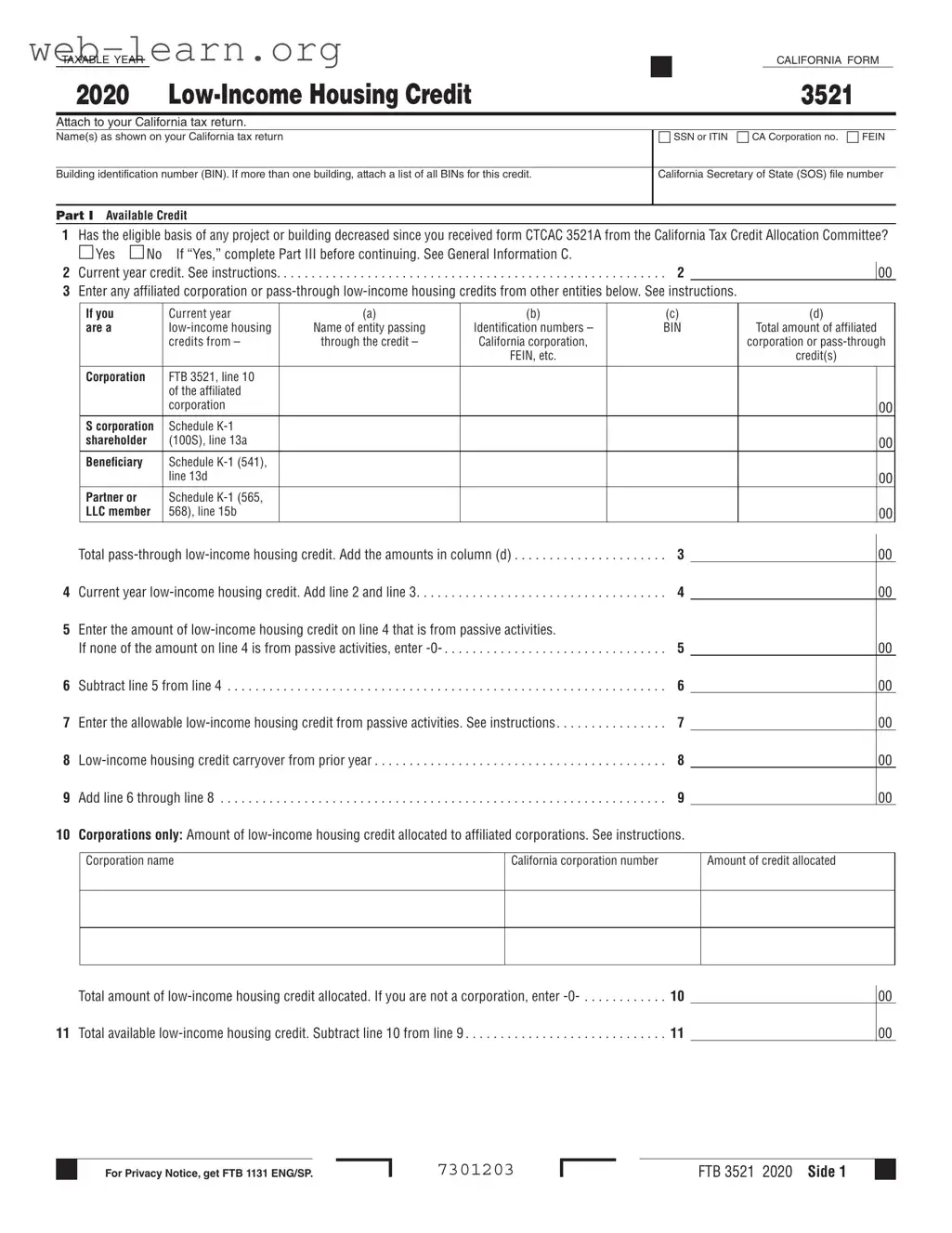
7301203
FTB 3521 2020 Side 1
TAXABLE YEAR
2020
Low-Income Housing Credit
CALIFORNIA FORM
3521
Attach to your California tax return.
Name(s) as shown on your California tax return
SSN or ITIN
CA Corporation no.
FEIN
Building identification number (BIN). If more than one building, attach a list of all BINs for this credit. California Secretary of State (SOS) file number
Part I Available Credit
1 Has the eligible basis of any project or building decreased since you received form CTCAC 3521A from the California Tax Credit Allocation Committee?
Yes No If “Yes,” complete Part III before continuing. See General Information C.
2 Current year credit. See instructions.
....................................................... 2 00
3 Enter any affiliated corporation or pass-through low-income housing credits from other entities below. See instructions.
If you
are a
Current year
low-income housing
credits from –
(a)
Name of entity passing
through the credit –
(b)
Identification numbers –
California corporation,
FEIN, etc.
(c)
BIN
(d)
Total amount of affiliated
corporation or pass-through
credit(s)
Corporation FTB 3521, line 10
of the affiliated
corporation
00
S corporation
shareholder
Schedule K-1
(100S), line 13a
00
Beneciary Schedule K-1 (541),
line 13d
00
Partner or
LLC member
Schedule K-1 (565,
568), line 15b
00
Total pass-through low-income housing credit. Add the amounts in column (d) ...................... 3 00
4 Current year low-income housing credit. Add line 2 and line 3.................................... 4 00
5 Enter the amount of low-income housing credit on line 4 that is from passive activities.
If none of the amount on line 4 is from passive activities, enter -0-
................................ 5 00
6 Subtract line 5 from line 4 ............................................................... 6 00
7 Enter the allowable low-income housing credit from passive activities. See instructions................ 7 00
8 Low-income housing credit carryover from prior year .......................................... 8 00
9 Add line 6 through line 8 ................................................................ 9 00
10 Corporations only: Amount of low-income housing credit allocated to affiliated corporations. See instructions.
Corporation name California corporation number Amount of credit allocated
Total amount of low-income housing credit allocated. If you are not a corporation, enter -0- ............ 10 00
11 Total available low-income housing credit. Subtract line 10 from line 9
For Privacy Notice, get FTB 1131 ENG/SP.
............................. 11 00
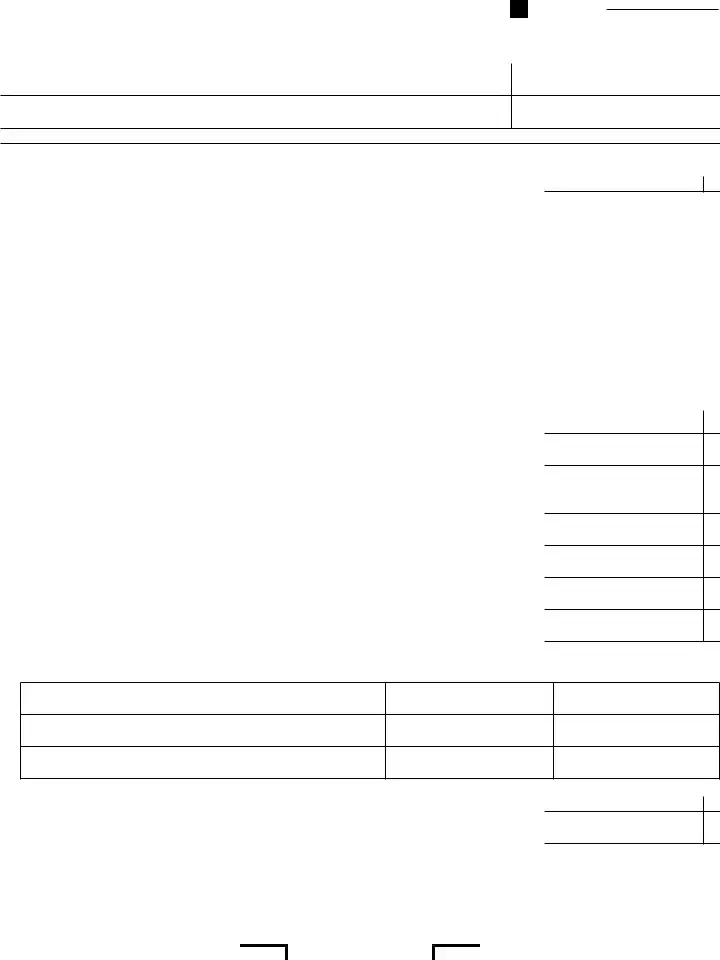
7302203
Side 2 FTB 3521 2020
Part II Carryover Computation
12 a Credit claimed. Enter the amount of the credit claimed on the current year tax return.
See instructions.
....................................................................12a 00
(Do not include any assigned credit claimed on form FTB 3544, Part B.)
12 b Total credit assigned. Enter the total amount from form FTB 3544, Part A, column (g).
If you are not a corporation, enter -0-. See instructions
.......................................12b 00
13 Credit carryover available for future years. Add line 12a and line 12b, subtract the result from line 11 .....13 00
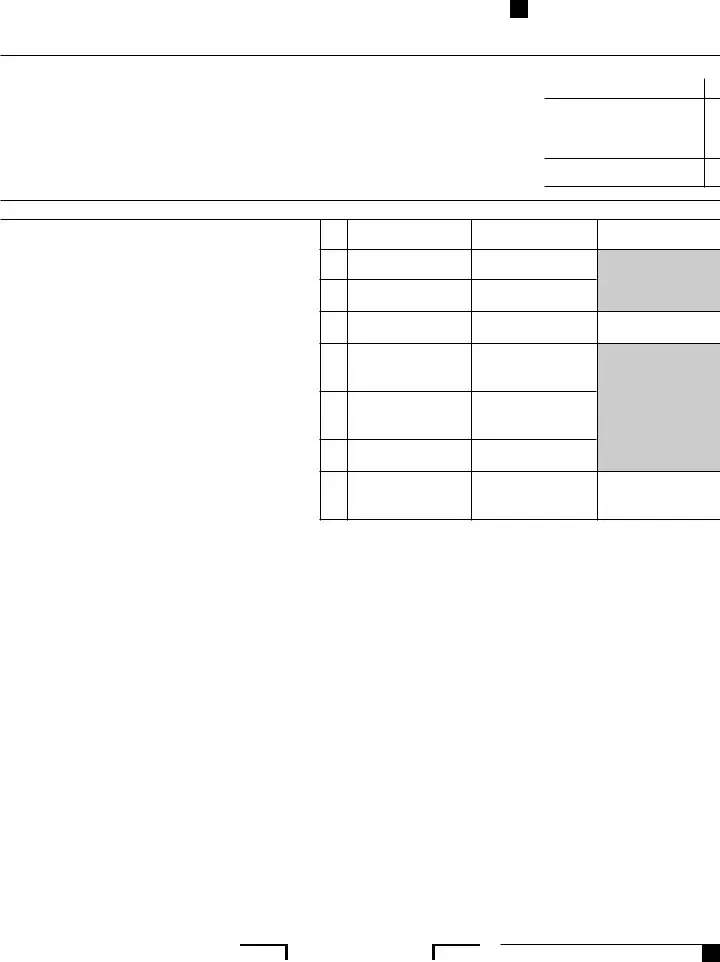
Part III Basis Recomputations. Complete this part only if the basis in a project or building has decreased. Use additional sheets if necessary.
(a)
Building 1
(b)
Building 2
(c)
Total
14 Date building was placed in service (month/year)
.......... 14
15 BIN.............................................. 15
16 Eligible basis of building. See General Information C........ 16
17 Low-income portion (lesser of unit percentage or
floor-space percentage). See instructions
................ 17
18 Qualified basis of low-income building. Multiply line 16
by line 17
......................................... 18
19 Applicable percentage. See General Information B.......... 19
20 Multiply line 18 by line 19. See Specific Line Instructions for
Part I, line 2
....................................... 20

Form Information

Fact Name Details
Form Purpose The California Form 3521 is used to claim the Low-Income Housing Credit for eligible projects.
Governing Law This form is governed by California Revenue and Taxation Code Section 17058.
Filing Requirement Taxpayers must attach Form 3521 to their California tax return to claim the credit.
Eligibility Criteria To qualify, the project must meet specific low-income housing requirements set by the California Tax Credit Allocation Committee.
Credit Calculation The credit amount is determined based on the eligible basis of the building and any applicable percentages.

Detailed Guide for Filling Out California 3521

Completing the California Form 3521 requires careful attention to detail. This form is essential for reporting low-income housing credits on your California tax return. Once you have filled it out, ensure that you attach it to your tax return before submission.

  1. Gather necessary information: Collect your California tax return, Social Security Number (SSN) or Individual Taxpayer Identification Number (ITIN), California Corporation number, and Federal Employer Identification Number (FEIN). You will also need the Building Identification Number (BIN) and California Secretary of State (SOS) file number.
  2. Fill out your name(s): Write your name(s) as they appear on your California tax return at the top of the form.
  3. Complete Part I - Available Credit:
    • Question 1: Indicate if the eligible basis of any project or building has decreased since receiving form CTCAC 3521A. Check "Yes" or "No."
    • Question 2: Enter the current year credit amount as instructed.
    • Question 3: List any affiliated corporation or pass-through low-income housing credits from other entities. Fill in the name of the entity, identification numbers, and total amount of credits.
    • Question 4: Add the amounts from line 2 and line 3 to find the current year low-income housing credit.
    • Question 5: Enter the amount of credit from passive activities, or -0- if none applies.
    • Question 6: Subtract line 5 from line 4.
    • Question 7: Enter the allowable low-income housing credit from passive activities as per instructions.
    • Question 8: Input the low-income housing credit carryover from the prior year.
    • Question 9: Add lines 6 through 8 for the total available low-income housing credit.
    • Question 10: For corporations only, enter the amount of low-income housing credit allocated to affiliated corporations.
    • Question 11: Subtract line 10 from line 9 to find the total available low-income housing credit.
  4. Complete Part II - Carryover Computation:
    • Line 12a: Enter the amount of credit claimed on your current year tax return.
    • Line 12b: Enter the total credit assigned from form FTB 3544.
    • Line 13: Add lines 12a and 12b, then subtract from line 11 to find the credit carryover available for future years.
  5. Complete Part III - Basis Recomputations: Only if the basis in a project or building has decreased, provide the necessary details including the date the building was placed in service, BIN, eligible basis, low-income portion, qualified basis, applicable percentage, and calculations as instructed.
  6. Review your form: Double-check all entries for accuracy and completeness before attaching it to your California tax return.

Obtain Answers on California 3521

  1. What is the California Form 3521?

    The California Form 3521 is used to claim the Low-Income Housing Credit for the taxable year. This form must be attached to your California tax return. It helps property owners and developers reduce their tax liability by providing credits for investing in low-income housing projects.

  2. Who needs to file Form 3521?

    Individuals or corporations that have invested in qualifying low-income housing projects must file Form 3521. If you have received a form CTCAC 3521A from the California Tax Credit Allocation Committee, you are likely eligible to claim this credit.

  3. What information do I need to complete Form 3521?

    You will need several pieces of information to complete the form, including:

    • Your name(s) as shown on your California tax return
    • Your Social Security Number (SSN) or Individual Taxpayer Identification Number (ITIN)
    • Your California Corporation number or Federal Employer Identification Number (FEIN)
    • The Building Identification Number (BIN) for the property

  4. What should I do if my project's eligible basis has decreased?

    If the eligible basis of your project or building has decreased since you received Form CTCAC 3521A, you must complete Part III of the form. This section allows you to recalculate the basis and determine the allowable credit.

  5. How do I calculate my current year low-income housing credit?

    The current year low-income housing credit is calculated by adding the amounts from line 2 and line 3 of the form. Line 2 pertains to your current year credit, while line 3 includes any affiliated corporation or pass-through credits you may have received.

  6. What is a carryover credit?

    A carryover credit allows you to apply any unused low-income housing credit to future tax years. If you claim a credit but do not use the entire amount, you can carry over the remaining credit to offset taxes in subsequent years.

  7. What do I do if I am not a corporation?

    If you are not a corporation, you will need to enter -0- in the sections of the form that ask for corporation-specific information, such as the amount of low-income housing credit allocated to affiliated corporations. Ensure that you still complete the relevant sections for individual claimants.

  8. Where can I find additional instructions for Form 3521?

    Additional instructions for completing Form 3521 can be found in the official guidelines provided by the California Franchise Tax Board (FTB). These guidelines will help you navigate the form and ensure that you are claiming the correct amounts.

  9. How do I submit Form 3521?

    Form 3521 should be submitted along with your California tax return. Ensure that all sections of the form are completed accurately to avoid delays or issues with your tax filing.

Common mistakes

Filling out the California Form 3521 can be a straightforward process, but many people make common mistakes that can lead to delays or issues with their tax returns. Understanding these pitfalls can help ensure that your application is completed correctly.

One frequent mistake is failing to provide accurate identification numbers. The form requires your Social Security Number (SSN) or Individual Taxpayer Identification Number (ITIN), as well as the California Corporation number or Federal Employer Identification Number (FEIN) if applicable. Omitting or incorrectly entering these numbers can lead to significant complications, including processing delays.

Another common error involves the building identification number (BIN). If you have more than one building, it’s essential to attach a list of all BINs associated with the credit. Neglecting to do this can result in the form being returned for correction, which can slow down the credit allocation process.

Many individuals also overlook the question regarding the decrease in the eligible basis of any project or building. If the answer is "Yes," it is crucial to complete Part III of the form before proceeding. Skipping this step can lead to inaccuracies in your credit calculation.

When it comes to calculating the current year credit, some filers forget to refer to the instructions. The instructions provide guidance on how to accurately determine the credit amount, and failing to follow them can lead to incorrect figures being reported on the form.

In the section for affiliated corporation or pass-through low-income housing credits, people often miscalculate or misreport the total amounts. It’s vital to ensure that the amounts in column (d) are accurately totaled, as any discrepancies can affect the final credit calculation.

Another mistake is related to the passive activities credit. Some filers do not correctly identify the amount of low-income housing credit that comes from passive activities. If none of the amount on line 4 is from passive activities, you should enter -0-. Not doing so can create confusion in your credit computation.

Additionally, when entering the allowable low-income housing credit from passive activities, some individuals forget to consult the instructions. This can lead to errors that affect the overall credit calculation, potentially resulting in a lower credit than you are entitled to.

Finally, corporations must be cautious when allocating credits to affiliated corporations. If you are not a corporation, it’s essential to enter -0- on line 10. Misunderstanding this requirement can lead to incorrect reporting, which may complicate your tax situation.

By being aware of these common mistakes, you can improve your chances of successfully completing the California Form 3521. Careful attention to detail and following the provided instructions can make a significant difference in ensuring your low-income housing credit is processed smoothly.

Documents used along the form

The California Form 3521 is specifically used for claiming the Low-Income Housing Credit. However, there are several other forms and documents that are commonly associated with this process. Understanding these documents can help ensure that all necessary information is provided and that the application process runs smoothly.

  • California Form 3544: This form is used to assign low-income housing credits to other entities. It details the amount of credit being assigned and requires the signatures of both the assignor and assignee.
  • California Form 588: This is the Nonresident Withholding Agreement form. It is necessary for nonresident entities that earn income in California and may be subject to withholding taxes.
  • California Form 540: This is the standard individual income tax return form for California residents. It is where taxpayers report their income and claim various credits, including the low-income housing credit.
  • California Schedule K-1 (100S): This form reports income, deductions, and credits from S corporations to their shareholders. It includes information that may be relevant for those claiming low-income housing credits.
  • California Schedule K-1 (541): Similar to the K-1 for S corporations, this form is used for partnerships and LLCs. It details the income and credits that beneficiaries need to report on their tax returns.
  • California Schedule K-1 (565): This form is used for reporting income from limited liability companies (LLCs). It includes information that may be necessary for claiming low-income housing credits.
  • Form FTB 1131: This document provides the privacy notice related to the collection of personal information. It is important for taxpayers to understand how their data will be used and protected.
  • California Form 3521A: This is a form issued by the California Tax Credit Allocation Committee that provides information regarding the allocation of credits. It is critical for determining eligibility for the low-income housing credit.
  • Building Identification Number (BIN) List: If multiple buildings are involved, a list of BINs must be attached to the Form 3521. This list helps identify each property associated with the credit claim.
  • Documentation of Eligible Basis: Supporting documentation that proves the eligible basis of the building is often required. This can include construction costs, appraisals, or other relevant financial documents.

Each of these forms and documents plays a role in the overall process of claiming the Low-Income Housing Credit in California. Ensuring that all necessary paperwork is completed and submitted can help facilitate a smoother application process and improve the chances of a successful claim.

Similar forms

  • California Form 3500: This form is used to apply for the California Nonprofit Corporation Tax Exemption. Like Form 3521, it involves tax credits and deductions related to specific types of properties, emphasizing the importance of eligibility criteria and documentation.
  • California Form 3544: This form is for the assignment of low-income housing credits. It shares similarities with Form 3521 in that both require detailed information about credits and allocations, focusing on the flow of benefits from one entity to another.
  • California Form 540: This is the California Resident Income Tax Return. Both forms require personal identification information and report credits, although Form 540 encompasses a broader range of income and deductions.
  • IRS Form 8586: This federal form is for claiming low-income housing credits. It parallels Form 3521 in its focus on low-income housing projects, requiring documentation of eligibility and calculations of available credits.
  • California Form 3805Z: This form is used for the California Enterprise Zone Credit. Both forms involve tax credits aimed at promoting specific economic activities, highlighting the need for compliance with regulations and eligibility requirements.
  • California Form 100: This is the California Corporation Franchise or Income Tax Return. Similar to Form 3521, it requires corporations to report income and applicable credits, focusing on the financial aspects of business operations.
  • California Form 540NR: This form is for non-residents or part-year residents filing income tax returns. Like Form 3521, it includes sections for reporting credits and deductions, emphasizing the importance of accurate reporting for tax compliance.

Dos and Don'ts

When filling out the California Form 3521, it is important to follow certain guidelines to ensure accuracy and compliance. Here’s a list of things to do and avoid:

  • Do double-check all personal information, such as names and identification numbers, for accuracy.
  • Don't leave any required fields blank. Make sure to fill in all necessary information.
  • Do read the instructions carefully before starting to fill out the form.
  • Don't forget to attach any required supporting documents, such as lists of building identification numbers if applicable.
  • Do calculate your credits accurately, ensuring that all additions and subtractions are correct.
  • Don't use outdated forms. Always use the most current version available.
  • Do keep a copy of the completed form for your records.
  • Don't submit the form late. Be mindful of deadlines to avoid penalties.

Misconceptions

Misconceptions about the California Form 3521 can lead to confusion and errors in tax reporting. Here are nine common misunderstandings:

  • The form is only for corporations. Many believe that only corporations need to file Form 3521. In reality, both individuals and corporations involved in low-income housing projects may need to use this form.
  • Form 3521 is optional. Some taxpayers think that submitting Form 3521 is optional if they have low-income housing credits. However, it is mandatory to attach this form to the California tax return if claiming the credit.
  • All low-income housing credits can be claimed in one year. There is a misconception that taxpayers can claim all credits in the year they are earned. In fact, credits may need to be carried over to future years if they exceed the current year’s tax liability.
  • Only new projects qualify for the credit. Some individuals assume that only newly constructed low-income housing projects are eligible for the credit. However, existing projects that meet certain criteria can also qualify.
  • Passive activity credits are automatically included. It is often believed that all credits from passive activities are automatically included in the total credit. Taxpayers must specifically identify and report passive activity credits separately.
  • The form does not require supporting documentation. There is a common belief that no additional documentation is needed when submitting Form 3521. In fact, taxpayers may need to provide supporting documents to substantiate their claims.
  • Only the original taxpayer can claim the credit. Some think that only the original owner of a low-income housing project can claim the credit. However, credits can be transferred or assigned to other entities under certain conditions.
  • Form 3521 is the same as federal forms. A misconception exists that California Form 3521 is similar to federal forms for low-income housing credits. While they may have similar purposes, they are distinct and have different requirements.
  • Filing deadlines are the same as federal deadlines. Many taxpayers assume that the deadlines for filing Form 3521 align with federal tax deadlines. However, California may have different deadlines, and it is essential to be aware of these dates to avoid penalties.

Key takeaways

When filling out and using the California 3521 form, consider the following key takeaways:

  • Attach the Form: Always attach the California 3521 form to your California tax return.
  • Building Identification: Provide the building identification number (BIN). If there are multiple buildings, include a list of all BINs.
  • Eligible Basis Check: Determine if the eligible basis of any project has decreased since receiving form CTCAC 3521A. If yes, complete Part III before proceeding.
  • Current Year Credit: Calculate the current year credit based on the instructions provided.
  • Pass-Through Credits: Report any affiliated corporation or pass-through low-income housing credits from other entities in the designated sections.
  • Carryover Information: Include any low-income housing credit carryover from prior years in the appropriate line.
  • Corporation Specifics: Corporations must report the amount of low-income housing credit allocated to affiliated corporations.
  • Final Calculation: The total available low-income housing credit is calculated by subtracting allocated credits from the total credits available.