Homepage Blank California 149 Form
Outline

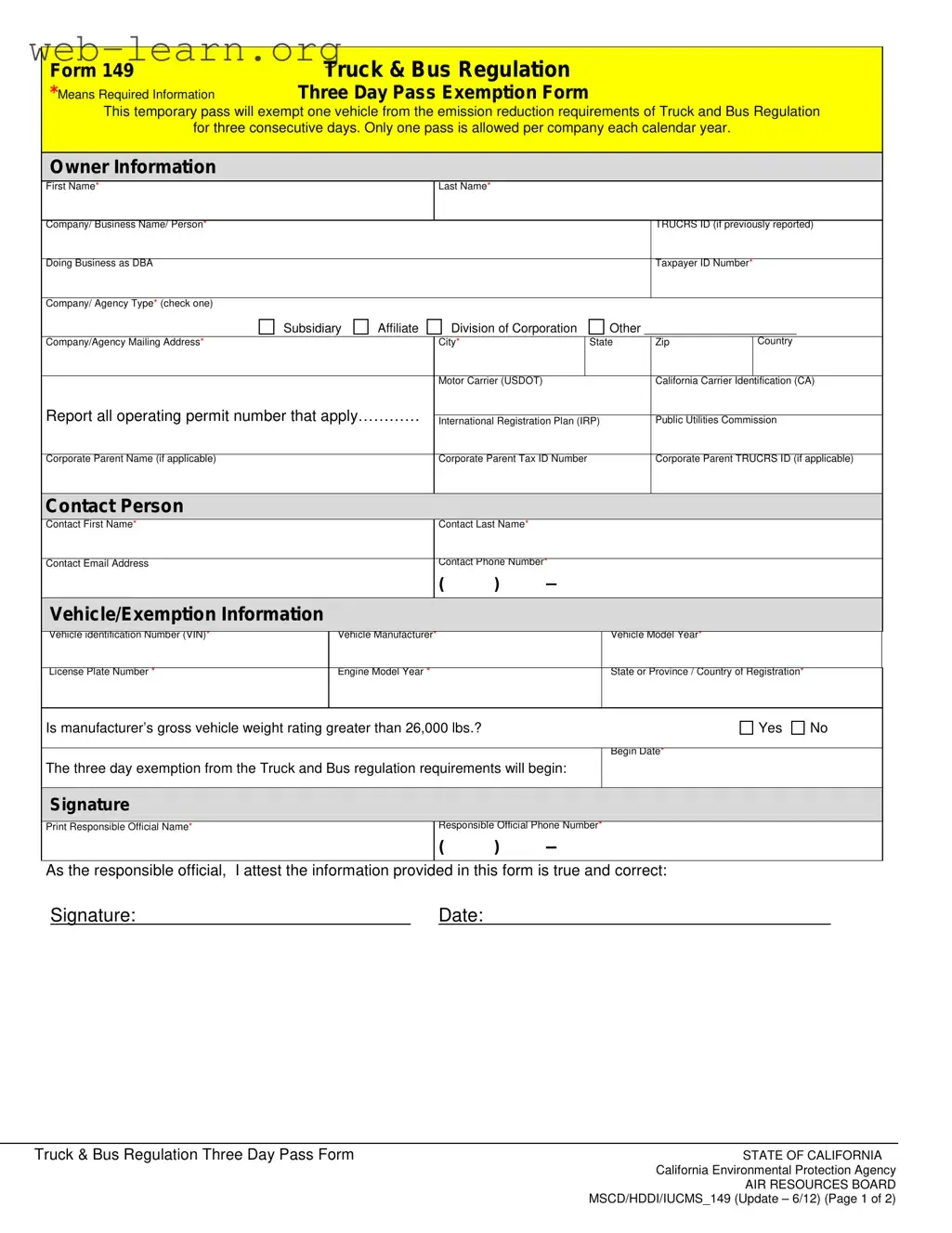
The California 149 form, officially known as the Truck and Bus Regulation Three Day Pass Exemption Form, plays a crucial role for fleet owners needing temporary relief from stringent emission reduction requirements. This form allows a single vehicle to operate in California for three consecutive days without meeting the state's emission standards, making it an essential tool for businesses that may face compliance challenges. Each company is limited to one pass per calendar year, ensuring that the system is used judiciously. To complete the form, owners must provide detailed information, including their company name, contact details, and specifics about the vehicle in question, such as its VIN, manufacturer, and engine model year. The pass can be obtained by submitting the completed form to the California Air Resources Board (ARB) at least three days before the vehicle's planned entry into the state. If the ARB does not respond in time, the vehicle may still operate under the exemption. Importantly, there are no mileage restrictions during the three-day period, but fleet owners must be aware of their obligations to present the form upon request to avoid penalties. Understanding the guidelines for when a Three Day Pass is necessary can help businesses navigate California's complex regulatory landscape effectively.

Sample - California 149 Form

Truck & Bus Regulation Three Day Pass Form STATE OF CALIFORNIA
California Environmental Protection Agency
AIR RESOURCES BOARD
MSCD/HDDI/IUCMS_149 (Update – 6/12) (Page 1 of 2)
Form 149
Truck & Bus Regulation
*
Means Required Information
Three Day Pass Exemption Form
This temporary pass will exempt one vehicle from the emission reduction requirements of Truck and Bus Regulation
for three consecutive days. Only one pass is allowed per company each calendar year.
Owner Information
First Name
*
Last Name
*
Company
/ Business N
/ Person
*
TRUCRS ID
(if previously reported)
Doing Business as DBA
Tax
payer
I
D N
umber
*
Company/ Agency Type
*
(check one)
Subsidiary Affiliate Division of Corporation Other ______________________
Company/Agency Mailing Address
*
City
*
State
Zip
Country
Report all operating permit number that apply…………
Motor Carrier (USDOT)
California Carrier Identification (CA)
International Registration Plan (IRP)
Public Utilities Commission
Corporate Parent Name (if applicable)
Corporate Parent
Tax I
D N
umber
Corporate Parent TRUCRS ID
(if applicable)
Contact Person
Contact First N
*
Contact Last N
ame
*
Contact Email A
ddress
Contact P
hone
N
umber
*
( )
Vehicle/Exemption Information
Vehicle identification
N
umber (VIN)
*
Vehicle
M
anu
facturer
*
Vehicle
Model
Year
*
License Plate Number
*
Engine Model Year
*
State or Province
/
Country of Registration
*
Is manufacturer’s gross vehicle weight rating greater than 26,000 lbs.? Yes No
The three day exemption from the Truck and Bus regulation requirements will begin:
Begin Date
*
Signature
Print Responsible Official Name
*
Responsible
O
fficial
P
hone
N
umber
*
( )
As the responsible official, I attest the information provided in this form is true and correct:
Signature: _ Date: _
What is a Three Day Pass?
A Three Day Pass is a temporary permit that allows a fleet owner to operate one vehicle per calendar year
in California that does not meet the emission reduction requirements of the Truck and Bus regulation. The
three day period begins at 12:00 am on the date you specify on the form.
How do I obtain a Three Day Pass?
You must complete a request form and submit the information to the Air Resources Board (ARB) three
days prior to the vehicle entering California. The pass will be granted as long as it is the first request made
by the fleet in the calendar year. If the ARB fails to respond by the date of the vehicles planned entry, the
vehicle may operate in California for the requested three-day period. The vehicle operator must present a
copy of the form to Air Resources Board personnel upon request, or the fleet owner may be subject to
penalties.
Mail the Request for the Three Day Pass to:
Truck & Bus Reporting, 5th Floor
PO BOX 2815
California Air Resources Board
Sacramento, CA 95812
You may also fax the form to our office at (916)323-5526, or Email the forms to us at
Is there a limit on the number of miles I can operate under this pass?
There are no mileage limits for a vehicle operating during the three day period specified in an approved
Three Day Pass.
Do I need a Three Day Pass?
If you reported the vehicle as part of your fleet to use the phase in option or flexibility options in the
regulation, and your fleet is in compliance, you do not need a three day pass. The following are situations
that you should use a three day pass:
If you reported to use flexibility options but you need to temporarily bring a vehicle into California that
you did not report.
If you are using the model year schedule to comply (not required to report) and you want to
temporarily bring a noncompliant truck into California. A summary of the engine model year schedule
for heavier trucks is shown below
Engine Model Year Schedule for Heavier Trucks (More than 26,000 lb GVWR)
Engine year
PM Filter by:
2010
Engine by:
1993 & Older Not Required January 1, 2015
1994-1995 Not Required January 1, 2016
1996-1999 January 1, 2012 January 1, 2020
2000-2004 January 1, 2013 January 1, 2021
2005-2006 January 1, 2014 January 1, 2022
2007 & Newer Already Equipped January 1, 2023
If your truck has a gross vehicle weight rating (GVWR) between 14,001 and 26,000 pounds your first
compliance date is not until January 1, 2015. An overview of the Truck and Bus regulation compliance
requirements are available at
http://www.arb.ca.gov/msprog/onrdiesel/documents/FSRegSum.pdf.
If you have any questions or need help completing the form, please contact us at 866-6DIESEL
(866-634-3735) or by email at: [email protected].

Form Information

Fact Name Details
Purpose The California 149 form is used to request a temporary Three Day Pass, allowing a vehicle to operate without meeting certain emission requirements.
Eligibility Only one Three Day Pass is allowed per company each calendar year, and it can exempt one vehicle for three consecutive days.
Application Process Submit the completed form to the Air Resources Board (ARB) at least three days before the vehicle enters California.
Governing Law This form is governed by California's Truck and Bus Regulation under the California Environmental Protection Agency.
Contact Information For assistance, contact the ARB at 866-634-3735 or email [email protected].
Mileage Limitations There are no mileage limits for vehicles operating under the Three Day Pass during the specified period.

Detailed Guide for Filling Out California 149

To obtain a Three Day Pass for a vehicle that does not meet California's Truck and Bus Regulation emission requirements, the California 149 form must be completed accurately. This process involves gathering necessary information about the vehicle and the owner, and submitting the form to the Air Resources Board. Following these steps will ensure that the application is filled out correctly.

  1. Begin by gathering all necessary information about the vehicle and the owner. This includes personal details, vehicle identification, and company information.
  2. Fill in the owner information section. Provide your first name, last name, company or business name, TRUCRS ID (if applicable), and taxpayer ID number.
  3. Select the type of company or agency by checking one of the options: Subsidiary, Affiliate, Division of Corporation, or Other. If you select "Other," specify the type.
  4. Enter the company or agency mailing address, including the city, state, zip code, and country.
  5. Provide the motor carrier (USDOT) number and California Carrier Identification (CA) number, if applicable. Report all operating permit numbers that apply, including the International Registration Plan (IRP) and Public Utilities Commission details.
  6. If applicable, provide the corporate parent name and tax ID number, as well as the corporate parent TRUCRS ID.
  7. Fill in the contact person's information, including their first name, last name, email address, and phone number.
  8. Complete the vehicle/exemption information section. Enter the vehicle identification number (VIN), manufacturer, model year, license plate number, engine model year, and state or province/country of registration.
  9. Indicate whether the manufacturer's gross vehicle weight rating is greater than 26,000 lbs by selecting "Yes" or "No."
  10. Specify the begin date for the three-day exemption period.
  11. Sign the form, print the responsible official's name, and provide their phone number.
  12. Finally, attest that the information provided is true and correct by signing and dating the form.

Once the form is completed, it can be submitted to the California Air Resources Board by mail, fax, or email. Ensure that the submission is made at least three days before the vehicle's planned entry into California to avoid any penalties or issues.

Obtain Answers on California 149

  1. What is a Three Day Pass?

    A Three Day Pass is a temporary permit that allows a fleet owner to operate one vehicle in California that does not meet the emission reduction requirements of the Truck and Bus regulation. This pass is valid for three consecutive days, starting at 12:00 am on the specified date.

  2. How do I obtain a Three Day Pass?

    To obtain a Three Day Pass, complete the request form and submit it to the Air Resources Board (ARB) at least three days before the vehicle enters California. The pass will be granted if it is the first request made by your fleet in that calendar year. If the ARB does not respond by the vehicle's planned entry date, the vehicle may still operate in California for the requested period. You can mail, fax, or email the request form to the ARB.

    • Mail: Truck & Bus Reporting, 5th Floor, PO BOX 2815, California Air Resources Board, Sacramento, CA 95812
    • Fax: (916) 323-5526
    • Email: [email protected]
  3. Is there a limit on the number of miles I can operate under this pass?

    No, there are no mileage limits for a vehicle operating during the three-day period specified in an approved Three Day Pass.

  4. Do I need a Three Day Pass?

    If your fleet is compliant and you reported the vehicle as part of it to use the phase-in or flexibility options, you do not need a Three Day Pass. However, you should use this pass in the following situations:

    • If you need to temporarily bring a vehicle into California that was not reported.
    • If you are using the model year schedule for compliance and want to bring a noncompliant truck into California.
  5. What are the compliance dates for heavier trucks?

    The compliance dates vary based on the engine model year for heavier trucks (more than 26,000 lbs GVWR). For example:

    • 1993 & Older: Not Required
    • 1994-1995: Not Required until January 1, 2016
    • 1996-1999: Compliance required by January 1, 2020
    • 2000-2004: Compliance required by January 1, 2021
    • 2005-2006: Compliance required by January 1, 2022
    • 2007 & Newer: Already Equipped, compliance by January 1, 2023
  6. What if I have questions or need help with the form?

    If you have questions or need assistance completing the form, you can contact the ARB at 866-6DIESEL (866-634-3735) or via email at [email protected].

  7. What happens if I do not have the Three Day Pass during operation?

    It is essential to present a copy of the form to Air Resources Board personnel upon request. Failure to do so may result in penalties for the fleet owner.

Common mistakes

Filling out the California 149 form can be a straightforward process, but many people make common mistakes that can lead to delays or complications. One frequent error is neglecting to provide all required information. Each field marked with an asterisk (*) is essential for processing the request. Omitting even one piece of information can result in the form being returned or delayed, causing frustration and potential penalties.

Another mistake often made is failing to check the eligibility of the vehicle. The form is specifically for vehicles that do not meet emission reduction requirements. If you submit a request for a vehicle that is already compliant, you may not only waste your time but also risk penalties. It's crucial to ensure that the vehicle in question truly qualifies for the three-day exemption.

People also frequently overlook the importance of providing accurate contact information. The contact person’s name, email address, and phone number are vital. If the Air Resources Board (ARB) needs to reach you for clarification or further information, having incorrect or incomplete contact details can lead to missed communications and delays in processing your request.

Another common error is misunderstanding the timeline for submission. The form must be submitted at least three days prior to the vehicle's entry into California. Many applicants mistakenly believe they can submit it on the same day of entry, which can lead to disqualification from receiving the pass. Planning ahead is essential to avoid this pitfall.

In addition, some individuals fail to sign the form or provide a date next to their signature. This may seem like a minor detail, but without a signature, the form is not valid. Ensure that the responsible official's name is printed clearly and that the signature is present to attest to the accuracy of the information provided.

Lastly, many people do not keep a copy of the completed form for their records. This can be a significant oversight, especially if questions arise later regarding the exemption. Retaining a copy allows for easy reference and can be crucial if any issues occur during the vehicle's operation in California.

Documents used along the form

The California 149 form, also known as the Truck & Bus Regulation Three Day Pass Exemption Form, is essential for fleet owners who need temporary relief from emission reduction requirements. Alongside this form, several other documents are often utilized to ensure compliance and streamline the process. Understanding these forms can help in navigating the regulatory landscape more effectively.

  • California Air Resources Board (CARB) Compliance Certificate: This document verifies that a vehicle meets California's emission standards. It is crucial for fleet owners to have this certificate for each vehicle to avoid penalties.
  • Truck and Bus Regulation Compliance Report: This report outlines a fleet's compliance status with the Truck and Bus Regulation. It is used to track adherence to emission requirements and to demonstrate compliance during inspections.
  • Vehicle Registration Document: This document provides proof of a vehicle's registration with the state. It includes details such as the Vehicle Identification Number (VIN) and the owner's information, which are essential for any regulatory submissions.
  • Maintenance Records: Keeping detailed maintenance records is vital for demonstrating compliance with emission standards. These records show that vehicles have been properly maintained and any necessary repairs have been completed.
  • Emission Test Results: These results indicate whether a vehicle meets the required emission standards. They are often required for compliance checks and can be crucial for obtaining permits.
  • Fleet Information Report: This report provides an overview of all vehicles within a fleet, including their compliance status and any exemptions that may apply. It helps in managing fleet operations effectively.
  • Contact Information Form: This form collects essential contact details for fleet owners or operators. It ensures that the California Air Resources Board can reach the right person for any inquiries or compliance issues.

Familiarizing oneself with these documents can significantly ease the process of compliance with California's Truck and Bus regulations. Each form plays a specific role in ensuring that fleet operations run smoothly and adhere to state requirements. Keeping these documents organized and accessible will aid in maintaining compliance and avoiding potential penalties.

Similar forms

The California 149 form, which serves as a temporary exemption for vehicles from the Truck and Bus Regulation, shares similarities with several other documents. Each of these forms addresses specific regulatory needs and requirements for vehicle operation. Below is a list of documents that are comparable to the California 149 form:

  • California 150 Form: This form is used for requesting a temporary permit for vehicles that do not meet emissions standards, similar to the three-day exemption provided by the California 149 form.
  • California 151 Form: This document allows fleet owners to apply for an extension on compliance deadlines, akin to the temporary relief offered by the California 149 form.
  • California 152 Form: This form is for reporting non-compliant vehicles and requesting special consideration, paralleling the exemption process of the California 149 form.
  • California 153 Form: Used for applying for a temporary operating permit for vehicles under special circumstances, it functions similarly to the California 149 form in providing short-term relief from regulatory requirements.
  • California 154 Form: This form is utilized for requesting an exemption for specific vehicle types, much like the California 149 form's three-day exemption for non-compliant vehicles.
  • California 155 Form: This document allows fleet owners to report changes in vehicle status or ownership, which can impact compliance, similar to the information required in the California 149 form.
  • California 156 Form: This form is for requesting a temporary suspension of compliance requirements due to unforeseen circumstances, mirroring the temporary exemption process of the California 149 form.
  • California 157 Form: This document is for applying for a special permit for vehicles that require modifications to meet compliance standards, akin to the exemption provided by the California 149 form.

Each of these forms serves a specific purpose within California's vehicle regulation framework, offering various avenues for compliance and exemption. Understanding their similarities can assist fleet owners in navigating regulatory requirements more effectively.

Dos and Don'ts

When filling out the California 149 form for a Three Day Pass, it’s essential to ensure accuracy and completeness. Here are seven things you should and shouldn’t do:

  • Do provide all required information, including your first and last name, company name, and contact details.
  • Do double-check the Vehicle Identification Number (VIN) and ensure it matches the vehicle you are registering.
  • Do submit the form at least three days before the vehicle enters California to avoid any delays.
  • Do ensure that the responsible official signs and dates the form, attesting to the accuracy of the information provided.
  • Don’t submit multiple requests for the same vehicle within a calendar year, as only one pass is allowed per company.
  • Don’t forget to include your contact phone number; it’s crucial for any follow-up questions.
  • Don’t ignore the guidelines regarding vehicle weight; ensure you indicate if the vehicle's gross weight exceeds 26,000 lbs.

Misconceptions

Misconceptions about the California 149 form can lead to confusion for fleet owners. Here are nine common misunderstandings:

  • Only one pass can be requested per year. Many believe they can apply for multiple passes within a year. However, the regulation allows only one three-day pass per company each calendar year.
  • The pass can be used for any vehicle. Some think they can use the pass for any truck. In reality, the vehicle must not meet the emission reduction requirements of the Truck and Bus regulation.
  • There is a mileage limit during the three-day period. It is a common belief that there are restrictions on how far the vehicle can travel. In fact, there are no mileage limits for vehicles operating under this pass.
  • The pass is automatically granted. Many assume that submitting the form guarantees approval. Approval is contingent on it being the first request of the calendar year and must be submitted three days in advance.
  • The pass is not necessary if the fleet is compliant. Some fleet owners think they do not need a pass if their fleet complies with regulations. However, a pass is still needed for vehicles not reported as part of the fleet.
  • All vehicles need a pass to enter California. It is a misconception that every vehicle entering the state requires a pass. Only non-compliant vehicles that are not part of the reported fleet need the pass.
  • Contacting the Air Resources Board is unnecessary. Some believe they can fill out the form without any further communication. However, for assistance or clarification, contacting the Air Resources Board can be beneficial.
  • The start date of the pass is flexible. Many think they can choose any start date. The pass begins at 12:00 am on the date specified in the form and cannot be changed once submitted.
  • There is no need to present the pass during inspections. Some assume they can operate without showing the pass. In fact, the vehicle operator must present a copy of the form to Air Resources Board personnel upon request.

Key takeaways

Key Takeaways for Filling Out and Using the California 149 Form:

  • The California 149 form provides a temporary three-day pass to exempt one vehicle from emission reduction requirements.
  • Only one pass is allowed per company each calendar year, so plan accordingly.
  • Complete all required fields, including owner information and vehicle details, to ensure the application is processed smoothly.
  • The exemption period begins at 12:00 am on the specified date, so choose your start date carefully.
  • Submit the form to the Air Resources Board (ARB) at least three days before the vehicle enters California.
  • There are no mileage limits during the three-day exemption period; you can operate the vehicle as needed.
  • If your fleet is compliant or if you reported the vehicle for phase-in options, you may not need a three-day pass.
  • For assistance, reach out to the ARB via phone or email if you have questions about the form or process.