Homepage Blank California 1296 32 Form
Outline

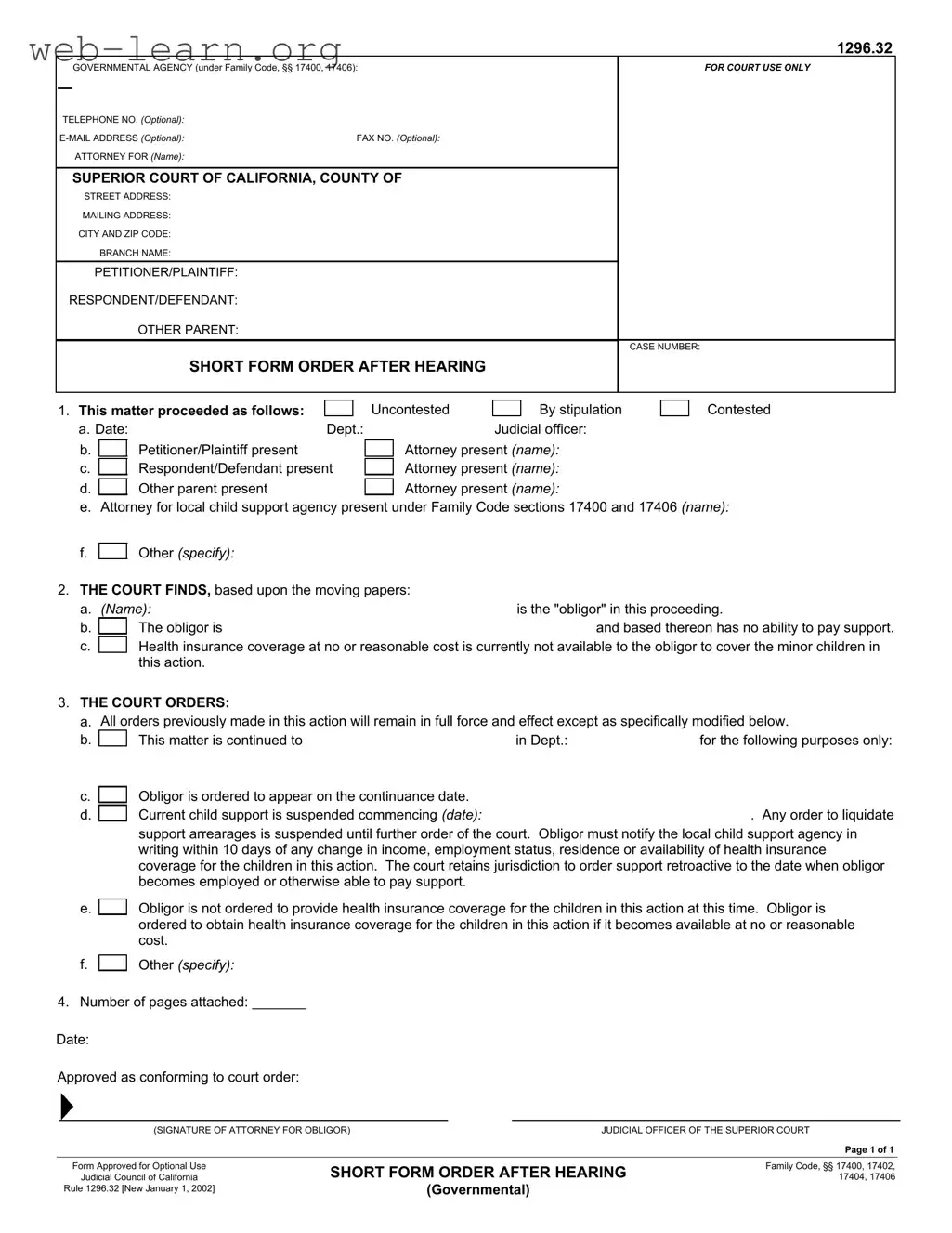
The California 1296 32 form, also known as the Short Form Order After Hearing, plays a crucial role in family law proceedings, particularly those involving child support. This form is utilized by governmental agencies under the Family Code sections 17400 and 17406, ensuring that all parties involved in a child support case are treated fairly and that the court's decisions are clearly documented. The form includes essential information such as the names of the petitioner, respondent, and other parents, as well as the case number and court details. It outlines the proceedings of the court hearing, indicating whether the case was contested or uncontested, and notes the presence of attorneys and other relevant parties. Importantly, the form captures the court's findings regarding the obligor's ability to pay support, health insurance availability, and any modifications to previous orders. It also specifies the obligations of the obligor, including the requirement to notify the local child support agency of any changes in circumstances. By providing a structured format for these critical details, the California 1296 32 form helps ensure that child support cases are managed effectively and transparently.
Sample - California 1296 32 Form

TELEPHONE NO. (Optional):
FOR COURT USE ONLYGOVERNMENTAL AGENCY (under Family Code, §§ 17400, 17406):
ATTORNEY FOR (Name):
SUPERIOR COURT OF CALIFORNIA, COUNTY OF
STREET ADDRESS:
MAILING ADDRESS:
CITY AND ZIP CODE:
BRANCH NAME:
PETITIONER/PLAINTIFF:
RESPONDENT/DEFENDANT:
CASE NUMBER:
SHORT FORM ORDER AFTER HEARING
This matter proceeded as follows:
Date:
b.
c.
Current child support is suspended commencing (date): . Any order to liquidate
All orders previously made in this action will remain in full force and effect except as specifically modified below.
THE COURT FINDS, based upon the moving papers:
is the "obligor" in this proceeding.
Date:
JUDICIAL OFFICER OF THE SUPERIOR COURT
Approved as conforming to court order:
Form Approved for Optional Use
Judicial Council of California
Rule 1296.32 [New January 1, 2002]
SHORT FORM ORDER AFTER HEARING
(Governmental)
Family Code, §§ 17400, 17402,
17404, 17406
1.
a.
Petitioner/Plaintiff present
Respondent/Defendant present
a.
b.
1296.32
Obligor is not ordered to provide health insurance coverage for the children in this action at this time. Obligor is
ordered to obtain health insurance coverage for the children in this action if it becomes available at no or reasonable
cost.
OTHER PARENT:
FAX NO. (Optional):
Uncontested By stipulation Contested
Dept.: Judicial officer:
d. Other parent present
Attorney present (name):
e. Attorney for local child support agency present under Family Code sections 17400 and 17406 (name):
f. Other (specify):
2.
The obligor is and based thereon has no ability to pay support.
c.
Health insurance coverage at no or reasonable cost is currently not available to the obligor to cover the minor children in
this action.
THE COURT ORDERS:3.
a.
b.
This matter is continued to in Dept.: for the following purposes only:
c.
Obligor is ordered to appear on the continuance date.
d.
e.
f.
support arrearages is suspended until further order of the court. Obligor must notify the local child support agency in
writing within 10 days of any change in income, employment status, residence or availability of health insurance
coverage for the children in this action. The court retains jurisdiction to order support retroactive to the date when obligor
becomes employed or otherwise able to pay support.
Other (specify):
(SIGNATURE OF ATTORNEY FOR OBLIGOR)
E-MAIL ADDRESS (Optional):
(Name):
Number of pages attached: _______4.
Page 1 of 1

Form Information

Fact Name Details
Governing Law The California 1296.32 form is governed by Family Code sections 17400 and 17406.
Purpose This form is used for court proceedings related to child support and obligations.
Parties Involved The form involves a petitioner/plaintiff, a respondent/defendant, and potentially an other parent.
Optional Contact Information It allows optional entries for telephone number, email address, and fax number.
Judicial Officer The form requires the name of the judicial officer presiding over the case.
Obligor Definition The form identifies the "obligor," the person responsible for child support payments.
Support Orders Current child support can be suspended, and orders may be modified by the court.
Health Insurance Requirement The obligor must obtain health insurance for the children if it becomes available at no or reasonable cost.

Detailed Guide for Filling Out California 1296 32

Completing the California 1296.32 form is an important step in the legal process. This form is used in family law cases, particularly those involving child support matters. After filling out the form, it will need to be submitted to the appropriate court for processing. Below are the steps to guide you through filling out the form accurately.

  1. Begin by entering the name of the governmental agency at the top of the form.
  2. Provide the telephone number, e-mail address, and fax number if applicable. These fields are optional.
  3. Identify the attorney for the party by writing their name in the designated space.
  4. Fill in the Superior Court of California, County of with the appropriate county name.
  5. Enter the street address and mailing address of the court.
  6. Specify the city and zip code where the court is located.
  7. Indicate the branch name of the court.
  8. List the names of the petitioner/plaintiff and the respondent/defendant.
  9. Include the name of the other parent if applicable.
  10. Enter the case number associated with this matter.
  11. In section 1, document the details of the hearing, including the date and department where it occurred.
  12. Indicate whether the petitioner/plaintiff, respondent/defendant, and other parent were present during the hearing.
  13. Note if the matter was uncontested or contested and provide the name of the judicial officer and any attorneys present.
  14. In section 2, identify the obligor and state their ability to pay support.
  15. Discuss the availability of health insurance coverage for the minor children.
  16. In section 3, outline the court’s orders, including any modifications to previous orders.
  17. Specify the continuance date and the department for future proceedings.
  18. Document any orders related to child support and the obligor's responsibilities.
  19. Indicate the number of pages attached to the form.
  20. Finally, sign and date the form, and ensure the signature of the attorney for the obligor is included.

Obtain Answers on California 1296 32

  1. What is the purpose of the California 1296 32 form?

    The California 1296 32 form, also known as the Short Form Order After Hearing, is used in family law cases, specifically regarding child support matters. It documents the findings and orders made by the court after a hearing, ensuring that all parties are aware of their obligations and the court's decisions.

  2. Who completes the California 1296 32 form?

    The form is typically completed by the attorney representing the obligor, who is the person responsible for paying child support. In some cases, it may also be filled out by the local child support agency or another party involved in the case.

  3. What information is required on the form?

    The form requires various details, including:

    • The names of the petitioner/plaintiff and respondent/defendant.
    • The case number.
    • Details about the hearing, such as the date and department.
    • Findings related to the obligor's ability to pay support and health insurance coverage.

  4. What happens if the obligor cannot pay child support?

    If the court finds that the obligor has no ability to pay support, the current child support obligations may be suspended. The court will retain the authority to order support retroactively if the obligor's financial situation changes in the future.

  5. What are the obligations of the obligor after the hearing?

    The obligor is required to:

    • Notify the local child support agency in writing within 10 days of any changes in income, employment status, residence, or health insurance availability.
    • Appear in court on any specified continuance dates.
    • Obtain health insurance coverage for the children if it becomes available at no or reasonable cost.

  6. Can the court modify previous orders?

    Yes, the court can modify previous orders as needed. The form specifies that all prior orders will remain in effect unless explicitly changed in the new order.

  7. What is the significance of the judicial officer's signature?

    The signature of the judicial officer indicates that the court has reviewed and approved the findings and orders documented in the form. This signature is essential for the order to be enforceable.

  8. How many pages can be attached to the form?

    The form allows for additional pages to be attached if necessary. The number of attached pages should be noted on the form to ensure that all relevant information is included.

  9. When should the form be submitted?

    The form should be submitted to the court immediately following the hearing. Timely submission ensures that the court's orders are officially recorded and enforceable.

Common mistakes

Filling out the California 1296.32 form can be straightforward, but many people make common mistakes that can delay the process or lead to complications. One of the most frequent errors is leaving out essential contact information. While providing a telephone number, email address, and fax number is optional, including them can facilitate communication with the court and the local child support agency. Omitting this information may result in missed notifications or important updates.

Another mistake often seen is failing to accurately identify all parties involved. The form requires clear identification of the petitioner, respondent, and any other parent. If someone is listed incorrectly or not at all, it can create confusion and potentially jeopardize the case. Ensure that names are spelled correctly and all necessary parties are included to avoid unnecessary complications.

Many individuals also overlook the importance of detailing the circumstances surrounding the case. Section 2 of the form asks for specific findings, such as the obligor's ability to pay support and the availability of health insurance. Incomplete or vague responses can lead to misunderstandings or unfavorable rulings. Providing clear and thorough information helps the court make informed decisions.

Another common oversight is neglecting to specify dates and other critical details in the order section. For example, the form requires a date for when child support is suspended and the date for the continuance. Missing these details can lead to delays in processing the order. Always double-check that all dates and relevant information are filled in correctly.

People also sometimes forget to sign the form. The signature of the attorney for the obligor is necessary to validate the document. Without it, the form may be deemed incomplete. Ensure that all required signatures are present before submitting the form to avoid unnecessary delays.

Lastly, failing to attach any required documents can be a significant mistake. If there are additional pages or evidence that need to accompany the form, they must be clearly labeled and included. Not doing so can result in the court not having all the information needed to proceed with the case. Always check that all attachments are in order before submission.

Documents used along the form

The California 1296.32 form is often accompanied by several other documents that play crucial roles in family law proceedings, particularly those related to child support and custody matters. Understanding these documents can help streamline the legal process and ensure that all necessary information is provided to the court.

  • California Child Support Guideline Calculator: This tool helps determine the appropriate amount of child support based on the income of both parents and the needs of the child. It provides a standardized calculation to support fair financial arrangements.
  • Income and Expense Declaration (Form FL-150): This form is used to disclose the financial situation of both parents. It includes details about income, expenses, assets, and liabilities, helping the court assess each party's ability to pay support.
  • Notice of Motion (Form FL-300): This document is filed to request a court hearing regarding child support or custody issues. It outlines the specific requests being made and notifies the other party of the upcoming hearing.
  • Judgment (Form FL-180): This form finalizes the court's decisions regarding child support, custody, and visitation. It serves as the official record of the court's orders and is essential for enforcement purposes.
  • Child Support Agency Referral (Form FL-395): This form is submitted to request assistance from the local child support agency. It initiates the process for the agency to help establish or modify child support orders.
  • Declaration Under Uniform Child Custody Jurisdiction and Enforcement Act (UCCJEA) (Form FL-105): This document provides information about the child's residence history and helps the court determine jurisdiction for custody matters. It is vital for cases involving multiple states.
  • Proof of Service (Form FL-335): This form confirms that legal documents have been properly served to the other party. It is essential for ensuring that all parties are aware of the proceedings and can respond accordingly.

Each of these documents serves a specific purpose in family law proceedings. By preparing and submitting them alongside the California 1296.32 form, parties can ensure that their cases are presented clearly and comprehensively to the court. This preparation can significantly impact the outcome of the proceedings.

Similar forms

The California 1296.32 form is a legal document used in family law proceedings, particularly in child support cases. It has similarities with several other legal forms that serve related purposes. Below is a list of ten documents that share characteristics with the California 1296.32 form:

  • California 1296.30 Form: This form is also related to child support hearings and addresses similar issues of obligation and support modifications.
  • California 1296.31 Form: This document deals with the enforcement of child support orders, focusing on the obligor's responsibilities and compliance.
  • California 1300 Form: Used for child custody and visitation matters, this form also requires court findings and orders based on parental obligations.
  • California 1500 Form: This is a request for child support services and is often used to initiate cases involving child support enforcement.
  • California 1310 Form: This form addresses the modification of child support orders, similar to the provisions found in the 1296.32 form.
  • California 1320 Form: This document is utilized for the establishment of paternity, which can impact child support obligations.
  • California 1250 Form: It is a request for a hearing regarding child support, focusing on the need for judicial intervention in support matters.
  • California 1400 Form: This form pertains to the acknowledgment of parentage and is relevant in determining financial responsibilities for child support.
  • California 17400 Form: This document is specifically related to the local child support agency's involvement in support cases, similar to the 1296.32 form.
  • California 1315 Form: Used for child support arrears, this form addresses the accumulation of unpaid support and related court orders.

Each of these forms plays a crucial role in family law and child support cases, ensuring that obligations are clearly defined and enforced. Understanding their similarities can help individuals navigate the legal landscape more effectively.

Dos and Don'ts

When filling out the California 1296.32 form, it is essential to follow certain guidelines to ensure accuracy and compliance. Here are some important dos and don'ts:

  • Do fill in all required fields completely and accurately to avoid delays in processing.
  • Do provide your contact information, such as telephone number and email address, if applicable.
  • Don't leave any sections blank that are mandatory. Incomplete forms may be rejected.
  • Don't use legal jargon or overly complex language. Clear and straightforward language is preferred.

Misconceptions

The California 1296 32 form is often misunderstood. Here are seven common misconceptions about this form, along with clarifications.

  • The form is only for child support cases. While the 1296 32 form is commonly used in child support proceedings, it can also apply to other matters related to family law, particularly those involving obligations to provide support.
  • It is mandatory to have an attorney present. Although having legal representation can be beneficial, it is not a requirement to submit the 1296 32 form. Individuals can represent themselves if they choose to do so.
  • The obligor is always responsible for paying support. The form allows for the possibility that the obligor may not have the ability to pay support. If the court finds that the obligor lacks the financial means, support payments may be suspended.
  • The form guarantees a specific outcome. Submitting the 1296 32 form does not ensure a favorable decision. The court evaluates each case based on its unique circumstances before making a ruling.
  • Health insurance coverage is always required. The form indicates that the obligor is not currently ordered to provide health insurance for the children if it is not available at a reasonable cost. This requirement may change if affordable options become available.
  • Changes in circumstances do not need to be reported. It is essential for the obligor to notify the local child support agency of any changes in income, employment, or health insurance coverage within ten days, as specified in the form.
  • The court's jurisdiction ends after the hearing. The court retains jurisdiction to order support retroactively if the obligor becomes able to pay in the future. This means that the court can revisit the issue of support as circumstances change.

Understanding these misconceptions can help individuals navigate the complexities of family law more effectively.

Key takeaways

When filling out the California 1296.32 form, there are several important aspects to keep in mind. This form is essential for cases involving child support and is used by the court to document findings and orders after a hearing. Here are some key takeaways:

  • Understand the Purpose: This form is primarily used to record the court's findings and orders related to child support after a hearing.
  • Identify the Parties: Clearly list the names of the petitioner, respondent, and other parent involved in the case.
  • Be Accurate with Dates: Make sure to provide accurate dates for the hearing and any relevant deadlines.
  • Document Findings: The form requires the court to make specific findings, such as the obligor's ability to pay support and the availability of health insurance.
  • Understand Obligations: If you are the obligor, be aware of your responsibilities, including notifying the local child support agency of any changes in your situation.
  • Keep Copies: Always retain copies of the completed form for your records, as well as any attached documents.
  • Follow Up: After the hearing, ensure you are aware of any future court dates or requirements specified in the orders.
  • Seek Assistance if Needed: If you're unsure about how to complete the form or what it entails, consider seeking help from a legal professional.

Filling out the California 1296.32 form accurately can significantly impact your case. Take your time, ensure all information is correct, and understand the implications of what you are signing. This attention to detail can help in navigating the child support process more smoothly.