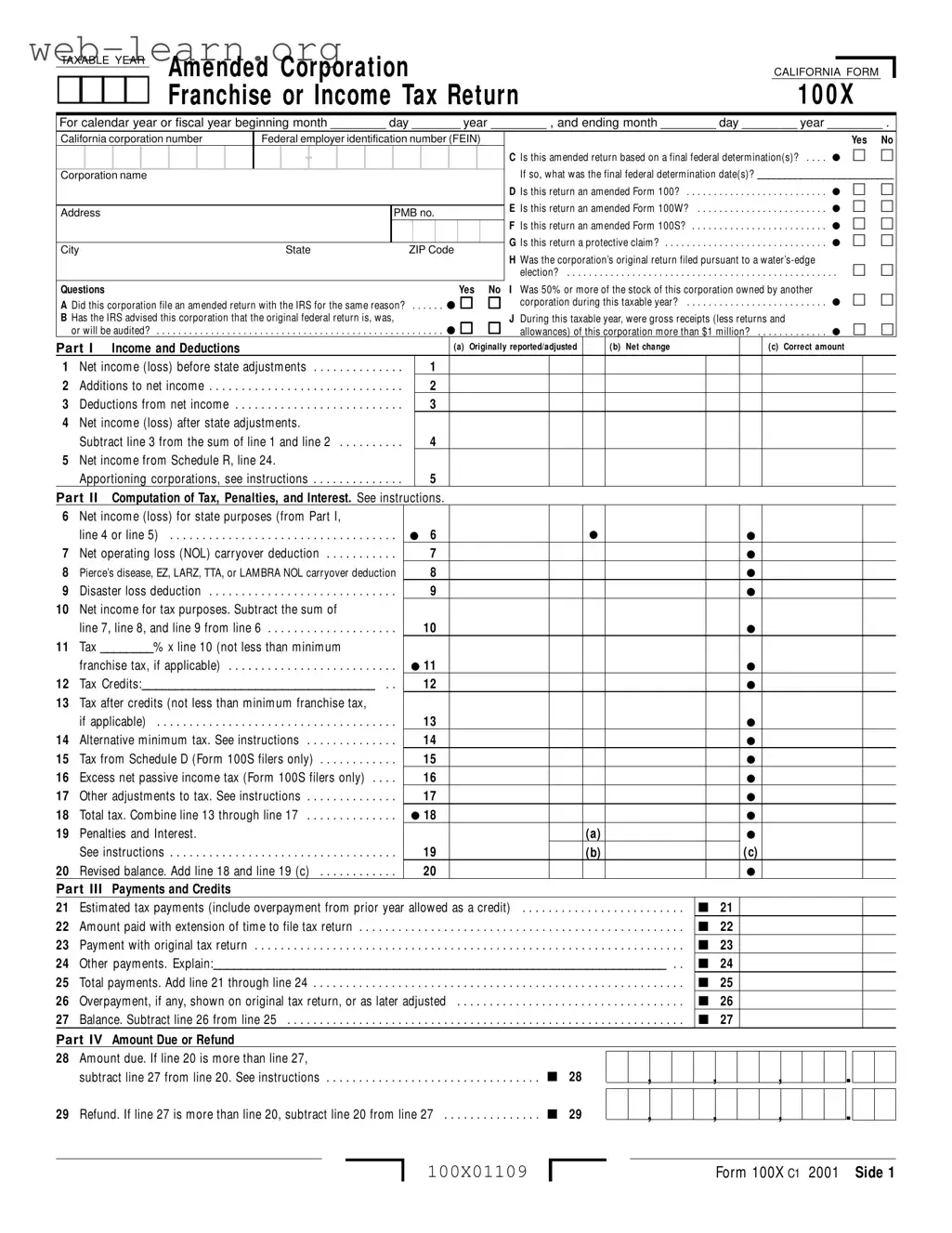
Homepage Blank California 100X Form
Outline

The California 100X form serves as a critical tool for corporations seeking to amend their previously filed tax returns. Designed specifically for California's franchise or income tax purposes, this form allows businesses to correct errors, report changes, or claim refunds related to their original tax filings. Corporations must indicate the taxable year for which they are amending their return, as well as provide essential identifying information, including their California corporation number and federal employer identification number (FEIN). The form contains a series of questions to determine the nature of the amendment, such as whether it is based on a final federal determination or if it is a protective claim. Additionally, it includes sections for reporting income, deductions, and any adjustments to tax liabilities, along with the computation of penalties and interest. The 100X form also requires a detailed explanation of the changes made, ensuring transparency and clarity in the amendment process. Understanding the nuances of this form is vital for corporations aiming to navigate California's tax landscape effectively and ensure compliance with state regulations.


Sample - California 100X Form

Form 100X C1 2001 Side 1
Amended Corporation
Franchise or Income Tax Return
TAXABLE YEAR
첸첸첸첸
For calendar year or fiscal year beginning month ________ day _______ year ________ , and ending month ________ day ________ year ________ .
Corporation name
Address PMB no.
City State ZIP Code
Questions Yes No
A Did this corporation file an amended return with the IRS for the same reason? . . . . . .
B Has the IRS advised this corporation that the original federal return is, was,
or will be audited? . . . . . . . . . . . . . . . . . . . . . . . . . . . . . . . . . . . . . . . . . . . . . . . . . . . . .
California corporation number Federal employer identification number (FEIN)
100X01109
CALIFORNIA FORM
100X
-
Ye s No
C Is this amended return based on a final federal determination(s)? . . . . 쐌첸
If so, what was the final federal determination date(s)? _________________________
D Is this return an amended Form 100? . . . . . . . . . . . . . . . . . . . . . . . . . . 쐌첸
E Is this return an amended Form 100W? . . . . . . . . . . . . . . . . . . . . . . . . 쐌첸
F Is this return an amended Form 100S? . . . . . . . . . . . . . . . . . . . . . . . . . 쐌첸
G Is this return a protective claim? . . . . . . . . . . . . . . . . . . . . . . . . . . . . . . 쐌첸
H Was the corporation’s original return filed pursuant to a water’s-edge
election? . . . . . . . . . . . . . . . . . . . . . . . . . . . . . . . . . . . . . . . . . . . . . . . . . . 첸첸
I Was 50% or more of the stock of this corporation owned by another
corporation during this taxable year? . . . . . . . . . . . . . . . . . . . . . . . . . . 쐌첸
J During this taxable year, were gross receipts (less returns and
allowances) of this corporation more than $1 million? . . . . . . . . . . . . . 쐌첸
(a) Originally reported/adjusted (b) Net change (c) Correct amount
Part I Income and Deductions
1 Net income (loss) before state adjustments . . . . . . . . . . . . . . 1
2 Additions to net income . . . . . . . . . . . . . . . . . . . . . . . . . . . . . . 2
3 Deductions from net income . . . . . . . . . . . . . . . . . . . . . . . . . . 3
4 Net income (loss) after state adjustments.
Subtract line 3 from the sum of line 1 and line 2 . . . . . . . . . . 4
5 Net income from Schedule R, line 24.
Apportioning corporations, see instructions . . . . . . . . . . . . . . 5
Part II Computation of Tax, Penalties, and Interest. See instructions.
6 Net income (loss) for state purposes (from Part I,
line 4 or line 5) . . . . . . . . . . . . . . . . . . . . . . . . . . . . . . . . . . .
6
7 Net operating loss (NOL) carryover deduction . . . . . . . . . . . 7
8 Pierce’s disease, EZ, LARZ, TTA, or LAMBRA NOL carryover deduction 8
9 Disaster loss deduction . . . . . . . . . . . . . . . . . . . . . . . . . . . . . 9
10 Net income for tax purposes. Subtract the sum of
line 7, line 8, and line 9 from line 6 . . . . . . . . . . . . . . . . . . . . 10
11 Tax ________% x line 10 (not less than minimum
franchise tax, if applicable) . . . . . . . . . . . . . . . . . . . . . . . . . .
11
12 Tax Credits:___________________________________ . . 12
13 Tax after credits (not less than minimum franchise tax,
if applicable) . . . . . . . . . . . . . . . . . . . . . . . . . . . . . . . . . . . . . 13
14 Alternative minimum tax. See instructions . . . . . . . . . . . . . . 14
15 Tax from Schedule D (Form 100S filers only) . . . . . . . . . . . . 15
16 Excess net passive income tax (Form 100S filers only) . . . . 16
17 Other adjustments to tax. See instructions . . . . . . . . . . . . . . 17
18 Total tax. Combine line 13 through line 17 . . . . . . . . . . . . . .
18
19 Penalties and Interest.
See instructions . . . . . . . . . . . . . . . . . . . . . . . . . . . . . . . . . . . 19
20 Revised balance. Add line 18 and line 19 (c) . . . . . . . . . . . . 20
(a)
(b)
(c)
Part III Payments and Credits
21 Estimated tax payments (include overpayment from prior year allowed as a credit) . . . . . . . . . . . . . . . . . . . . . . . . . 쮿 21
22 Amount paid with extension of time to file tax return . . . . . . . . . . . . . . . . . . . . . . . . . . . . . . . . . . . . . . . . . . . . . . . . . . 쮿 22
23 Payment with original tax return . . . . . . . . . . . . . . . . . . . . . . . . . . . . . . . . . . . . . . . . . . . . . . . . . . . . . . . . . . . . . . . . . . 쮿 23
24 Other payments. Explain:____________________________________________________________________ . . 쮿 24
25 Total payments. Add line 21 through line 24 . . . . . . . . . . . . . . . . . . . . . . . . . . . . . . . . . . . . . . . . . . . . . . . . . . . . . . . . . 쮿 25
26 Overpayment, if any, shown on original tax return, or as later adjusted . . . . . . . . . . . . . . . . . . . . . . . . . . . . . . . . . . . 쮿 26
27 Balance. Subtract line 26 from line 25 . . . . . . . . . . . . . . . . . . . . . . . . . . . . . . . . . . . . . . . . . . . . . . . . . . . . . . . . . . . . . 쮿 27
Part IV Amount Due or Refund
28 Amount due. If line 20 is more than line 27,
subtract line 27 from line 20. See instructions . . . . . . . . . . . . . . . . . . . . . . . . . . . . . . . . .
쮿 28
29 Refund. If line 27 is more than line 20, subtract line 20 from line 27 . . . . . . . . . . . . . . . 쮿 29
..
..
.
..
..
.
,,,
,,,
Side 2 Form 100X C1 2001
Part V Explanation of Changes
1 Enter name, address, and California corporation number used on original tax return (if same as shown on this amended return, write “Same”).
2 Explanation of Changes to items in Part I, Part II, Part III, and Part IV.
Enter the line number from Side 1 for each item that is changing and give the reason for each change. Attach all supporting forms and schedules for items
changed. Include federal schedules if a change was made to the federal return. Be sure to include the corporation name and California corporation number
on each attachment. Refer to the instructions and forms in the tax booklet for the year that is being amended.
_________________________________________________________________________________________________________________________________
_________________________________________________________________________________________________________________________________
_________________________________________________________________________________________________________________________________
_________________________________________________________________________________________________________________________________
_________________________________________________________________________________________________________________________________
_________________________________________________________________________________________________________________________________
_________________________________________________________________________________________________________________________________
_________________________________________________________________________________________________________________________________
_________________________________________________________________________________________________________________________________
_________________________________________________________________________________________________________________________________
_________________________________________________________________________________________________________________________________
_________________________________________________________________________________________________________________________________
_________________________________________________________________________________________________________________________________
_________________________________________________________________________________________________________________________________
_________________________________________________________________________________________________________________________________
_________________________________________________________________________________________________________________________________
100X01209
Where to File
Form 100X
If the Form 100X results in a refund or no
amount due, mail the amended tax return to:
FRANCHISE TAX BOARD
PO BOX 942857
SACRAMENTO CA 94257-0500
If the Form 100X results in an amount due,
mail the amended tax return to:
FRANCHISE TAX BOARD
PO BOX 942857
SACRAMENTO CA 94257-0501
Please
Sign
Here
Paid
Preparer’s
Use Only
Under penalties of perjury, I declare that I have filed an original return and I have examined this amended return, including accompanying schedules and statements, and to
the best of my knowledge and belief, this amended return is true, correct, and complete. Declaration of preparer (other than taxpayer) is based on all information of which
preparer has any knowledge.
Signature of officer Title Date Telephone
()
Preparer’s signature Date Check if self-
employed
Paid preparer’s SSN/PTIN
Telephone
()
Firms name (or yours, if
self-employed) and address
-
FEIN
Federal employer identification number (FEIN)
Corporation name
Address PMB no.
City State ZIP Code
California corporation number
-
For Privacy Act Notice, get form FTB 1131.
Form 100X 2001 Page 1
Instructions for Form 100X
Amended Corporation Franchise or Income Tax Return
General Information
Income year vs. taxable year
Effective for years beginning on or after
January 1, 2000, references to income year
were replaced with taxable year in all
provisions of the Corporation Law (CTL), the
Administration of the Franchise and Income
Tax Law (AFITL), and the Personal Income Tax
Law (PITL). When referring to an income
measurement period beginning before
January 1, 2000, the term taxable year
should be interpreted to mean income year.
Statute of limitation
California Revenue and Taxation Code Section
19306 was amended to provide that the
statute of limitation (SOL) for a refund will be
four years from the later of the original due
date or the date the tax return was filed. This
law change is effective for any year with an
open SOL for issuing a refund as of January 1,
2000. If the tax return is delinquent, the SOL
for refund will revert back to four years from
the original due date, not the extended due
date.
Preparer Tax Identification Number (PTIN)
Beginning January 1, 2000, tax professionals
have the option of providing their individual
Social Security Number (SSN) or Preparer Tax
Identification Number (PTIN) on returns they
prepare. Preparers who want a PTIN must
complete and submit federal Form W-7P,
Application for Preparer Tax Identification
Number, to the IRS.
A Purpose
Use Form 100X to amend a previously filed
Form 100, California Corporation Franchise or
Income Tax Return; Form 100W, California
Corporation Franchise or Income Tax Return
Waters-Edge Filers; or Form 100S, California
S Corporation Franchise or Income Tax
Return.
A claim for refund of an overpayment of tax
should be made by filing a Form 100X.
If the corporation is filing an amended tax
return in response to a billing notice the
corporation received, the corporation will
continue to receive billing notices until the
amended tax return is accepted. In addition,
the corporation must pay the assessed tax
before the corporation can claim a refund for
any part of the assessed tax.
Note: Do not use this form to change the
corporate filing status. If changing corporate
status from a C corporation to an S corpora-
tion, or vice versa, file form FTB 3560,
S Corporation Election or Termination/
Revocation.
Unless otherwise stated, the term corpora-
tion as used in Form 100X and in these
instructions includes banks, financial
corporations, S corporations, exempt
homeownersassociations, political organiza-
tions, limited liability companies; and limited
liability partnerships classified as
corporations.
B When to File
File Form 100X only after the original tax
return has been filed. Corporations must file a
claim for refund within four years from the
original due date of the tax return, the date
the tax return was filed, or within one year
from the date the tax was paid, whichever is
later. Tax returns filed before the due date are
considered as filed on the original due date.
If the federal corporate tax return is examined
and changed by the Internal Revenue Service
(IRS), report these changes to the Franchise
Tax Board (FTB) within six months of the final
federal determination by either:
Filing Form 100X, Amended Corporation
Income Tax Return; or
Sending a letter with copies of the federal
changes to:
CORPORATION RAR
FRANCHISE TAX BOARD
PO BOX 942857
SACRAMENTO CA 94257-0501
With either method, you must include a copy
of the final federal determination, all underly-
ing data and schedules that explain or support
the federal adjustments. Please note that most
penalties assessed by the IRS also apply
under California law. If penalties are included
in a payment with the amended return, see the
instructions for line 19, Penalties and Interest.
C Where to File
Tax Due
If tax is due, and the corporation is not
required to use electronic funds transfer
(EFT), make check or money order payable to
the Franchise Tax Board. Write the California
corporation number and2001 Taxable Year
Form 100X’’ on the check or money order.
Mail Form 100X with the check or money
order to:
FRANCHISE TAX BOARD
PO BOX 942857
SACRAMENTO CA 94257-0501
Note: If the corporation must pay its tax
liability using EFT, all payments must be
remitted by EFT to avoid penalties. See the
instructions for line 28, Amount Due.
Refund
Mail Form 100X to:
FRANCHISE TAX BOARD
PO BOX 942857
SACRAMENTO CA 94257-0500
Private Delivery Services
California law conforms to federal law
regarding the use of certain designated
private delivery services to meet the “timely
mailing as timely filing/paying rule for tax
returns and payments. See federal Form 1120,
U.S. Corporation Income Tax Return, for a list
of designated delivery services. Private
delivery services cannot deliver items to PO
boxes. If using one of these services to mail
any item to the FTB, DO NOT use an FTB PO
box. Address the amended tax return to:
FRANCHISE TAX BOARD
SACRAMENTO CA 95827
Private Mailbox (PMB) Number
If the corporation leases a PMB from a private
business rather than a PO box from the United
States Postal Service, include the box number
in the field labeled PMB no.” in the address
area.
Specific Line Instructions
Questions
B and C – The corporation must report any
changes made by the IRS that result in
additional tax to the FTB within six months of
the date of the final federal determination in
the following instances:
Based on a federal audit;
Reporting a final federal determination; or
The IRS asked for information to establish
the accuracy of specific items on the
federal return and a change was made.
If the IRS changes result in a refund for
California, generally the corporation must file
a claim within two years of the IRS final
determination date.
Be sure to include a complete copy of the final
federal determination and all supporting
computations and schedules, along with a
schedule of the adjustments as applicable to
the corporation’s California tax liability. For
more information, get FTB Pub. 1008, Federal
Tax Adjustments and Your Notification
Responsibilities to California.
D, E, and F – Check the appropriate box to
indicate whether this Form 100X is being filed
to amend a Form 100, Form 100W, or
Form 100S.
G – Check the “ Yes box if this Form 100X is
being filed as a protective claim for refund. A
protective claim is a claim for refund filed
before the expiration of the statute of
limitations for which a determination of the
claim depends on the resolution of some
other disputed issues, such as pending state
or federal litigation or audit.
H Corporations are not allowed to elect or
terminate a water’s-edge election on an
amended return. For information on how to
elect or terminate a water’s-edge election, get
the Form 100-W, Water’s-Edge Booklet.
I and J – If this amended return is being filed
to report an increase or decrease to the
prepaid minimum franchise tax, answer
question I and question J.
Columns (a), (b), and (c)
Column (a) Enter the amounts as shown on
the original or last previously amended tax
return or, if the tax return was adjusted or
examined, enter the amounts that were
determined by the FTB as a result of the
examination, whichever occurred later.
Page 2 Form 100X 2001
Column (b) Enter the net increase or the net
decrease for each line changed. List each
change on Side 2, Part V, question 2 and
provide an explanation and supporting
schedules for each change.
Column (c) Add any increase in column (b)
to the amount in column (a) or subtract any
decrease in column (b) from the amount in
column (a) and enter the result in column (c).
If there is no change, enter the amount from
column (a) in column (c).
Part I Income and Deductions
Line 5 Net income from Schedule R
If the corporate taxpayer apportions its
business income to California and there is a
net change in the amount of net business
income (loss) after state adjustments
apportioned to the corporate taxpayer, then
the corporate taxpayer must recompute and
attach Schedule R, Apportionment and
Allocation of Income.
Part II Computation of Tax,
Penalties, and Interest
For additional information (such as applicable
tax rates or instructions on how to determine
net operating loss carryover, alternative
minimum tax (AMT), excess net passive
income tax, etc.) refer to Form 100,
Form 100W, or Form 100S instructions for
the taxable year being amended.
Line 14 Alternative minimum tax (AMT)
Note: This applies to Form 100 or Form 100W
filers only.
Enter in column (b) the net increase or net
decrease in AMT between the original
Schedule P (100), Alternative Minimum Tax
and Credit Limitations Corporations, or
Schedule P (100W), Alternative Minimum Tax
and Credit Limitations Water’s-Edge Filers,
and the amended Schedule P (100) or
Schedule P (100W). Be sure to attach the
amended Schedule P (100) or
Schedule P (100W) to Form 100X.
Line 17 Other adjustments to tax
For interest adjustments under the “look-
back method of completed long-term
contracts, enter the net increase or net
decrease in column (b). Be sure to sign the
amended form FTB 3834, Interest Computa-
tion Under the Look-Back Method for
Completed Long-Term Contracts, and attach it
to Form 100X.
Also, enter in column (b) the net increase or
net decrease of any credit recapture, LIFO
recapture, or tax on installment sales. For
more information, get Form 100, Form 100W,
or Form 100S, Schedule J, Add-on Taxes and
Recapture of Tax Credits, for taxable years
1991 through 2001 or get Form 100 or
Form 100S instructions for taxable years
1988 through 1990.
Enter the increase or decrease to the $600
prepayment minimum franchise tax for
qualified new corporations per California
Revenue and Taxation Code Section 23221,
effective for taxable years beginning on or
after January 1, 1997, and before January 1,
1999. Enter the increase or decrease to the
$300 prepayment for taxable years beginning
on or after January 1, 1999, and before
January 1, 2000. (For corporations incorpo-
rating on or after January 1, 2000, there is no
prepayment.)
Line 19 Penalties and Interest
Line 19 (a) In column (b) enter the net
increase or net decrease of any penalties
being reported on the amended return.
Line 19 (b) In column (b) enter the net
increase or net decrease of interest being
reported on the amended return.
Line 19 (c) In column (c) enter the total of
line 19 column (a) and column (b).
If the corporation does not compute the
interest due, FTB will figure any interest due
and bill the corporation. Interest accrues on
the unpaid tax from the original due date of
the return to the date paid. For the applicable
interest rates, get FTB Pub. 1138A, Bank and
Corporation Billing Information.
Part III Payments and Credits
Enter any payments or credits on the
appropriate line.
Part IV Amount Due or Refund
Line 28 Amount due
Make the check or money order payable to the
Franchise Tax Board for the amount shown
on line 28. Write the California corporation
number and taxable year on the check. Attach
the check to the front of Form 100X.
Note: A corporation required to pay its taxes
through EFT must make all payments by EFT,
even if the tax due on the original tax return
was paid by check or money order. Indicate
which taxable year the payment should be
applied to when paying by EFT.
Line 29 Refund
If the corporation is entitled to a refund larger
than the amount claimed on the original tax
return, line 29 will show the amount of
refund. The FTB will figure any interest due
and will include it in the refund. If you are
claiming a refund for interest previously paid,
include the interest amount on line 19.
Part V Explanation of
Changes
Line 1
If the original tax return was filed using a
different Corporation name, address, and/or
California corporation number, enter the
name, address, and California corporation
number used on the original tax return on this
line.
Line 2
Explain in detail any changes made to the
amounts listed in Side 1, column (a). Include
in your explanation the line number refer-
ences for both the original and amended tax
returns and any detailed computations.
Include a copy of the federal Form 1120X and
schedules if a change was made to the federal
return. Include the corporations name and
California corporation number on all
attachments.
Where to Get Tax Forms and
Publications
By Internet – You can download, view, and
print California bank and corporation tax
forms and publications. Go to our Website at:
www.ftb. ca.gov
By phone To order 2001 business entity tax
forms call (800) 338-0505 and follow the
recorded instructions. This service is available
to callers with touchtone phones from 6 a.m.
to 8 p.m., Monday through Friday except state
holidays. Please allow two weeks to receive
your order. If you live outside of California,
please allow three weeks to receive your
order.
By mail Write to:
TAX FORMS REQUEST UNIT
FRANCHISE TAX BOARD
PO BOX 307
RANCHO CORDOVA CA 95741-0307
General Toll-Free Phone Service
Our general toll-free phone service is available
Monday through Friday, from 7 a.m. until
8 p.m and from 8 a.m. until 5 p.m. on
Saturdays.
Note: We may modify these hours without
notice to meet operational needs.
From within the
United States . . . . . . . . . . . (800) 852-5711
From outside the
United States . . . . . . . . . . . (916) 845-6500
(not toll-free)
Assistance for persons with disabilities
The FTB complies with the Americans with
Disabilities Act. Persons with hearing or
speech impairments call:
From voice phone
(California Relay Service) . . . . (800) 735-2922
From TTY/TDD
(Direct line to FTB
customer service) . . . . . . . . (800) 822-6268
For all other assistance or
special accommodations . . (800) 852-5711

Form Information

Fact Name Details
Purpose of Form The California 100X form is used to amend a previously filed Corporation Franchise or Income Tax Return (Form 100, 100W, or 100S).
Filing Deadline Corporations must file Form 100X within four years from the original due date of the tax return or the date the tax return was filed, whichever is later.
Governing Law This form is governed by the California Revenue and Taxation Code, particularly Sections 19306 and 23221.
Protective Claims The form can be filed as a protective claim for refund, which allows corporations to claim a refund while certain issues are still under dispute.
IRS Changes If the IRS makes changes to a corporation's federal return, those changes must be reported to the Franchise Tax Board (FTB) within six months of the final federal determination.
Minimum Franchise Tax Even if a corporation has no tax liability, it may still be subject to a minimum franchise tax, which must be considered when filing.
Payment Instructions If tax is due, checks should be made payable to the Franchise Tax Board, and the corporation number along with the taxable year should be noted on the payment.
Refund Process Refunds should be mailed to the FTB at a designated address if the amended return results in an overpayment or no amount due.
Signature Requirement The amended return must be signed by an authorized officer of the corporation, declaring the accuracy of the information provided.

Detailed Guide for Filling Out California 100X

Filling out the California 100X form is an important step for corporations seeking to amend their previously filed tax returns. Completing this form accurately ensures that any changes to income, deductions, or credits are properly reported to the Franchise Tax Board. Below are the steps to guide you through the process of filling out the form.

  1. Begin by entering the taxable year for the amended return. Specify whether it is for a calendar year or a fiscal year, and fill in the appropriate dates.
  2. Provide the California corporation number and the Federal Employer Identification Number (FEIN).
  3. Indicate whether this amended return is based on a final federal determination by answering the yes/no question.
  4. Fill in the corporation name and address, including the PMB number if applicable.
  5. Answer the questions regarding the original return, including whether it was filed as a water’s-edge election and if the corporation has filed an amended return with the IRS for the same reason.
  6. In Part I, report the income and deductions. Enter amounts in the columns for originally reported/adjusted, net change, and correct amount for each line item.
  7. In Part II, compute tax, penalties, and interest. Fill in the appropriate lines based on the calculations from Part I.
  8. In Part III, report any payments and credits made, including estimated tax payments and payments made with the original tax return.
  9. In Part IV, determine if there is an amount due or a refund. Complete the calculations for line 28 (amount due) and line 29 (refund).
  10. In Part V, provide an explanation of changes made to the original return. Include the line numbers and reasons for each change.
  11. Sign and date the form. If a preparer is involved, include their information as well.
  12. Mail the completed form to the appropriate address based on whether there is a refund or an amount due.

Obtain Answers on California 100X

  1. What is the California 100X form?

    The California 100X form is an amended corporation franchise or income tax return. Corporations use this form to correct errors or make changes to a previously filed Form 100, Form 100W, or Form 100S. It allows corporations to amend their tax filings for various reasons, including adjustments to income, deductions, or tax credits.

  2. When should a corporation file the 100X form?

    A corporation should file the 100X form after submitting its original tax return. The amended return must be filed within four years from the original due date, the date the tax return was filed, or within one year from the date the tax was paid, whichever is later. This ensures that any adjustments are made in a timely manner.

  3. How does a corporation determine if it needs to file a 100X form?

    If a corporation discovers that it made mistakes on its original tax return, it should consider filing a 100X form. Common reasons include changes in income, deductions, or credits that were not reported correctly. Additionally, if the IRS audits the original return and makes adjustments, the corporation must report these changes to the Franchise Tax Board (FTB) using the 100X form.

  4. What information is required to complete the 100X form?

    To complete the 100X form, a corporation must provide its California corporation number, federal employer identification number (FEIN), and details about the original return. This includes the taxable year, the corporation's name and address, and specific line items that are being amended. A clear explanation of the changes made must also be included.

  5. Where should the 100X form be filed?

    The filing location for the 100X form depends on whether there is an amount due or a refund. If the amended return results in a refund or no amount due, it should be mailed to:

    • FRANCHISE TAX BOARD
    • PO BOX 942857
    • SACRAMENTO, CA 94257-0500

    If there is an amount due, the form should be sent to:

    • FRANCHISE TAX BOARD
    • PO BOX 942857
    • SACRAMENTO, CA 94257-0501
  6. What should a corporation do if it disagrees with the IRS's adjustments?

    If a corporation disagrees with the IRS's adjustments, it can file a protective claim using the 100X form. This claim allows the corporation to seek a refund while the dispute is being resolved. It is important to file this claim before the statute of limitations expires.

  7. Are there penalties for not filing the 100X form when required?

    Yes, failing to file the 100X form when necessary can result in penalties and interest. The FTB may assess penalties for underreporting income or failing to report changes made by the IRS. It is crucial to address any discrepancies promptly to avoid additional charges.

  8. Can a corporation change its filing status using the 100X form?

    No, the 100X form cannot be used to change a corporation's filing status, such as switching from a C corporation to an S corporation. To change the filing status, a different form, specifically Form FTB 3560, must be used.

  9. What supporting documents are needed when filing the 100X form?

    When filing the 100X form, corporations must attach any supporting documents that explain the changes made. This includes copies of federal schedules if changes were made to the federal return, as well as any other relevant forms and schedules that support the adjustments being reported.

Common mistakes

Filling out the California 100X form can be a complex process. One common mistake is failing to check the correct boxes for the type of amended return being filed. This includes distinguishing between Form 100, Form 100W, and Form 100S. Not marking the appropriate box can lead to delays or rejections.

Another frequent error is neglecting to provide the correct California corporation number and Federal Employer Identification Number (FEIN). These numbers are crucial for identifying the corporation and linking the amended return to the original filing. Missing or incorrect numbers can cause significant processing issues.

Many individuals also forget to include an explanation of changes made in Part V. This section requires a detailed account of what has changed and why. Omitting this information can lead to questions from the Franchise Tax Board (FTB) and potentially slow down the processing of the return.

Some filers make the mistake of not attaching necessary supporting documents. If changes were made to the federal return, relevant schedules must accompany the 100X form. Failure to provide these documents can result in the return being deemed incomplete.

Additionally, errors in calculating the amounts in columns (a), (b), and (c) are common. These columns require precise figures based on previous returns and adjustments. Miscalculations can lead to incorrect tax liabilities, which may trigger further penalties or interest.

Another issue arises when taxpayers do not sign the form. Both the officer of the corporation and the preparer must sign the return. A missing signature can result in the return being rejected by the FTB.

Some individuals also overlook the deadlines for filing the amended return. The 100X must be submitted within a specific timeframe after the original return has been filed. Missing this deadline can forfeit the right to claim a refund.

Furthermore, failing to indicate whether the amended return is based on a final federal determination can complicate matters. This information helps the FTB understand the context of the changes being made.

Lastly, some filers neglect to double-check their mailing addresses. If the return is sent to the wrong address, it can lead to delays or miscommunication. Ensuring that the correct address is used is vital for timely processing.

Documents used along the form

The California 100X form is an essential document for corporations seeking to amend their previously filed tax returns. Alongside this form, several other documents may also be required to ensure a complete and accurate filing. Below is a list of commonly used forms and documents that often accompany the California 100X form.

  • Form 100: This is the original California Corporation Franchise or Income Tax Return. Corporations must file this form to report their income, deductions, and tax liability for a specific taxable year.
  • Form 100W: This form is used by corporations that elect to file as water’s-edge filers. It allows corporations to report income and deductions while limiting the scope of their taxable income to specific jurisdictions.
  • Form 100S: This is the California S Corporation Franchise or Income Tax Return. It is specifically for S corporations to report their income, deductions, and tax liabilities.
  • Schedule R: This schedule is used for apportioning income for corporations doing business both within and outside California. It details how income is divided among different jurisdictions.
  • Form 1120X: This is the federal amended return for corporations. If changes are made to the federal return, this form must be filed with the IRS, and a copy should be included with the California 100X filing.

Each of these forms plays a vital role in the amendment process, ensuring that all financial information is accurately reported and that the corporation complies with both state and federal tax regulations. Careful attention to detail is essential when completing these documents.

Similar forms

  • Form 100: This is the original California Corporation Franchise or Income Tax Return. The 100X form serves to amend any errors or changes made in the original filing, similar to how the 100 form is used for initial reporting.
  • Form 100W: This form is specifically for Water’s-Edge Filers. Like the 100X, it allows corporations to amend their previously filed Water’s-Edge tax returns, ensuring compliance with California tax regulations.
  • Form 100S: This is the California S Corporation Franchise or Income Tax Return. The 100X form can be used to amend a previously filed 100S, correcting any mistakes or changes in reported income or deductions.
  • Form 1120X: This is the federal amended corporate tax return. Just as the 100X allows for amendments to California returns, the 1120X allows corporations to correct their federal tax filings.
  • Form 8862: This form is used to claim the Earned Income Credit after disallowance. Similar to the 100X, it allows taxpayers to amend their claims based on new eligibility criteria or changes in circumstances.
  • Form 1040X: This is the amended individual income tax return. Like the 100X, it provides a means for individuals to correct previously filed tax returns for errors or omissions.
  • Form 940: This is the Employer's Annual Federal Unemployment (FUTA) Tax Return. If a business needs to amend its FUTA tax return, it can use a similar process as the 100X for correcting previous filings.
  • Form 941-X: This form is used to amend the Employer’s Quarterly Federal Tax Return. The process mirrors that of the 100X, allowing for corrections to payroll tax filings.
  • Form 720X: This is the amended Quarterly Federal Excise Tax Return. Similar to the 100X, it is utilized to correct errors in previously submitted excise tax returns.
  • Form 8862: This form is used to claim the Earned Income Credit after disallowance. Similar to the 100X, it allows taxpayers to amend their claims based on new eligibility criteria or changes in circumstances.

Dos and Don'ts

Things to Do When Filling Out the California 100X Form:

  • Ensure the original return has been filed before submitting the amended form.
  • Double-check all figures for accuracy before submission.
  • Attach all required supporting documents and schedules.
  • Clearly explain any changes in Part V, including line references.
  • Sign and date the form to confirm its authenticity.
  • Use the correct mailing address based on whether you owe taxes or expect a refund.
  • Keep a copy of the completed form and all attachments for your records.
  • Use a designated private delivery service if necessary, ensuring it’s not a PO box.
  • Include your California corporation number and taxable year on payments.
  • File within the appropriate time limits to avoid penalties.

Things Not to Do When Filling Out the California 100X Form:

  • Do not submit the form without first filing the original return.
  • Avoid using incorrect or outdated forms; ensure you have the latest version.
  • Do not leave any sections blank; provide information for all required fields.
  • Do not forget to check boxes that apply to your situation.
  • Refrain from altering or crossing out information on the form.
  • Do not ignore the need for a clear explanation of changes in Part V.
  • Do not mail the form to a PO box if using a private delivery service.
  • Do not forget to include payment if you owe taxes.
  • Do not submit without a signature, as it invalidates the form.
  • Do not wait until the last minute to file; allow time for processing.

Misconceptions

  • Misconception 1: The California 100X form can be used to change a corporation's filing status.
  • This is incorrect. The 100X form is specifically for amending a previously filed tax return, not for changing the corporate filing status. For status changes, a different form must be used.

  • Misconception 2: Filing a 100X guarantees a refund.
  • Not necessarily. Filing the 100X may lead to a refund if an overpayment is identified, but it does not guarantee one. The refund is contingent on the specifics of the amendment.

  • Misconception 3: The 100X form must be filed immediately after the original return.
  • This is a common misunderstanding. The 100X should only be filed after the original return has been submitted and processed. There is a specific timeframe for filing amendments.

  • Misconception 4: There are no penalties for late filing of the 100X.
  • This is false. If the 100X is filed after the deadline, penalties may apply. It is essential to adhere to the filing timelines to avoid unnecessary fees.

  • Misconception 5: The 100X form can be used to amend federal tax returns.
  • This is incorrect. The 100X form is solely for California state tax returns. For federal amendments, a different form, such as the 1120X, should be used.

  • Misconception 6: You do not need to provide explanations for changes on the 100X.
  • This is a misconception. It is required to provide detailed explanations for any changes made on the amended return. This helps clarify the reasons for the amendment.

  • Misconception 7: The 100X can be filed electronically.
  • As of now, the 100X form must be filed by mail. Electronic filing is not an option for this specific form, so ensure it is sent to the correct address.

  • Misconception 8: All changes made on the 100X will automatically be accepted by the Franchise Tax Board (FTB).
  • This is not true. The FTB reviews all amendments and may request additional information or clarification before accepting the changes.

  • Misconception 9: You can file a 100X at any time without restrictions.
  • This is misleading. There are strict deadlines for filing the 100X. Generally, it must be filed within four years from the original due date or the date the return was filed, whichever is later.

Key takeaways

  • The California 100X form is specifically designed for corporations that need to amend a previously filed California Corporation Franchise or Income Tax Return. This includes Forms 100, 100W, and 100S.

  • Filing the 100X form is essential if there were changes to the corporation's income, deductions, or any other relevant information that affects the tax liability.

  • Corporations must file the 100X within four years from the original due date of the tax return or the date the tax was paid, whichever is later. This is crucial to ensure that claims for refunds are valid.

  • When filling out the form, be sure to provide detailed explanations for any changes made. This includes referencing specific line numbers from both the original and amended returns.

  • If the amended return results in a refund, it should be mailed to the Franchise Tax Board at the designated address for refunds. Conversely, if there is an amount due, use the address for payments.

  • It’s important to include all necessary supporting documentation, such as federal schedules, to substantiate the changes being made on the 100X form.

  • Corporations must ensure that they check the appropriate boxes on the form to indicate the nature of the amendments being made, such as whether it is a protective claim or based on a final federal determination.