Homepage Blank California 100 We Form
Outline

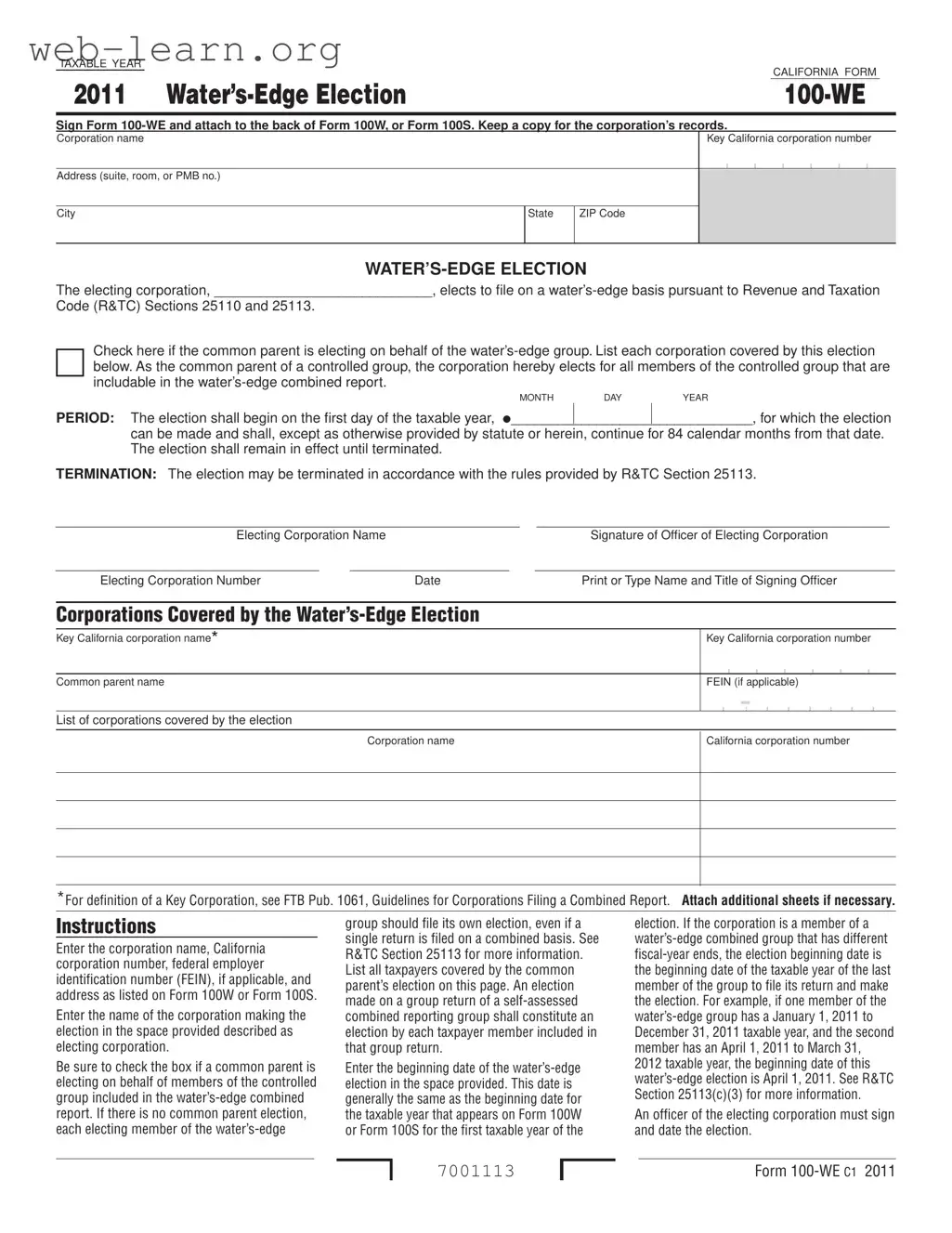
The California 100 We form, officially known as the Water's-Edge Election form, plays a crucial role for corporations operating within California's tax framework. This form allows corporations to elect to file their taxes on a water’s-edge basis, which can significantly affect their tax liabilities. When a corporation opts for this election, it indicates its intention to include only certain income derived from sources within the United States, thereby potentially reducing its overall taxable income. The form requires the corporation to provide essential information such as its name, California corporation number, and address. It also necessitates the identification of any common parent corporation making the election on behalf of a controlled group. The election period typically commences on the first day of the taxable year and lasts for 84 months unless terminated earlier according to specific regulations. Corporations must carefully list all members included in this election, ensuring compliance with the Revenue and Taxation Code sections governing such filings. Proper completion of the form is critical, as it not only affects the corporation’s tax obligations but also requires the signature of an authorized officer, solidifying the corporation's commitment to the election. Understanding the nuances of the California 100 We form is essential for corporations looking to navigate the complexities of state taxation effectively.
Sample - California 100 We Form

Form 100-WE C1 2011
Water’s-Edge Election
TAXABLE YEAR
2011
CALIFORNIA FORM
100-WE
WATER’S-EDGE ELECTION
The electing corporation, ____________________________, elects to file on a water’s-edge basis pursuant to Revenue and Taxation
Code (R&TC) Sections 25110 and 25113.
Check here if the common parent is electing on behalf of the water’s-edge group. List each corporation covered by this election
below. As the common parent of a controlled group, the corporation hereby elects for all members of the controlled group that are
includable in the water’s-edge combined report.
PERIOD: The election shall begin on the first day of the taxable year, I_______________________________, for which the election
can be made and shall, except as otherwise provided by statute or herein, continue for 84 calendar months from that date.
The election shall remain in effect until terminated.
TERMINATION: The election may be terminated in accordance with the rules provided by R&TC Section 25113.
___________________________________________________________________ ___________________________________________________
Electing Corporation Name Signature of Officer of Electing Corporation
______________________________________ _______________________ ____________________________________________________
Electing Corporation Number Date Print or Type Name and Title of Signing Officer
7001113
Sign Form 100-WE and attach to the back of Form 100W, or Form 100S. Keep a copy for the corporation’s records.
MONTH DAY YEAR
Instructions
Enter the corporation name, California
corporation number, federal employer
identification number (FEIN), if applicable, and
address as listed on Form 100W or Form 100S.
Enter the name of the corporation making the
election in the space provided described as
electing corporation.
Be sure to check the box if a common parent is
electing on behalf of members of the controlled
group included in the water’s-edge combined
report. If there is no common parent election,
each electing member of the water’s-edge
group should file its own election, even if a
single return is filed on a combined basis. See
R&TC Section 25113 for more information.
List all taxpayers covered by the common
parent’s election on this page. An election
made on a group return of a self-assessed
combined reporting group shall constitute an
election by each taxpayer member included in
that group return.
Enter the beginning date of the water’s-edge
election in the space provided. This date is
generally the same as the beginning date for
the taxable year that appears on Form 100W
or Form 100S for the first taxable year of the
election. If the corporation is a member of a
water’s-edge combined group that has different
fiscal-year ends, the election beginning date is
the beginning date of the taxable year of the last
member of the group to file its return and make
the election. For example, if one member of the
water’s-edge group has a January 1, 2011 to
December 31, 2011 taxable year, and the second
member has an April 1, 2011 to March 31,
2012 taxable year, the beginning date of this
water’s-edge election is April 1, 2011. See R&TC
Section 25113(c)(3) for more information.
An officer of the electing corporation must sign
and date the election.
Corporations Covered by the Water’s-Edge Election
Key California corporation name
*
Key California corporation number
Common parent name FEIN (if applicable)
List of corporations covered by the election
Corporation name California corporation number
*For definition of a Key Corporation, see FTB Pub. 1061, Guidelines for Corporations Filing a Combined Report. Attach additional sheets if necessary.
Corporation name Key California corporation number
Address (suite, room, or PMB no.)
City State ZIP Code

Form Information

Fact Name Details
Purpose The California Form 100-WE is used for corporations electing to file on a water’s-edge basis, allowing for a combined report of income from certain foreign and domestic corporations.
Governing Laws This form is governed by the California Revenue and Taxation Code, specifically Sections 25110 and 25113.
Filing Requirement Corporations must attach Form 100-WE to either Form 100W or Form 100S and retain a copy for their records.
Election Duration The water’s-edge election begins on the first day of the taxable year and lasts for 84 calendar months unless terminated earlier.
Termination Rules Corporations can terminate the election according to the rules set forth in R&TC Section 25113.
Common Parent Election If a common parent corporation elects on behalf of a controlled group, it must check the appropriate box on the form to indicate this choice.

Detailed Guide for Filling Out California 100 We

Filling out the California 100 We form requires careful attention to detail. This form is essential for corporations electing to file on a water's-edge basis. Follow these steps to ensure accurate completion.

  1. Enter the corporation name as listed on Form 100W or Form 100S.
  2. Input the California corporation number associated with your corporation.
  3. Provide the address, including suite, room, or PMB number, city, state, and ZIP code.
  4. In the section labeled WATER’S-EDGE ELECTION, write the name of the electing corporation.
  5. If applicable, check the box indicating that the common parent is electing on behalf of the water’s-edge group.
  6. List all corporations covered by this election in the designated area.
  7. Specify the beginning date of the water’s-edge election in the format MONTH/DAY/YEAR.
  8. Ensure an officer of the electing corporation signs and dates the form.
  9. Print or type the name and title of the signing officer.

Once completed, attach the 100 We form to the back of Form 100W or Form 100S. Remember to keep a copy for your records. This will help ensure that all necessary information is readily available for future reference.

Obtain Answers on California 100 We

  1. What is the California 100 We form?

    The California 100 We form, also known as Form 100-WE, is used by corporations to elect to file on a water's-edge basis. This election allows corporations to report their income based on a specific set of rules outlined in California's Revenue and Taxation Code. By making this election, corporations can potentially benefit from certain tax advantages.

  2. Who needs to file the 100 We form?

    Any corporation that wishes to elect for a water's-edge combined report must file this form. If a corporation is part of a controlled group, the common parent can file on behalf of all members. Each member of the group that wants to make this election should be listed on the form.

  3. What is the duration of the water's-edge election?

    The water's-edge election begins on the first day of the taxable year specified in the form. This election will continue for a total of 84 calendar months, unless terminated earlier according to the rules provided by the Revenue and Taxation Code. It remains in effect until the corporation decides to terminate it.

  4. How do I terminate the water's-edge election?

    To terminate the water's-edge election, a corporation must follow the guidelines set forth in R&TC Section 25113. This may involve submitting a notice or specific documentation to the appropriate tax authority. It's important to ensure that all steps are followed correctly to avoid any complications.

  5. What information is required to complete the 100 We form?

    When completing the 100 We form, you'll need to provide several key pieces of information:

    • The name of the electing corporation
    • The California corporation number
    • The federal employer identification number (FEIN), if applicable
    • The address as listed on Form 100W or Form 100S
    • The beginning date of the water's-edge election

    Make sure to check the box if a common parent is making the election on behalf of the group.

  6. Who should sign the 100 We form?

    An officer of the electing corporation must sign and date the form. This signature is crucial, as it verifies that the information provided is accurate and that the corporation is officially making the election. Ensure that the name and title of the signing officer are printed or typed clearly on the form.

Common mistakes

Filling out the California 100 We form can be a straightforward process, but there are common mistakes that many people make. Avoiding these pitfalls can save time and ensure compliance. One frequent error is not providing complete information about the corporation. Each section requires specific details, including the corporation name, California corporation number, and address. Missing any of these details can lead to delays or even rejection of the form.

Another mistake is failing to check the box for a common parent when applicable. If a common parent is electing on behalf of the water’s-edge group, it’s crucial to indicate this clearly. Omitting this step can lead to confusion about which entities are included in the election, potentially complicating the filing process.

Many individuals also overlook the importance of accurately entering the beginning date of the water’s-edge election. This date should align with the taxable year stated on Form 100W or Form 100S. If there are multiple members with different fiscal year ends, it’s essential to use the date that corresponds to the last member’s taxable year. Miscalculating this date can result in significant issues down the line.

Additionally, people often forget to list all corporations covered by the election. It’s vital to include every taxpayer that falls under the common parent’s election. Leaving out a corporation can invalidate the election for the entire group, leading to potential tax liabilities.

Signing the form is another crucial step that is sometimes neglected. An officer of the electing corporation must sign and date the election. Without this signature, the form is not valid, and the election cannot take effect. This oversight can easily be avoided by double-checking the form before submission.

Lastly, many filers fail to keep a copy of the completed form for their records. Retaining a copy is essential for future reference, especially if questions arise regarding the election. It’s a simple step that can prevent headaches later on. By being mindful of these common mistakes, you can navigate the California 100 We form process with confidence and ease.

Documents used along the form

The California Form 100-WE is essential for corporations electing to file on a water’s-edge basis. However, it is often accompanied by several other forms and documents that facilitate compliance with state tax regulations. Below is a list of common forms used in conjunction with the California 100-WE form, each serving a distinct purpose in the tax filing process.

  • Form 100W: This is the California Corporation Franchise or Income Tax Return. Corporations use it to report income, calculate tax liability, and claim credits. It is essential for those electing to file a water’s-edge return.
  • Form 100S: This form is for S Corporations in California. It allows these entities to report income and pay taxes at the corporate level, which is necessary for those making the water’s-edge election.
  • Form 100-ES: This is the Estimated Tax for Corporations form. Corporations must use it to make estimated tax payments throughout the year based on expected income, ensuring they meet tax obligations timely.
  • Form 3519: This form is used to report the California Corporate Tax Extension. If a corporation needs more time to file its tax return, it can submit this form to request an extension, avoiding late penalties.
  • Form 592: This is the Resident Withholding Statement. It is necessary for corporations that have made payments to non-residents, ensuring that proper withholding taxes are reported and paid to the state.
  • Form 568: This form is for Limited Liability Companies (LLCs) in California. It helps LLCs report income, deductions, and credits, especially if they are part of a water’s-edge group.
  • Form 100-CR: This is the California Corporation Tax Credit form. Corporations use it to claim various tax credits that may reduce their overall tax liability.
  • Form FTB 3814: This form is used for the California Compromise of Tax Liability. It allows corporations to settle tax liabilities for less than the full amount owed, if they qualify under specific conditions.

Each of these forms plays a critical role in ensuring compliance with California tax laws. They provide a framework for corporations to accurately report their financial activities and manage their tax obligations effectively. Understanding the purpose of each document can help corporations navigate the complexities of tax filing in California.

Similar forms

The California Form 100 We is a specific document used by corporations to elect to file on a water’s-edge basis. Here are ten other documents that share similarities with the California 100 We form, along with explanations of how they are alike:

  • Form 100W: This is the California Corporation Franchise or Income Tax Return. Like the 100 We form, it is used for reporting income and taxes for corporations operating in California, particularly those electing to file a combined report.
  • Form 100S: This is the California S Corporation Franchise or Income Tax Return. Similar to the 100 We, it is filed by corporations electing S Corporation status, focusing on income reporting and tax obligations.
  • Form 1120: This is the U.S. Corporation Income Tax Return. It serves a similar purpose on a federal level, allowing corporations to report their income, deductions, and taxes owed, akin to the California forms.
  • Form 1120S: This is the U.S. Income Tax Return for an S Corporation. Like the 100S, it is for S Corporations and is used to report income and deductions at the federal level.
  • Form 5471: This document is used to report information about foreign corporations. It is similar in that it involves reporting corporate income and activities, particularly for U.S. shareholders of foreign entities.
  • Form 8865: This is the Return of U.S. Persons With Respect to Certain Foreign Partnerships. Similar to the 100 We, it requires reporting of income and operations, specifically for partnerships that have foreign connections.
  • Form 1065: This is the U.S. Return of Partnership Income. Like the 100 We form, it is used for reporting income and tax obligations, but specifically for partnerships rather than corporations.
  • Form 990: This is the Return of Organization Exempt from Income Tax. While it serves non-profits, it shares the commonality of requiring organizations to report financial information and operational details.
  • Form 2553: This form is used by corporations to elect S Corporation status. It is similar to the 100 We in that it is a formal election process for tax reporting purposes.
  • Form 5472: This is used by foreign-owned U.S. corporations to report transactions with related parties. Like the 100 We, it involves disclosures related to corporate structure and financial activities.

Dos and Don'ts

When filling out the California 100 We form, it is important to follow specific guidelines to ensure accuracy and compliance. Here are six things you should and shouldn't do:

  • Do enter the corporation name and California corporation number as they appear on Form 100W or Form 100S.
  • Do check the box if a common parent is electing on behalf of the water’s-edge group.
  • Do list all corporations covered by the common parent’s election on the designated page.
  • Do ensure an officer of the electing corporation signs and dates the form.
  • Don't forget to keep a copy of the completed form for the corporation's records.
  • Don't leave any required fields blank, as this may delay processing or lead to rejection.

Misconceptions

Many people have misunderstandings about the California Form 100-WE, which is used for the Water’s-Edge Election. Here are some common misconceptions:

  • Only large corporations can file Form 100-WE. This is not true. Any eligible corporation can make this election, regardless of size.
  • The election is permanent. The Water’s-Edge Election lasts for 84 months but can be terminated earlier if needed.
  • All members of a controlled group must file separately. If a common parent makes the election, it can cover all members in a combined report.
  • Form 100-WE is only for corporations based in California. While the form is specific to California, it applies to corporations with activities in multiple states.
  • You can change the election date after filing. Once the election date is set, it cannot be altered. It must align with the taxable year.
  • Filing Form 100-WE guarantees lower taxes. The election may provide certain benefits, but it does not automatically lower tax liability.
  • There is no need for an officer's signature. An authorized officer must sign the form for it to be valid.
  • The election applies to all tax years. The election is valid for a specific period and does not carry over indefinitely.
  • Form 100-WE can be filed at any time. There are specific deadlines for making the election, usually tied to the taxable year.

Understanding these misconceptions can help corporations navigate the filing process more effectively. It is crucial to be informed and ensure compliance with California tax regulations.

Key takeaways

When filling out and using the California 100-WE form, consider the following key takeaways:

  • Purpose of the Form: The 100-WE form is used for electing to file on a water’s-edge basis, which allows certain corporations to limit their taxable income to income derived from sources within the United States.
  • Eligibility: Only corporations that meet the criteria outlined in the Revenue and Taxation Code can elect to file using this form.
  • Common Parent Election: If a common parent is electing on behalf of a controlled group, ensure to check the appropriate box on the form.
  • Corporation Information: Accurately enter the corporation name, California corporation number, and federal employer identification number (FEIN) as they appear on Form 100W or Form 100S.
  • Election Duration: The water’s-edge election begins on the first day of the taxable year and lasts for 84 calendar months, unless terminated earlier.
  • Termination Rules: Familiarize yourself with the termination rules under R&TC Section 25113, as the election can be terminated under specific conditions.
  • Signature Requirement: An officer of the electing corporation must sign and date the election to validate it.
  • Record Keeping: Keep a copy of the completed 100-WE form with the corporation’s records for future reference.

By following these guidelines, you can ensure that the form is completed correctly and that your corporation complies with California tax regulations.