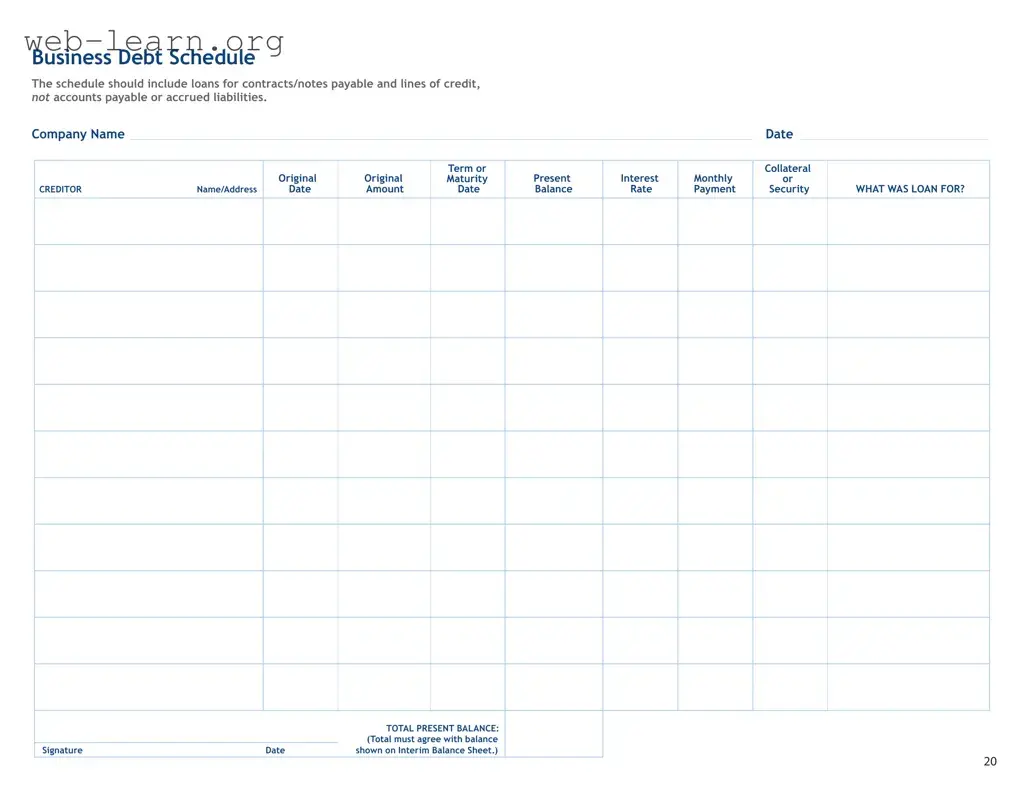
The Business Debt Schedule form serves as a crucial tool for businesses to organize and present their outstanding debts. This form is specifically designed to capture essential details about loans, contracts, notes payable, and lines of credit, while excluding accounts payable and accrued liabilities. Users will need to provide the company name and date at the top of the form, followed by a comprehensive listing of each creditor. For every debt listed, the form requires information such as the creditor's name and address, the original date of the loan, the original amount borrowed, and the term or maturity date. Additionally, it asks for the present balance, interest rate, and monthly payment associated with each debt. It is important to specify the collateral or security tied to the loan, as well as the purpose of the loan. At the end of the schedule, a total present balance must be calculated, ensuring it aligns with the balance shown on the interim balance sheet. Finally, a signature and date are needed to validate the information provided.

| Fact Name | Description |
|---|---|
| Purpose | The Business Debt Schedule form is designed to provide a comprehensive overview of a company's outstanding debts, specifically focusing on loans and lines of credit. |
| Exclusions | This schedule does not include accounts payable or accrued liabilities, ensuring clarity in financial reporting. |
| Required Information | Key details such as creditor name, original amount, maturity date, and present balance must be included to accurately reflect the company's financial obligations. |
| Total Present Balance | The total present balance must match the balance shown on the Interim Balance Sheet, reinforcing consistency in financial documentation. |
| Collateral | Information about collateral or security tied to the loans must be disclosed, providing insight into the risk associated with each debt. |
| Interest Rate | The form requires the interest rate for each loan, which is crucial for understanding the cost of borrowing over time. |
| Governing Laws | State-specific forms may be governed by various laws, such as the Uniform Commercial Code (UCC), which regulates secured transactions. |
| Signature Requirement | A signature is required to validate the information provided, ensuring accountability and accuracy in the reporting process. |
Completing the Business Debt Schedule form is an important step in understanding your business's financial obligations. After filling out this form, you'll have a clearer picture of your debts, which can help in making informed financial decisions.
What is the purpose of the Business Debt Schedule form?
The Business Debt Schedule form is designed to provide a clear overview of a company's outstanding debts. It includes loans for contracts, notes payable, and lines of credit. This form helps businesses track their financial obligations and ensures that all debts are accurately reported.
What types of debts should be included in the schedule?
The schedule should include:
It is important to note that accounts payable and accrued liabilities are not included in this form.
What information is required for each creditor?
For each creditor, the following information must be provided:
How is the total present balance calculated?
The total present balance is calculated by summing the present balances of all listed debts. This total must match the balance shown on the interim balance sheet to ensure accuracy in financial reporting.
Why is it important to provide the interest rate?
The interest rate is a critical component of the debt schedule. It affects the total cost of borrowing and helps in understanding the financial obligations associated with each debt. Accurate reporting of the interest rate aids in financial planning and analysis.
What does the section "WHAT WAS LOAN FOR?" entail?
This section requires a brief description of the purpose of each loan. Providing this information helps stakeholders understand the context of the debt and how it contributes to the company's operations or growth.
What should be done if there are discrepancies in the reported balances?
If discrepancies are found between the total present balance and the interim balance sheet, it is essential to review each entry for accuracy. Verify the amounts and ensure that all debts have been included. Correct any errors before finalizing the schedule.
Is there a signature required on the Business Debt Schedule form?
Yes, a signature is required on the form. This signature indicates that the information provided is accurate and has been reviewed. It is typically dated to reflect when the schedule was completed.
When filling out the Business Debt Schedule form, one common mistake is including accounts payable or accrued liabilities. This form is specifically designed for loans, contracts, notes payable, and lines of credit. Including other types of debt can lead to inaccuracies and confusion.
Another frequent error is failing to provide complete creditor information. Each entry should clearly list the creditor's name and address. Missing details can delay processing and create complications in verifying debts.
Many people overlook the importance of accurate original amounts. Entering incorrect figures can misrepresent the financial obligations of the business. Ensure that the original amounts match the actual loan documents to maintain integrity.
In addition, the term or maturity date is often filled out incorrectly. This date indicates when the debt is due. Double-check this information to avoid potential issues with repayment schedules.
Another mistake is neglecting to update the present balance. The present balance should reflect the most current amount owed. An outdated figure can lead to discrepancies and misinterpretations of the business's financial status.
Interest rates are sometimes entered inaccurately. Ensure that the interest rate corresponds with the terms of the loan agreement. Incorrect rates can affect calculations and overall debt assessments.
People often forget to specify what the loan was for. This information is crucial for understanding the purpose of the debt and its impact on the business. Providing context helps in evaluating the financial health of the company.
Lastly, failing to sign and date the form is a common oversight. The signature confirms the accuracy of the information provided. Without it, the form may be considered incomplete and could delay processing.
The Business Debt Schedule form is an important document that outlines a company's debts. When preparing this schedule, several other forms and documents may also be needed to provide a complete financial picture. Here are some commonly used documents that complement the Business Debt Schedule.
Gathering these documents along with the Business Debt Schedule can help create a clearer understanding of a company's financial obligations and overall health. This information is vital for making informed decisions about financing and managing business debts.
The Business Debt Schedule form is an important financial document that outlines a company's outstanding debts. Several other documents share similarities with this form, primarily in their focus on financial obligations and liabilities. Below are seven documents that are comparable to the Business Debt Schedule, along with explanations of their similarities.
When completing the Business Debt Schedule form, it’s crucial to be thorough and accurate. Here are five important dos and don’ts to keep in mind:
Understanding the Business Debt Schedule form is crucial for accurate financial reporting. However, several misconceptions can lead to confusion. Here’s a list of common misunderstandings:
By addressing these misconceptions, businesses can better navigate their financial obligations and maintain accurate records.
When filling out and using the Business Debt Schedule form, consider the following key takeaways: