Homepage Blank Business Certificate Form
Outline

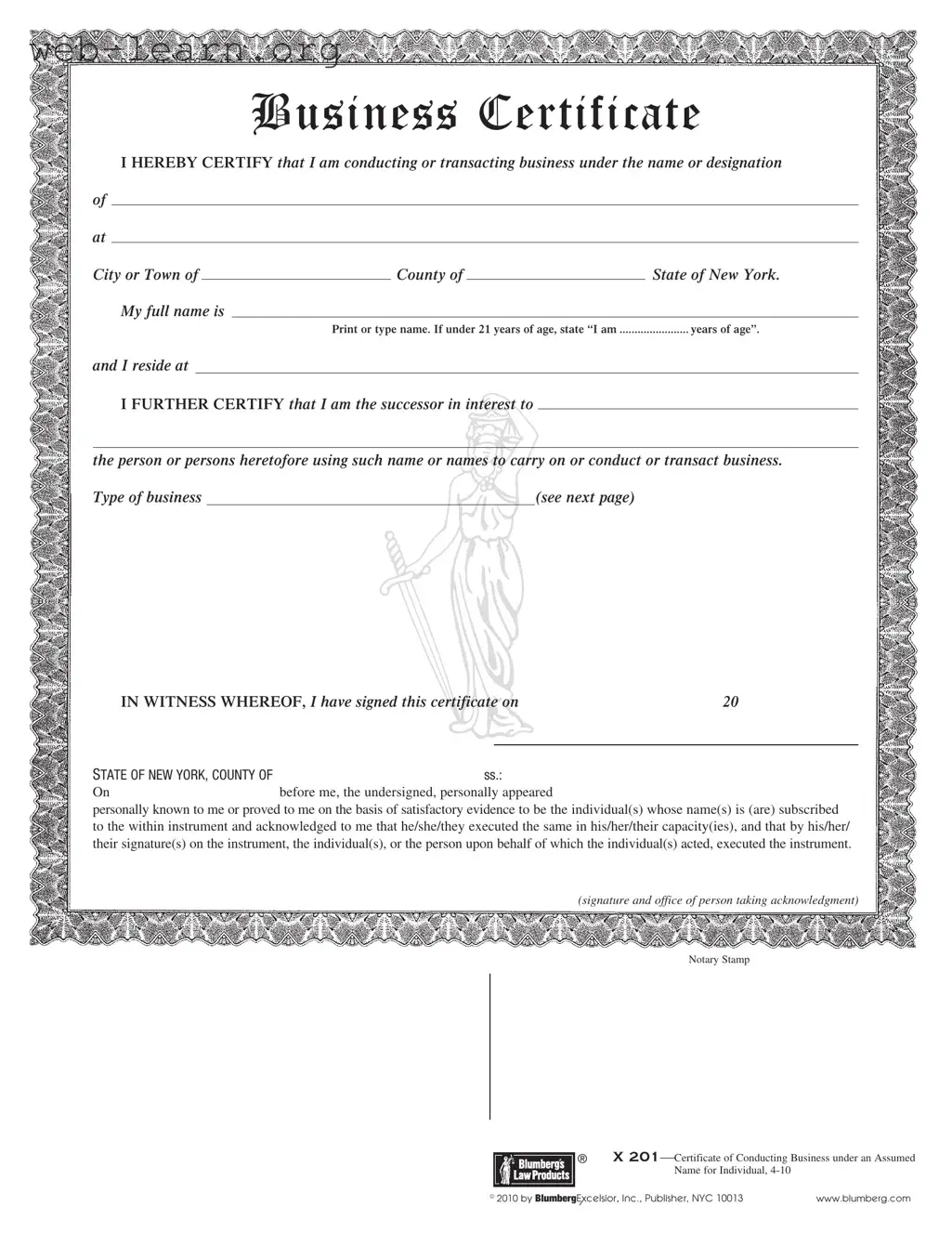
The Business Certificate form is a crucial document for individuals and entities conducting business under an assumed name in New York State. This form requires the business owner to certify their identity and the name under which they operate. It includes essential details such as the city or town, county, and state where the business is located. Additionally, the form prompts the owner to disclose their full name and age, particularly if they are under 21 years old. The certificate also acknowledges any previous users of the business name, ensuring a clear succession of interest. Furthermore, it outlines the type of business being conducted, ranging from retail to professional services, allowing for a comprehensive understanding of the business's nature. The completion of this form necessitates a notarization process, affirming the authenticity of the signatures involved. A certified copy of the form must be displayed at the business premises, ensuring transparency and compliance with local regulations. Overall, the Business Certificate form serves as a foundational step for lawful business operations, fostering trust and accountability in the marketplace.


Sample - Business Certificate Form

X
201Certificate of Conducting Business under an Assumed
Name for Individual, 4-10
©
2010 by BlumbergExcelsior, Inc., Publisher, NYC 10013 www.blumberg.com
STATE OF NEW YORK, COUNTY OF ss.:
On before me, the undersigned, personally appeared
personally known to me or proved to me on the basis of satisfactory evidence to be the individual(s) whose name(s) is (are) subscribed
to the within instrument and acknowledged to me that he/she/they executed the same in his/her/their capacity(ies), and that by his/her/
their signature(s) on the instrument, the individual(s), or the person upon behalf of which the individual(s) acted, executed the instrument.
(signature and office of person taking acknowledgment)
®
Business Certificate
I HEREBY CERTIFY that I am conducting or transacting business under the name or designation
of
at
City or Town of County of State of New York.
My full name is
Print or type name. If under 21 years of age, state I am ....................... years of age
.
and I reside at
I FURTHER CERTIFY that I am the successor in interest to
the person or persons heretofore using such name or names to carry on or conduct or transact business.
Type of business (see next page)
IN WITNESS WHEREOF, I have signed this certificate on 20
Notary Stamp
INDEX No.
Certificate
of
CONDUCTING BUSINESS UNDER
THE NAME OF
State of New York
ss.:
County of
On before me, the undersigned,
personally appeared
personally known to me or proved to me on the basis of satisfac-
tory evidence to be the individual(s) whose name(s) is (are) sub-
scribed to the within instrument and acknowledged to me that he/
she/they executed the same in his/her/their capacity(ies), and that
by his/her/their signature(s) on the instrument, the individual(s), or
the person upon behalf of which the individual(s) acted, executed
the instrument.
(signature and office of individual taking acknowledgment)
State of
ss.:
County of
On before me, the undersigned,
personally appeared
personally known to me or proved to me on the basis of satis-
factory evidence to be the individual(s) whose name(s) is (are)
subscribed to the within instrument and acknowledged to me
that he/she/they executed the same in his/her/their capacity(ies),
and that by his/her/their signature(s) on the instrument, the
individual(s), or the person upon behalf of which the individual(s)
acted, executed the instrument.
(signature and office of individual taking acknowledgment)
GBL §130.4. A certified copy of the original certificate, or if an amended certificate has been filed, then of the most
recent amended certificate filed shall be conspicuously displayed on the premises at each place in which the business for
which the same was filed is conducted.
Some counties request the type of business.
Consultant Services Medical—Home Care Services
Educational Services Professional—Technical Services
Entertainment–Recreation Real Estate Services
Finance–Insurance Services Retail Trade
Home Improvement Services Wholesale Trade
Other (state type)

Form Information

Fact Name Description
Purpose The Business Certificate form is used to register a business name in New York State.
Governing Law This form is governed by the New York General Business Law, specifically GBL §130.
Age Requirement If the individual is under 21 years of age, they must state their age on the form.
Successor Certification The form requires a declaration that the signer is the successor in interest to a prior business name user.
Type of Business Applicants must specify the type of business they are conducting, such as retail or professional services.
Notary Requirement The form must be signed in the presence of a notary public who will acknowledge the signature.
Filing Location A certified copy of the certificate must be displayed at the business location.
Multiple Counties Some counties in New York may have additional requirements or forms for specific business types.
Signature The form requires the signature of the individual conducting the business, affirming the information provided is accurate.
Form Updates Amended certificates must be filed if there are changes to the business name or structure.

Detailed Guide for Filling Out Business Certificate

Completing the Business Certificate form is a straightforward process that requires specific information about your business and personal details. Once you have filled out the form, you will need to submit it to the appropriate county office for processing. Below are the steps to guide you through filling out the form.

  1. Begin by entering the name under which you are conducting or transacting business.
  2. Indicate the city or town where your business is located.
  3. Specify the county in which your business operates.
  4. Write "State of New York" to indicate the state.
  5. Provide your full name. Ensure it is printed or typed clearly.
  6. If you are under 21 years of age, state your age by writing “I am [your age] years of age.”
  7. Enter your residential address.
  8. Certify that you are the successor in interest to any previous person or persons using the business name.
  9. Select the type of business you are conducting from the provided options, or state "Other" if applicable.
  10. Sign and date the certificate. Write the date on which you are signing the form.
  11. Find a notary public to witness your signature. They will need to complete the acknowledgment section of the form.

Obtain Answers on Business Certificate

  1. What is a Business Certificate?

    A Business Certificate is a legal document that allows individuals or businesses to conduct business under a specific name in New York. This certificate is essential for ensuring that the business name is registered and recognized by the state.

  2. Who needs to file a Business Certificate?

    Anyone conducting business under a name that is different from their legal name must file a Business Certificate. This includes sole proprietors, partnerships, and corporations. It helps to protect consumers and provides transparency in business operations.

  3. How do I fill out the Business Certificate form?

    To fill out the form, provide your full name, the business name you intend to use, and your address. If you are under 21 years old, you will need to indicate your age. Also, specify the type of business you are conducting. Make sure to sign the certificate at the end.

  4. Where do I submit the Business Certificate?

    You should submit the completed Business Certificate to the county clerk's office where your business is located. Each county may have different submission requirements, so it’s a good idea to check with your local office.

  5. Is there a fee for filing a Business Certificate?

    Yes, there is typically a fee associated with filing a Business Certificate. The amount can vary by county, so it’s best to confirm the fee with your local county clerk’s office.

  6. How long is the Business Certificate valid?

    The Business Certificate does not have an expiration date, but it must be updated if there are any changes to the business name, address, or ownership. If you cease business operations, you should also file a cancellation.

  7. Do I need to display the Business Certificate?

    Yes, a certified copy of your Business Certificate must be displayed prominently at each location where you conduct business. This helps ensure that customers can verify the legitimacy of your business.

  8. What if I change my business name?

    If you decide to change your business name, you will need to file an amended Business Certificate. This process is similar to filing the original certificate, and you should also update any relevant local and state registrations.

  9. Can I file a Business Certificate online?

    Some counties in New York may offer online filing options for Business Certificates. Check with your local county clerk’s office to see if this service is available and what the process entails.

Common mistakes

Filling out the Business Certificate form can seem straightforward, but many people make common mistakes that can lead to delays or complications. One frequent error is failing to provide the correct business name. The form requires individuals to clearly state the name under which they are conducting business. If this name does not match what is used in practice, it can create confusion and legal issues down the line.

Another common mistake involves the omission of required personal information. Individuals must include their full name and address on the form. Additionally, if the person is under 21 years of age, they must explicitly state their age. Neglecting to provide this information can result in the form being rejected, causing unnecessary delays in the business registration process.

Many also overlook the section regarding the type of business being conducted. The form specifies that individuals should indicate their business type, such as retail or services. Failing to select an appropriate category can lead to misclassification and potential regulatory issues. It is essential to accurately reflect the nature of the business to ensure compliance with local laws.

Finally, individuals often forget to have their signatures properly acknowledged. The form requires a notary public to verify the identity of the signer. Without this acknowledgment, the certificate may not be valid. It is crucial to complete this step to ensure that the document holds legal weight and can be used effectively in business operations.

Documents used along the form

When establishing a business, various forms and documents are often required alongside the Business Certificate. These documents help ensure compliance with local regulations and provide essential information about the business. Below is a list of commonly used forms that complement the Business Certificate.

  • Certificate of Incorporation: This document is necessary for businesses that choose to operate as corporations. It officially establishes the corporation in the state and outlines its purpose, structure, and governance.
  • Operating Agreement: For limited liability companies (LLCs), this internal document details the management structure and operating procedures of the business. It serves as a guideline for decision-making and member responsibilities.
  • Employer Identification Number (EIN) Application: This form is required for businesses that plan to hire employees or operate as a corporation or partnership. An EIN is necessary for tax purposes and is often needed to open a business bank account.
  • Sales Tax Certificate: If a business sells goods or services subject to sales tax, this certificate must be obtained. It allows the business to collect sales tax from customers and remit it to the state.
  • Business License: Depending on the type of business and its location, a business license may be required. This license permits the business to operate legally within a specific jurisdiction and ensures compliance with local regulations.
  • Partnership Agreement: For businesses formed as partnerships, this document outlines the terms of the partnership, including profit sharing, responsibilities, and dispute resolution. It helps prevent misunderstandings among partners.

These forms and documents play a crucial role in the establishment and operation of a business. Ensuring that all necessary paperwork is completed accurately can help prevent legal issues and promote a smooth business operation.

Similar forms

  • Business License: This document grants permission to operate a business within a specific jurisdiction. Like the Business Certificate, it requires details about the business name and owner, ensuring compliance with local regulations.
  • DBA (Doing Business As) Registration: Similar to the Business Certificate, a DBA allows a business to operate under a name different from its legal name. It also involves filing with local authorities to ensure transparency.
  • Partnership Agreement: This document outlines the terms of a partnership. While it focuses on the relationship between partners, it often includes information about the business name, similar to the Business Certificate.
  • Articles of Incorporation: When forming a corporation, this document is filed with the state. It includes the business name and purpose, paralleling the requirement in the Business Certificate for name disclosure.
  • Operating Agreement: For LLCs, this document details the management structure and operational procedures. It typically includes the business name, akin to what is required in the Business Certificate.
  • Trade Name Registration: This is another form of name registration, similar to the DBA. It protects a business's name and ensures that it can legally operate under that name, much like the Business Certificate.
  • Fictitious Name Registration: This document allows businesses to operate under a name that is not their legal name. It serves a similar purpose as the Business Certificate, requiring official acknowledgment of the business name.
  • Certificate of Good Standing: This document verifies that a business is legally registered and compliant with state requirements. While it does not focus on the business name, it is often used alongside a Business Certificate to demonstrate legitimacy.
  • Employer Identification Number (EIN) Application: This form is necessary for tax purposes and requires the business name. It shares a common goal with the Business Certificate: establishing a recognized business identity.
  • Business Registration Form: This document registers a business with the local government. It includes details about the business name and owner, similar to the information required in the Business Certificate.

Dos and Don'ts

When filling out the Business Certificate form, it is important to be careful and thorough. Here are some guidelines to help you through the process:

  • Do print or type your name clearly.
  • Do provide your full name as it appears on your identification.
  • Do indicate your age if you are under 21 years old.
  • Do make sure to include the city, county, and state where you will conduct business.
  • Do check the type of business you are operating from the provided options.
  • Don't leave any required fields blank.
  • Don't use abbreviations or nicknames for your business name.
  • Don't forget to sign and date the certificate.
  • Don't ignore the notary requirement; ensure it is completed properly.
  • Don't submit the form without reviewing it for errors.

Following these steps can help ensure that your Business Certificate form is filled out correctly. This can save you time and avoid complications later on.

Misconceptions

Understanding the Business Certificate form is crucial for anyone looking to operate a business under a specific name in New York. However, several misconceptions can lead to confusion. Here are seven common misunderstandings regarding this important document:

  • It is only for new businesses. Many believe that the Business Certificate is only necessary for startups. In reality, even established businesses that wish to operate under a different name must file this certificate.
  • Only sole proprietors need to file. Some think that only individuals running sole proprietorships require a Business Certificate. However, partnerships and corporations also need to file if they are using an assumed name.
  • Filing the certificate guarantees trademark protection. Many people assume that obtaining a Business Certificate provides trademark rights. This is not the case; a Business Certificate does not protect the name from being used by others.
  • It can be filed anywhere in New York. A common misconception is that the Business Certificate can be filed in any county. In fact, it must be filed in the county where the business is primarily conducted.
  • Age restrictions are not important. Some individuals overlook the age requirement stated in the form. If a business owner is under 21, they must explicitly state their age on the certificate.
  • The certificate does not need to be displayed. A frequent misunderstanding is that once filed, the certificate can be kept away from public view. In reality, a certified copy must be prominently displayed at the business location.
  • Only one certificate is needed for multiple locations. Many believe that a single Business Certificate suffices for multiple business locations. However, a separate certificate is required for each location where the business operates under the assumed name.

Clarifying these misconceptions can help ensure compliance and smooth operation for businesses in New York. Understanding the requirements and implications of the Business Certificate is essential for anyone engaging in business activities under an assumed name.

Key takeaways

Filling out and using the Business Certificate form is an important step for individuals conducting business under an assumed name in New York. Here are key takeaways to consider:

  • The form must be filled out accurately with the name under which the business will operate.
  • Include the city, town, county, and state where the business is located.
  • Provide your full name and, if under 21 years of age, indicate your age.
  • Certify that you are the successor in interest to any previous users of the business name.
  • Clearly state the type of business you are conducting.
  • Sign and date the form to validate your certification.
  • A notary public must acknowledge your signature for the certificate to be legally binding.

Once completed, a certified copy of the original certificate should be displayed at each business location. This ensures compliance with local regulations and informs the public about the business's operating name.