Homepage Blank BOS Form
Outline

The BOS form, or Business Operating Statement, serves as a crucial tool for businesses of all sizes, providing a comprehensive snapshot of financial performance over a specific period. This form typically includes key components such as revenue, expenses, and net income, allowing business owners and stakeholders to assess operational efficiency and profitability. By detailing both fixed and variable costs, the BOS form helps in identifying trends and making informed decisions about resource allocation. Additionally, it can facilitate communication with investors and lenders, showcasing the financial health of the enterprise. Timely and accurate completion of the BOS form is essential, as it not only aids in internal management but also plays a significant role in compliance with regulatory requirements. Understanding how to properly utilize this form can empower businesses to navigate financial landscapes more effectively, ultimately driving growth and sustainability.
Sample - BOS Form

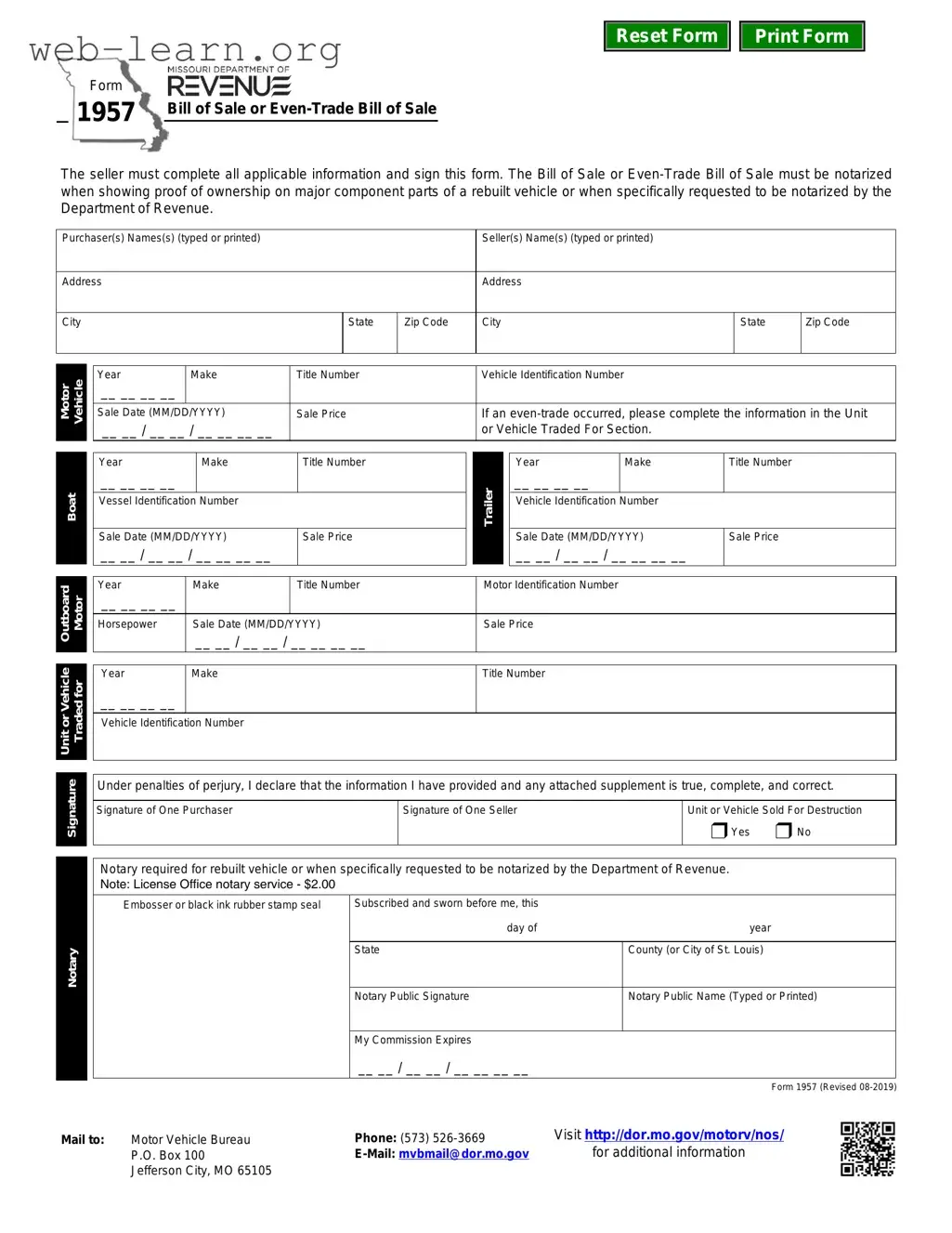
Form
1957
Bill of Sale or Even-Trade Bill of Sale
The seller must complete all applicable information and sign this form. The Bill of Sale or Even-Trade Bill of Sale must be notarized
when showing proof of ownership on major component parts of a rebuilt vehicle or when specifically requested to be notarized by the
Department of Revenue.
Purchaser(s) Names(s) (typed or printed) Seller(s) Name(s) (typed or printed)
Address Address
City State Zip Code City State Zip Code
Subscribed and sworn before me, this
day of year
State County (or City of St. Louis)
Notary Public Signature Notary Public Name (Typed or Printed)
My Commission Expires
Notary
Embosser or black ink rubber stamp seal
Year Make Title Number Vehicle Identification Number
Sale Date (MM/DD/YYYY)
Sale Price
If an even-trade occurred, please complete the information in the Unit
or Vehicle Traded For Section.
__ __ / __ __ / __ __ __ __
__ __ __ __
Motor
Vehicle
Year Make Title Number
Vehicle Identification Number
__ __ __ __
Unit or Vehicle
Traded for
Signature of One Purchaser Signature of One Seller Unit or Vehicle Sold For Destruction
r Yes r No
Under penalties of perjury, I declare that the information I have provided and any attached supplement is true, complete, and correct.
Signature
Year Make Title Number Motor Identification Number
Horsepower Sale Date (MM/DD/YYYY) Sale Price
__ __ __ __
__ __ / __ __ / __ __ __ __
Outboard
Motor
Notary required for rebuilt vehicle or when specifically requested to be notarized by the Department of Revenue.
Note: License Ofce notary service - $2.00
Year Make Title Number Year Make Title Number
Vessel Identification Number Vehicle Identification Number
Sale Date (MM/DD/YYYY) Sale Price Sale Date (MM/DD/YYYY) Sale Price
__ __ __ __ __ __ __ __
__ __ / __ __ / __ __ __ __ __ __ / __ __ / __ __ __ __
Boat
Trailer
__ __ / __ __ / __ __ __ __
Form 1957 (Revised 08-2019)
Mail to: Motor Vehicle Bureau
Phone: (573) 526-3669
Visit http://dor.mo.gov/motorv/nos/
P.O. Box 100
for additional information
Jefferson City, MO 65105
Reset Form
Print Form

Form Information

Fact Name Description
Purpose The BOS form, or Bill of Sale, serves as a legal document that transfers ownership of personal property from one party to another.
State-Specific Variations Different states may have their own versions of the BOS form, each tailored to comply with local laws and regulations.
Governing Laws The governing laws for the BOS form vary by state. For example, in California, it is governed by the California Civil Code, while in Texas, it falls under the Texas Business and Commerce Code.
Required Information Typically, a BOS form must include the names of the buyer and seller, a description of the item being sold, and the sale price.
Legal Importance Having a properly completed BOS form can provide legal protection for both the buyer and seller in case of disputes regarding the sale.

Detailed Guide for Filling Out BOS

Filling out the BOS form is an important step in your process. Make sure to have all necessary information ready before you begin. This will help you complete the form accurately and efficiently.

  1. Start by writing your name in the designated area at the top of the form.
  2. Next, provide your current address. Include the street, city, state, and zip code.
  3. Enter your phone number in the appropriate section. Ensure it’s correct for future contact.
  4. Fill in your email address. This should be an address you check regularly.
  5. Provide any additional information requested on the form. This may include identification numbers or dates.
  6. Review all the information you have entered. Make sure it is accurate and complete.
  7. Sign and date the form at the bottom. Your signature confirms the information is true.

Once you have completed the form, it is ready for submission. Ensure you keep a copy for your records.

Obtain Answers on BOS

  1. What is the BOS form?

    The BOS form, or Business Operating Statement form, is a document used by businesses to summarize their operational performance over a specific period. It provides a clear overview of revenue, expenses, and net income, helping stakeholders understand the financial health of the organization.

  2. Who needs to fill out the BOS form?

    Typically, small to medium-sized businesses, non-profit organizations, and some larger entities may utilize the BOS form. It is particularly beneficial for business owners, managers, and financial analysts who require a concise summary of operational performance.

  3. What information is required to complete the BOS form?

    To complete the BOS form, the following information is usually necessary:

    • Total revenue generated during the reporting period
    • Cost of goods sold (COGS)
    • Operating expenses, including salaries, rent, and utilities
    • Any other relevant income or expenses

    Accurate and up-to-date financial data is crucial for a meaningful analysis.

  4. How often should the BOS form be completed?

    The frequency of completing the BOS form can vary based on the needs of the business. Many organizations opt to fill it out monthly, quarterly, or annually. Regular updates can help management track performance trends and make informed decisions.

  5. How can the BOS form benefit my business?

    The BOS form offers several advantages:

    • It provides a snapshot of financial performance, aiding in decision-making.
    • It can help identify areas of improvement by comparing revenue and expenses.
    • It is useful for securing funding, as lenders often request financial statements.

    By utilizing the BOS form, businesses can enhance their operational efficiency and strategic planning.

  6. Is the BOS form the same as a financial statement?

    No, the BOS form is not the same as a comprehensive financial statement. While it summarizes operational performance, financial statements such as balance sheets and cash flow statements provide a broader view of a company's financial position. The BOS form focuses specifically on income and expenses over a defined period.

  7. Where can I find a template for the BOS form?

    Templates for the BOS form can often be found online through various business resources, accounting software, or financial consulting firms. Many organizations provide customizable templates that can be adapted to fit specific business needs.

Common mistakes

Filling out the BOS form can be a straightforward task, but many individuals encounter common pitfalls that can lead to delays or complications. One of the most frequent mistakes is failing to read the instructions thoroughly. The instructions provide essential information about what is required. Skipping this step can result in incomplete submissions or the need to correct errors later.

Another common error is not providing accurate personal information. This includes names, addresses, and contact details. Even a small typo can create confusion or lead to issues with communication. It’s crucial to double-check these details before submitting the form.

People often overlook the importance of signing the form. A signature is not just a formality; it signifies that the information provided is true and complete. Without a signature, the form may be considered invalid, which can delay processing.

In addition, individuals sometimes forget to include necessary supporting documents. Depending on the purpose of the BOS form, additional paperwork may be required. Failing to include these documents can lead to rejection of the application or request.

Another mistake is neglecting to keep a copy of the completed form. Retaining a copy is vital for personal records and can be helpful if any issues arise later. Without a copy, individuals may find themselves in a difficult position if they need to reference their submission.

Many people also misjudge the deadlines associated with the BOS form. Submitting the form late can have serious consequences. It's important to be aware of any timelines and ensure that the form is submitted on time.

Moreover, some individuals rush through the form, leading to careless mistakes. Taking the time to carefully review each section can prevent errors that might otherwise complicate the process. A thorough review can save time and stress in the long run.

Finally, failing to seek assistance when needed can be a significant oversight. If there are uncertainties about how to fill out the form, reaching out for help can clarify things. Whether it’s a friend, family member, or professional, getting guidance can make the process smoother.

Documents used along the form

The Bill of Sale (BOS) form is a crucial document used in various transactions, particularly for the sale of personal property. However, it is often accompanied by additional forms and documents that help ensure a smooth transfer of ownership and protect the interests of both parties involved. Below is a list of other forms commonly used alongside the BOS form.

  • Title Transfer Document: This document is essential for transferring ownership of vehicles or certain types of property. It provides proof that the seller has relinquished their ownership rights to the buyer.
  • Purchase Agreement: This agreement outlines the terms and conditions of the sale, including price, payment methods, and any warranties or guarantees. It serves as a binding contract between the buyer and seller.
  • Affidavit of Identity: This document is often used to verify the identities of the parties involved in the transaction. It can help prevent fraud and ensure that both parties are who they claim to be.
  • Inspection Report: An inspection report may be required for certain types of property, such as vehicles or real estate. It details the condition of the item being sold, providing transparency and protecting the buyer's interests.
  • Bill of Sale Receipt: This receipt is a proof of transaction that the seller provides to the buyer after the sale is completed. It confirms that the buyer has received the item and the seller has received payment.

These documents, when used in conjunction with the Bill of Sale form, help facilitate a clear and legally sound transaction. Each form plays a specific role in ensuring that both parties understand their rights and obligations, ultimately contributing to a successful exchange of property.

Similar forms

The BOS form, or Bill of Sale, is an important document used in various transactions. It serves as proof of the transfer of ownership of goods or property. There are several other documents that share similar functions or purposes. Here are five such documents:

  • Purchase Agreement: This document outlines the terms and conditions of a sale between a buyer and a seller. Like the BOS form, it serves as a record of the transaction and details what is being sold, the price, and any contingencies.
  • Receipt: A receipt is a simple acknowledgment of payment received for goods or services. It confirms that a transaction has occurred, similar to how the BOS form confirms the transfer of ownership.
  • Lease Agreement: This document is used when one party allows another to use property for a specified time in exchange for payment. While it does not transfer ownership, it establishes the terms of use, much like the BOS form establishes ownership transfer.
  • Warranty Deed: A warranty deed is a legal document that guarantees a property title is clear and free of claims. It serves a similar purpose to the BOS form in that it provides assurance of ownership, specifically for real estate transactions.
  • Title Certificate: This document proves ownership of a vehicle or property. It is similar to the BOS form as it is essential for transferring ownership and ensuring that the new owner has legal rights to the item.

Each of these documents plays a crucial role in confirming and facilitating transactions, ensuring that all parties involved have a clear understanding of their rights and responsibilities.

Dos and Don'ts

When filling out the BOS form, it's important to follow certain guidelines to ensure accuracy and efficiency. Here are ten things you should and shouldn't do:

  • Do read the instructions carefully before starting.
  • Don't leave any required fields blank.
  • Do use clear and legible handwriting if filling it out by hand.
  • Don't use abbreviations unless specified in the guidelines.
  • Do double-check all entries for accuracy.
  • Don't submit the form without reviewing it first.
  • Do keep a copy of the completed form for your records.
  • Don't forget to sign and date the form where required.
  • Do ask for help if you're unsure about any part of the form.
  • Don't rush through the process; take your time to ensure everything is correct.

Misconceptions

Understanding the BOS form can be challenging, and several misconceptions often arise. Here are ten common misunderstandings about the BOS form, along with clarifications to help clear up any confusion.

  1. All BOS forms are the same. Many people believe that every BOS form is identical. In reality, the form may vary based on specific requirements or jurisdictions.
  2. You only need to fill out the BOS form once. Some assume that completing the BOS form is a one-time task. However, updates or changes in circumstances may require a new submission.
  3. The BOS form is optional. It is a common misconception that submitting the BOS form is not mandatory. In many cases, it is a required document for legal proceedings.
  4. Filling out the BOS form is straightforward. While the form may seem simple, it can be complex. Proper attention to detail is crucial to avoid errors that could delay processing.
  5. There is no deadline for submitting the BOS form. Some individuals think they can submit the form at any time. Most jurisdictions impose strict deadlines that must be adhered to.
  6. Anyone can fill out the BOS form. Although it may appear accessible, certain legal nuances mean that having assistance from a qualified professional is often beneficial.
  7. Submitting the BOS form guarantees approval. Many believe that simply submitting the form will lead to automatic acceptance. Approval depends on meeting all necessary criteria and requirements.
  8. Once submitted, the BOS form cannot be changed. There is a misconception that any errors on the form are final. In fact, amendments can often be made if they are submitted in a timely manner.
  9. The BOS form is only for specific cases. Some think the form is limited to certain types of legal matters. It can be applicable in various situations, depending on the jurisdiction.
  10. All information on the BOS form is public. Many assume that all details provided are accessible to the public. However, certain information may be kept confidential, depending on the case.

By addressing these misconceptions, individuals can approach the BOS form with a clearer understanding, ensuring a smoother process and better compliance with legal requirements.

Key takeaways

The BOS (Business Operating Statement) form is an essential document for businesses. Understanding how to fill it out and utilize it effectively can lead to better financial management. Here are some key takeaways regarding the BOS form:

  • Accuracy is Crucial: Ensure that all financial data entered is accurate to reflect the true state of the business.
  • Regular Updates: The BOS form should be updated regularly to provide an up-to-date snapshot of the business’s financial health.
  • Comprehensive Information: Include all relevant income and expense categories to capture the full picture of financial performance.
  • Use as a Planning Tool: The BOS can help in forecasting future financial performance and setting budgets.
  • Review with Stakeholders: Share the completed BOS form with key stakeholders to ensure transparency and informed decision-making.
  • Compliance and Record Keeping: Maintain a copy of the BOS form for compliance purposes and future reference.