When it comes to buying or selling a boat, having the right documentation is crucial to ensure a smooth transaction. One essential document in this process is the Boat Bill of Sale form. This form serves multiple purposes: it acts as a receipt for the buyer, provides proof of ownership for the seller, and can even serve as a means to transfer registration with state authorities. Typically, it includes important details such as the names and addresses of both the buyer and seller, a description of the boat including its make, model, and identification number, as well as the sale price. Additionally, it may outline any warranties or conditions related to the sale, ensuring that both parties are clear on the terms of the agreement. By using this form, both buyers and sellers can protect their interests and ensure compliance with legal requirements, making it a vital component of any boat transaction.
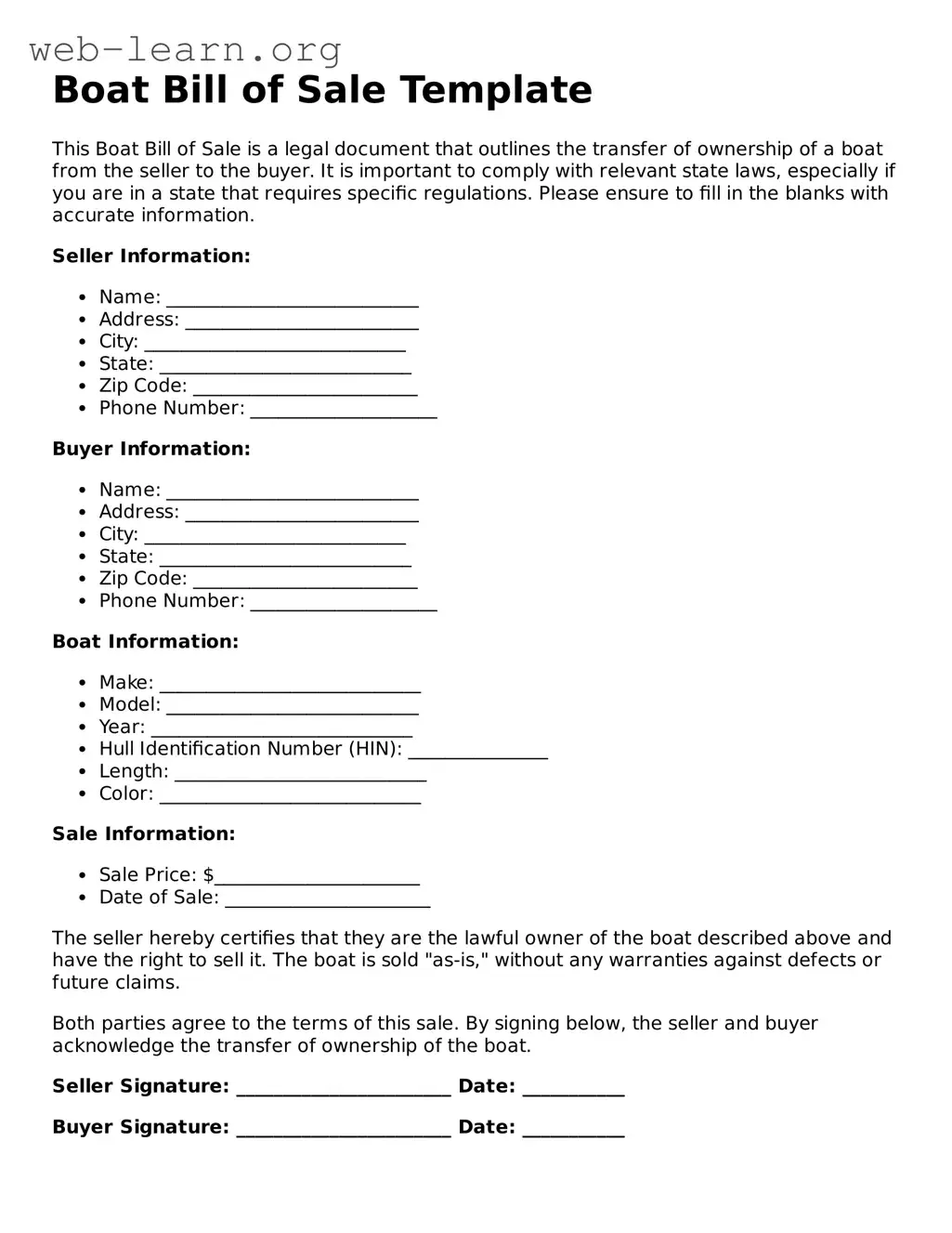
Boat Bill of Sale Template
This Boat Bill of Sale is a legal document that outlines the transfer of ownership of a boat from the seller to the buyer. It is important to comply with relevant state laws, especially if you are in a state that requires specific regulations. Please ensure to fill in the blanks with accurate information.
Seller Information:
Buyer Information:
Boat Information:
Sale Information:
The seller hereby certifies that they are the lawful owner of the boat described above and have the right to sell it. The boat is sold "as-is," without any warranties against defects or future claims.
Both parties agree to the terms of this sale. By signing below, the seller and buyer acknowledge the transfer of ownership of the boat.
Seller Signature: _______________________ Date: ___________
Buyer Signature: _______________________ Date: ___________
This document may need to be notarized based on state laws. Please check local regulations for any additional requirements.
| Fact Name | Description |
|---|---|
| Purpose | The Boat Bill of Sale form serves as a legal document that records the transfer of ownership of a boat from one party to another. |
| Required Information | This form typically requires details such as the names of the buyer and seller, the boat's make, model, year, and hull identification number. |
| State-Specific Forms | Each state may have its own version of the Boat Bill of Sale form, which must comply with local laws governing boat ownership transfers. |
| Governing Laws | In the United States, laws regarding boat sales and ownership can vary by state. For example, California's governing law is found in the California Vehicle Code. |
| Notarization | Some states may require the Boat Bill of Sale to be notarized to ensure authenticity and prevent fraud. |
| Importance of Accuracy | Filling out the form accurately is crucial, as errors can lead to disputes over ownership or complications with registration. |
Once you have your Boat Bill of Sale form ready, you will need to fill it out carefully. This document serves as a record of the sale and transfer of ownership of the boat. It’s important to ensure that all information is accurate to avoid any future disputes.
What is a Boat Bill of Sale?
A Boat Bill of Sale is a legal document that records the transfer of ownership of a boat from one party to another. It serves as proof of the transaction and includes essential details about the boat, the buyer, and the seller.
What information is typically included in a Boat Bill of Sale?
The document generally includes the following information:
Is a Boat Bill of Sale required by law?
While a Boat Bill of Sale is not always legally required, it is highly recommended. Many states require some form of documentation to register the boat, and having a Bill of Sale can simplify this process. Additionally, it provides legal protection for both the buyer and the seller.
Can I create my own Boat Bill of Sale?
Yes, individuals can create their own Boat Bill of Sale. It is important to ensure that all necessary information is included and that the document is signed by both parties. Templates are often available online, which can serve as a helpful starting point.
What should I do after completing the Boat Bill of Sale?
After completing the Boat Bill of Sale, both the buyer and seller should retain a copy for their records. The buyer may need to present the document when registering the boat with their state’s Department of Motor Vehicles or equivalent agency.
What if there are issues after the sale?
If issues arise after the sale, such as disputes regarding the condition of the boat or ownership claims, the Boat Bill of Sale can serve as a crucial piece of evidence. It is advisable to keep all communication related to the sale documented as well.
Can a Boat Bill of Sale be used for financing purposes?
A Boat Bill of Sale can sometimes be used to secure financing for a boat purchase. Lenders may require a copy of the Bill of Sale as proof of purchase before approving a loan. It is essential to check with the financial institution for their specific requirements.
When filling out a Boat Bill of Sale form, individuals often overlook crucial details that can lead to complications later. One common mistake is failing to provide accurate information about the boat. This includes the boat's make, model, year, and hull identification number. Omitting or incorrectly stating these details can create confusion and may affect the registration process.
Another frequent error is not including the correct sale price. The sale price must reflect the agreed amount between the buyer and seller. Inaccuracies in this section can lead to tax implications or disputes in the future. It is essential to ensure that both parties agree on the price before finalizing the document.
Many people also neglect to date the Bill of Sale. A date is crucial as it indicates when the transaction occurred. Without this information, it may be challenging to prove ownership transfer, which can cause issues if the buyer needs to register the boat or if disputes arise later.
Signatures are another area where mistakes commonly occur. Both the buyer and seller must sign the document to validate the sale. Failing to obtain the necessary signatures can render the Bill of Sale ineffective. Furthermore, some individuals forget to include printed names alongside signatures, which can create ambiguity about who signed the document.
In addition, individuals often forget to provide contact information. Including phone numbers and addresses for both parties is vital. This information allows for easy communication if any issues arise after the sale. Without it, reaching out to the other party can become problematic.
Another mistake involves not keeping a copy of the completed Bill of Sale. Both the buyer and seller should retain a copy for their records. This document serves as proof of the transaction and can be essential for future reference, especially during registration or if legal issues arise.
Lastly, some individuals fail to check state-specific requirements. Each state may have different regulations regarding boat sales and the necessary documentation. Not adhering to these regulations can lead to complications during the registration process. It is crucial to research and understand the requirements in your state to ensure compliance.
When purchasing or selling a boat, several important documents accompany the Boat Bill of Sale form. These documents help ensure a smooth transaction and protect both the buyer and seller. Below are some commonly used forms that you may encounter.
Understanding these documents can greatly assist in navigating the process of buying or selling a boat. Each form plays a vital role in ensuring that all parties are informed and protected throughout the transaction.
The Boat Bill of Sale form serves as a crucial document in the transfer of ownership for a boat. It shares similarities with several other documents used in various transactions. Below are six documents that are akin to the Boat Bill of Sale, along with explanations of their similarities.
Each of these documents plays a vital role in facilitating transactions and ensuring that both parties are protected throughout the process.
When filling out a Boat Bill of Sale form, it is important to follow certain guidelines to ensure the document is completed accurately. Here are some dos and don'ts:
Many people have misunderstandings about the Boat Bill of Sale form. Here are six common misconceptions:
Some believe that a Boat Bill of Sale is just a simple receipt. In reality, it serves as a legal record of the transaction between the buyer and the seller.
Many think that only the seller's signature is required. Both the buyer and the seller should sign the document to validate the transaction.
Some assume that a Bill of Sale is only needed for new boat purchases. However, it is essential for both new and used boats to document ownership transfer.
Many people believe notarization is optional. While it may not be required in all states, having the document notarized can add an extra layer of protection.
Some confuse the Bill of Sale with the boat title. The Bill of Sale is a record of the sale, while the title proves ownership.
Many think that a verbal agreement suffices. A written Bill of Sale is crucial to provide clear evidence of the transaction.
When engaging in the sale or purchase of a boat, the Boat Bill of Sale form serves as a crucial document. Understanding its importance and how to properly fill it out can facilitate a smooth transaction. Here are some key takeaways:
By following these guidelines, individuals can ensure that their boat sale is conducted properly and that both parties are protected throughout the process.
Bill of Sale for Mobile Home - The form typically requires signatures from both the buyer and the seller.