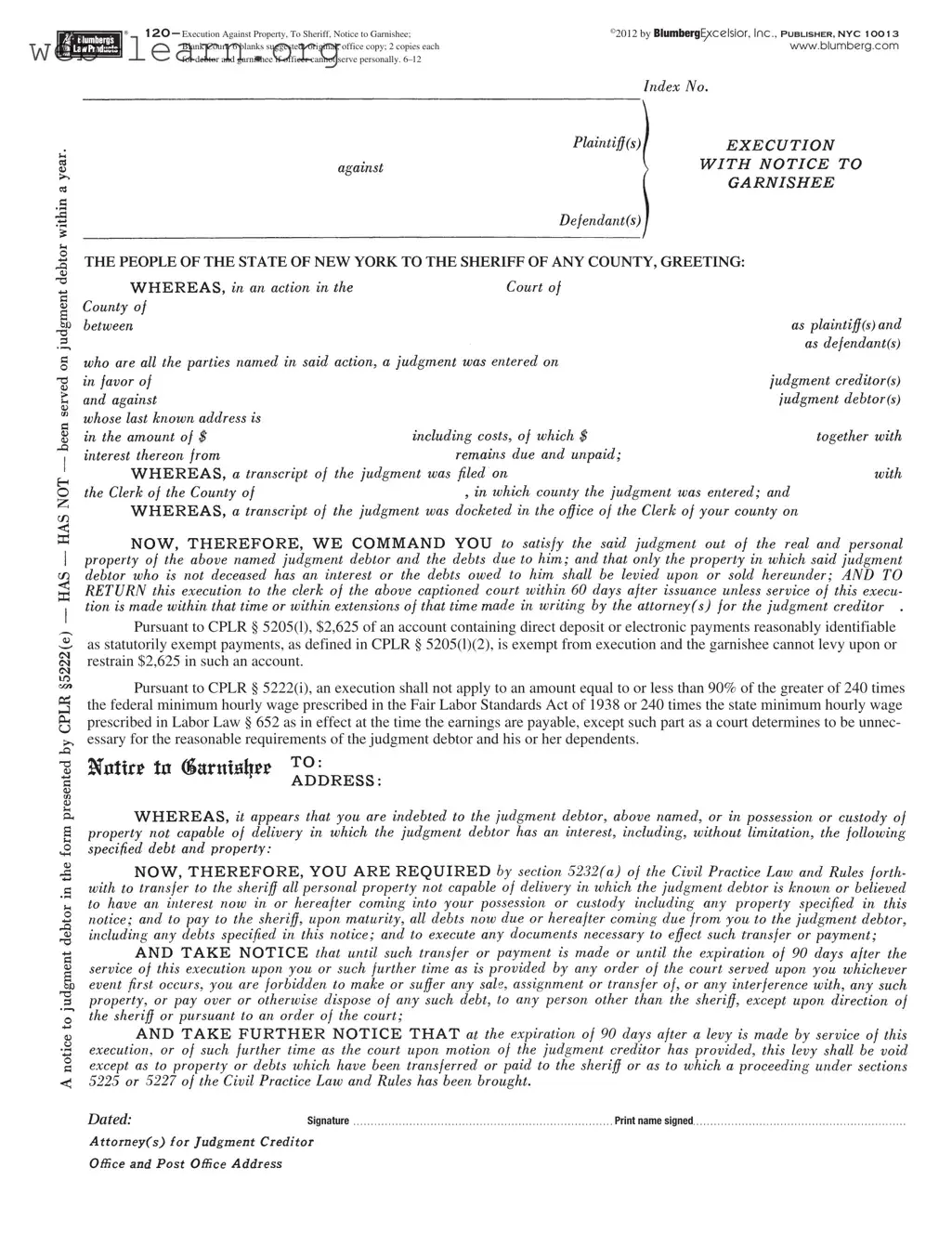
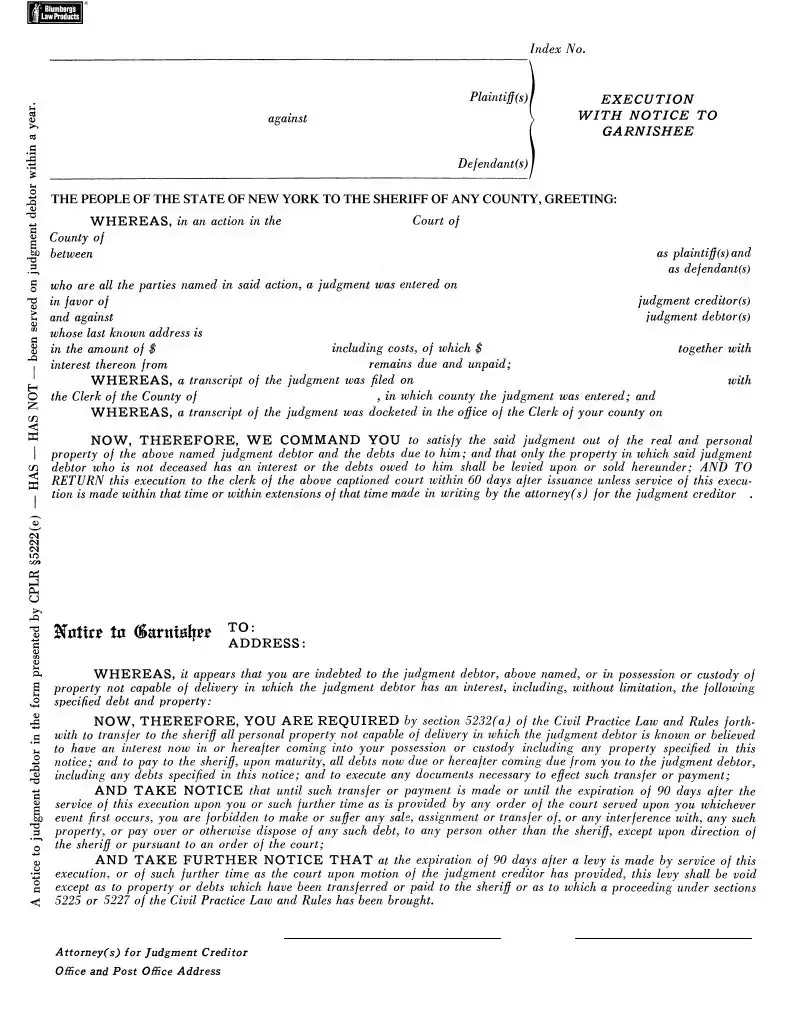
The Blumberg 120 form plays a crucial role in the execution of judgments against property, serving as an essential tool for creditors seeking to collect debts owed to them. This form is designed to facilitate the process of garnishment, where a creditor can obtain a court order to seize a debtor's assets or income to satisfy a judgment. It includes several key components that ensure compliance with legal requirements, such as identifying the parties involved, including the judgment creditor, the debtor, and the garnishee—typically a bank or employer. The form also outlines specific exemptions that protect certain amounts from being levied, such as funds from direct deposits that are statutorily exempt, ensuring that debtors retain some financial security. Additionally, it provides instructions for the sheriff regarding the execution process and includes important notices about defendants who were not served with a summons, highlighting restrictions on levying against their sole property. Understanding the intricacies of the Blumberg 120 form can help both creditors and debtors navigate the often complex landscape of debt collection, ensuring that rights are upheld while adhering to legal standards.

| Fact Name | Description |
|---|---|
| Form Purpose | The Blumberg 120 form is used for execution against property, directing the sheriff to notify the garnishee. |
| Governing Law | This form is governed by the New York Civil Practice Law and Rules (CPLR), specifically sections 5205 and 5222. |
| Exempt Amount | According to CPLR § 5205(l), $2,625 in accounts containing direct deposits or electronic payments is exempt from execution. |
| Minimum Wage Calculation | CPLR § 5222(i) stipulates that execution does not apply to amounts equal to or less than 90% of 240 times the federal or state minimum wage. |
| Signature Requirement | The form requires a signature and printed name of the individual completing the document. |
| Notice to Defendants | There is a section for notifying defendants who were not served with a summons, restricting execution against their sole property. |
| Copies Required | The form suggests providing an original, an office copy, and two copies each for the debtor and garnishee if personal service is not possible. |
Filling out the Blumberg 120 form requires careful attention to detail. This form is essential for executing a judgment against property and notifying the garnishee. Follow these steps to ensure accurate completion.
Once completed, the form should be submitted to the appropriate sheriff's office for execution. Ensure that you have multiple copies, as you may need them for the debtor and garnishee, as well as for your records.
What is the Blumberg 120 form?
The Blumberg 120 form is a legal document used in the process of execution against property. It allows a creditor to request the sheriff to collect a judgment by seizing property owned by the debtor. This form is important for ensuring that the creditor can recover the owed amount through legal means.
Who should fill out the Blumberg 120 form?
The form should be filled out by the creditor or their attorney. It requires specific information about the judgment debtor, the garnishee (the person or entity holding the debtor's property), and details about the property to be seized. Accurate information is crucial for the form to be valid.
How many copies of the Blumberg 120 form are needed?
You will need a total of six copies of the Blumberg 120 form. This includes the original, an office copy, and two copies each for the debtor and the garnishee. If the sheriff cannot serve the documents personally, additional copies may be necessary.
What protections does the Blumberg 120 form provide for debtors?
The form includes protections for debtors under New York law. For example, certain amounts in bank accounts, such as $2,625 from direct deposits or electronic payments, are exempt from execution. Additionally, a portion of the debtor's earnings may also be protected from garnishment.
What happens if a defendant was not served with a summons?
If a defendant has not been served with a summons, the execution against their property will be restricted. The sheriff cannot levy on the sole property of that defendant. However, property owned jointly with other defendants may still be subject to collection.
What should I do if I need assistance with the Blumberg 120 form?
If you need help, consider consulting with a legal professional or a document preparer. They can guide you through the process and ensure that the form is completed correctly. This assistance can help avoid delays or complications in the execution process.
Where can I find more information about the Blumberg 120 form?
For more details, you can visit the official Blumberg website at www.blumberg.com. They provide resources and additional information about the form and its usage. It’s a good idea to stay informed about any updates or changes to the form and related legal processes.
Filling out the Blumberg 120 form can be a straightforward process, but many people make common mistakes that can lead to delays or complications. One frequent error is failing to provide all required copies. The form specifies that you need the original, an office copy, and two copies each for the debtor and garnishee. Neglecting to prepare the correct number of copies can result in unnecessary delays in processing.
Another mistake involves incorrect information about the judgment debtor. It is crucial to ensure that the name and address of the judgment debtor are accurate and up-to-date. Any discrepancies can cause issues with the execution process. Additionally, some individuals forget to include the index number. This number is essential for identifying the case and must be clearly noted on the form.
Many people also overlook the importance of signatures. The form requires a signature from the attorney or the person filing the execution. Failing to sign the document can render it invalid, causing further delays. Furthermore, it’s vital to print the name of the person who signed the form. This step is often missed, leading to confusion about who is responsible for the filing.
Another common oversight is misunderstanding the exemption rules. Under CPLR § 5205(l), certain amounts in a bank account may be exempt from execution. If the garnishee is not aware of these exemptions, they might incorrectly attempt to levy funds that should be protected. It’s important to be informed about these exemptions to avoid unnecessary complications.
People sometimes misinterpret the endorsement section of the form. This section is crucial for notifying the court about any defendants who were not served. Failing to correctly fill out this part can limit the execution's effectiveness. It’s essential to detail any defendants that were not served to ensure compliance with legal requirements.
Moreover, individuals often forget to include the address of the garnishee. This information is vital for the sheriff to execute the order correctly. Without a complete address, the execution process may stall. Similarly, neglecting to specify the location of the property can lead to confusion and delays in enforcement.
Another frequent error is not paying attention to the date. The form must be dated to validate the execution request. If the date is missing or incorrect, it can lead to complications in the legal process. Additionally, many individuals fail to check for any additional fees or requirements that may apply. Understanding the full scope of what is needed can prevent surprises later.
Finally, some people rush through the process without reviewing the completed form. It’s easy to overlook small mistakes that can have significant consequences. Taking the time to double-check all entries and ensuring that everything is filled out correctly can save a lot of time and frustration.
The Blumberg 120 form is often accompanied by various other documents that help facilitate the execution process against property. Each of these forms serves a specific purpose in ensuring that the legal proceedings are conducted smoothly and in accordance with the law. Below is a list of commonly used forms and documents that may be relevant.
Understanding these documents is crucial for anyone involved in the execution process. Each form plays a vital role in ensuring that the rights of all parties are respected and that the legal process is followed correctly.
When filling out the Blumberg 120 form, it's important to follow some guidelines to ensure accuracy and compliance. Here’s a list of things to do and avoid:
Understanding the Blumberg 120 form can be challenging due to various misconceptions. Below is a list of common misunderstandings about this form, along with clarifications to help you navigate its use.
Clarifying these misconceptions can help individuals better understand their rights and responsibilities when dealing with the Blumberg 120 form. It is always advisable to seek assistance if there are uncertainties regarding its use.
When filling out and using the Blumberg 120 form, it is essential to understand its purpose and the specific requirements involved. This form is primarily used for execution against property and serves as a notice to the garnishee. Here are key takeaways to consider:
Understanding these key points will help in effectively utilizing the Blumberg 120 form, ensuring compliance with legal requirements while protecting the rights of all parties involved.