Homepage Blank Biomedical Waste Operating Plan Form
Outline

The Biomedical Waste Operating Plan form serves as an essential tool for facilities managing biomedical waste, ensuring compliance with health regulations while promoting safety and environmental responsibility. This comprehensive document outlines key components necessary for effective waste management, including detailed instructions for completion, training requirements for personnel, and protocols for identifying, segregating, and containing biomedical waste. The form also emphasizes the importance of proper labeling and storage practices, alongside contingency plans for emergencies such as spills. Additionally, it provides a clear framework for documenting the transportation of waste, whether handled internally or by licensed transporters. With resources like sample training outlines and attendance records, this plan not only facilitates adherence to the Florida Administrative Code but also fosters a culture of safety and preparedness within healthcare facilities. By following this operating plan, facilities can ensure that they meet regulatory standards while protecting both their staff and the community from potential health risks associated with biomedical waste.


Sample - Biomedical Waste Operating Plan Form

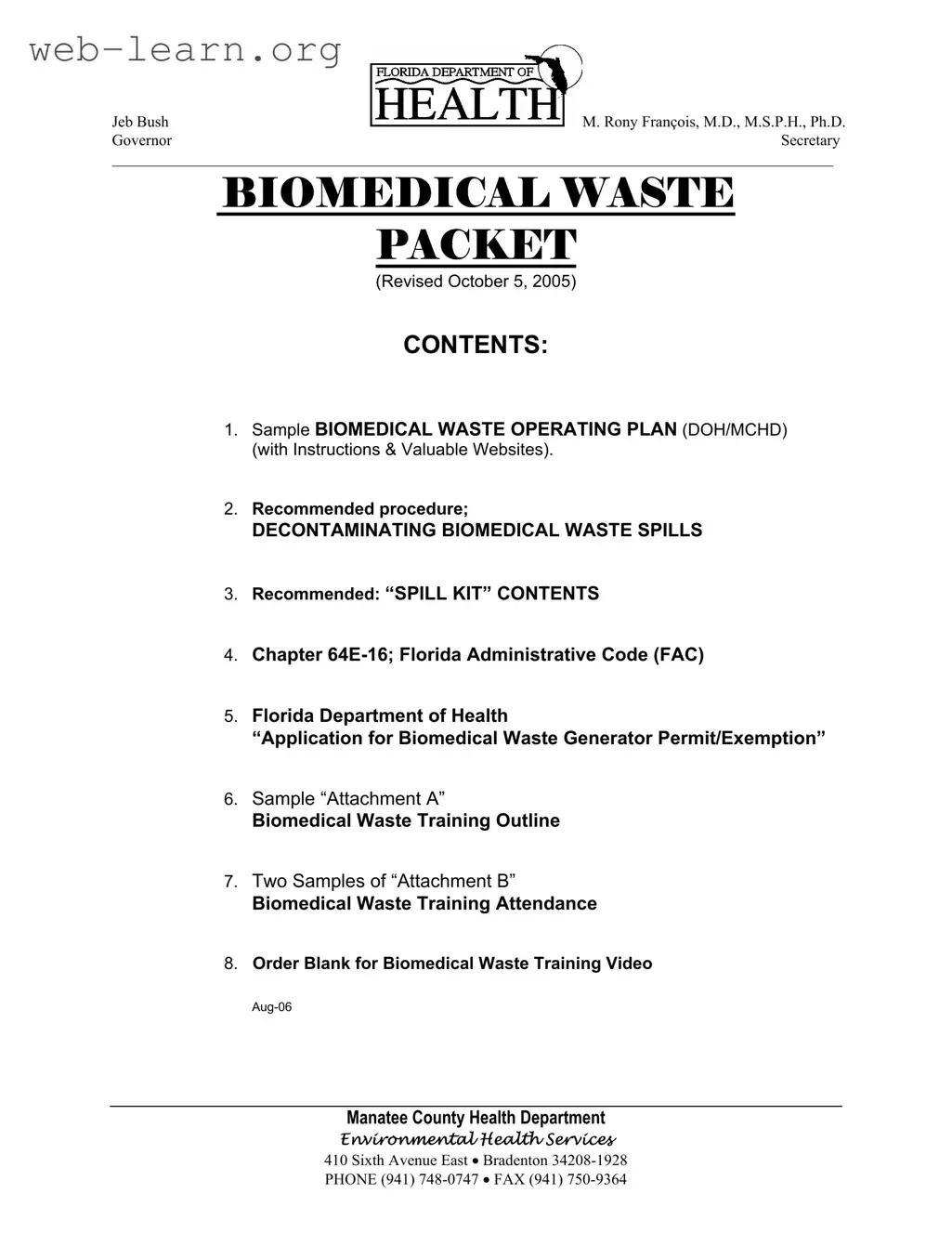
Jeb Bush M. Rony François, M.D., M.S.P.H., Ph.D.
Governor Secretary
____________________________________________________________________________________________
Manatee County Health Department
Environmental Health Services
410 Sixth Avenue East Bradenton 34208-1928
PHONE (941) 748-0747 FAX (941) 750-9364
BIOMEDICAL WASTE
PACKET
(Revised October 5, 2005)
CONTENTS:
1. Sample BIOMEDICAL WASTE OPERATING PLAN (DOH/MCHD)
(with Instructions & Valuable Websites).
2. Recommended procedure;
DECONTAMINATING BIOMEDICAL WASTE SPILLS
3. Recommended: “SPILL KIT” CONTENTS
4. Chapter 64E-16; Florida Administrative Code (FAC)
5. Florida Department of Health
“Application for Biomedical Waste Generator Permit/Exemption”
6. Sample “Attachment A”
Biomedical Waste Training Outline
7.
Two Samples of “Attachment B”
Biomedical Waste Training Attendance
8. Order Blank for Biomedical Waste Training Video
Aug-06
Aug-06 Page 2 of 27
BIOMEDICAL WASTE OPERATING PLAN
FACILITY NAME (
1)
TABLE OF CONTENTS
I. DIRECTIONS FOR COMPLETING THE BIOMEDICAL WASTE PLAN
II. PURPOSE
III. TRAINING FOR PERSONNEL
IV. DEFINITION, IDENTIFICATION, AND SEGREGATION OF BIOMEDICAL WASTE
V. CONTAINMENT
VI. LABELING
VII. STORAGE
VIII. TRANSPORT
IX. PROCEDURE FOR DECONTAMINATING BIOMEDICAL WASTE SPILLS
X. CONTINGENCY PLAN
XI. BRANCH OFFICES
XII. MISCELLANEOUS
ATTACHMENT A: BIOMEDICAL WASTE TRAINING OUTLINE
ATTACHMENT B: BIOMEDICAL WASTE TRAINING ATTENDANCE
ATTACHMENT C: PLAN FOR TREATMENT OF BIOMEDICAL WASTE
(Not Included; Available upon request)
Use of this plan format is voluntary and not required by the Department of Health. It is provided as a
service to assist biomedical waste facilities in complying with the requirements of Chapter 64E-16,
F.A.C.
Aug-06 Page 3 of 27
I. DIRECTIONS FOR COMPLETING THE BIOMEDICAL WASTE PLAN
Blank 1: Enter the name of your facility.
Blank 2: Enter where you keep your employee training records.
Blank 3: List the items of biomedical waste that are produced in your facility and the location where
each waste item is generated.
Blank 4: Enter the name of the manufacturer of your facility’s red bags. This company must be
on the Department of Health (DOH) list of compliant red bags (this list can be obtained from the
following website:
www.doh.state.fl.us/environment/community/biomedical/red_bags.htm) or
from your DOH biomedical waste coordinator OR you must have results supplied by the bag
manufacturer from an independent laboratory that indicate that your red bags meet the
bag construction requirements of Chapter 64E-16, Florida Administrative Code (F.A.C.). If your
facility does not use red bags, enter N/A.
Blank 5: Indicate where the documentation for the construction standards of your facility’s red
bags is kept. or if your facility does not use red bags, enter N/A.
Blank 6: Indicate where unused, red biomedical waste bags are kept in operational areas (not in stock or
in central storage) so that working staff can get them quickly when they need them. If your
facility does not use red bags, enter N/A.
Blank 7: Enter the place where your biomedical waste is stored. 1.How is this area “Washable”?
2. Is this area “Out of the Client Traffic Area” (how)?
3. How is this area’s access restricted?
If your biomedical waste is picked up by a licensed biomedical waste transporter
but you have no storage area, indicate your procedure for preparing your biomedical waste for
pick-up. If you have no pick-up and no storage area, enter N/A.
Blank 8: Enter all the required information about your registered biomedical waste transporter. The
website
www.doh.state.fl.us/environment/community/biomedical/transporters.htm has a list of
such transporters. If you do not use a transporter, enter N/A.
Blank 9: Enter the name(s) of the employee(s) designated to transport your facility’s untreated
biomedical waste to another facility. If your facility does not transport your own biomedical
waste, enter N/A.
Blank 10: Enter the name of the facility to which your facility transports your own untreated biomedical
waste. If your facility does not transport your own biomedical waste, enter N/A.
Blank 11: Describe the procedure and products your facility will use to decontaminate a spill or leak of
biomedical waste.
Blank 12: Enter the required information about the registered biomedical waste transporter who
will transport your biomedical waste on a contingency basis.
Blank 13: If personnel from your facility also work at a branch office of your facility, enter the name
of the branch office. If you have no branch office, enter N/A.
Blank 14: Enter the street address, city, and state of the branch office named in (13). If you have no
branch office, enter N/A.
Aug-06 Page 4 of 27
Blank 15: Enter the weekdays the branch office named in (13) is open. If you have no branch
office, enter N/A.
Blank 16: Enter the normal work hours for each day the branch office named in (13) is open. If you have
no branch office, enter N/A.
Blank 17: Indicate where a copy of this biomedical waste operating plan will be kept in your facility.
Blank 18: Indicate where the current biomedical waste permit or exemption document will be kept in your
facility.
Blank 19: Indicate where your facility will keep its current copy of the biomedical waste rules,
Chapter 64E-16, F.A.C.
Blank 20: Indicate where your facility will keep copies of its biomedical waste inspections from
at least the last three (3) years.
Blank 21: If your facility transports your own biomedical waste, indicate where your transport log is kept.
If you do not transport your own biomedical waste, enter N/A.
Attachment A:
Activities addressed should be those from Section III that are carried out in your
facility.
Attachment B:
Enter the required information to document training sessions.
Attachment C: To be completed only if your facility treats biomedical waste. If your facility has
untreated biomedical waste removed by a registered transporter or you transport your own
untreated waste, do not complete this attachment.
Aug-06 Page 5 of 27
II. PURPOSE
The purpose of this Biomedical Waste Operating Plan is to provide guidance and
describe requirements for the proper management of biomedical waste in our facility.
Guidelines for management of biomedical waste are found in Chapter 64E-16, Florida
Administrative Code (F.A.C.), and in section 381.0098, Florida Statutes.
III. TRAINING FOR PERSONNEL
Biomedical waste training will be scheduled as required by paragraph 64E-
16.003(2)(a), F.A.C. Training sessions will detail compliance with this operating plan
and with Chapter 64E-16, F.A.C. Training sessions will include all of the following
activities that are carried out in our facility:
Definition and Identification of Biomedical Waste
Segregation
Storage
Labeling
Transport
Procedure for Decontaminating Biomedical Waste Spills
Contingency Plan for Emergency Transport
Procedure for Containment
Treatment Method
Training for the activities that are carried out in our facility is outlined in Attachment A.
Our facility must maintain records of employee training. These records will be kept
(2)
Training records will be kept for participants in all training sessions for a minimum of
three (3) years and will be available for review by Department of Health (DOH)
inspectors. An example of an attendance record is appended in Attachment B.
IV. DEFINITION, IDENTIFICATION, AND SEGREGATION OF BIOMEDICAL WASTE
Biomedical waste is any solid or liquid waste which may present a threat of infection
to humans. Biomedical waste is further defined in subsection 64E-16.002(2), F.A.C.
Items of sharps and non-sharps biomedical waste generated in this facility and the
locations at which they are generated are:
(3)
If biomedical waste is in a liquid or semi-solid form and aerosol formation is minimal,
the waste may be disposed into a sanitary sewer system or into another system
approved to receive such waste by the Department of Environmental Protection or the
DOH.
Aug-06 Page 6 of 27
V. CONTAINMENT
Red bags for containment of biomedical waste will comply with the required physical
properties.
Our red bags are manufactured by
(4)
Our documentation of red bag construction standards is kept
(5)
Working staff can quickly get red bags at
(6)
Sharps will be placed into sharps containers at the point of origin.
Filled red bags and filled sharps containers will be sealed at the point of origin. Red
bags, sharps containers, and outer containers of biomedical waste, when sealed, will
not be reopened in this facility. Ruptured or leaking packages of biomedical waste will
be placed into a larger container without disturbing the original seal.
VI. LABELING
All sealed biomedical waste red bags and sharps containers will be labeled with this
facility’s name and address prior to offsite transport. If a sealed red bag or sharps
container is placed into a larger red bag prior to transport, placing the facility’s name
and address only on the exterior bag is sufficient.
Outer containers must be labeled with our transporter’s name, address, registration
number, and 24-hour phone number.
VII. STORAGE
When sealed, red bags, sharps containers, and outer containers will be stored in areas
that are restricted through the use of locks, signs, or location. The 30-day storage time
period will commence when the first non-sharps item of biomedical waste is placed into
a red bag or sharps container, or when a sharps container that contains only sharps is
sealed.
Indoor biomedical waste storage areas will be constructed of smooth, easily cleanable
materials that are impervious to liquids. These areas will be regularly maintained in a
sanitary condition. The storage area will be vermin/insect free. Outdoor storage areas
also will be conspicuously marked with a six-inch international biological hazard symbol
and will be secure from vandalism.
Biomedical waste will be stored and restricted in the following manner:
(7)
Aug-06 Page 7 of 27
VIII. TRANSPORT
We will negotiate for the transport of biomedical waste only with a DOH-registered
company. If we contract with such a company, we will have on file the pick-up receipts
provided to us for the last three (3) years. Transport for our facility is provided by:
a. The following registered biomedical waste transporter:
Company name (8)
Address
Phone
Registration number
Place pick-up receipts are kept
OR
b. An employee of this facility who works under the following guidelines:
We will transport our own biomedical waste. For tracking purposes, we
will maintain a log of all biomedical waste transported by any employee
for the last three (3) years. The log will contain waste amounts, dates,
and documentation that the waste was accepted by a permitted facility.
Name of employee(s) who is(are) assigned transport duty:
(9)
Biomedical waste will be transported to:
(10)
Aug-06 Page 8 of 27
IX. PROCEDURE FOR DECONTAMINATING BIOMEDICAL WASTE SPILLS
(11)
X. CONTINGENCY PLAN
If our registered biomedical waste transporter is unable to transport this facility’s
biomedical waste, or if we are unable temporarily to treat our own waste, then the
following registered biomedical waste transporter will be contacted:
Company name (12)
Address
Phone
Registration number
XI. BRANCH OFFICES
The personnel at our facility work at the following branch offices during the days and
times indicated:
1) Office name (13)
Office address (14)
Days of operation (15)
Hours of operation (16)
2) Office name (13)
Office address (14)
Days of operation (15)
Hours of operation (16)
Aug-06 Page 9 of 27
XII. MISCELLANEOUS
For easy access by all of our staff, a copy of this biomedical waste operating plan
will be kept in the following place:
(17)
The following items will be kept where indicated:
a. Current DOH biomedical waste permit/ exemption document
(18)
b. Current copy of Chapter 64E-16, F.A.C.
(19)
c. Copies of biomedical waste inspection reports from last three (3) years
(20)
d. Transport log
(21)
Aug-06 Page 10 of 27
ATTACHMENT A: BIOMEDICAL WASTE TRAINING OUTLINE
Facility Name:
Trainer’s Name:
Outline:

Form Information

Fact Name Details
Governing Law The Biomedical Waste Operating Plan is governed by Chapter 64E-16 of the Florida Administrative Code (FAC) and section 381.0098 of the Florida Statutes.
Purpose This plan provides guidance for the proper management of biomedical waste in facilities to ensure safety and compliance.
Voluntary Use Utilizing this plan format is voluntary and not mandated by the Department of Health.
Training Requirements Personnel must receive training on biomedical waste management as outlined in paragraph 64E-16.003(2)(a), F.A.C.
Record Keeping Training records must be maintained for a minimum of three years and be available for inspection by the Department of Health.
Spill Procedures The plan includes a procedure for decontaminating biomedical waste spills, ensuring staff are prepared for emergencies.
Red Bag Compliance Facilities must use red bags that comply with DOH standards, with documentation available for inspection.
Attachments The plan includes several attachments, such as a training outline and attendance records, to support compliance and training efforts.

Detailed Guide for Filling Out Biomedical Waste Operating Plan

Filling out the Biomedical Waste Operating Plan form is an important step in ensuring compliance with health regulations. Follow these steps carefully to complete the form accurately.

  1. Enter the name of your facility in Blank 1.
  2. Provide the location where you keep your employee training records in Blank 2.
  3. List the items of biomedical waste produced in your facility and where each item is generated in Blank 3.
  4. Enter the name of the manufacturer of your facility’s red bags in Blank 4. Ensure this company is on the Department of Health's compliant list or has independent lab results confirming compliance.
  5. Indicate where documentation for the construction standards of your red bags is kept in Blank 5. If not applicable, enter N/A.
  6. Specify where unused red biomedical waste bags are kept in operational areas in Blank 6. Again, enter N/A if not applicable.
  7. Enter the storage location for your biomedical waste in Blank 7. Describe how the area is washable, out of client traffic, and restricted in access. If applicable, outline your procedure for preparing waste for pick-up.
  8. Provide information about your registered biomedical waste transporter in Blank 8. If not applicable, enter N/A.
  9. List the names of employees designated to transport untreated biomedical waste in Blank 9. Enter N/A if not applicable.
  10. Enter the name of the facility where your untreated biomedical waste is transported in Blank 10. If not applicable, enter N/A.
  11. Describe your decontamination procedure for spills or leaks in Blank 11.
  12. Provide details about the registered transporter for contingency purposes in Blank 12.
  13. If applicable, enter the name of any branch office in Blank 13. If not applicable, enter N/A.
  14. Enter the address of the branch office in Blank 14. If not applicable, enter N/A.
  15. Specify the weekdays the branch office is open in Blank 15. If not applicable, enter N/A.
  16. Enter the normal work hours for each day the branch office is open in Blank 16. If not applicable, enter N/A.
  17. Indicate where a copy of the biomedical waste operating plan will be kept in Blank 17.
  18. Specify where the current biomedical waste permit or exemption document will be kept in Blank 18.
  19. Indicate where your facility keeps the current copy of the biomedical waste rules in Blank 19.
  20. Indicate where copies of biomedical waste inspections from the last three years are kept in Blank 20.
  21. If applicable, indicate where your transport log is kept in Blank 21. If not applicable, enter N/A.

After completing the form, ensure all sections are filled out correctly. Review your entries for accuracy and clarity. This will help maintain compliance and ensure proper management of biomedical waste in your facility.

Obtain Answers on Biomedical Waste Operating Plan

  1. What is the purpose of the Biomedical Waste Operating Plan?

    The Biomedical Waste Operating Plan is designed to guide facilities in the proper management of biomedical waste. It outlines the requirements set forth in Chapter 64E-16 of the Florida Administrative Code and section 381.0098 of the Florida Statutes. By following this plan, facilities can ensure they handle biomedical waste safely and in compliance with state regulations.

  2. Who needs to complete the Biomedical Waste Operating Plan?

    Any facility that generates biomedical waste must complete the Biomedical Waste Operating Plan. This includes hospitals, clinics, laboratories, and any other entities that produce waste that may pose an infection risk. The plan helps these facilities identify, segregate, and manage their biomedical waste effectively.

  3. What kind of training is required for personnel?

    Personnel must undergo training that covers various aspects of biomedical waste management. This includes understanding the definition and identification of biomedical waste, proper segregation, storage, labeling, and transport procedures. Training sessions also address how to decontaminate spills and the contingency plans for emergencies. Records of this training must be kept for at least three years and be available for review by the Department of Health inspectors.

  4. How should biomedical waste be stored and transported?

    Biomedical waste should be stored in a designated area that is cleanable and away from client traffic. Access to this area must be restricted to authorized personnel only. For transportation, facilities must use registered biomedical waste transporters. If a facility transports its own waste, they must document the procedure and ensure compliance with safety standards. Proper labeling and containment are essential during both storage and transport to minimize any health risks.

Common mistakes

Completing the Biomedical Waste Operating Plan form is crucial for compliance and safety. However, many individuals make common mistakes that can lead to complications. Awareness of these pitfalls can help ensure a smoother process.

One frequent mistake is failing to accurately enter the facility name in Blank 1. This detail is essential for identifying the responsible party. Omitting or misspelling this information can create confusion and hinder communication with regulatory bodies.

Another common error involves neglecting to specify the location of employee training records in Blank 2. This oversight can lead to difficulties during inspections. Keeping training records accessible is vital for demonstrating compliance with training requirements.

Many people also struggle with Blank 3, where they must list the items of biomedical waste produced in their facility. Incomplete or vague descriptions can result in misunderstandings about the types of waste being managed. This can jeopardize the facility's compliance with safety regulations.

In Blank 4, entering the name of the manufacturer of red bags is crucial. Some individuals may not check if the manufacturer is on the Department of Health's compliant list. Using non-compliant bags can lead to serious legal repercussions and safety risks.

Another mistake occurs in Blank 6, where individuals fail to indicate the location of unused red biomedical waste bags. Quick access to these bags is necessary for staff during emergencies. Not providing this information can delay response times in critical situations.

In Blank 7, individuals often overlook the requirement to describe how the biomedical waste storage area is made washable and restricted from client traffic. Providing clear answers is essential for ensuring that the waste is managed safely and effectively.

Additionally, some people forget to include necessary details about the registered biomedical waste transporter in Blank 8. This information is vital for ensuring that the waste is handled by a licensed professional, which is a key aspect of compliance.

Finally, many individuals do not keep copies of their biomedical waste inspections as required in Blank 20. Failing to maintain these records can lead to challenges during audits or inspections, potentially resulting in penalties or corrective actions.

By being mindful of these common mistakes, facilities can better navigate the complexities of the Biomedical Waste Operating Plan form. Proper completion not only ensures compliance but also promotes a safer environment for all.

Documents used along the form

In managing biomedical waste, various documents complement the Biomedical Waste Operating Plan form. Each of these documents plays a crucial role in ensuring compliance with regulations and promoting safe practices. Below is a list of commonly used forms and documents in this context.

  • Decontaminating Biomedical Waste Spills Procedure: This document outlines the steps to take in the event of a biomedical waste spill. It provides guidelines for containment, cleanup, and safety measures to protect staff and patients.
  • Spill Kit Contents Recommendation: This list specifies the necessary items to include in a spill kit. Having the right materials readily available can facilitate quick and effective responses to spills.
  • Application for Biomedical Waste Generator Permit/Exemption: Facilities must submit this application to the Florida Department of Health to obtain the necessary permits or exemptions for generating biomedical waste.
  • Biomedical Waste Training Outline (Attachment A): This outline details the training topics that staff must cover to ensure proper handling and management of biomedical waste. It serves as a framework for training sessions.
  • Biomedical Waste Training Attendance Records (Attachment B): Facilities must maintain records of employee attendance at training sessions. This documentation is essential for compliance and may be reviewed during inspections.
  • Plan for Treatment of Biomedical Waste (Attachment C): This plan is required if a facility treats its biomedical waste on-site. It outlines the methods and procedures for treatment and disposal.

These documents work together to support safe and compliant biomedical waste management practices. Ensuring that all relevant forms are completed and accessible is vital for the health and safety of both staff and the community.

Similar forms

  • Hazardous Waste Management Plan: Similar to the Biomedical Waste Operating Plan, this document outlines procedures for identifying, handling, and disposing of hazardous waste to ensure safety and compliance with regulations.
  • Infection Control Plan: This document details strategies for preventing and controlling infections in healthcare settings, much like the Biomedical Waste Operating Plan aims to mitigate risks associated with biomedical waste.

  • Environmental Management Plan: This plan addresses the management of environmental impacts from a facility's operations, akin to how the Biomedical Waste Operating Plan focuses on waste management practices.
  • Emergency Response Plan: This document provides protocols for responding to emergencies, such as spills or accidents, similar to the contingency plans outlined in the Biomedical Waste Operating Plan.
  • Occupational Safety and Health Administration (OSHA) Safety Plan: This plan outlines safety procedures to protect employees from workplace hazards, paralleling the training and safety measures in the Biomedical Waste Operating Plan.
  • Training Program Outline: Similar to the training requirements in the Biomedical Waste Operating Plan, this document details training topics and schedules for staff to ensure compliance with safety regulations.
  • Waste Disposal Policy: This policy defines procedures for the disposal of various types of waste, including biomedical waste, much like the guidelines provided in the Biomedical Waste Operating Plan.
  • Standard Operating Procedures (SOPs): SOPs provide step-by-step instructions for specific tasks, similar to the detailed procedures for managing biomedical waste in the Operating Plan.
  • Quality Assurance Plan: This plan ensures that processes meet established standards, akin to how the Biomedical Waste Operating Plan ensures compliance with waste management regulations.
  • Compliance Audit Checklist: This checklist is used to verify adherence to regulations and policies, similar to how the Biomedical Waste Operating Plan helps facilities ensure they meet legal requirements.

Dos and Don'ts

When filling out the Biomedical Waste Operating Plan form, it is important to follow specific guidelines to ensure accuracy and compliance. Below are five things you should do and five things you should avoid.

  • Do enter the name of your facility accurately in Blank 1.
  • Do keep your employee training records organized and accessible.
  • Do list all items of biomedical waste produced, along with their locations.
  • Do ensure that the manufacturer of your red bags is compliant with DOH standards.
  • Do describe the procedure for decontaminating spills clearly in Blank 11.
  • Don't leave any blanks empty unless instructed to enter N/A.
  • Don't provide inaccurate information about your biomedical waste transporter.
  • Don't forget to indicate where your transport log is kept if applicable.
  • Don't overlook the importance of maintaining records for at least three years.
  • Don't use red bags that are not listed as compliant by the Department of Health.

Misconceptions

  • Misconception 1: The Biomedical Waste Operating Plan is mandatory.
  • Many believe that using the Biomedical Waste Operating Plan format is required by the Department of Health. In reality, it is voluntary. This format serves as a helpful guide for facilities to comply with regulations.

  • Misconception 2: All biomedical waste must be disposed of in red bags.
  • Some think that red bags are the only option for biomedical waste disposal. However, if a facility does not use red bags, they can simply indicate "N/A" in the relevant sections of the form.

  • Misconception 3: Training records are optional.
  • It is a common belief that keeping training records for employees is not essential. In fact, facilities must maintain these records for a minimum of three years for compliance and inspection purposes.

  • Misconception 4: The plan does not require updates.
  • Some assume that once the plan is completed, it remains unchanged. Facilities should regularly review and update their Biomedical Waste Operating Plan to reflect any changes in procedures or regulations.

  • Misconception 5: All biomedical waste can be disposed of in the same manner.
  • Many people think that all types of biomedical waste are treated equally. Different types of waste, such as sharps and non-sharps, have specific handling and disposal requirements that must be followed.

  • Misconception 6: There is no need for a contingency plan.
  • Some believe that having a contingency plan for emergencies is unnecessary. In reality, a well-prepared facility must have procedures in place for unexpected situations, such as spills or leaks of biomedical waste.

Key takeaways

Understanding the Biomedical Waste Operating Plan form is crucial for compliance and safety. Here are key takeaways to consider:

  1. Clearly identify your facility's name and maintain accurate records of employee training. This documentation is essential for compliance and must be readily accessible for inspections.
  2. List all types of biomedical waste generated in your facility, along with their specific locations. This helps ensure proper management and segregation of waste.
  3. Ensure that the red bags used for biomedical waste meet the standards set by the Florida Department of Health. Documentation from the bag manufacturer may be required.
  4. Establish a clear procedure for decontaminating spills or leaks of biomedical waste. This procedure should be well-documented and communicated to all personnel involved.
  5. Keep copies of the Biomedical Waste Operating Plan and relevant permits in designated locations within your facility. This ensures that all staff can access critical information when needed.

Timely completion and adherence to these guidelines will enhance safety and compliance in your facility.