Homepage Blank Bill of Lading with a Supplement Form
Outline

The Bill of Lading with a Supplement form serves as a critical document in the shipping and freight industry, facilitating the transfer of goods and outlining the terms of transport. This form not only acts as a receipt for the cargo but also establishes the contractual relationship between the shipper and the carrier. Key aspects include detailed information about the parties involved, descriptions of the goods being shipped, and the agreed-upon terms regarding delivery and liability. The Supplement section allows for additional clauses or modifications to be included, ensuring that all parties have a clear understanding of their responsibilities and rights. By incorporating these elements, the form helps mitigate disputes and enhances the efficiency of shipping operations. Understanding the nuances of this document is essential for anyone involved in logistics, as it lays the groundwork for a successful shipping process.
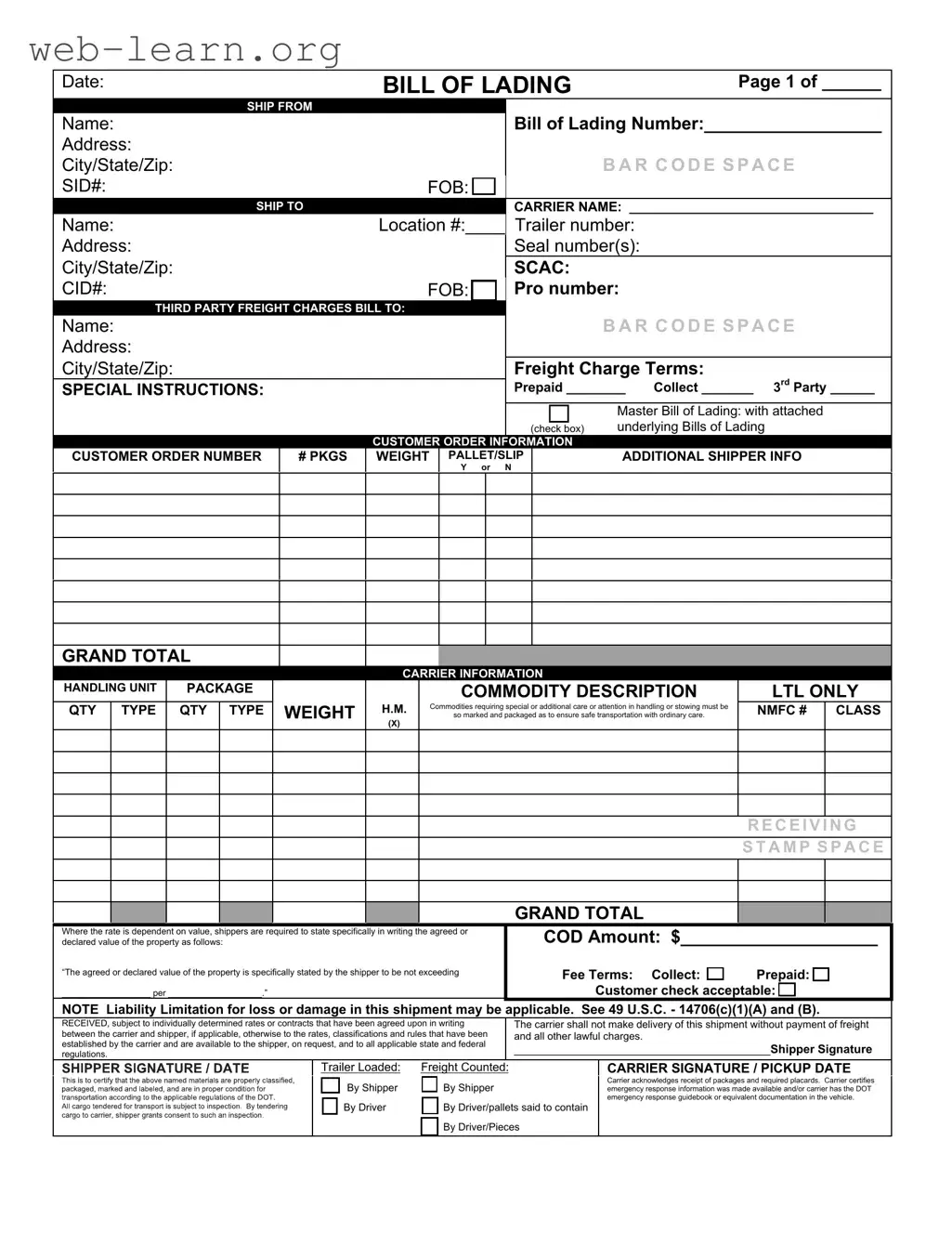
Sample - Bill of Lading with a Supplement Form

Date:
BILL OF LADING
Page 1 of ______
SHIP FROM
Name: Bill of Lading Number:__________________
Address:
City/State/Zip:
B A R C O D E S P A C E
SID#:
FOB:
o
SHIP TO
CARRIER NAME: _________________________________
Name: Location #:____ Trailer number:
Address: Seal number(s):
City/State/Zip: SCAC:
CID#:
FOB:
o
Pro number:
THIRD PARTY FREIGHT CHARGES BILL TO:
Name:
B A R C O D E S P A C E
Address:
City/State/Zip: Freight Charge Terms:
SPECIAL INSTRUCTIONS:
Prepaid ________ Collect _______ 3
rd
Party ______
o
(check box)
Master Bill of Lading: with attached
underlying Bills of Lading
CUSTOMER ORDER INFORMATION
CUSTOMER ORDER NUMBER # PKGS WEIGHT
PALLET/SLIP
Y or N
ADDITIONAL SHIPPER INFO
GRAND TOTAL
CARRIER INFORMATION
HANDLING UNIT
PACKAGE
COMMODITY DESCRIPTION LTL ONLY
QTY TYPE QTY TYPE
WEIGHT
H.M.
(X)
Commodities requiring special or additional care or attention in handling or stowing must be
so marked and packaged as to ensure safe transportation with ordinary care.
NMFC #
CLASS
R E C E I V I N G
S T A M P S P A C E
GRAND TOTAL
Where the rate is dependent on value, shippers are required to state specifically in writing the agreed or
declared value of the property as follows:
COD Amount: $____________________
“The agreed or declared value of the property is specifically stated by the shipper to be not exceeding
__________________ per ___________________.”
Fee Terms: Collect: ¨ Prepaid: o
Customer check acceptable: o
NOTE Liability Limitation for loss or damage in this shipment may be applicable. See 49 U.S.C. - 14706(c)(1)(A) and (B).
RECEIVED, subject to individually determined rates or contracts that have been agreed upon in writing
between the carrier and shipper, if applicable, otherwise to the rates, classifications and rules that have been
established by the carrier and are available to the shipper, on request, and to all applicable state and federal
regulations.
The carrier shall not make delivery of this shipment without payment of freight
and all other lawful charges.
_______________________________________Shipper Signature
SHIPPER SIGNATURE / DATE
Trailer Loaded: Freight Counted:
CARRIER SIGNATURE / PICKUP DATE
This is to certify that the above named materials are properly classified,
packaged, marked and labeled, and are in proper condition for
transportation according to the applicable regulations of the DOT.
p By Shipper
p By Driver
p By Shipper
p By Driver/pallets said to contain
Carrier acknowledges receipt of packages and required placards. Carrier certifies
emergency response information was made available and/or carrier has the DOT
emergency response guidebook or equivalent documentation in the vehicle.
p By Driver/Pieces
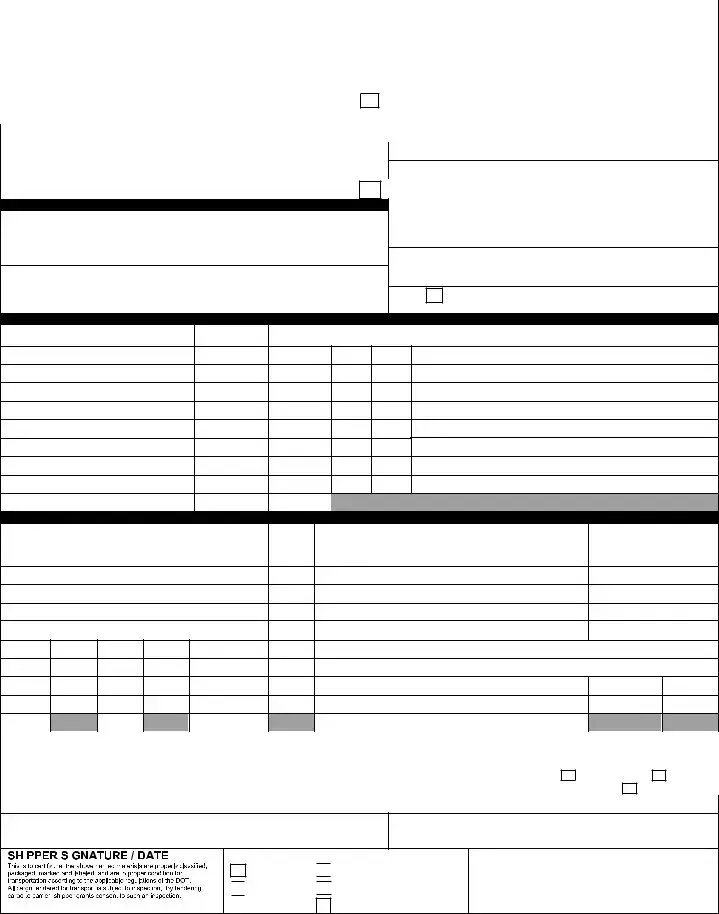
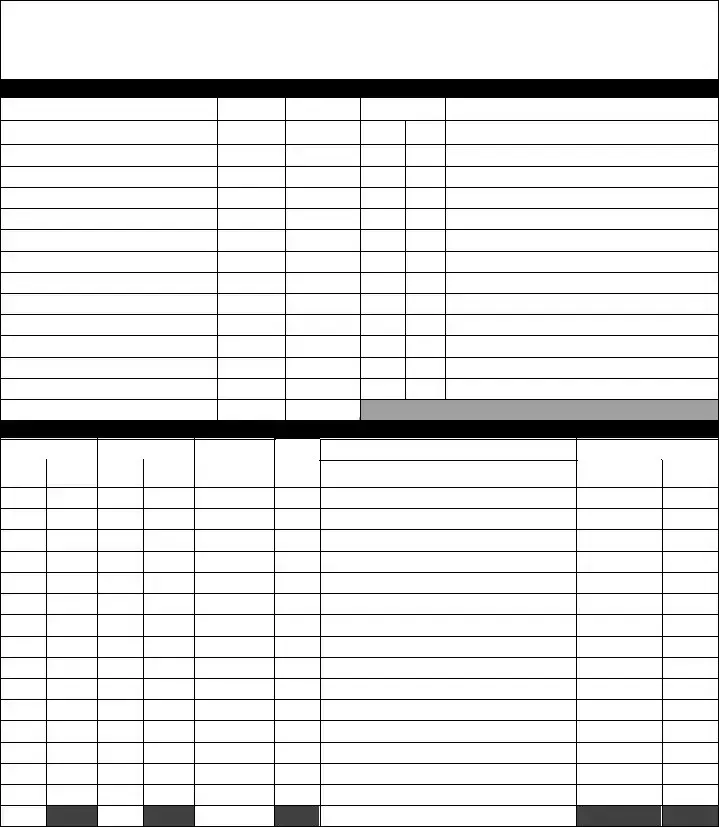
SUPPLEMENT TO THE BILL OF LADING
Page _________
Bill of Lading Number: __________________
CUSTOMER ORDER INFORMATION
CUSTOMER ORDER NUMBER # PKGS WEIGHT
PALLET/SLIP
Y or N
ADDITIONAL SHIPPER INFO
PAGE SUBTOTAL
CARRIER INFORMATION
HANDLING UNIT
PACKAGE
COMMODITY DESCRIPTION LTL ONLY
QTY TYPE QTY TYPE
WEIGHT
H.M.
(X)
Commodities requiring special or additional care or attention in handling or stowing must
be so marked and packaged as to ensure safe transportation with ordinary care.
NMFC # CLASS
PAGE SUBTOTAL

Form Information

Fact Name Description
Definition A Bill of Lading is a legal document between a shipper and a carrier that details the type, quantity, and destination of goods being transported.
Types There are several types of Bills of Lading, including straight, order, and bearer, each serving different purposes in shipping and logistics.
Supplement Form A Supplement form may be used to add additional terms or conditions to the original Bill of Lading, ensuring clarity in shipping agreements.
Governing Laws The governing laws for Bills of Lading can vary by state. For example, in California, the Uniform Commercial Code (UCC) applies.
Importance The Bill of Lading serves as a receipt for the goods, a document of title, and a contract of carriage, making it essential for legal and logistical purposes.

Detailed Guide for Filling Out Bill of Lading with a Supplement

Once you have the Bill of Lading with a Supplement form in hand, it’s time to fill it out carefully. This document is essential for shipping goods and ensuring that everything is accounted for. By following the steps below, you can complete the form accurately and efficiently.

  1. Start by entering the date at the top of the form. This helps track when the shipment was initiated.
  2. Next, fill in the name and address of the shipper. This is the person or company sending the goods.
  3. Provide the name and address of the consignee. This individual or business will receive the shipment.
  4. List the origin and destination of the shipment. Include city, state, and zip code for both locations.
  5. Describe the goods being shipped. Be as detailed as possible, including quantity, weight, and any special handling instructions.
  6. Indicate the shipping method. Specify whether it’s ground, air, or another mode of transport.
  7. Include any additional charges that may apply, such as insurance or handling fees.
  8. Sign and date the form at the bottom. This signature confirms that the information provided is accurate.

With the form completed, you can now proceed to submit it to the relevant shipping company or carrier. Ensure that you keep a copy for your records, as it may be needed for tracking or claims in the future.

Obtain Answers on Bill of Lading with a Supplement

  1. What is a Bill of Lading?

    A Bill of Lading is a legal document issued by a carrier to a shipper. It serves three primary purposes: it acts as a receipt for the goods, it provides evidence of the contract of carriage, and it serves as a document of title to the goods. This document is essential for the transportation of goods, particularly in international trade.

  2. What is the purpose of a Supplement form?

    The Supplement form is used to provide additional information or amendments to the original Bill of Lading. It may include changes in shipping instructions, corrections of errors, or the addition of new details about the cargo. This form ensures that all parties involved have the most accurate and up-to-date information regarding the shipment.

  3. Who needs to sign the Bill of Lading?

    Typically, the Bill of Lading must be signed by the shipper and the carrier. The shipper is the person or company sending the goods, while the carrier is the entity responsible for transporting the goods. In some cases, the consignee, or the person receiving the goods, may also need to sign the document to acknowledge receipt.

  4. What information is included in a Bill of Lading?

    A Bill of Lading generally includes the following information:

    • Name and address of the shipper
    • Name and address of the consignee
    • Description of the goods
    • Quantity and weight of the cargo
    • Shipping instructions
    • Terms and conditions of the carriage
  5. Can a Bill of Lading be transferred?

    Yes, a Bill of Lading can be transferred, particularly if it is a negotiable Bill of Lading. This means that the rights to the goods can be transferred from one party to another. The transfer typically occurs through endorsement, where the original holder signs the document over to a new party, thereby passing ownership of the goods.

  6. What happens if there is a discrepancy in the Bill of Lading?

    If discrepancies are found in the Bill of Lading, they must be addressed promptly. The shipper should notify the carrier immediately to correct any errors. Failure to resolve discrepancies can lead to disputes, delays, or issues with the delivery of goods.

  7. How long should I keep a Bill of Lading?

    It is advisable to keep a Bill of Lading for at least three to seven years, depending on your business needs and legal requirements. Retaining this document can be crucial for record-keeping, resolving disputes, or for tax purposes. Always consult with a legal advisor to determine the appropriate retention period for your specific situation.

Common mistakes

Filling out a Bill of Lading with a Supplement form can seem straightforward, but many people make common mistakes that can lead to complications down the line. One frequent error is neglecting to provide accurate details about the shipment. This includes the description of the goods, their weight, and dimensions. Inaccurate information can result in delays, additional charges, or even legal disputes. Always double-check the details before submission to ensure everything is correct.

Another mistake is failing to include the necessary signatures. A Bill of Lading is a legal document, and it requires the signatures of both the shipper and the carrier. Without these signatures, the document may not be considered valid. It’s essential to confirm that all required parties have signed the document before it is finalized. This simple step can prevent potential issues during transit.

People also often overlook the importance of understanding the terms and conditions associated with the Bill of Lading. Each form may have specific clauses that outline responsibilities, liabilities, and rights. Ignoring these can lead to misunderstandings or disputes later. Taking the time to read and comprehend these terms can save a lot of trouble in the future.

Additionally, some individuals forget to keep copies of the completed Bill of Lading with a Supplement form. This document serves as a receipt and proof of the contract between the shipper and carrier. Without a copy, it may be challenging to resolve any issues that arise during transport. Always retain a copy for your records, as it can be invaluable if any disputes occur.

Lastly, failing to update the form when changes occur is a common mistake. If there are any modifications to the shipment, such as a change in delivery address or alterations in the contents, these must be documented. Neglecting to do so can lead to miscommunication and potential delivery errors. Keeping the Bill of Lading current is crucial for smooth operations.

Documents used along the form

The Bill of Lading with a Supplement form is a crucial document in the shipping industry, serving as a receipt for goods and a contract between the shipper and carrier. Alongside this form, several other documents are often utilized to ensure a smooth transportation process. Below is a list of five important documents commonly associated with the Bill of Lading.

  • Commercial Invoice: This document details the sale transaction between the buyer and seller. It includes information such as the description of goods, quantities, prices, and payment terms. The commercial invoice is essential for customs clearance and for the buyer to process payment.
  • Packing List: The packing list provides a detailed breakdown of the contents of the shipment. It includes information on the number of packages, weight, dimensions, and a description of the items. This document helps both the shipper and receiver verify the shipment upon arrival.
  • Certificate of Origin: This document certifies the country in which the goods were produced. It is often required by customs authorities to determine tariffs and trade regulations. The certificate of origin can facilitate smoother customs processing.
  • Insurance Certificate: This document proves that the goods are insured during transit. It outlines the coverage details and provides peace of mind to both the shipper and the recipient. In the event of loss or damage, this certificate is critical for filing claims.
  • Import/Export License: Depending on the nature of the goods, an import or export license may be required. This document grants permission to move goods across international borders and ensures compliance with local regulations.

These documents, when used in conjunction with the Bill of Lading with a Supplement form, create a comprehensive framework for successful shipping operations. Proper documentation not only aids in compliance but also enhances communication between all parties involved in the transportation process.

Similar forms

The Bill of Lading with a Supplement form is an important document in shipping and logistics. It serves as a receipt for goods and outlines the terms of the transportation. Several other documents share similarities with this form. Here are four such documents:

  • Freight Bill: This document details the charges for transporting goods. Like the Bill of Lading, it serves as a receipt and outlines the terms of payment for the shipping services rendered.
  • Shipping Invoice: A shipping invoice provides a detailed list of goods shipped, along with their prices. It is similar to the Bill of Lading in that it acts as a record of the transaction and can be used for accounting purposes.
  • Delivery Receipt: This document is issued upon delivery of goods, confirming that the items have been received in good condition. It shares similarities with the Bill of Lading by serving as proof of delivery and acceptance of the goods.
  • Export Declaration: An export declaration is required for goods being shipped internationally. It provides information about the shipment and is similar to the Bill of Lading in that it serves as an official record of the shipment's details and compliance with regulations.

Understanding these documents can help ensure smooth transactions and compliance in the shipping process.

Dos and Don'ts

When filling out the Bill of Lading with a Supplement form, it is important to follow certain guidelines to ensure accuracy and compliance. Here’s a list of things you should and shouldn’t do:

  • Do double-check all information for accuracy before submitting.
  • Do use clear and legible handwriting or type the information.
  • Do ensure that all required fields are completed.
  • Do keep a copy of the completed form for your records.
  • Don't leave any fields blank unless specified as optional.
  • Don't use abbreviations that may confuse the reader.
  • Don't forget to sign and date the form where required.

Misconceptions

Understanding the Bill of Lading with a Supplement form is crucial for anyone involved in shipping and logistics. However, several misconceptions can lead to confusion. Here is a list of common misunderstandings:

  1. The Bill of Lading is only a receipt. Many believe that this document serves solely as proof of receipt for goods. In reality, it also functions as a contract and a document of title.
  2. All Bills of Lading are the same. There are different types of Bills of Lading, including straight, negotiable, and sea waybills. Each type serves a unique purpose and has distinct legal implications.
  3. The Bill of Lading guarantees delivery. While it outlines the terms of transport, it does not guarantee that the goods will be delivered without issues. Delays and damages can still occur.
  4. Once signed, the Bill of Lading cannot be changed. Amendments can be made to the Bill of Lading, but they typically require agreement from all parties involved.
  5. The Supplement form is optional. In many cases, the Supplement form is necessary to provide additional details about the shipment, such as special handling instructions or additional terms.
  6. Only the shipper needs to understand the Bill of Lading. All parties, including the consignee and carriers, should have a clear understanding of the document to ensure smooth transactions.
  7. Electronic Bills of Lading are not legally binding. Electronic versions of the Bill of Lading can be just as legally binding as their paper counterparts, provided they meet specific legal requirements.
  8. The Bill of Lading with a Supplement form is only for international shipments. This document is used for both domestic and international shipping, depending on the nature of the transport.

Being aware of these misconceptions can help individuals navigate the complexities of shipping and ensure compliance with legal requirements.

Key takeaways

Understanding the Bill of Lading with a Supplement form is essential for anyone involved in shipping and logistics. Here are some key takeaways to keep in mind:

  • Purpose: The Bill of Lading serves as a receipt for goods and a contract between the shipper and the carrier.
  • Details Matter: Ensure all information, including names, addresses, and item descriptions, is accurate to avoid delays.
  • Supplement Usage: The Supplement form is used to add additional information or amendments to the original Bill of Lading.
  • Signatures Required: Both the shipper and the carrier must sign the document to validate the agreement.
  • Keep Copies: Always retain copies of the Bill of Lading and any supplements for your records and future reference.
  • Legal Implications: Understand that this document can serve as evidence in disputes regarding shipment terms and conditions.
  • Tracking Shipments: Use the Bill of Lading number to track shipments and ensure timely delivery.
  • Compliance: Familiarize yourself with local and federal regulations that may impact how you fill out the form.

By keeping these takeaways in mind, you can navigate the complexities of shipping documentation more effectively.