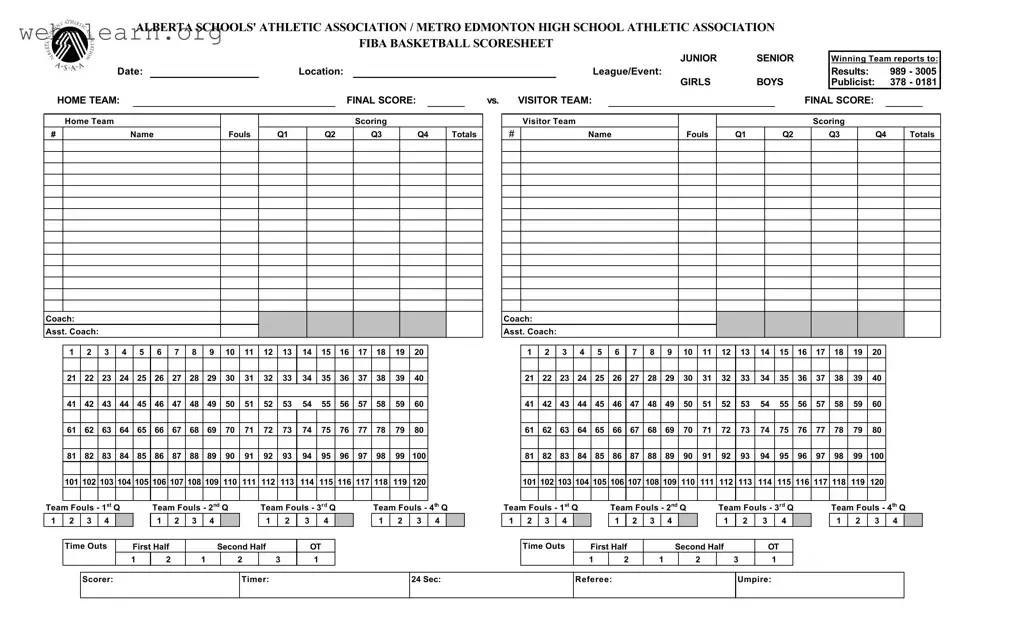
The Basketball Scoresheet form is an essential tool for documenting the details of a game, ensuring that every aspect of the match is recorded accurately. This form captures crucial information, including the teams involved, the date and location of the game, and the final scores for both the home and visitor teams. It provides space for tracking individual player statistics, such as fouls and points scored, across each quarter of play. Coaches for both teams can be noted, along with their respective assistants, allowing for a comprehensive overview of the coaching staff. Additionally, the scoresheet includes sections for team fouls and timeouts, which are vital for understanding the flow of the game. By meticulously filling out this form, teams can maintain a clear record of their performance and make informed decisions for future games. Overall, the Basketball Scoresheet form serves as a reliable reference for players, coaches, and fans alike, contributing to the overall integrity and enjoyment of the sport.

| Fact Name | Description |
|---|---|
| Governing Associations | The scoresheet is used under the auspices of the Alberta Schools' Athletic Association and the Metro Edmonton High School Athletic Association. |
| Game Information | Essential details such as the date, location, and league or event are required to be filled out on the scoresheet. |
| Scoring Details | The scoresheet includes sections for both home and visitor teams, allowing for tracking of individual player scores and fouls across four quarters. |
| Team Fouls Tracking | Fouls committed by each team are recorded for each quarter, providing a clear overview of the game's discipline and player participation. |
| Time Outs Management | The form includes sections to track timeouts taken by each team during the first half, second half, and any overtime periods. |
Filling out the Basketball Scoresheet form is essential for accurately recording the details of a game. This form captures important information such as team names, scores, fouls, and player statistics. Completing it correctly ensures that the game is documented properly for future reference and analysis.
What is the purpose of the Basketball Scoresheet form?
The Basketball Scoresheet form is designed to record essential game information during basketball matches. This includes details about the teams, individual player statistics, fouls, and the final score. It serves as an official document that can be used for tracking team performance, verifying results, and maintaining a historical record of games played.
How do I fill out the scoresheet correctly?
Filling out the scoresheet requires attention to detail. Start by entering the date, location, and league or event at the top of the form. Next, list the home and visitor teams, along with their respective coaches. As the game progresses, record each player's scoring, fouls, and totals for each quarter. Ensure that you note team fouls for each quarter as well. At the end of the game, calculate the final scores and verify that all information is accurate before submission.
Who is responsible for submitting the completed scoresheet?
The responsibility for submitting the completed scoresheet typically falls on the winning team. The designated publicist or a representative from the winning team should ensure that the scoresheet is submitted promptly to the appropriate league or association contact. This ensures that the game results are officially recorded and can be referenced in future standings or statistics.
What should I do if I notice an error on the scoresheet after the game?
If an error is discovered after the game, it is important to address it as soon as possible. Contact the league or association to report the error and provide any necessary corrections. Depending on the league's policies, there may be a formal process for submitting corrections. It is crucial to maintain accurate records, as discrepancies can affect standings and player statistics.
When filling out the Basketball Scoresheet form, many people make common mistakes that can lead to confusion or inaccuracies. One frequent error is failing to clearly indicate the winner of the game. This information is crucial for record-keeping and should be noted immediately after the game concludes.
Another mistake is neglecting to fill in the date and location of the game. These details provide context for the scoresheet and are important for future reference. Omitting this information can make it difficult to track games over time.
Incorrectly entering the final scores for both the home and visitor teams is also a common issue. Double-checking the scores before submitting the form can prevent discrepancies that might affect standings or records.
People often forget to list the names of the coaches for both teams. Including this information is essential, as it helps to identify the individuals responsible for team management during the game.
Another frequent oversight involves the scoring section. Some individuals fail to record the player fouls or the points scored in each quarter. Each player’s performance needs to be documented accurately for statistical purposes.
Many also overlook the section for team fouls by quarter. Keeping track of fouls is important for understanding the game dynamics and can influence coaching strategies in real-time.
Another mistake is not utilizing the time-out sections correctly. Time-outs should be recorded as they happen to ensure accurate tracking of game flow and strategy adjustments.
In some cases, the scoring section is left incomplete. Players' totals should be summed up at the end of the game to provide a clear overview of each player’s contribution.
Failing to sign the scoresheet is another common error. The signatures of the scorer, timer, and referees validate the scoresheet and confirm that all information is accurate.
Finally, not reviewing the scoresheet before submission can lead to multiple errors. Taking a moment to ensure all sections are filled out correctly can save time and avoid complications later on.
The Basketball Scoresheet form is essential for tracking the details of a basketball game, including player statistics and team performance. Several other forms and documents are commonly used alongside this scoresheet to ensure comprehensive record-keeping and organization during games.
These documents work together to create a thorough record of the basketball game, ensuring all aspects are accounted for and facilitating effective communication among coaches, players, and officials.
When filling out the Basketball Scoresheet form, attention to detail is crucial. Here are four important dos and don'ts to keep in mind:
By following these guidelines, you can ensure that the scoresheet is completed correctly and serves its purpose effectively.
Here are four common misconceptions about the Basketball Scoresheet form:
In reality, the scoresheet captures various statistics, including fouls and timeouts, for both teams. It provides a comprehensive overview of the game's progress.
Both the home and visitor teams must provide their information on the scoresheet. This ensures accurate record-keeping for the entire game.
This is incorrect. The scoresheet serves as an official record of the game and may be used for league standings, player statistics, and future reference.
While it may seem simple, the scoresheet should be completed by someone knowledgeable about the game. Accurate recording of stats is essential for maintaining the integrity of the game.
Using the Basketball Scoresheet form effectively is essential for accurate game tracking. Here are key takeaways to consider: