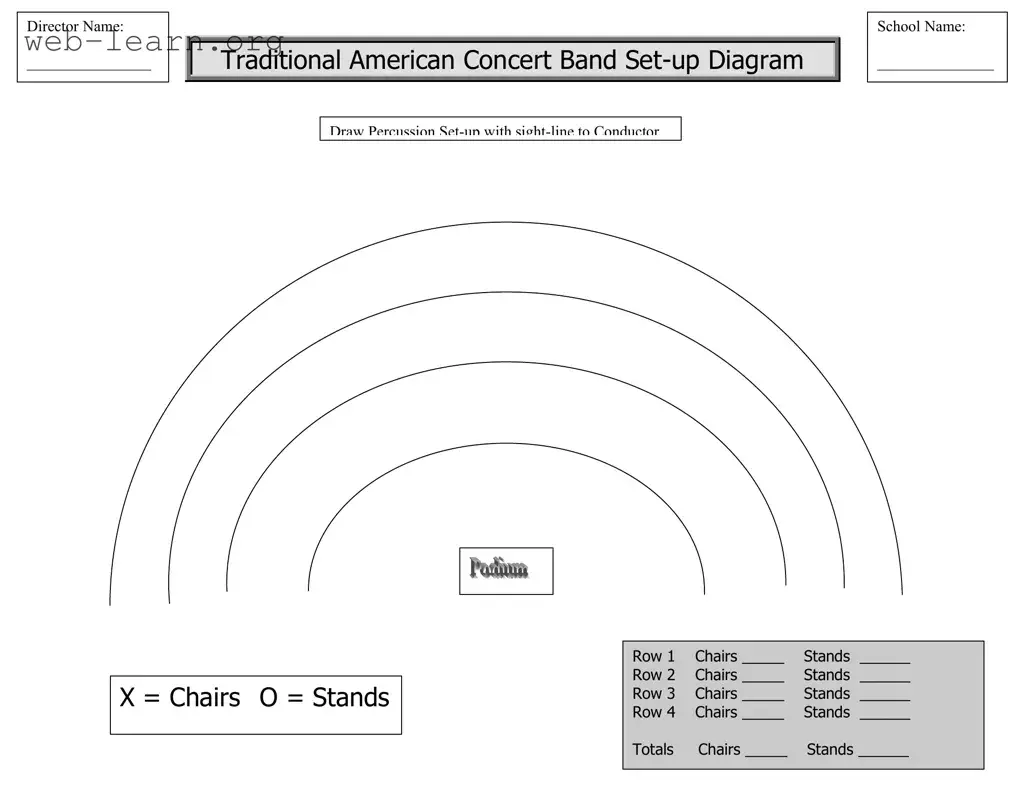
The Band Seating Chart form is an essential tool for music directors and band organizers, facilitating the effective arrangement of musicians for performances. This form allows directors to clearly outline the seating and standing arrangements for each section of the band, ensuring that every musician has a designated spot that optimizes their sightlines to the conductor. It includes spaces for the director's name and the school, as well as performance details such as the date and time. The layout is divided into rows, with designated areas for chairs and music stands, which helps in visualizing the overall setup. Specific instructions regarding percussion placement highlight the importance of maintaining a consistent setup for these instruments. Additionally, the form emphasizes the need for timely submission, providing a fax number for directors to send their completed charts. By detailing the number of chairs and stands required for each section, this form not only aids in logistical planning but also contributes to a smoother performance experience for both musicians and audiences.
| Fact Name | Description |
|---|---|
| Purpose | The Band Seating Chart form is designed to assist in organizing the seating arrangement for a concert band performance. |
| Director Information | It requires the director's name and the school name to ensure proper identification of the ensemble. |
| Performance Details | The form includes spaces to fill in the performance date and time, which are crucial for scheduling. |
| Seating Arrangement | Rows are designated for different sections of the band, allowing for an organized setup that enhances acoustics. |
| Chair and Stand Count | Each row has designated spaces for the number of chairs and music stands, ensuring that all musicians have adequate resources. |
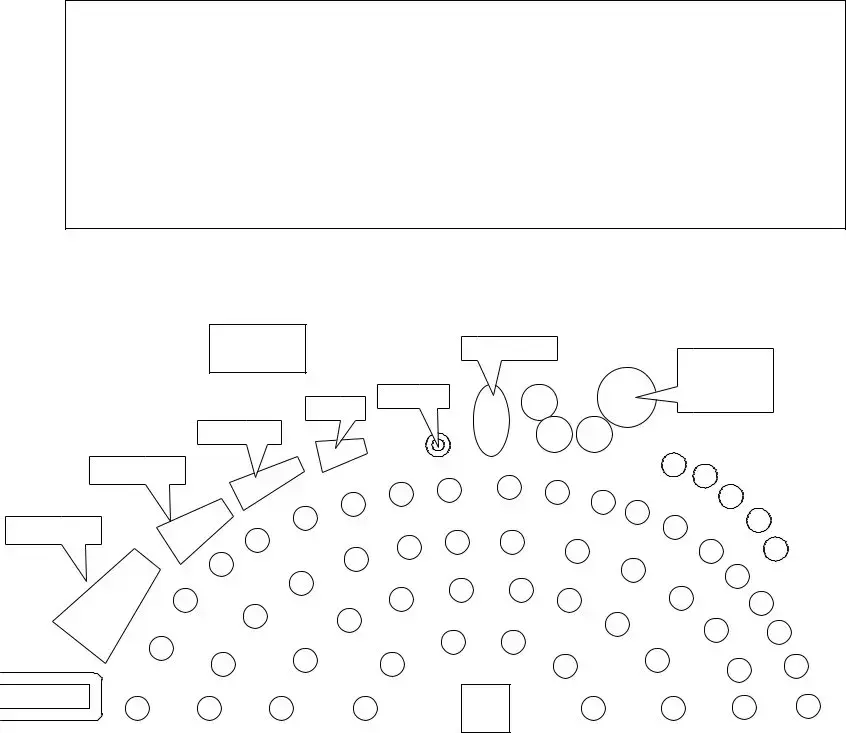
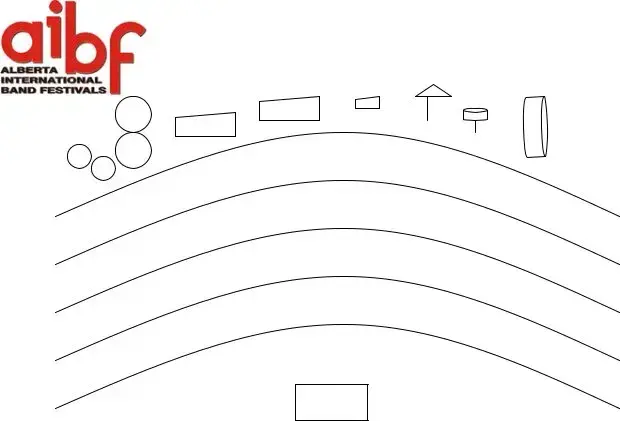
| Percussion Setup | Specific instructions indicate that the percussion section must adhere to a basic setup, maintaining sight lines to the conductor. |
| Fax Submission | The form must be faxed to a specific number prior to a set deadline, emphasizing the importance of timely communication. |
| Stage Crew Assistance | The AIBF stage crew is available to assist in setting up the stage according to the submitted requirements. |
| Historical Context | This form references the 2007 Huron Concert Band, illustrating its use in a real-world setting. |
| State-Specific Law | In some states, such as California, laws governing school performances may require specific documentation for safety and compliance. |
Filling out the Band Seating Chart form is essential for ensuring that your band is properly set up for performance. Accurate completion of the form will help the stage crew understand your specific requirements. Follow the steps below to fill out the form correctly.
What is the purpose of the Band Seating Chart form?
The Band Seating Chart form is designed to help organize the seating arrangement for a concert band performance. It allows directors to specify the number of chairs and music stands needed for each row, ensuring that all musicians are properly accommodated and can see the conductor clearly.
How should I fill out the form?
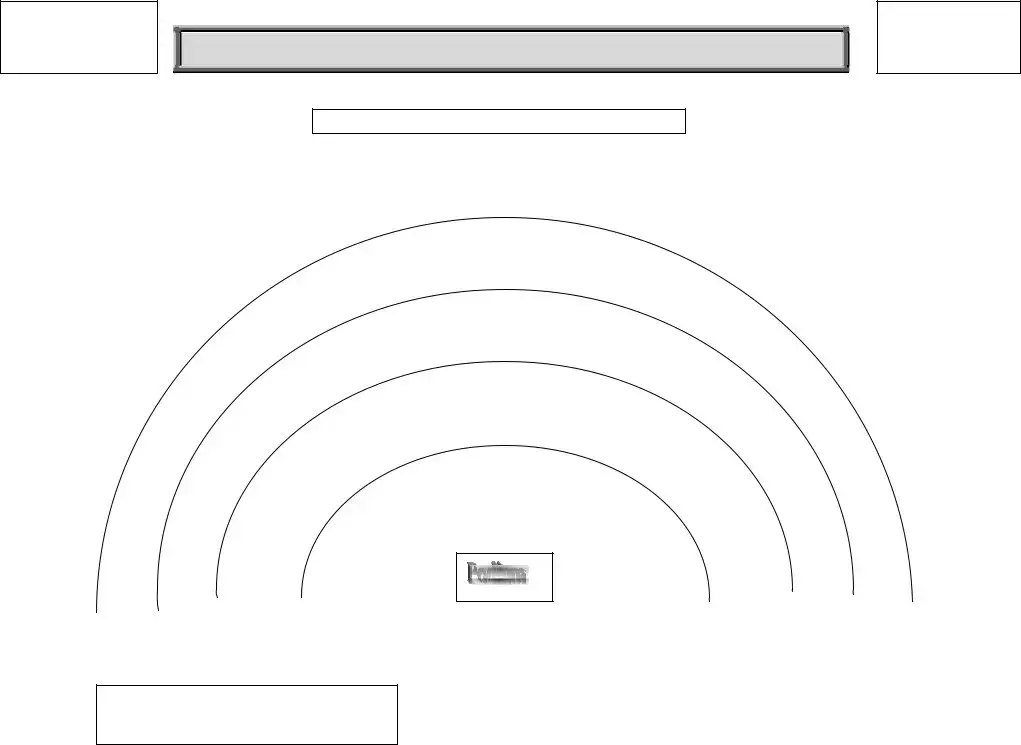
To complete the form, start by entering the director's name, school name, performance date, and time. Next, indicate the number of chairs and music stands required for each row. Use the provided diagram to visualize the traditional American concert band set-up. Be sure to include the percussion setup as specified.
What if I have special seating requirements?
If you have specific needs, such as additional chairs for certain instruments or a unique arrangement, note those details in the designated area of the form. The AIBF stage crew will make every effort to accommodate your requests within the basic percussion setup.
When is the deadline for submitting the form?
It is important to fax the completed form to 780-438-1465, attention Rob Speers, before March 1, 2008. Meeting this deadline ensures that the stage crew has ample time to prepare the seating arrangement for your performance.
What if I need to change the seating arrangement after submitting the form?
Changes to the seating arrangement should be communicated as soon as possible. Contact the stage crew directly to discuss any adjustments. However, keep in mind that changes may be limited depending on the timing and the crew's schedule.
Can I see an example of a completed seating chart?
Yes, an example is provided in the form. For instance, the 2007 Huron Concert Band's seating arrangement included specific numbers of chairs and stands for each row, detailing the instruments represented. This example can serve as a helpful reference when filling out your own chart.
Filling out the Band Seating Chart form can seem straightforward, but many individuals make common mistakes that can lead to confusion or miscommunication. One prevalent error is neglecting to include the director's name at the top of the form. This omission can complicate matters, as the stage crew may struggle to identify which band is associated with the submitted chart.
Another frequent mistake involves failing to accurately represent the number of chairs and stands for each row. For instance, if a person writes down incorrect totals for chairs or stands, it can disrupt the entire arrangement. It is essential to double-check these figures to ensure they reflect the actual needs of the band.
Some individuals may also overlook the specific requirements for percussion instruments. The form explicitly states that percussion must remain in the basic setup. Ignoring this guideline can lead to significant logistical challenges on performance day, as the stage crew will be unable to accommodate any last-minute changes.
Additionally, individuals sometimes forget to fax the completed form by the specified deadline. The instruction to submit the form prior to March 1, 2008, is crucial for the planning process. Missing this deadline could result in inadequate preparations, affecting the overall performance experience.
Another common oversight is the failure to clearly label the rows and instruments. While the form provides a structure, it is vital to ensure that each row is distinctly marked with the correct number of chairs and stands. Ambiguities in labeling can lead to confusion during setup, potentially impacting the performance.
Some people may also neglect to include the performance date and time. This information is essential for coordinating the setup and ensuring that everything is ready when the band arrives. Without these details, the stage crew may not prioritize the setup effectively.
Moreover, individuals sometimes misinterpret the traditional American concert band setup diagram. It is important to refer to this diagram closely to understand how to position the chairs and stands correctly. Misalignment can hinder musicians' sightlines to the conductor, which is critical for a cohesive performance.
Lastly, many individuals fail to communicate any special requests or considerations in the designated area of the form. Whether it involves specific arrangements for certain instruments or additional equipment needs, these details are vital for the stage crew to accommodate the band effectively.
By being mindful of these common mistakes, individuals can help ensure a smooth and successful performance. Attention to detail in filling out the Band Seating Chart form can make a significant difference in the overall experience for both the musicians and the audience.
When organizing a concert, several documents complement the Band Seating Chart form to ensure everything runs smoothly. Each of these forms serves a specific purpose, helping directors, stage crews, and musicians coordinate effectively. Below is a brief overview of commonly used documents alongside the Band Seating Chart.
Using these documents in conjunction with the Band Seating Chart form can significantly enhance the organization and execution of a concert. Each form plays a vital role in ensuring that all aspects of the performance are well-coordinated, ultimately leading to a successful event.
Filling out the Band Seating Chart form is an important task that can greatly impact the performance experience for both musicians and the audience. Here are some key dos and don'ts to keep in mind:
By following these guidelines, you can help ensure a smooth setup for your concert band performance. Good luck!
Misconceptions about the Band Seating Chart form can lead to confusion and inefficiencies during performances. Here are six common misunderstandings:
Filling out and using the Band Seating Chart form is essential for organizing a successful performance. Here are some key takeaways to keep in mind: